





Women’s participation in skills training Pakistan is constrained primarily by social and safety barriers, rather than preferences or the ability to monetise skills. Evidence from interventions that reduce these constraints shows that addressing mobility barriers can significantly increase women’s economic participation.
Editor’s note: For a broader synthesis of themes covered in this article, check out Issue 2 of our VoxDevLit on Female Labour Force Participation.
Many public programmes seek to expand economic opportunities for disadvantaged groups through cash transfers, employment support, and skills training. These initiatives often target populations historically excluded from state benefits, such as the poor, rural communities, and women. But programmes can only succeed if people are actually able to access what is being offered. In practice, many eligible individuals miss out on valuable services (Gupta forthcoming) despite large potential gains (Jacoby and Mansuri 2015) because of seemingly small frictions. These access barriers are especially consequential for women, helping sustain persistent gender gaps in economic participation across much of the Global South (World Economic Forum 2025).
One particularly important constraint facing women is limited mobility. Yet policymakers designing programmes for women often pay too little attention to the barriers they face in moving outside the home and communities, even as a growing evidence base (Heath et al. 2025) shows that such restrictions strongly shape women’s economic choices.
How large are these mobility constraints, what drives them, and what works to ease them? Addressing these questions requires three steps: measuring where mobility barriers arise, quantifying the costs they impose, and testing alternative ways of reducing them. Doing so can help distinguish whether mobility barriers reflect a minor inconvenience or a deeper constraint, and whether easing them can unlock the full benefits of public programmes for women.
Measuring the costs of mobility and access
We took on these questions in the context of a 2014 programme teaching in-demand tailoring skills to women in Punjab, Pakistan (Cheema, Khwaja, Naseer, and Shapiro forthcoming). The ideal experiment for understanding mobility barriers would randomise both distance and the many other challenges women face in accessing valuable training opportunities. That is infeasible, but one can come close by randomly allocating training centres across villages, which creates exogenous variation in how far women must travel to attend. In addition, by also randomising stipend amounts at the village and household level, we can assess how much financial compensation is needed to overcome various distance constraints, and capture inconvenience costs by precisely measuring travel fees (e.g. bus and taxi fares) and wait times to get to training. Finally, we randomise a set of additional interventions, including trainee and community engagement activities designed by local NGOs, peer-based incentives, and a novel, context-specific option of community-endorsed safe group transport, to test whether easing informational, social, or mobility barriers can meaningfully increase take-up.
Understanding mobility barriers to accessing skills training
To study these barriers at scale, we collaborated with the Punjab Skills Development Fund to implement a skills training programme that randomly allocated training centres across 324 villages, reaching more than 8,000 households. The programme taught tailoring skills women expressed interest in, including how to measure and cut cloth effectively, how to assemble durable garments, and how to manage a range of repairs and embellishments.
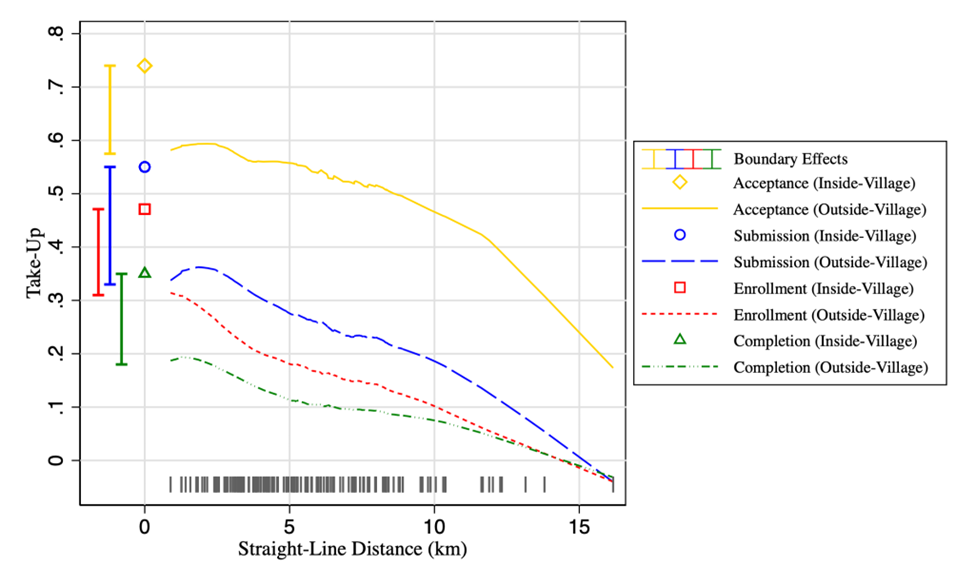
We find that mobility barriers are substantial and discontinuous: take-up declines with distance at every stage of the process, from accepting and submitting the training voucher to enrolling and completing the course. A large part of this access constraint is faced simply when exiting the village. On average, establishing a training centre inside a woman’s own village increases enrolment and completion nearly fourfold relative to offering the same opportunity elsewhere with a voucher and stipend.
By randomising training centre locations – creating experimental variation in the distance women had to travel – and measuring these distances precisely for each cluster of homes, we can assess how much of the take-up gap emerges the moment women have to leave their community (Figure 1). Completion rates are about 35% when training is offered within the village, but drop to less than 20% as soon as women must cross the village boundary, even if doing so requires only a short walk or a brief bus ride. This sharp ‘boundary effect’ is difficult to reconcile with standard travel costs: crossing the village boundary does not involve a large jump in distance or time, nor any formal border, toll, or fixed cost. Instead, it points to a deeper mobility barrier that begins as soon as women must travel outside their own community.
Figure 1: Effect of distance on take-up
Compensating women for crossing village boundaries is quite costly. The stipend needed to induce women to simply leave their village is about the same as the median monthly household spending on all non-food items, and nearly three times larger than standard estimates of travel and time costs. Security seems to be one of the most important factors driving these costs. Women with greater safety concerns and those who must cross under-populated areas to get to training centres, a proxy for insecurity, have lower take-up. Consistent with this, providing a community-endorsed option of safe group transport removes approximately half of the boundary effect. But many interventions our NGO partners thought would be helpful did not work. In particular, neither providing women’s families with more information about training centres nor holding community meetings to increase the social acceptability of travel to training seemed to help.
Critically, the programme’s benefits were just as large for women who trained within their own village, facing low mobility constraints, as for the far fewer women who overcame mobility barriers to attend training outside their community. For 30 months after the training, participating women spent more time stitching, reported improved design and sewing skills, saw modest increases in earnings from tailoring activities, and were also more likely to own a sewing machine. In this setting, the hidden barriers to travel screened out women who would have benefited from the training.
Access barriers as a development challenge
Addressing mobility constraints is essential to expanding women’s access not only to skills training, but also to earning opportunities and a wide range of public services. Our findings suggest that these barriers cannot simply be overcome by compensating travel costs and that offering sufficient stipends would be extremely costly, and require payments that would be quite distortionary, at least in the Pakistani context.
Instead, effective policy must recognise socially driven mobility constraints, including concerns about women’s safety in public spaces, as a central barrier. Addressing them will require tangible measures such as careful decisions about where services are located and the provision of safe transport options, if programmes are to fully deliver on their promise of economic opportunity.
References
Cheema, A, A I Khwaja, M F Naseer, and J N Shapiro (forthcoming), “Glass walls: Experimental evidence on constraints faced by women in accessing valuable skilling opportunities,” Journal of Political Economy.
Gupta, S (forthcoming), “Perils of the paperwork: The impact of information and application assistance on social benefit take-up in India,” American Economic Journal: Economic Policy.
Heath, R, A Bernhardt, G Borker, A Fitzpatrick, A Keats, M McKelway, A Menzel, Y Molina, and G Sharma (2025), “Female labour force participation,” VoxDevLit, 11(2).
Jacoby, H G, and G Mansuri (2015), “Crossing boundaries: How social hierarchy impedes economic mobility,” Journal of Economic Behavior & Organization, 117: 135–154.
World Economic Forum (2025), "Global gender gap report 2025".