




Educated unemployment in urban West Africa stems from educated workers rationally waiting for scarce, high-paying public and formal private jobs in labour markets characterised by severe hiring frictions. Policies that reduce private-sector hiring costs, rather than expanding public employment or subsidising self-employment, are most effective at lowering unemployment and raising welfare.
Editor’s note: For a broader synthesis of themes covered in this article, check out our VoxDevLit on Barriers to Search and Hiring in Urban Labour Markets.
Jacob Mincer, the father of modern labour economics, wrote in 1991: “A major benefit of education is the lower risk of unemployment at higher educational levels.”
Mincer’s statement remains true in many high-income countries three decades on. But in low- and middle-income economies the relationship often runs the other way: unemployment rises with education (Feng et. al 2024). This phenomenon of ‘educated unemployment’ is more than a statistical curiosity; it is a policy problem with economic, social, and political stakes.
In recent work (Girsberger and Méango 2025), we provide new evidence on the workings of urban labour markets in West Africa and develop a theoretical framework that explains why educated workers struggle to find jobs. We use this framework to show why certain labour-market policies – such as public-sector recruitment programmes – may fail to generate broad welfare gains, while policies that target underlying labour-market frictions and stimulate private-sector hiring hold greater promise.
Educated workers face higher unemployment…
Figure 1: Educated unemployment in urban West Africa
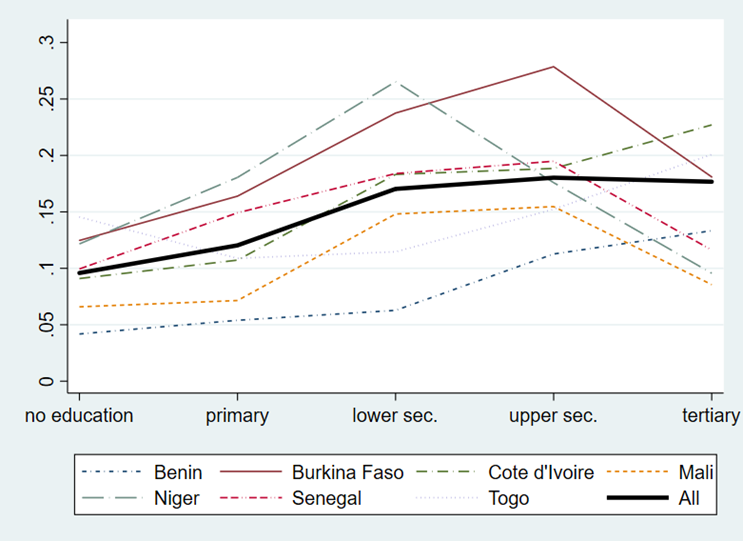
Note: This figure shows unemployment rates by education for men in the economic capital of seven Francophone West African economies using the 1-2-3 Survey (2001/2002). The black thick line depicts the pooled average across all seven cities.
Figure 1 highlights a striking pattern across seven major cities in West Africa: educated workers are more likely to be unemployed. In every capital, men with secondary or tertiary education face substantially higher unemployment than those without formal schooling. On average, about 10% of workers with no formal education are unemployed, compared with more than 17% among those with secondary education or higher. These gaps remain large even after accounting for the more advantaged background of educated workers who can afford to search for work longer. In short, contrary to Mincer’s classic view, higher education does not protect workers from unemployment in urban West Africa.
…but they land salaried and better-paid jobs when they find work
Figure 2: Employment shares in the public, private, and self-employment sectors
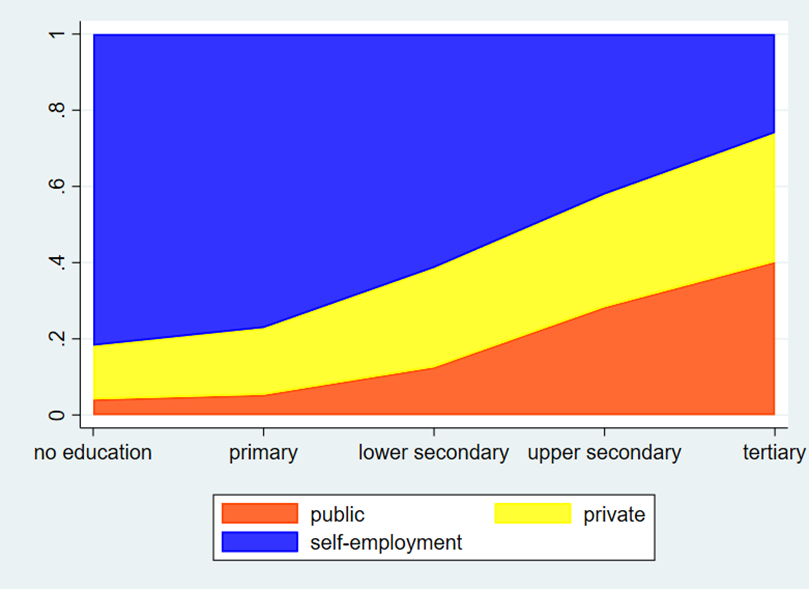
Note: This figure shows the share of men employed in the public, private, and self-employment sectors by education level in urban West Africa (1-2-3 Survey).
Figure 2 reveals a second striking pattern: workers sort into different types of jobs according to their education. Those with no schooling overwhelmingly enter self-employment – around 80% of them – while most tertiary-educated workers join either the public sector or take on a job in the private sector. In broad terms, higher education shifts workers out of self-employment and into salaried jobs.
Does this decision pay off? Figure 3 provides an answer.
Figure 3: Earnings in the public, private, and self-employment sectors
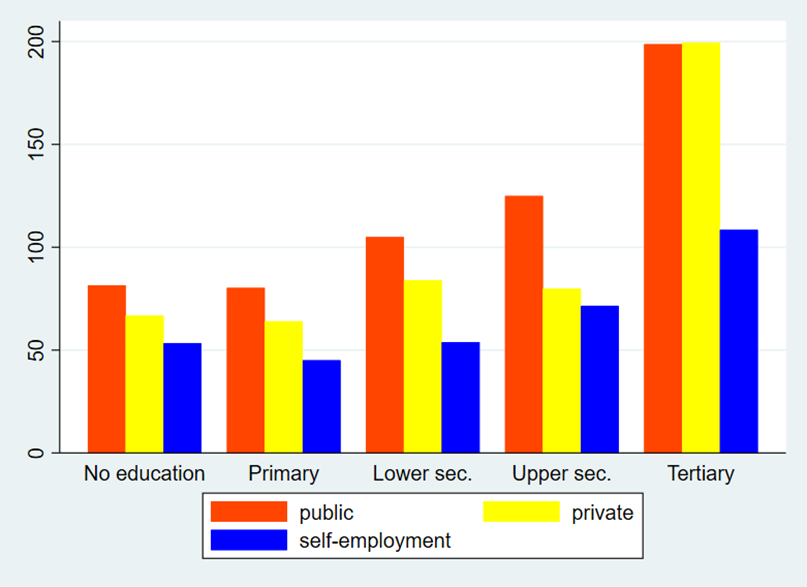
Note: This figure reports average earnings of male workers in the public, private, and self-employment sectors by education (1-2-3 Survey). The bottom 1% and top 1% of earnings are excluded.
Returns to education are steep in public and private employment but comparatively flat in self-employment. Moreover, once workers enter self-employment, it becomes much harder for them to search for and secure a public- or private-sector job later on. Self-employment is thus not a stepping stone towards formal employment in low-income economies (Donovan et al. 2023). Better-educated workers therefore have a strong incentive to forgo self-employment opportunities and wait – sometimes for extended periods – for a salaried job offer in the public or private sector.
Public employment is especially attractive due to its generous pay and high job security. These features create long queues for a limited number of public vacancies and contribute to the phenomenon of ‘educated unemployment’.
What these facts imply, and why a model is useful
The evidence points to a common mechanism behind educated unemployment in urban West Africa. There are few attractive formal jobs and substantial frictions, especially in private-sector hiring. At the same time, strong competition from a relatively generous public sector and educated workers’ reluctance to take up self‑employment generate educated unemployment. Educated unemployment is thus not about ‘too many graduates’ but about too few good jobs and the way search frictions and sectoral queues interact when public jobs pay premia and private hiring is costly.
Waiting for a salaried job may be individually optimal for an educated worker, but widespread unemployment carries substantial social and economic costs. Labour-market frictions and unemployment slow structural transformation and growth (Donovan and Schoellman 2023), and can exacerbate political discontent (Campante and Chor 2012). Unsurprisingly, governments across West Africa and beyond pursue a range of labour-market policies to address the problem. While we have a growing understanding of how these policies affect individuals (Caria et al. 2024), we know far less about how they play out in equilibrium. This is precisely where a model becomes valuable.
To compare policies on equal footing, we develop a tractable three‑sector search‑and‑matching model and estimate it using the 1‑2‑3 Survey (2001/2002) for Ouagadougou and Dakar. We then use the model to analyse which interventions can meaningfully ease educated unemployment and deliver broad welfare gains.
Which policies effectively reduce educated unemployment and improve welfare?
Our paper contrasts four equally costly interventions governments have considered:
- Public job creation: Expanding public vacancies increases the public payroll but crowds out private hiring by tightening the formal market and drawing educated jobseekers into public queues. The net effect is a slight rise in overall and educated unemployment and little welfare gain.
- Self‑employment subsidies: Raising self‑employment income modestly shifts workers into self‑employment, with small welfare gains concentrated among the less‑educated. But it can pull workers out of the private sector and nudge up aggregate unemployment, doing little for jobless secondary and tertiary graduates who prefer to keep waiting for formal jobs.
- Private‑sector hiring subsidies (vacancy‑cost reductions): This is by far the most effective policy. A subsidy package financed by a 10% spending increase would boost private formal employment, reduce unemployment (including among the educated), and raise welfare substantially. This policy promises particularly large gains where hiring frictions are severe. The policy targets the binding constraint – high vacancy costs under low matching efficiency – and expands attractive alternatives to public queues.
- Partial unemployment insurance: Income support increases reservation wages and search duration, and makes people better off, but it raises overall and educated unemployment.
Two structural levers can amplify the gains from effective labour-market policies. First, modest private‑sector productivity improvements materially expand formal hiring and welfare. Second, reforms that push educational attainment increase the supply of employable workers and induce firms to post more vacancies, resulting in more and better work opportunities for everyone.
Actionable lessons for policymakers
- Do not rely on public‑sector hiring as an unemployment fix. In equilibrium, expanding public employment displaces private hiring and keeps graduates in queues. Over time, this raises unemployment and weighs on the wage bill.
- Avoid untargeted self‑employment subsidies if the goal is to help graduates. They deliver small income gains for the least educated but do little to reduce educated unemployment and can shrink the formal sector at the margin.
- Prioritise lowering the costs of creating formal private jobs. Cutting vacancy‑posting costs – through lighter regulation, faster recruitment services, or effective job‑matching platforms – expands private hiring, lowers unemployment, and makes waiting for public jobs less attractive. This is where scarce fiscal resources buy the greatest gains.
- Pair labour‑market reforms with productivity and foundational‑skills upgrades. Firm‑level productivity support (management, market access, credit) and universal basic education raise the returns to hiring and strengthen the pipeline of job‑ready workers. Taken together with lower vacancy costs, these measures can durably reduce educated unemployment.
Broader relevance beyond West Africa
Many African labour markets share core features seen here: a small formal private sector, a relatively prominent public sector, widespread self‑employment, and large search frictions. Where public jobs pay premia and private hiring is costly, educated workers rationally queue – and unemployment among graduates rises. Policies that expand the private‑formal margin and weaken queuing incentives are likely to travel well across contexts with similar fundamentals.
References
Campante, F R, and D Chor (2012), “Why was the Arab world poised for revolution? Schooling, economic opportunities, and the Arab spring,” Journal of Economic Perspectives, 26(2): 167–187.
Caria, S, K Orkin, A Andrew, R Garlick, R Heath, and N Singh (2024), “Barriers to search and hiring in urban labour markets,” VoxDevLit, 10(1).
Donovan, K, W J Lu, and T Schoellman (2023), “Labor market dynamics and development,” Quarterly Journal of Economics, 138: 2287–2325.
Donovan, K, and T Schoellman (2023), “The role of labor market frictions in structural transformation,” Oxford Development Studies, 51(4): 362–374.
Feng, Y, D Lagakos, and J E Rauch (2024), “Unemployment and development,” Economic Journal, 134(658): 614–647.
Girsberger, E M, and R Méango (2025), “The puzzle of educated unemployment in West Africa,” Unpublished manuscript.