





In recent decades, Malaysia achieved rapid inclusive growth, yet focus group discussions with Malaysian citizens across the country have reported stagnating living standards and rising dissatisfaction. This disconnect reflects pressures not captured by aggregate data, including rising costs, work pressure, debt, stress, and weakening social cohesion, which shapes how people experience and evaluate economic progress.
Malaysia is widely regarded as a development success story (Stiglitz 2007). Over the past half-century, it moved from a low-income, commodity-dependent economy to an upper-middle-income manufacturing exporter. GDP per capita rose steadily. Poverty declined sharply across all ethnic groups. By most conventional economic indicators, Malaysia did almost everything right.
And yet, in 2018, Malaysians voted out the coalition that had governed the country for sixty years, the same coalition that presided over these gains. Why would voters turn against a government that delivered growth, poverty reduction, and rising material living standards? This question motivated our research (Asadullah, Biradavolu, Rao, and Simler 2025), which combines standard economic analysis with systematic qualitative evidence on how people experience economic change.
The ‘Malaysia puzzle’ in official data
The quantitative record is clear. Malaysia’s growth was rapid, sustained, and broadly inclusive. Poverty fell from nearly 50% in 1970 to close to zero by the mid-2010s. Income growth was pro-poor, and relative inequality declined.
Figure 1: Per capita income growth in South-East Asia (constant 2010 USD)
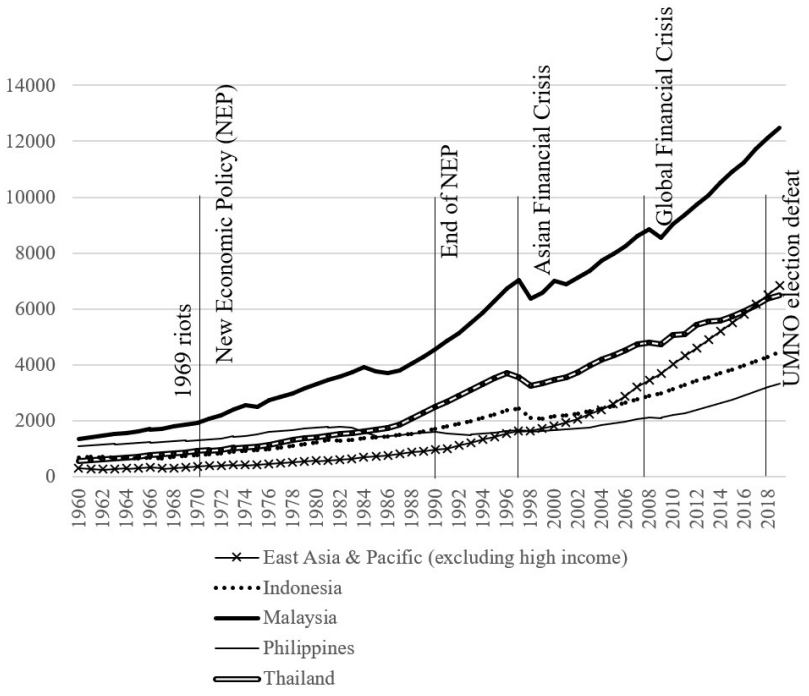
Note: GDP per capita is in constant 2010 US$. Source: Authors, based on World Development Indicators.
Figure 2: Poverty headcount ratios in Malaysia
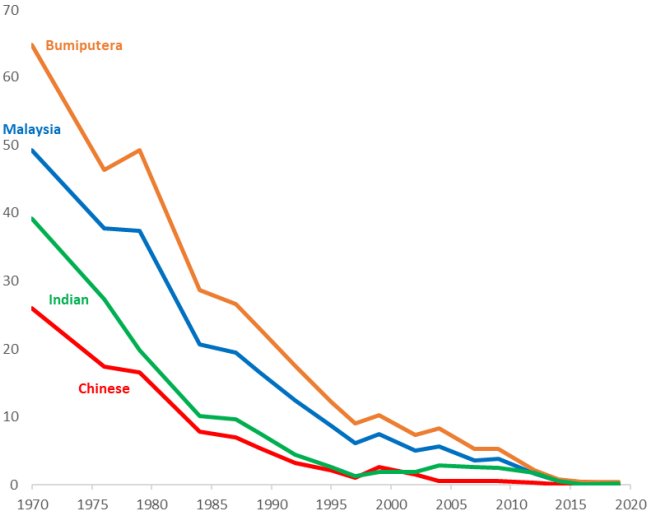
Notes: Based on old national PLI. Ethnicity is based on the identity of the household head. Source: Department of Statistics, Malaysia (2020).
Yet open-ended focus group discussions from the years leading up to the 2018 election pointed in a different direction. A growing share of Malaysians reported that their standard of living had stagnated or worsened. Many said that life felt harder than it had five years earlier.
Figure 3: Life satisfaction in Malaysia (percentage of respondents)
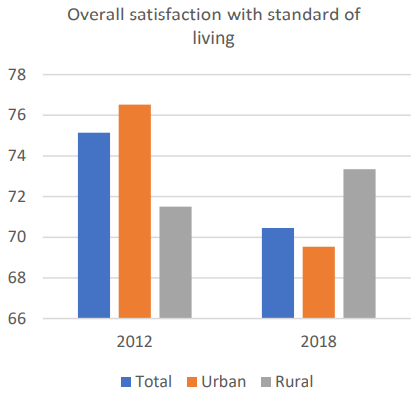
Source: Gallup World Poll.
The contrast between economic success and political discontent was striking. It was not obvious how to reconcile these trends using standard indicators alone. This dissonance motivated us to look beyond aggregate data and examine how economic change was being experienced on the ground.
Listening to Malaysians: Learning from lived experiences
In order to shed light on this paradox, we decided to listen directly to the voices of Malaysians. In 2019, we conducted 56 focus group discussions across three regions: urban Selangor (greater Kuala Lumpur), Terengganu on the east coast of peninsular Malaysia, and Sabah in East Malaysia. Participants were drawn from low- and middle-income groups and included all three major ethnic communities – Bumiputera (Malays and other indigenous people), Chinese, and Indian. Discussions were conducted in participants’ native languages. Rather than relying on structured satisfaction questions, we used open-ended prompts to encourage participants to describe change in their own terms:
- How is your life different from your parents’ generation?
- Compared to five years ago, is life easier, harder, or the same?
- What are your hopes and concerns for the future?
The aim was not to replace quantitative analysis, but to complement it – to identify dimensions of well-being that are difficult to capture using conventional survey instruments.
Key findings: What people told us
Five themes emerged repeatedly across regions, ethnic groups, and income categories.
- The imbalance between income and expenses. Participants consistently described a growing gap between earnings and expenses. Many spoke of a sense that incomes were no longer sufficient to sustain what they viewed as a basic standard of living.
“At month’s end, I feel like going insane… Salary is not enough to meet the daily basic needs for today’s living standard.” – Indian respondent, Selangor
Importantly, these concerns were rarely framed in terms of absolute deprivation. Most participants acknowledged being materially better off than their parents. What had changed, in their view, was the cost of keeping up with rising expectations.
- Multiple jobs and dual earners. Financial security increasingly required two earners per household, and often multiple jobs per individual.
“Most of the people in my salary range actually work two jobs… I cannot go up. I cannot go down. I am stuck.” – Chinese respondent, Selangor
Increased work intensity provided income but reduced time, flexibility, and resilience.
- Debt without assets. Debt was widespread. Savings were limited. Asset accumulation – particularly housing – was seen as increasingly unattainable for younger households.
Moderator: Anybody here who has no debt?
Group: We all have debts one way or the other.
– Rural Terengganu
Several participants noted that spending on small, visible items often reflected the absence of affordable long-term investments rather than excess consumption.
- Stress and insecurity. Material improvements coexisted with rising stress and anxiety.
“Those days even in small houses we used to sleep well. Now, even with three-storeyed houses, we can’t sleep in peace.” – Indian respondent, Selangor
Participants frequently contrasted physical comfort with declining mental and emotional well-being.
- Weaker social ties. Across ethnic groups, older participants described a loss of everyday social interaction and cohesion.
“In the past, I was in one class with Indians and Chinese… It is not the case right now.” – Bumiputera respondent, Selangor
Economic inclusion, in other words, did not necessarily translate into stronger social integration.
These findings do not contradict Malaysia’s success in reducing poverty and inequality as captured in official statistics. Rather, they point to dimensions of well-being that are difficult to capture using standard economic indicators.
Income and consumption data provide limited insight into time scarcity, debt-related stress, congestion, or the shifting social norms that define what counts as a minimally acceptable standard of living. As economies grow, these factors may become increasingly important in shaping how people evaluate their own well-being.
Two strands of social thought help frame these observations
Karl Polanyi emphasised that economic life is embedded in social institutions, and warned that treating land, labour, and money as commodities governed primarily by markets could undermine social protections. Many of the concerns expressed in the focus groups – particularly around housing, education, and access to urban space – reflect growing reliance on market mechanisms in domains that were previously more socially mediated.
Fred Hirsch’s concept of the “social limits to growth” provides a complementary perspective. Hirsch argued that once basic material needs are met, growth increasingly generates competition over positional goods – goods whose value depends on relative rather than absolute access. Public goods that were once widely available can become congested or privatised, producing what he termed “social scarcity”.
Participants’ accounts of traffic congestion, residential crowding, rising housing costs, and loss of open space align closely with this dynamic. Growth continues, but its social returns become more uneven and more contested.
Taken together, these perspectives help explain how sustained growth can coexist with a sense of insecurity and imbalance, particularly for households near the middle or lower end of the income distribution.
Learning from the ground up: Implications for policy
Malaysia’s paradox is unlikely to be unique. Similar patterns are visible in many middle-income, and increasingly high-income, countries.
The lesson is not that growth has failed, but that growth changes the conditions under which people assess progress. Understanding those changes requires combining measurement with interpretation, and outcomes with experience.
For development policy, this suggests a need to look beyond aggregate success and pay closer attention to how economic change is lived, negotiated, and understood on the ground.
Three implications follow:
- Growth and job creation remain essential, but they are no longer sufficient. As countries develop, managing the social consequences of growth becomes increasingly important.
- Well-being is not only material but relational. Policies that protect shared public goods – housing, transport, education quality, public space – and that reduce social fragmentation may play a critical role in sustaining public support for growth.
- Policy design can benefit from closer engagement with lived experience. Systematic use of qualitative, bottom-up data can surface emerging tensions that aggregate indicators may miss. Advances in methods now make it possible to collect and analyse such data rigorously and at scale, complementing traditional surveys.
References
Asadullah, M N, M Biradavolu, V Rao, and K Simler (2025), “Is there an underside to economic growth? A mixed-methods analysis of Malaysia,” World Bank Economic Review, 39(4): 867–892.
Hirsch, F (1976), Social limits to growth, Harvard University Press.
Polanyi, K (1944), The great transformation: The political and economic origins of our time, Farrar & Rinehart.
Stiglitz, J (2007), “The Malaysian miracle,” The Guardian.