









We develop a new method to analyse open-ended qualitative interviews with large samples, and apply it to interviews with Rohingya refugees and Bangladeshi hosts on parent’s aspirations for children, revealing dimensions of aspiration that standard surveys systematically miss. For instance, despite lower formal education, Rohingya refugees exhibit higher navigational capacity than host communities, a strength that becomes visible only through open-ended methods while still allowing for statistical inference.
Editor’s note: For a broader synthesis of themes covered in this article, check out our VoxDevLit on Refugees and Other Forcibly Displaced Populations.
Understanding complex phenomena like aspirations, well-being, or identity requires more than asking people to choose from a list. It requires an open-ended conversation. Yet, most economic research relies on structured surveys that force complex ideas into predefined categories. As a result, economists often miss how people actually think about their futures, and how they navigate the obstacles they face.
In new work (Ashwin et al. 2026), we show how open-ended interviews can be analysed at scale, combining the depth of qualitative research with the statistical power economists expect. Using over 2,200 conversational interviews with Rohingya refugees and their Bangladeshi hosts in Cox’s Bazar, we uncover dimensions of aspiration that standard surveys systematically miss.
Our most surprising finding is that, despite having far lower levels of formal education, Rohingya refugees display greater capacity to plan, adapt, and pursue their goals than their host communities. This ‘navigational capacity’, the ability to imagine pathways forward and act on them, does not show up in conventional survey measures but emerges clearly when people are allowed to speak in their own words.
To reach this result, we develop a method that scales traditional qualitative analysis using supervised machine learning. The approach preserves the bottom-up logic of close reading while making it possible to analyse representative samples of open-ended interviews. It allows economists to listen more carefully without giving up rigour.
From close reading to statistical inference
Traditional qualitative research follows a rigorous but labour-intensive process. Researchers conduct open-ended interviews in which respondents speak in their own terms. Instead of selecting from predetermined options, interviewers ask questions such as “what are your hopes for your children?” and probe further based on responses. Trained qualitative researchers then read transcripts repeatedly, inductively developing a coding framework and manually coding interviews.
Figure 1: The coding structure showing three main dimensions: Ambitions (material goals), Aspirations (moral/religious values), and Navigational Capacity
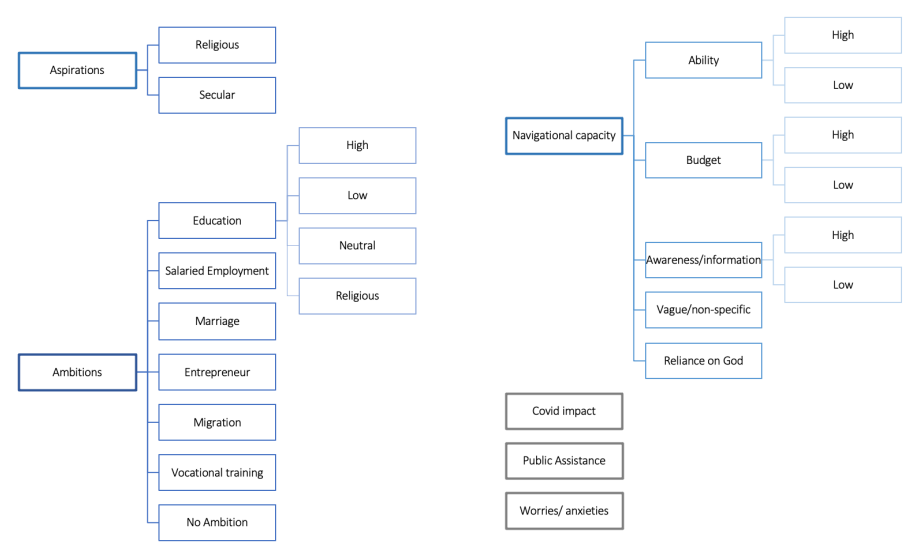
Our method extends this process rather than replacing it. We first conducted open-ended interviews with a large, representative sample. Experienced qualitative researchers then followed the standard inductive coding approach on a carefully selected subsample of interviews. These human-coded interviews were then used to train supervised machine-learning models that learn how patterns in language correspond to qualitative themes.
We then applied the trained models to the remaining interviews, creating an ‘enhanced sample’ that combined human judgment with machine annotation. This allowed us to retain interpretive richness while achieving the sample sizes needed for statistical inference.
We extensively validated the approach, testing for systematic bias in machine predictions, examining how increased sample size trades off against added measurement error, and showing that relatively modest numbers of human-coded interviews can be scaled effectively. The result is a method that preserves interpretive integrity while delivering statistical precision.
Figure 2: Visual summary showing how human-coded interviews are used to train models that predict codes for the full sample

Why not surveys or large language models?
This approach has several advantages over existing methods.
Compared to structured surveys, it captures concepts that are difficult to prespecify. Consider navigational capacity: the culturally shaped ability to imagine pathways towards a better future and act on them. Writing a good survey question to capture this concept requires knowing in advance how people understand and express it – precisely what surveys struggle to uncover. Open-ended interviews allow respondents to articulate ideas in their own terms, revealing dimensions that would otherwise remain invisible.
Compared to purely computational approaches such as topic modelling or annotation using large language models (LLMs), our method remains grounded in traditional qualitative analysis. The coding structure emerges from careful human reading rather than from statistical correlations alone, making interpretation transparent. We show that supervised models trained on human codes outperform unsupervised topic models and LLM-based annotation.
In particular, LLMs trained on Western text corpora can introduce substantial bias when applied to interviews from non-Western contexts, a concern we examine in detail in a companion paper (Ashwin et al. 2025).
Finally, compared to small-sample qualitative studies, scaling up dramatically increases statistical power. Standard errors shrink, enabling researchers to detect relationships that would be invisible in smaller samples.
To facilitate broader use, we provide an open-source Python package, iQual, which implements the full workflow from transcript processing to validation and statistical testing.
Aspirations in Cox’s Bazar
We apply this method to study parental aspirations among Rohingya refugees and their Bangladeshi hosts in Cox’s Bazar, Bangladesh, where roughly 750,000 Rohingya refugees live after having fled violence in Myanmar. Aspirations matter because they shape how families invest in education, health, and livelihoods, influencing how poverty and inequality persist across generations.
Economic research typically treats aspirations as material goals: desired education levels, occupations, or income (Genicot and Ray 2020). Other disciplines, however, conceptualise aspirations more broadly. For instance, philosopher Agnes Callard (2018) distinguishes between ambition (specific material goals) and aspiration as a process of becoming someone through acquiring values. While anthropologist Arjun Appadurai (2004) emphasises navigational capacity: the culturally determined ability to pursue goals effectively.
Our open-ended approach allows us to capture all three dimensions without imposing them on respondents. The coding structure that emerges distinguishes between material ambitions, moral or religious aspirations, and navigational capacity.
A surprising result: Refugees show higher navigational capacity
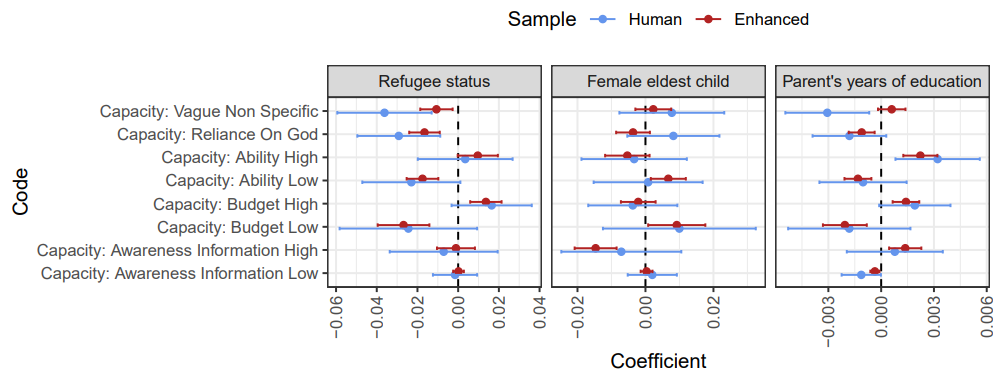
The most striking finding challenges conventional assumptions about refugees. Rohingya refugees have dramatically lower education levels than Bangladeshi hosts, averaging 1.9 versus 4.9 years of schooling. Based on education alone, one would expect refugees to have lower capacity to achieve their aspirations.
Yet across multiple indicators, refugees consistently display higher navigational capacity. They provide fewer vague or non-specific responses when describing how they will pursue goals, rely less exclusively on divine intervention, articulate obstacles more concretely, and are less likely to cite lack of money as an insurmountable barrier.
These patterns suggest a form of migrant selection that standard measures miss. Previous work has focused largely on education and formal skills. Our findings point to different capabilities: refugees who survive violence, navigate dangerous journeys, and secure refuge may be selected on resilience, adaptability, and problem-solving ability – traits not captured by schooling. Despite lower formal education, refugees may therefore exhibit greater navigational capacity.
Figure 3: Regression coefficients showing refugees have lower rates of low navigational capacity across multiple dimensions, despite lower education
Policy implications for refugees
These findings have direct policy relevance. Refugee programmes often focus on deficits in education, skills, or material resources. While these gaps are real, our evidence suggests that refugee populations also possess significant strengths. Policies may be more effective if they recognise and build on refugees’ existing agency and problem-solving capacity, rather than treating them solely as passive recipients of assistance.
Our interviews also reveal that aspirations extend beyond material goals. About 22% of parents express explicitly religious aspirations for their children, while 33% articulate secular moral aspirations. We also observe gendered patterns: parents are less likely to express either type of aspiration for daughters. These dimensions would be difficult to identify using standard survey instruments.
Beyond aspirations
Although we illustrate the method using aspirations, its applicability is broad. Research on well-being, social norms, discrimination, integration, or cultural change often involves concepts that are culturally specific, difficult to anticipate in advance, and better understood as processes or capabilities than as simple states. In such contexts, imposing prespecified categories risks distorting what researchers seek to measure.
Our validation exercises show that the method is robust: machine annotation does not introduce systematic bias, enhanced samples yield more precise estimates than human coding alone, and relatively modest human coding effort can be scaled effectively.
As economics increasingly engages with questions about how people think, what they value, and how they navigate their social worlds, methods are needed that capture nuance without sacrificing rigour. Our approach scales traditional qualitative analysis while remaining grounded in context, bridging the gap between the richness of real conversations and the statistical evidence needed to inform policy.
References
Appadurai, A (2004), “The capacity to aspire: Culture and the terms of recognition,” in Culture and Public Action, V Rao and M Walton (eds.), Stanford University Press: 59–84.
Ashwin, J, A Chhabra, and V Rao (2025), “Using large language models for qualitative analysis can introduce serious bias,” Sociological Methods & Research, 00491241251338246.
Ashwin, J, V Rao, M Biradavolu, A Chhabra, A Haque, A Khan, and N Krishnan (2026), “Qualitative analysis with large-N: A new method with an application to aspirations in Bangladesh,” Economic Journal, ueag005.
Callard, A (2018), Aspiration: The agency of becoming, Oxford University Press.
Genicot, G, and D Ray (2020), “Aspirations and economic behavior,” Annual Review of Economics, 12: 715–746.