

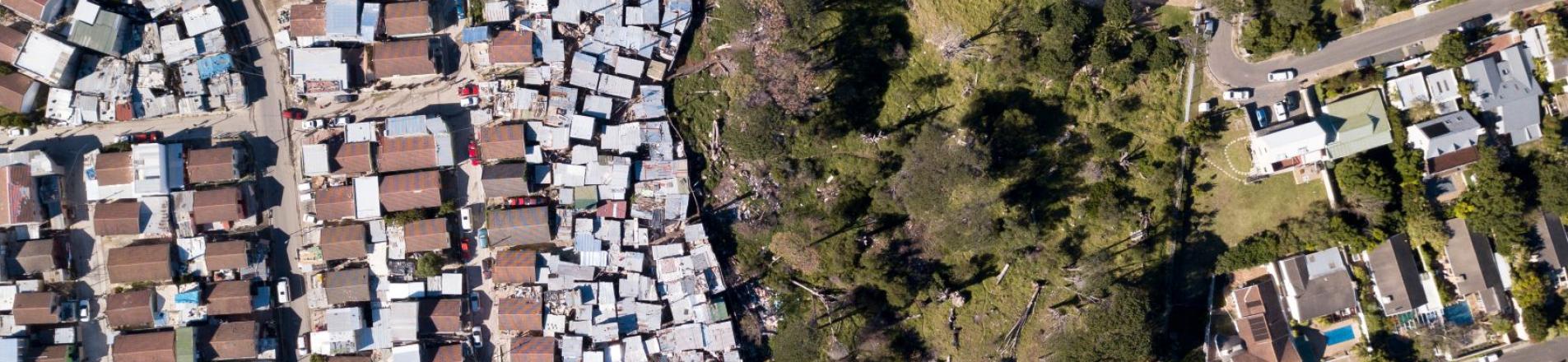


South Africa remains the most unequal country in the world despite the end of apartheid thirty years ago. Racial inequalities have declined but these gains have largely benefited a new Black elite. Government redistribution is substantial and has achieved more than standard inequality statistics suggest; however, it still falls short of delivering a truly inclusive and equitable economic transformation.
The most unequal country in the world (for which comparable data exists)
Thirty years after the end of apartheid, the top 10% of South Africa’s population still capture roughly 70% of pre-tax income – a level surpassing that of Brazil, India, or the US (Figure 1). Moreover, racial inequalities remain as extreme as disparities around the world: in 2019, average per capita factor income among White South Africans was comparable to national income per capita in Denmark; among Black South Africans, it was comparable to Bangladesh. What happened? Did the end of a uniquely discriminatory regime fail to deliver more equal outcomes? Or did things improve from an ever more extreme situation in 1993?
Figure 1: South African inequality in comparative perspective: Top 10% income share
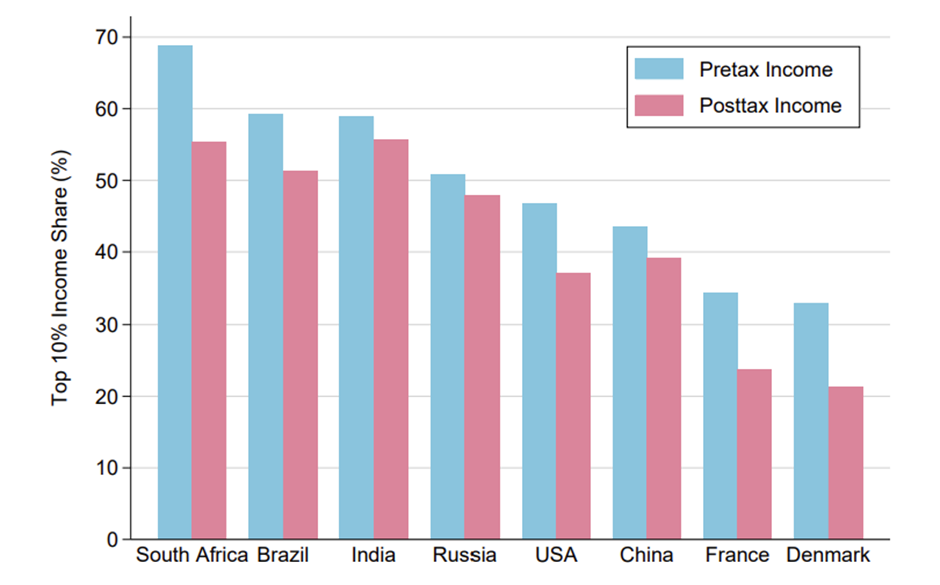
Notes: This figure compares the top 10% pre-tax and post-tax income shares in 2023 (2019 for South Africa) in selected countries. Data from the World Inequality Database (pre-tax income), Fisher-Post and Gethin (2025) (simplified estimates of post-tax income), and this paper (South Africa). The top 10% pre-tax income share reaches 70% in South Africa, compared to 33% in France.
These questions are at the heart of broader debates about institutional change (Acemoglu et al. 2015). South Africa’s democratic transition in 1994 was historically remarkable: a deeply entrenched racial regime dissolved without civil war or a massive exodus. Yet it also left in place an economy shaped by decades of legal racial segregation. Assessing what changed since the end of apartheid is therefore essential both for South Africa and for anyone thinking about how extremely unequal societies transform or fail to transform their economic structures.
A new framework for measuring redistribution
Answering these questions rigorously requires combining multiple sources of information that often tell inconsistent stories. In two new studies, we make progress in this direction. Applying the Distributional National Accounts (DINA) framework (Piketty et al. 2018), we construct a microdatabase for South Africa covering 1993 to 2019, to integrate household surveys, income tax tabulations, national accounts, and government budget data. The result is a comprehensive picture of inequality – before and after all major taxes and transfers – fully consistent with macroeconomic growth (Czajka and Gethin 2025). A companion study by Gethin (2026) provides systematic, time-varying estimates of who benefits from public services (education, healthcare, local government, policing, and transport), combining about twenty different types of household surveys with newly digitised budget reports. Together, these two articles provide a novel comprehensive view on the evolution of redistribution in a developing country over a generation.
The two periods of post-apartheid inequality
Our analysis reveals two sharply contrasting phases since the end of apartheid.
From 1993 to the mid-2000s, South Africa experienced solid economic growth but rising inequality. The Gini coefficient of factor income – income before any government intervention – rose from 0.80 to 0.86, as the top 10% saw their real incomes increase by over 140% while the bottom 50% saw a 20% decline. During this period, redistribution barely moved: the rollout of large cash transfer programmes was largely offset by simultaneous cuts in health and education spending.
From the mid-2000s onward, the picture changed considerably. Economic growth stagnated, but inequality began to fall. By 2019, the factor income Gini had returned to roughly 0.81. More significantly, redistribution expanded markedly. The combined expansion of the personal income tax, the child support grant, and health and education spending reduced post-tax inequality more than ever: whereas redistribution reduced the Gini coefficient by about 17 points in 1993, the gap had widened to over 20 points by 2019.
The redistributive roles of different fiscal instruments vary substantially. Direct taxes – particularly the personal income tax and the corporate income tax – are progressive, primarily borne by the top 10%. Indirect taxes, by contrast, are regressive: VAT and local taxes now absorb over 70% of the pre-tax income of the bottom 50%, up from 40% in 1993. Cash transfers, especially the old-age and child-support grants, have been the most powerful force for reducing inequality at the bottom, cutting the Gini by over 5 points. But it is public services where our results reveal the most overlooked story. In 2019, the poorest 50% of South Africans received 61% of public education spending, 50% of public healthcare, and 40% of local government services – but only 7–10% of transport infrastructure. Total in-kind transfers received by the bottom 50% are three times larger than cash transfers. Crucially, ignoring public services, underestimates the rise in redistribution since the end of apartheid by 60%.
The transformation of racial inequalities
South Africa’s racial legacy makes the dynamics of redistribution especially complex. Our new database allows us to trace racial income gaps from 1993 to 2019 in great detail, as well as to study the role of taxes and transfers in shaping them.
In terms of factor income, two phases emerge as well. Between 1993 and the mid-2000s, the White-to-Black per capita income ratio actually worsened – from 15.7 to 17 – as rising top incomes disproportionately benefited White South Africans. After the mid-2000s, this ratio fell sharply, reaching 9.3 in 2019. By linking our series to previous work on the pre-1993 period, we show that this is the lowest point in recorded history (Figure 2). Yet it remains extreme by international standards: the White-to-Black earnings ratio in the US stands at roughly 1.3 (Derenoncourt and Montialoux 2021), and even the racial wealth gap in the US is lower (Derenoncourt et al. 2024).
Figure 2: Racial inequality in South Africa, 1917–2019
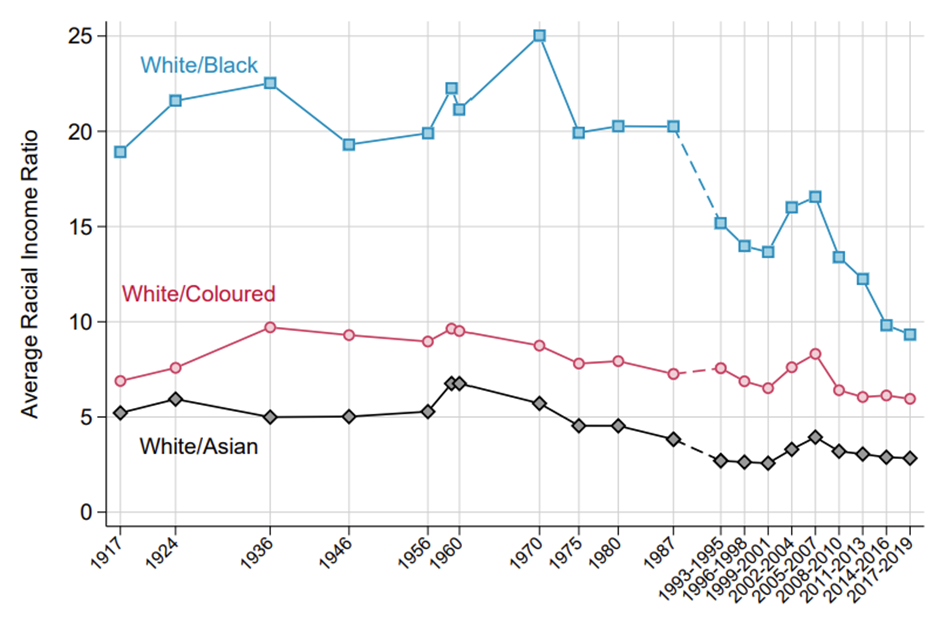
Notes: The figure plots the long-run evolution of racial inequality in terms of factor income in South Africa. Panel A plots the ratios of White-to-Black, Asian, and Coloured average factor incomes. The White-to-Black average factor income ratio reached over 20 in 1924, compared to 9 in 2019. Estimates until 1993 are based on data produced by Leibbrandt et al. (2009), rescaled to account for methodological differences.
What drove this decline? About half of the reduction in the racial income gap is attributable not to broad income convergence, but to the exceptional rise of top Black earners. Had the top decile of the Black income distribution grown only as fast as the ninth decile, the White-to-Black ratio would have fallen by only 23%, rather than the observed 41%. In other words, the emergence of a new Black economic elite was a crucial driver of measured racial convergence.
This concentration of factor income gains has paradoxical implications for redistribution. Overall, South Africa’s fiscal system redistributes roughly 12–13% of national income from White-to-Black South Africans – a proportion that has remained broadly stable since 1993. Yet within the Black population, redistribution has changed dramatically. The rise of top Black incomes has made the top 10% of Black earners increasingly liable for direct taxes and ineligible for social grants: their net fiscal contribution shifted from near zero in 1993 to -7% of national income by 2019. At the same time, net transfers received by the bottom 90% of Black South Africans grew from 13% to 19% of national income (Figure 3). Redistribution has not closed the racial gap more rapidly because it has increasingly been redistributing within the Black population rather than between racial groups.
Figure 3: Trends in overall redistribution by race and income group
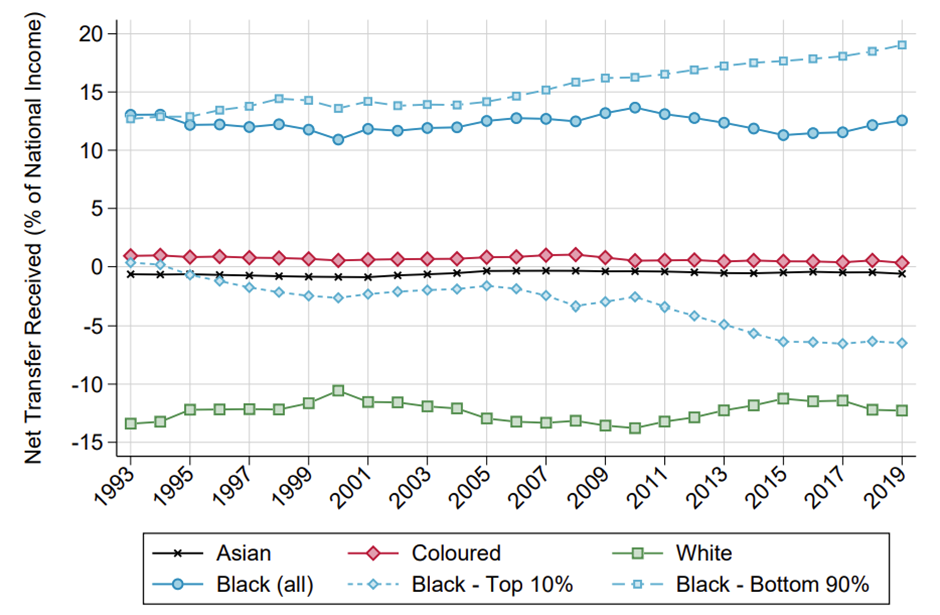
Notes: The figure plots the evolution of net transfers operated by the tax-and-transfer system between pre-tax income (panel A) and racial (panel B) groups from 1993 to 2019. The net transfer received by the bottom 50% increased from about 10% to 15%. The net transfer received by the Black population as a whole remained stable around 10–15%, but the net transfer received by the poorest 90% of Black individuals grew from 13% to almost 20%.
Implications for measurement and policy
These findings carry significant implications for how we measure inequality, track poverty, and design policy.
For measurement, accounting for public services fundamentally changes the picture of redistribution and living standards. In-kind transfers account for roughly half of all real income growth for the bottom 50% since 1993 (Figure 4). South Africa’s poorest households today receive, in public services alone, about five times their pre-tax income. Standard inequality statistics based on disposable income alone can therefore be deeply misleading. The tools developed in our research provide a first step towards closing this gap, which we hope can be extended to other contexts in future research.
Figure 4: Public services and real income growth among the bottom 50%
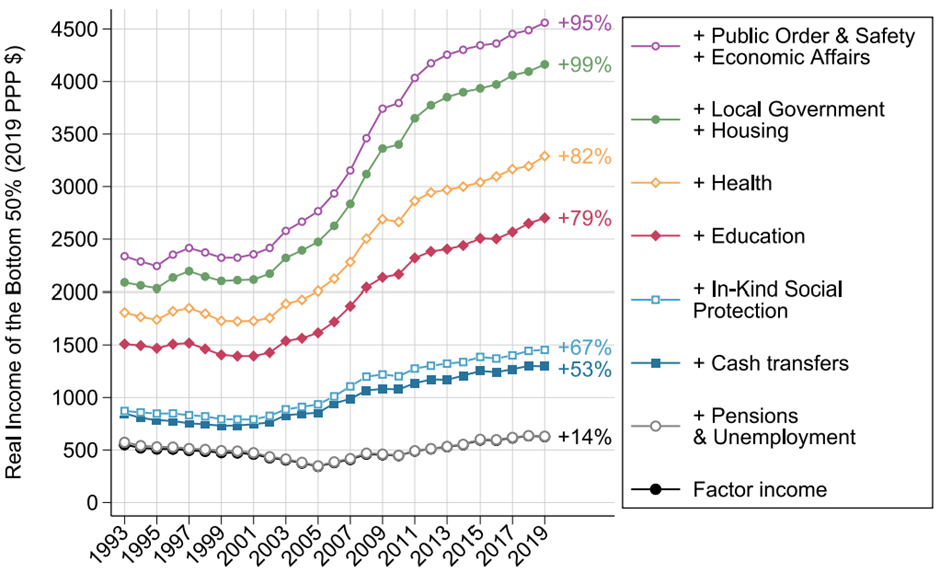
Notes: The figure represents the evolution of the real average income of the bottom 50%, before and after adding cash and in-kind transfers one by one to individual incomes. The average income of the bottom 50% grew by 14% in terms of factor income from 1993 to 2019, while it grew by 95% after adding all cash and in-kind transfers to individual incomes. Factor income is the sum of all capital and labour incomes, before any form of government redistribution. Local government: all government expenditure made by district and local municipalities. Public order and safety: police services, law courts, and prisons. Transport and economic affairs: public transport and transport infrastructure expenditure, as well as expenditure on other economic affairs, such as subsidies to agriculture, energy, manufacturing, and recreation and culture. Social protection: cash transfers and in-kind social protection programs. Income is split equally between all household members.
For policy, our findings identify both achievements and limits. South Africa has built one of the most redistributive fiscal systems among emerging economies – a remarkable achievement given the regime of extreme racial segregation and inequality that prevailed up to the mid-1990s. Yet extreme inequality persists even after accounting for redistribution. Our work closely relates to Carrillo et al. (2023) who demonstrate some of the long-term consequences of the massive forced relocation that took place under apartheid. Overall, this points to the importance of ‘predistribution’ reforms; in other words, policies that would help the poorest people access well-paying jobs and more productive assets. In light of our results, income-based redistribution alone is not likely to fully overcome the entrenched legacy of centuries of racist institutions.
References
Acemoglu, D, S Naidu, P Restrepo, and J Robinson (2015), "Democracy, redistribution, and inequality," in A B Atkinson and F Bourguignon (eds), Handbook of Income Distribution, 2: 1885–1966.
Carrillo, B, C Charris, and W Iglesias (2023), "Moved to poverty? A legacy of the apartheid experiment in South Africa," American Economic Journal: Economic Policy, 15(4): 183–221.
Czajka, L, and A Gethin (2025), "Racial inequality and redistribution in post-apartheid South Africa," Unpublished manuscript.
Derenoncourt, E, and C Montialoux (2021), "Minimum wages and racial inequality," Quarterly Journal of Economics, 136(1): 169–228.
Derenoncourt, E, C H Kim, M Kuhn, and M Schularick (2024), "Wealth of two nations: The US racial wealth gap, 1860–2020," Quarterly Journal of Economics, 139(2): 693–750.
Fisher-Post, M, and A Gethin (2025), "Government redistribution and development: Global estimates of tax-and-transfer progressivity, 1980–2023," Unpublished manuscript.
Gethin, A (2026), "Who benefits from public services? Novel evidence and implications for inequality measurement," Journal of Development Economics, 179: 103627.
Leibbrandt, M, I Woolard, and C Woolard (2009), "Poverty and inequality dynamics in South Africa: Post-apartheid developments in the light of the long-run legacy," South African Economic Policy under Democracy, 10: 270–300.
Piketty, T, E Saez, and G Zucman (2018), "Distributional national accounts: Methods and estimates for the United States," Quarterly Journal of Economics, 133(2): 553–609.