




Half of South Africa’s gender pay gap comes from women sorting into low-paying firms, with low formality and high churn being key to understanding this dynamic.
Why are women paid less than men? Standard explanations—occupation, hours, experience—matter; however, researchers have started paying increasing attention to where women work (Card et al. 2016). Evidence suggests that gender pay gaps appear to be largely driven by women working at lower-paying firms (Roulet et al. 2021).
In Bassier and Gautham (2025), we use tax data on the entire universe of formal workers in South Africa, uncovering a striking fact: nearly half of the gender pay gap is explained by women working at lower-paying firms than men, a share almost double the magnitude of estimates from rich countries.
We link this to the scarcity of formal sector jobs in developing countries (Keen and Kanbur 2015), which make it harder for women to both enter and move up the job ladder over the lifecycle.
The gender pay gap is (mainly) about where you work
We track millions of workers between 2010 and 2018 using administrative tax data, estimating the pay premium each firm provides. Conceptually, this adjusts for all worker characteristics (e.g. fixed education or occupation) and focuses just on the effect of the firm, since we look at the pay change when the same worker goes to a different firm, and average over hundreds of such switches per firm.
Our tax data on the formal sector shows a gender gap of 12%. We show that 45% of this shortfall—5.5 percentage points—is due to women’s greater presence in low-paying firms (i.e. firms that pay all their workers less).
We build on a rich evidence base studying the severe gender pay gap in the South African labour market, much of which is unexplained by worker characteristics such as occupation, skills, or experience (Bhorat and Goga 2013, Casale et al. 2021, Mosomi 2019). Our findings help explain the gap by putting the spotlight on firms.
A gender gap that grows, then shrinks
What’s striking is how the firm-pay gap evolves over the life cycle. The gap is very small for workers in their early twenties but expands greatly for those in their mid-20s to mid-40s—roughly in line with prime child-rearing years. This is consistent with the evidence on life-cycle gender gaps linked to the disproportionate care-work burden on women (Goldin et al. 2017, Mosomi 2019). But then, in an unexpected twist, it narrows again for older workers.
Why does this happen? First, among workers who stay continuously employed, women in their 30s move laterally or downward on the pay ladder more often than men, despite switching jobs just as frequently. Figure 1 shows that the total firm-pay gender gap gets worse over this age range (red line), driven by the gender gap for stayers or those continuously employed (grey line).
Figure 1: Decomposing the gender gap in firm pay premia over the life cycle
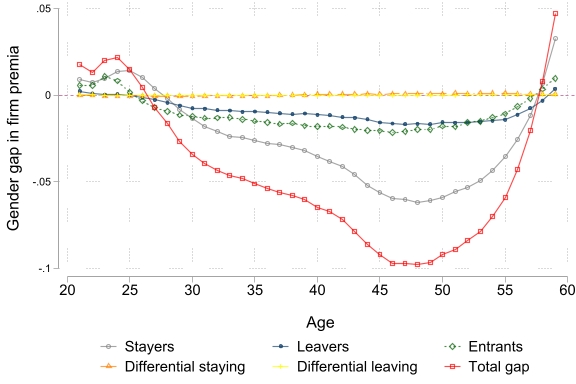
Note: The figure plots the contributions to the gender gap in firm pay premia by category. Stayers are defined as workers who are continuously employed, with changes in firm pay premia arising from switches across firms. Leavers are workers who are not observed in formal employment the following year, and entrants are workers who are not observed in formal employment the previous year. Differential staying and leaving are probabilities of staying and leaving the workforce. The total gap is the weighted sum of these components, which corresponds to the total cross-sectional firm-pay gender gap. Source: Bassier and Gautham 2025.
Second, women who (re)enter formal employment (after being unemployed or in informal work) usually do so in low-paying firms, an entry penalty that persists across ages and feeds the wider gap (green line).
Importantly, both women and men move in and out of formal jobs at comparable rates, so churn itself is not the culprit (yellow and orange lines). Data from South African labour force surveys supports this: we do not see a decline in formal-sector participation or hours worked by women during their child-rearing years.
What matters is where they land when they (re)enter: women disproportionately join jobs in low-premium sectors such as education, retail, and personal care, whereas men gravitate toward high-premium industries like construction, mining, and manufacturing. That industry split explains close to half the entrant gap. One big exception is the public sector. In South Africa, the state has actively pursued gender equity in hiring. Public administration employs a much higher share of women than men and offers relatively high pay premia.
Climbing the job ladder—or not
The firms that women join tend to be in lower-paying industries, have fewer resources, and are less likely to be covered by collective bargaining agreements that boost pay.
Women are just as likely to switch jobs when employed. The problem is that women’s job switches are less likely to lead to upward moves in the pay hierarchy, possibly due to employer discrimination or a need to prioritise non-pay job characteristics (such as flexibility). So, our story is not really one of women leaving formal jobs or refusing to hop jobs.
By their late 40s and 50s the gap narrows, as women begin to secure moves up the pay ladder more often than men (see Figure 1, red and grey lines). This is likely because, having been sorted into lower-paying firms earlier in their careers, they have more room to climb.
Why firms in developing countries may contribute more to the gender pay gap
The 45% share of the gender gap explained by firm sorting in South Africa dwarfs the roughly 20–25% documented for richer economies such as Portugal and Italy (Card et al. 2016, Casarico and Lattanzio 2024). Whereas our findings are more similar to those in other developing countries such as Brazil and Chile (Cruz and Rau 2022, Morchio and Moser 2021).
Why do firms matter more in places like South Africa? High unemployment and few outside options give firms greater wage-setting power, amplifying ‘monopsony’ (Bassier 2023). The resulting widening of firm premia in turn increases the firm-pay gender gap as women are positioned lower in the firm hierarchy. Moreover, high informality increases transitions in and out of employment, which matters because entrants generally have lower gaps than the continuously employed.
So, because formal jobs are scarce, entering or moving up within the formal sector is harder, especially for women. In fact, we show that in regions of South Africa with lower levels of formality, the gender gap in firm pay is wider. This relates to research on informality as a major channel through which child penalties operate (Berniell et al. 2024, Kleven et al. 2025).
Further research on gender pay gaps is necessary
Our data is limited to workers in formal sector firms (about 60% of the employed): small firms, informal workers, and self-employment remain off-screen. Gender gaps among informal workers follow very different patterns and are likely governed by different dynamics. We also cannot definitively separate employer bias from worker preferences in sorting.
Finally, while coarse industry codes explain nearly half the firm-pay gap, and around a quarter of the total gender gap, we need more research on why some sectors pay systematically less. Others argue that pay in care-intensive sectors such as education and health remain low as market prices likely understate social value in these sectors and ‘duty-to-care’ norms weaken workers’ bargaining power (Folbre et al. 2023).
Policy takeaways on closing the gender pay gap
Reducing the gender pay gap takes more than promoting equal pay for equal work. It means tackling the invisible sorting that happens across firms—and the structures that steer women into lower-paying ones; public sector hiring shows that it is possible. Similarly, policies that support childcare, promote flexibility without penalising pay, and reduce discrimination in hiring can also help drive meaningful change.
In developing countries especially, where formality is limited and transitions into good jobs are harder, policy can focus on easing women’s access to high-paying firms. Otherwise, sorting into low-paying firms will keep reinforcing the gender pay gap, one job move at a time.
References
Bassier, I and L Gautham (2025), “The firm-pay gender gap and formal sector churn over the life cycle,” Journal of Development Economics.
Bassier, I (2023), “Firms and inequality when unemployment is high,” Journal of Development Economics, 161: 103029.
Bhorat, H and S Goga (2013), “The gender wage gap in post-apartheid South Africa: A re-examination,” Journal of African Economies, 22(5): 827–848.
Card, D, A R Cardoso, and P Kline (2016), “Bargaining, sorting, and the gender wage gap: Quantifying the impact of firms on the relative pay of women,” The Quarterly Journal of Economics, 131(2): 633–686.
Casale, D, D Posel, and J Mosomi (2021), “Gender and work in South Africa,” in A Oqubay, F Tregenna, and I Valodia (eds.), The Oxford Handbook of the South African Economy, Oxford University Press, pp. 735–756.
Casarico, A and S Lattanzio (2024), “What firms do: Gender inequality in linked employer-employee data,” Journal of Labor Economics, 42(2): 325–355.
Cruz, G and T Rau (2022), “The effects of equal pay laws on firm pay premiums: Evidence from Chile,” Labour Economics, 75: 102135.
Folbre, N, L Gautham, and K Smith (2023), “Gender inequality, bargaining, and pay in care services in the United States,” ILR Review, 76(1): 86–111.
Goldin, C, S P Kerr, C Olivetti, and E Barth (2017), “The expanding gender earnings gap: Evidence from the LEHD-2000 Census,” American Economic Review, 107(5): 110–114.
Keen, M and R Kanbur (2015), “Rethinking informality,” VoxEU.
Morchio, I and C Moser (2021), “The gender pay gap: Micro sources and macro consequences,” Unpublished manuscript.
Mosomi, J (2019), “An empirical analysis of trends in female labour force participation and the gender wage gap in South Africa,” Agenda, 33(4): 29–43.
Roulet, A, M Stabile, and M G Palladino (2021), “Evolution of the wage gender gap: New firm-level evidence from France,” VoxEU.