






New narrative evidence for sub-Saharan Africa shows that fiscal tightening has larger negative effects on output in downturns, when implemented through spending cuts, and when aid is scarce.
Across sub-Saharan Africa (SSA), governments are under growing pressure to restore fiscal sustainability. Debt vulnerabilities have risen, financial conditions have tightened, official development assistance has declined, and repeated shocks have left many countries with little room for gradualism. As such, fiscal consolidation by cutting spending and raising tax has become necessary. But a central policy question remains: How large are the output effects of fiscal tightening?
Existing research has often suggested that the output costs of consolidation in the region are modest – much smaller than in advanced economies (Arizala et al. 2021, Woldu and Kano 2023, Badru et al. 2025). This has lent weight to the argument that fiscal tightening is feasible without causing significant economic damage. Our research points to a more nuanced conclusion with important implications for policy design, notably in terms of considering ways to attenuate the adverse effects of adjustment. We find that fiscal tightening in SSA can be significantly more contractionary than previously estimated, especially when it takes place during downturns, relies heavily on spending cuts, or occurs in a context of scarce external financing (Abdel-Latif, Bechchani, David, and Lemaire 2026).
Why earlier estimates may have understated the costs
Earlier studies may have painted a muted picture of fiscal adjustment in sub-Saharan Africa because they often relied on fiscal indicators that do not cleanly separate policy decisions from other forces. In the region, fiscal aggregates are heavily shaped by commodity price swings, inflation, and volatile external financing. That means standard measures can mistakenly signal a ‘consolidation’ episode even when the improvement in the fiscal balance simply reflects an oil price boom, or miss genuine tightening when governments cut spending or raise taxes during a downturn while the deficit still widens mechanically. In both cases, the true policy effort is obscured, and the estimated growth cost of fiscal adjustment is likely to look smaller than it really is. This identification flaw downplays the true impact of fiscal consolidation.
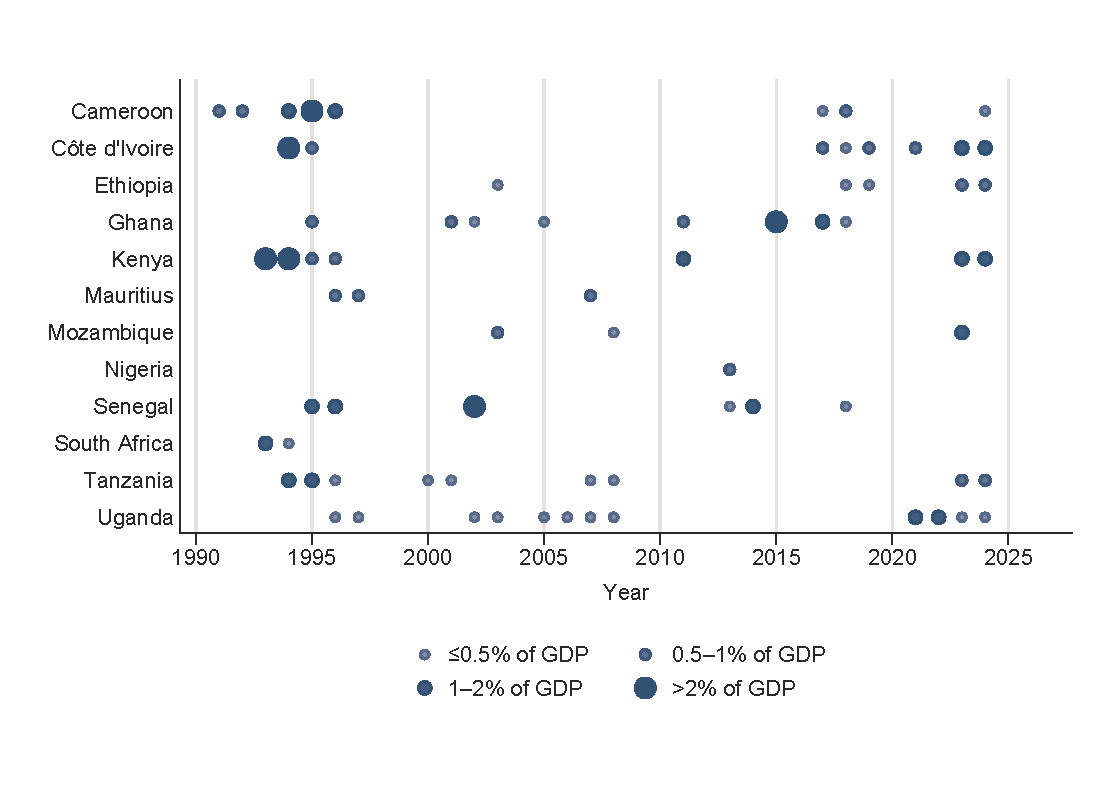
To address this problem, we build a new narrative dataset of discretionary fiscal consolidation measures for 14 SSA economies over 1990–2024.
An AI-assisted narrative for identifying fiscal tightening
We identify discretionary tightening measures directly from policymakers’ stated motivations in contemporaneous IMF staff reports, rather than inferring them from movements in aggregate fiscal balances. Following the narrative approach pioneered by Romer and Romer (2010) and Guajardo et al. (2014), we include only measures adopted for reasons unrelated to short-term cyclical conditions, such as restoring debt sustainability or pursuing longer-term structural objectives. We exclude measures taken in response to short‑term stabilisation needs or commodity price fluctuations.
A key innovation is the use of AI assisted text analysis to screen thousands of IMF documents, combined with detailed human verification. This hybrid approach improves coverage and consistency while preserving judgment where it matters most. The resulting dataset includes 72 fiscal consolidation episodes, with information on size, timing, and composition (tax versus spending).
Figure 1: Fiscal consolidations are frequent, sizable, and spread across countries and time
Sources: IMF staff reports and authors’ calculations.
Fiscal tightening has larger negative effects on output than previously believed
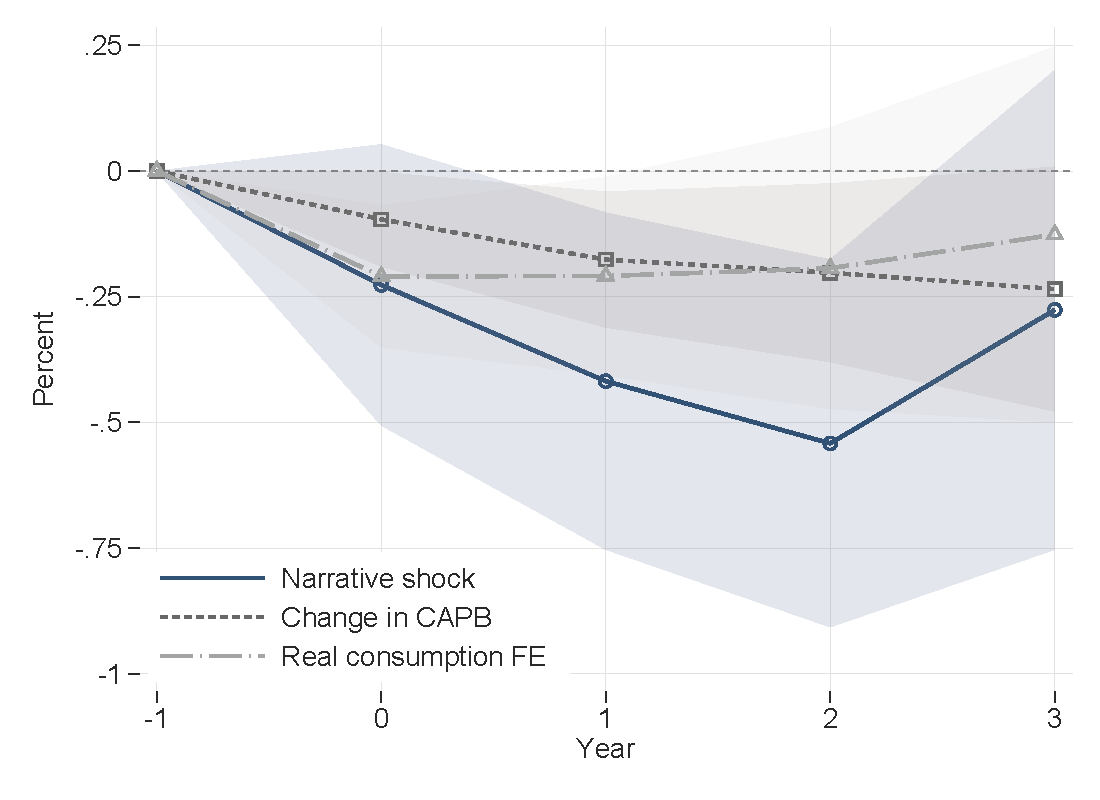
Our estimates suggest that fiscal consolidation in sub-Saharan Africa is considerably more contractionary than earlier studies implied. A fiscal consolidation of 1% of GDP lowers real output by about 0.5% after two years – more than twice the effect typically found in studies using conventional identification approaches on the same set of countries. In other words, fiscal tightening in SSA is far from painless. Once policy actions are measured more accurately, the apparent difference between sub-Saharan Africa and advanced economies narrows substantially.
Figure 2: Narrative identification implies larger output losses than CAPB or forecast-error shocks
Sources: WEO, IMF staff reports, and authors’ calculations.
Fiscal adjustment hurts more when implemented during bad times
Average effects tell only part of the story. The timing of fiscal consolidation matters greatly. We find that the negative effects of adjustment are especially large during economic downturns, when weak demand, spare capacity, and tighter credit conditions magnify the effects of lower public spending or higher taxes. The same adjustment undertaken during expansions is less damaging. This suggests that, when financing permits, governments can reduce the growth cost of consolidation by avoiding adjustment during periods of weakness and smoothing it over time instead.
Timing is not the only design choice that matters. The composition of fiscal adjustments also plays a central role.
Spending cuts hurt more than tax hikes
How governments consolidate matters too. We find that spending‑based adjustments are substantially more contractionary than tax‑based ones. A spending cut of 1% of GDP lowers output by about 1.2% after two years, compared with roughly 0.5% for a tax increase of the same size. One reason may be that consolidation episodes in SSA have often relied on cuts to public investment, while tax ratios remain low in many countries. This suggests that blunt expenditure compression can be especially costly, and that better-designed revenue mobilisation may sometimes offer a less damaging path to adjustment.
External financing can soften the blow
Fiscal consolidation is especially painful when countries are forced to adjust without external support. We find that output losses are much larger when official development assistance is low, likely because tighter financing constraints leave governments with less room to smooth the adjustment and protect priority spending. By contrast, when aid is more available it can cushion the short-term effects of consolidation.
Adjustment also affects the external sector
Fiscal consolidation affects not only output, but also the external sector. We find that tightening reduces imports, improves the current account balance, and is associated with a depreciation of the real effective exchange rate. These patterns are consistent with a domestic demand‑compression channel emphasised in open‑economy macroeconomic models.
What does this mean for policy?
These findings point to three broad lessons for policymakers in SSA.
- Adopting countercyclical policies improves outcomes. When possible, fiscal consolidation should be concentrated during economic expansion times rather than downturn. If adjustment during a slump is unavoidable, gradualism can help limit output losses.
- Favouring revenue mobilisation improves outcomes. Revenue‑based measures – particularly those that broaden the tax base and strengthen administration – tend to be less damaging to growth than spending cuts, especially cuts to public investment. Successful adjustment strategies should carefully sequence revenue and expenditure measures rather than relying on blunt expenditure compression.
- External support matters. Adequate official financing can play a critical buffering role during adjustment episodes. For development partners, this strengthens the case for aligning financial support with credible adjustment efforts to avoid deep recessions.
Looking ahead
One lesson stands out for sub-Saharan Africa: fiscal consolidations are more painful than once thought. The output costs of adjustment hinge on timing, composition, and financing conditions. This analysis is particularly pertinent for IMF staff, as it helps us be more attentive to risks associated with these factors in our policy advice. The real challenge is not just whether to tighten, but how to do so in a way that secures sustainability without unduly stifling growth.
Authors’ note: The views expressed in this blog are those of the authors and do not necessarily represent the views of the IMF, its Executive Board, or IMF management, nor those of the Université de Sherbrooke.
References
Abdel-Latif, H, K Bechchani, A C David, and T Lemaire (2026), "The fiscal multipliers narrative of Sub-Saharan Africa," Unpublished manuscript.
Arizala, F, J González-García, C G Tsangarides, and M Yenice (2021), "The impact of fiscal consolidations on growth in Sub-Saharan Africa," Empirical Economics, 61(1): 1–33.
Badru, R, A Calef, A E Ilori, and O E Omoju (2025), "Fiscal consolidation and asymmetric macroeconomic effects: Evidence from Sub-Saharan African countries," Economic Modelling, 147(1).
Guajardo, J, D Leigh, and A Pescatori (2014), "Expansionary austerity? International evidence," Journal of the European Economic Association, 12(4): 949–968.
Romer, C D, and D H Romer (2010), "The macroeconomic effects of tax changes: Estimates based on a new measure of fiscal shocks," American Economic Review, 100(3): 763–801.
Woldu, G, and I Kano (2023), "Fiscal multipliers and structural economic characteristics: Evidence from countries in sub-Saharan Africa," The World Economy, 46(8): 2335–2360.