







Expanding paid maternity leave in India from 12 to 26 weeks led employers to cut women's employment by up to 10% and favour men for promotions, while leaving wages unchanged. Women greatly valued longer leaves such that the policy was broadly cost-benefit neutral, but better-designed alternatives – such as insurance mechanisms spread across all workers or correcting employer beliefs about women’s leave taking – could benefit women while limiting job loss.
Editor’s note: For a broader synthesis of themes covered in this article, check out Issue 2 of our VoxDevLit on Female Labour Force Participation.
Paid maternity leave is among the most widespread ‘female-friendly’ workplace policies in the world, with over 145 countries providing some form of paid leave to new mothers (Hyland et al. 2020). Recent years have seen these policies proliferate across developing countries, with India, Pakistan, and Nigeria all more than doubling their duration of paid maternity leave over just the last decade. On the one hand, longer leave could benefit both employers and women by improving the recruitment and retention of talented female workers. On the other hand, by making female employees more expensive, leave expansions could unintentionally reduce women’s wages or employment. Even beyond wages and employment, longer maternity leave could shift women’s career trajectories: employers may promote women less (for fear of losing them), or they may promote women more if they expect mothers to return at higher rates after childbirth.
In recent work (Ghosh, Hao, Ho, Sharma, and Tandon 2025), we study a landmark policy change in India, the Maternity Benefit (Amendment) Act of 2017, that expanded paid maternity leave from 12 to 26 weeks. To identify the causal effect of the policy on women and men’s labour market outcomes, we use a difference-in-differences (DiD) design that compares firms that already offered longer durations of leave due to parent company policies (the treated group) to firms that offered shorter durations (the control group) within the same industry and firm size group. To speak to the full labour market, we assemble a new, first-of-its-kind dataset that covers formal workers comprising 45% of the non-agricultural workforce in India by linking three rich sources: (i) employer-employee-linked social security records that cover formal workers, (ii) career trajectories from the universe of LinkedIn profiles, and (iii) firm-level information on the pre-period duration of maternity leave constructed using Glassdoor reviews, newspaper announcements, and a representative survey of 500 large firms across India.
We find four key results:
- Employers responded to the higher cost of employing women by reducing women’s employment, but not their wages.
- Men’s wages increased as employers sought to retain experienced male workers in the face of a shrinking female workforce.
- Men were more likely to be promoted than women into managerial and more complex positions.
- The policy was cost-benefit neutral: it harmed women who lost jobs and employers who lost workers for longer, but also benefited women who took longer leaves and greatly valued them.
Employment, wages, and career trajectories
What does economic theory predict about how employers might respond to a maternity leave mandate? First, employers may pass the cost of a mandate onto female workers by reducing wages as in ‘compensating differentials’. However, employers who cannot reduce wages may instead lower women’s employment by hiring fewer women or letting more go. Which channel ultimately dominates will depend on whether wages can successfully adjust.
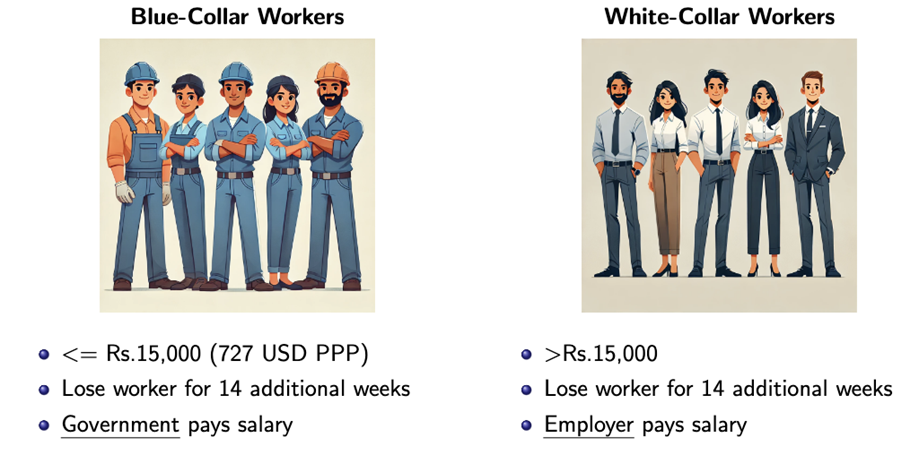
We find that the incidence of India’s maternity leave law fell entirely on employment rather than wages. We report all results separately for two groups of workers, as the policy imposed different costs for each group: for blue-collar workers earning below INR 15,000 per month (US$797 PPP), the government covered wages during leave so employers only lost workers for 14 additional weeks; for white-collar workers earning above this amount, employers both lost workers for a longer period and paid their wage during leave.
Figure 1: Maternity leave law for blue- and white-collar workers
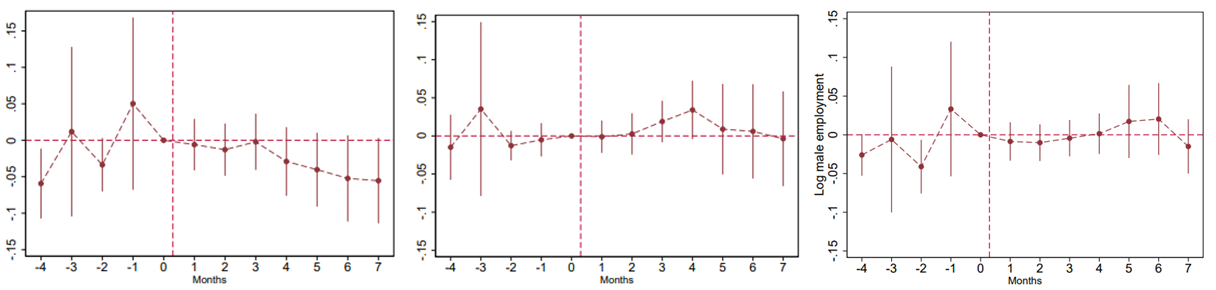
Blue-collar women’s employment declined by 5.5% within six months of the reform while white-collar women’s employment fell by 6% within the first year and by 10% four years later. These effects were concentrated among young women aged 18 to 35, the group most likely to become mothers.
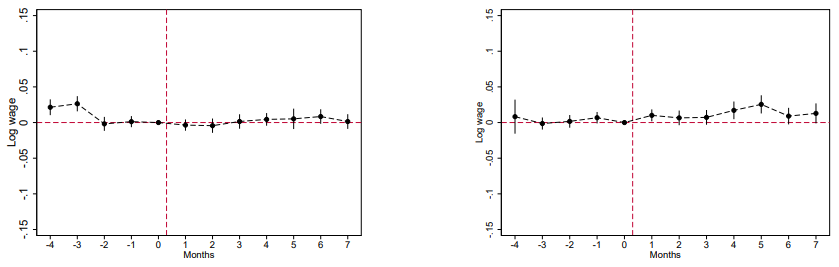
Strikingly, we find no impact on women’s wages, whether for existing workers or new hires, young or old. We can rule out even small wage declines (below 1%) at the 95% confidence level. By contrast, men’s wages rose by 1.8%, consistent with employers seeking to retain experienced male workers as women’s employment fell.
Figure 2: Effects on employment
(a) Women (Aged 18–35) (b) Women (Aged 35+) (c) Men
Why did India’s maternity leave law reduce employment but not wages? One explanation is that women did not value longer leaves, which would limit the scope for wage adjustments. Our survey evidence points against this explanation: nearly all women took the full 26 weeks of leave and report a very high willingness to pay for longer leave (25–30% of their monthly wages). A more consistent explanation, instead, is that women’s wages were rigid, both because norms prevent employers from cutting wages or paying workers differently for the same work, and because minimum wages often bind for these workers (Breza et al. 2018, Kaur 2019, Sharma 2025). Our finding that India’s maternity leave law reduced employment and not wages then underscores the importance of understanding wage rigidity for predicting the impact of maternity leave laws: when wages are rigid, the cost of a mandate will fall on young women rather than existing female workers, and the workforce will shift towards men and older women.
Figure 3: Effects on wages
(a) Women (b) Men
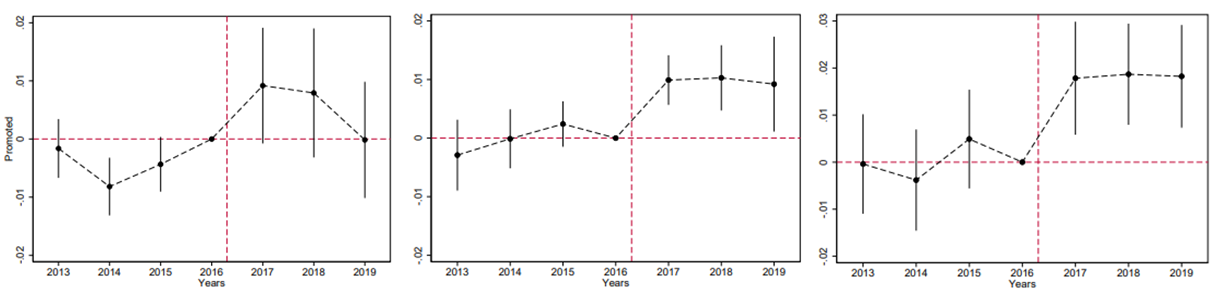
Beyond wages and employment, we find that the reform also shifted workers' career trajectories. LinkedIn data shows that employers were more likely to promote men into managerial positions than women, with men’s promotion rates increasing by 10% relative to baseline. Men and older women (above age 35) were also more likely to shift from routine into abstract roles that require greater analytical skills and firm-specific knowledge, such as software engineering, consulting, or finance. Young women, by contrast, were more likely to be placed in positions that require lower firm-specific knowledge, such as data entry, retail, or customer service.
Figure 4: Men and older women more likely to be promoted
(a) Men (Promoted) (b) Men (Abstract roles) (c) Women, aged 35+ (Abstract roles)
Costs versus benefits
The employment declines and slower career growth documented above paint a sobering picture, but they are not the whole story. Although the reform imposed real costs, it also delivered substantial benefits to women who remained employed.
The most striking evidence of the reform's value to these women comes from their own behaviour and stated preferences. We conducted surveys of blue-collar factory workers near Delhi to measure how much women take leave, and how much they value leave. Women took longer leaves: virtually 100% of women who took maternity leave after 2017 took the full 26 weeks, including those who had previously taken only 12 weeks. They also highly valued leave: the average woman valued leave at ~30% of her monthly salary, with higher valuations among younger women and those with fewer children.
Figure 5: Cost-benefit analysis
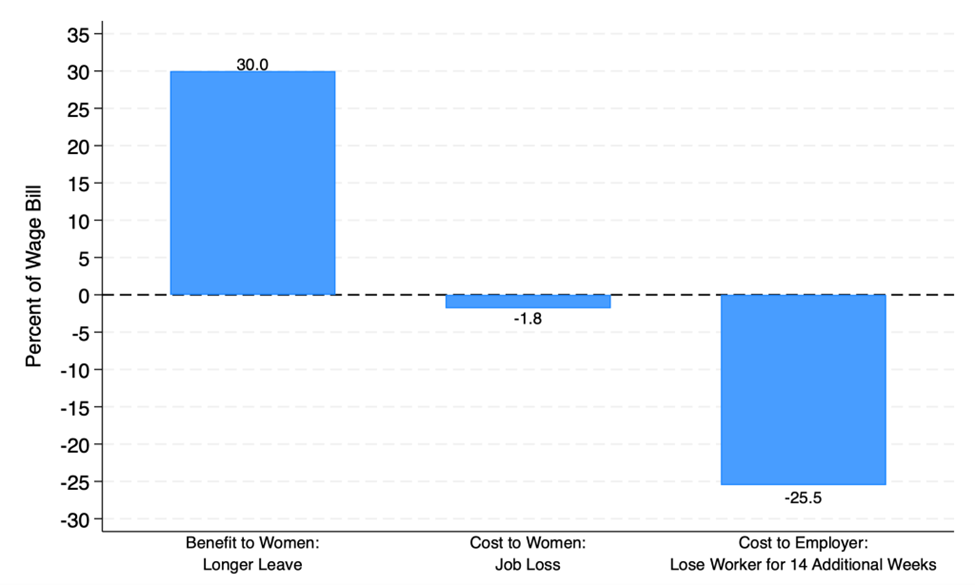
Note: Estimated benefits to women include value of 14 additional weeks of leave; the estimated cost of job loss includes the lost value of leave (it does not include wages which are a transfer from the employer to the worker, or any non-monetary value of the job); the estimated cost to employer includes replacement cost of worker for 14 additional weeks (inferred from the magnitude of the employment decline).
In sum, the reform was cost-benefit neutral: the benefits to women who stayed employed and valued leave almost fully offset costs to women who lost jobs and to employers who lost workers for longer, each worth about 25% of the female wage bill at baseline.
Policy implications
Together, our work shows that a policy that expanded paid maternity leave in India from 12 to 26 weeks led employers to reduce women’s employment by 6% within six months and 10% by year four, shifting the workforce towards men and older women, especially in higher-skilled jobs. However, the policy also benefited women who remained employed and valued longer leaves. Two key policy insights emerge:
- Policies intended to help workers can inadvertently harm another group. Policymakers would do well to anticipate these trade-offs before passing a policy and to choose designs that maximise benefits while minimising harm. Better designs in this context would include shorter leave durations (our survey suggests that increasing leave to 16 weeks would capture most of the policy’s benefits, as women value the first few weeks of leave most); alternatively, insurance mechanisms could compensate firms for the cost of losing workers for longer, financed through a broad payroll tax that makes all workers more expensive – not just women.
- A silver lining of the results is that to rationalise the large fall in female employment, employers would have to greatly overestimate the rate of leave-taking among women. These employer misperceptions suggest the tantalising possibility that correcting employers’ beliefs could produce gains for both workers and employers – benefiting women by reducing discrimination and benefiting employers who no longer underestimate the returns to hiring women.
References
Breza, E, S Kaur, and Y Shamdasani (2018), "The morale effects of pay inequality," Quarterly Journal of Economics, 133(2): 611–663.
Ghosh, P, S Hao, L Ho, G Sharma, and S Tandon (2025), "The effects of mandated maternity leave on labour market outcomes in India," Unpublished manuscript.
Hyland, M, S Djankov, and P K Goldberg (2020), "Gendered laws and women in the workforce," American Economic Review: Insights, 2(4): 475–490.
Kaur, S (2019), "Nominal wage rigidity in village labor markets," American Economic Review, 109(10): 3585–3616.
Sharma, G (2025), "Collusion among employers in India," Unpublished manuscript.