




Evidence from over 6,600 farm households in Zambia finds that droughts reduce yields of maize, beans, and groundnuts while prompting smallholders to diversify crops, adopt resilient seed varieties, and expand cultivated area. This suggests that well-timed extension support and greater investment in drought-tolerant crops could significantly strengthen the adaptive capacity of smallholder farming systems.
Editor’s note: For a broader synthesis of themes covered in this article, check out our VoxDevLit on Climate Adaptation.
Drought is no stranger to Africa’s smallholder farmers. Across sub-Saharan Africa, recurrent dry spells and multi-season droughts continue to plague agricultural production. But as climate change intensifies, the frequency and severity of these events are rising fast, and so are the stakes. In Zambia, where agriculture is a key sector and rain-fed cultivation dominates, the question of how smallholder households respond when rains fail is not merely academic. The question bears directly on food security, rural poverty, and the long-run resilience of one of the continent's most agriculture-dependent economies.
We investigate this question in recent work (Tabe-Ojong, Tolani, and Molua 2026). Using a nationally representative three-wave panel of over 6,600 Zambian farm households surveyed between 2012 and 2019, matched with satellite-derived drought indices, we examine not only how droughts damage crop yields but also how farmers adapt in response. Our results challenge a passive narrative of climate victimhood and reveal smallholder farmers as active and forward-looking, capable of significant behavioural adjustment under shocks.
Droughts hit hard, though unevenly
The first finding is unsurprising but important to document rigorously: droughts reduce crop yields, and they do so meaningfully. We measure drought exposure using the well-validated Standardized Precipitation Evapotranspiration Index (SPEI) that captures both precipitation deficits and evaporative demand, more completely capturing drought severity than rainfall alone. Our estimates, based on a household fixed effects approach, show that droughts reduce bean yields by 9.5%, groundnut yields by 7.2%, and maize yields by 6% (Figure 1). In the case of cowpea and sorghum, however, we find positive but statistically insignificant effects on yields.
Figure 1: Droughts and crop yields
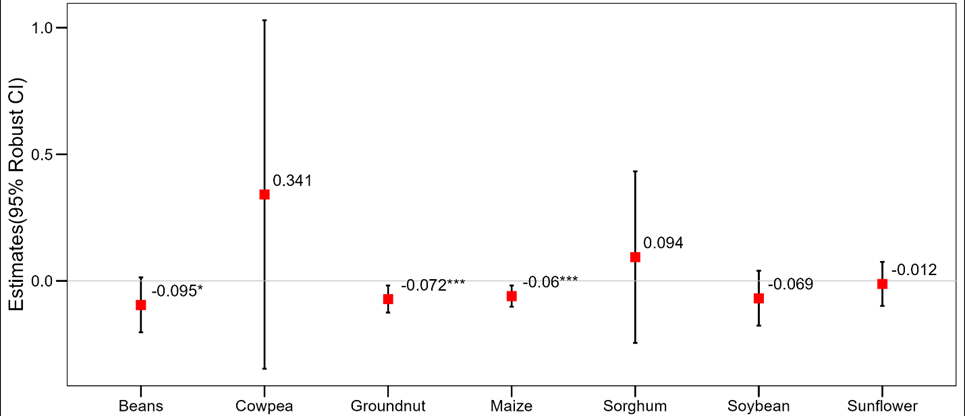
Notes: This figure displays estimated coefficients and their corresponding 95% confidence intervals as error bars. Crop yields are log-transformed. The presence of an asterisk (∗) above a coefficient indicates that the coefficient is statistically different from zero at a predetermined level of significance (∗∗∗p < 0.01, ∗∗p < 0.05, ∗p < 0.1).
These estimates are very telling with implications for food security. Maize is Zambia's dominant staple crop, underpinning both household food security and farm income for most rural Zambians. A 6% yield reduction in a bad year, compounded across multiple seasons, is enough to push a food-secure household into deficit. Beans and groundnuts – critical sources of protein and dietary diversity – are hit even harder (Tabe-Ojong et al. 2025). For households already operating at thin margins, these losses have consequences that ripple far beyond the harvest season.
Farmers adapt: Diversification, resilient seeds, and land expansion
One of our most compelling findings is that Zambian smallholders respond to drought exposure with a suite of proactive adaptation strategies that are all economically significant.
Households’ most prominent response is crop diversification. After experiencing drought, households increase the diversity of their crop portfolios by approximately 17.6%, moving towards a broader mix of crops that spreads agronomic and market risk across the farming system. We measured this using both the Simpson's Diversity Index and the Herfindahl-Hirschman Index; the finding is robust across multiple specifications and robustness checks. Households shift land towards crops that are more competitive under water-stressed conditions: opportunistic crops such as sorghum, cowpeas, and soybeans, which have historically received far less R&D attention than maize, but which perform relatively better when rainfall is scarce and see marked increases in their acreage share after drought years (Schneider Lecy et al. 2025). This has important implications for agricultural research priorities in the region.
Adoption of climate-resilient seed varieties is the second major adaptation pathway. Experiencing a 12-month drought increases the probability that a household will adopt climate-resilient crop varieties in subsequent seasons by 15 percentage points, while a 6-month drought increases the probability by 20 percentage points (Figure 2). This is a remarkably large effect, suggesting that drought functions as an information shock that motivates the uptake of technologies that extension programmes and development projects have often struggled to promote through conventional channels.
Figure 2: Droughts and climate-resilient crop varieties
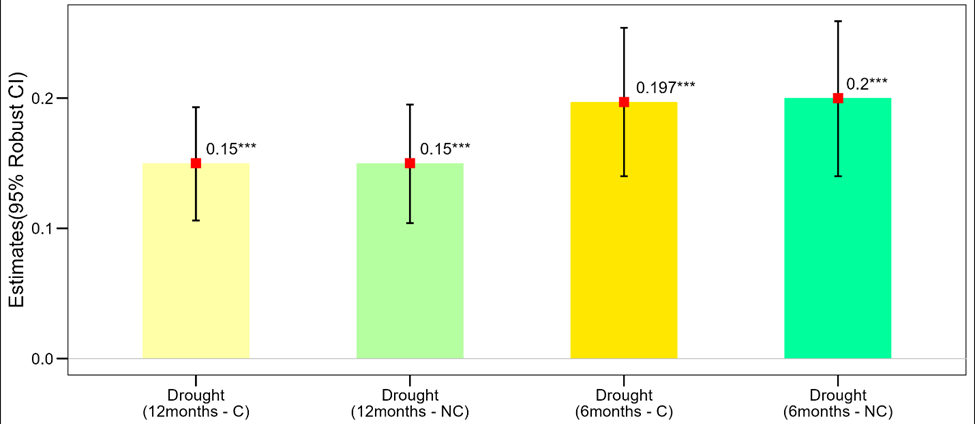
Notes: Climate-resilient crop varieties are measured as a dummy taking the value of 1 for adoption and 0 otherwise. This figure displays the estimated coefficients and their corresponding 95% confidence intervals as error bars. C stands for the addition of controls and NC for models with no controls. The presence of an asterisk (*) above a coefficient indicates that the coefficient is statistically different from zero at a predetermined level of significance (***p < 0.01, **p < 0.05, *p < 0.1).
Cropland expansion is the third response. Households expand their total cultivated area by 11–18% following drought exposure. This strategy reflects a straightforward logic: if output per unit of land has fallen, one way to recover total production is to cultivate more land. It is an adaptation available only to households with access to additional land.
Why do farmers adapt this way?
Understanding the mechanisms behind these adaptations matters for policy. Our analysis points to two complementary drivers:
- Risk mitigation: diversification and resilient seed adoption function as insurance strategies. By spreading production across multiple crops and investing in varieties that can better withstand water stress, households reduce the variance in their outcomes even if they cannot fully eliminate drought-induced losses.
- Relative crop competitiveness: as drought reduces maize yields, other crops such as legumes and coarse grains perform better in relative terms, as shown in Figure 3. Farmers observe this within-season variation and respond by reallocating land towards crops that show greater resilience. The adaptation is partly a response to information the drought itself generates.
Figure 3: Acreage cropland response to droughts
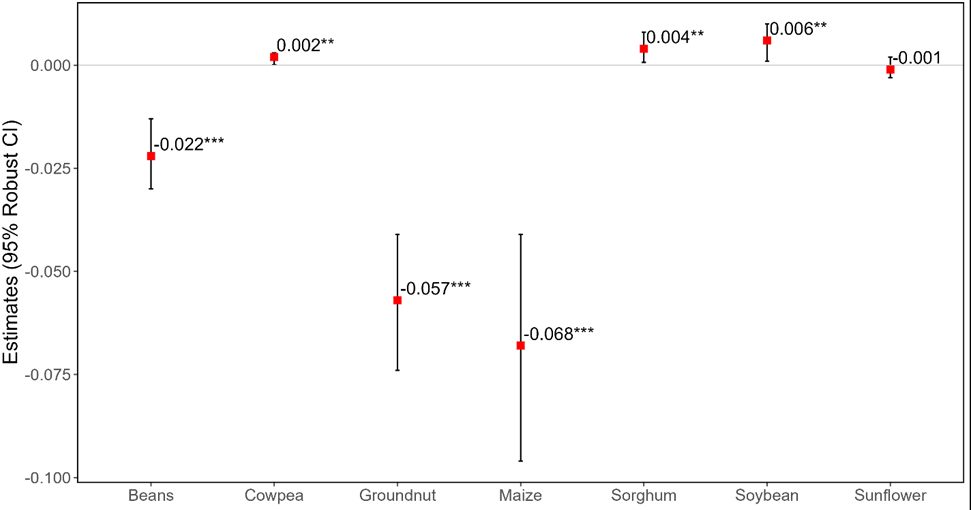
Notes: The outcomes here are crop-specific shares of cropland acreage. This figure displays estimated coefficients and their corresponding 95% confidence intervals as error bars. The presence of an asterisk (*) above a coefficient indicates that the coefficient is statistically different from zero at a predetermined level of significance (***p < 0.01, **p < 0.05, *p < 0.1).
The environmental dimension
The cropland expansion finding deserves particular attention from a sustainability perspective. While expanding cultivated areas is a rational household-level response to drought-induced yield losses, it carries risks for natural ecosystems if the land cleared comes from forests, wetlands, or other ecologically sensitive areas. In Zambia, as in many parts of sub-Saharan Africa, agricultural expansion has historically come at the cost of forest cover (Laurance et al. 2014). Policies that support smallholder adaptation to climate stress must therefore be attentive to the potential environmental externalities of land-use change by offering households alternative pathways to maintaining output that do not require converting additional natural land.
Policy implications for climate resilient agriculture
Three policy messages emerge clearly from our findings. First, support for crop diversification must address real barriers. The fact that households diversify in response to drought shows that they understand its value. But diversification is not cost-free: it requires knowledge of alternative crops, access to diverse seed varieties, and in some cases new equipment or management practices. Agri-environmental policies should tackle the financial and information barriers that currently prevent more households from diversifying before drought strikes, rather than waiting for the shock to do the work.
Second, investment in agricultural R&D for opportunistic crops should not be overlooked. Our findings show that when droughts hit, farmers turn to sorghum, cowpeas, and soybeans as buffers. Yet these crops receive a fraction of the public research investment directed at maize (Manners and van Etten 2018, Bollington et al. 2021). Closing this gap through breeding programmes (Tabe-Ojong et al. 2026b), agronomic research, and market development for drought-tolerant crops would significantly strengthen the adaptive capacity of smallholder farming systems.
Third, extension services need to be proactive rather than reactive. Drought appears to function as a powerful trigger for technology adoption: after experiencing crop loss, households are far more likely to invest in resilient crop varieties. This creates a window of opportunity for extension agents and development programmes to reach farmers with timely, relevant information precisely when receptivity is highest. Climate-smart advisory services that can respond rapidly to weather shocks rather than operating on fixed annual calendars would be far more effective at accelerating adaptation.
References
Bollington, A, M DeLonge, D Mungra, M Hayek, M Saifuddin, and S S McDermid (2021), "Closing research investment gaps for a global food transformation," Frontiers in Sustainable Food Systems, 5: 794594.
Laurance, W F, J Sayer, and K G Cassman (2014), "Agricultural expansion and its impacts on tropical nature," Trends in Ecology & Evolution, 29(2): 107–116.
Manners, R, and J van Etten (2018), "Are agricultural researchers working on the right crops to enable food and nutrition security under future climates?," Global Environmental Change, 53: 182–194.
Schneider Lecy, K, F A Gonzalez, I Becker-Reshef, and others (2025), "Agricultural research approaches for crops that nourish by improving nutrition, soil health, resilience and prosperity," Nature Food, 6: 1103–1106.
Tabe-Ojong, M P J, S M Eke Balla, and R Mofya-Mukuka (2025), "Rural wealth is associated with the consumption of nutritious and healthy foods in Zambia," Scientific Reports, 16: 593.
Tabe-Ojong, M P J, E Tolani, and E L Molua (2026), "Rolling back the tides: Impact of droughts on crop diversification and cropland expansion," Journal of Environmental Economics and Management, 136: 103260.
Tabe-Ojong, M P J, M Smale, N Jamora, and V Azevedo (2026b), "Linking the ICRISAT genebank to poverty reduction and welfare in Malawi," Australian Journal of Agricultural and Resource Economics, 70(1): 165–177.