





A four-year study of smallholder farmers in Malawi finds that combining cash transfers with intensive agricultural extension produces larger and more durable gains in crop production and household consumption than either intervention alone.
Editor’s note: For a broader synthesis of themes covered in this article, check out Issue 2 of our VoxDevLit on Agricultural Technology in Africa
Smallholder agricultural production in sub-Saharan Africa continues to fall short of its potential. Recent evidence finds that crop yields among smallholders are stagnant or even declining (Wollburg et al. 2024), and that no single constraint fully explains this pattern (Suri et al. 2024). The implication is that interventions that address constraints in isolation are unlikely to be successful. Growing evidence suggests that combining multiple interventions can unlock benefits that no single component achieves alone. For example, in Kenya, a programme bundling credit, inputs, insurance, and technical advice found large gains in yields and profits for smallholder maize farmers (Deutschmann et al. 2025). But there is still much to learn about which combinations of interventions work, for whom, for how long, and whether such gains translate into improvements in overall well-being.
While many programmes evaluate the provision of farm inputs and/or extension services (Caldwell et al. 2019), a growing body of work suggests that agricultural labour markets are an important constraint for many farmers, even smallholders. Evidence from Rwanda shows that failures in land and labour markets generate misallocation that limits technology adoption, even when the technology is demonstrably profitable (Jones et al. 2022). Related evidence from Zambia shows that seasonal liquidity constraints force poor farmers to sell their labour at low wages during the hungry season rather than invest it on their own farms, and that relieving these constraints raises both farm output and local wages (Fink et al. 2020).
Our research contributes to this evidence base by examining a programme in Malawi jointly targeting two binding constraints among smallholder cash crop farmers: resource constraints, addressed through cash or in-kind transfers, and information and management constraints, addressed through intensive agricultural extension services (Ambler, de Brauw, and Godlonton 2026). Our design allows us to isolate the independent effects of each component and identify their complementarities, while tracking these effects over four years. The design also recognises the importance of labour shortages at specific times during the growing season and management advice as a complement to technical training.
Targeting resource and knowledge constraints together
Our research focuses on smallholder farmers growing soy and groundnuts who were members of the National Smallholder Farmers' Association of Malawi (NASFAM) in Malawi. NASFAM is a large smallholder-owned organisation that promotes farming as a business and provides both commercial and social services to its members.
The programme drew on two cross-cutting randomised interventions.
Resource constraints. Farmer clubs were randomly assigned to receive transfers totalling approximately US$84 (roughly 15% of the gross value of agricultural output at baseline), paid out in three instalments timed to the agricultural calendar. Some clubs received the full transfer in cash; others received a combination of cash and in-kind inputs of equivalent value (hoes, seeds, sacks, and inoculant). A control group received only the resources typically associated with NASFAM membership (a seed loan worth 28% of the total value of the transfers received by treatment farmers).
Information and management constraints. Within each transfer arm, clubs were additionally randomised to receive either standard group-based NASFAM extension services or an intensive extension treatment. Intensive extension was specifically designed to simultaneously address two gaps: technical agricultural knowledge and farm management skills, including planning, record-keeping, and input decisions. The dual focus reflects an understanding that both knowing what to do in their own circumstances and being able to plan and execute it are necessary for farmers to improve their outcomes.
The research design allows us to estimate the independent effect of each component and their interaction. It further builds on earlier work by Ambler et al. (2020) in Senegal that examined a similar programme. We collected data at baseline and in three follow-up rounds spanning four years, enabling us to track investment behaviours, crop production, and household consumption over time.
Transfers alone improve focal crop production, but fall short of full transformation
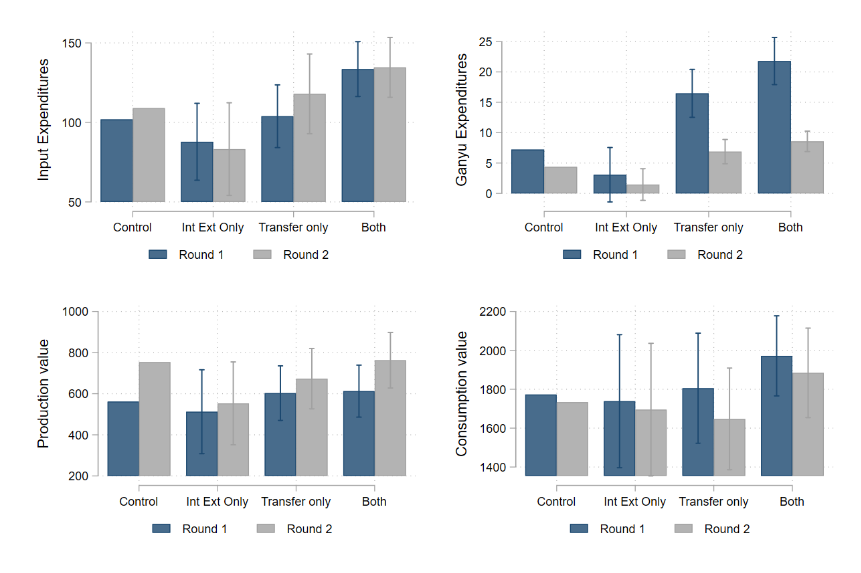
In the first year of the programme, farmers who received transfers (cash or inputs) invested significantly more in their farms than control group farmers. This investment was concentrated on labour expenditures. Transfer recipients substantially increased expenditures on hired day labour (ganyu), which drove up production of the programme's focal crops, soy, and groundnuts – gains that persisted into years two and three, after the transfers had ended. However, transfers alone did not translate into gains in the total value of crop production. Farmers who only received transfers reallocated their input expenditures towards the focal cash crops without increasing the overall scale of their agricultural operation.
Extension services alone, without transfers, produced more limited effects. Farmers who received intensive extension in the absence of resource transfers gained knowledge and improved their management practices, but lacked the financial resources to act on that knowledge at the scale required to meaningfully shift production.
Figure 1: Follow-up survey impacts
Complementarities between transfers and intensive extension
Farmers who received both transfers and intensive extension services had larger gains than farmers who received either component alone. They exhibited gains in agricultural investment and focal crop production and, moreover, increased total agricultural production and household consumption. We document clear complementarities, as the returns to addressing both constraints were higher than the additive effect of addressing the two components independently.
Extension services provide farmers with knowledge about how to use their land and inputs more effectively, but these results suggest that this knowledge has limited value without the resources to implement it. At the same time, transfers provide resources, but resources invested without detailed knowledge about optimal practices may not be used as efficiently. In this context, when both are provided together, farmers invest more, produce more, and have higher living standards as a result.
These complementarities last even after programming ends. Two and three years after the transfers were given out and one and two years after the extension concluded, farmers who had received the bundled intervention continued to outperform those who received only one component. Investment, production, and consumption remained elevated, suggesting that the combined intervention generated durable changes in farmers' practices and productive capacity.
Policy implications: Beyond technology to enabling factors
These results contribute to an evidence base that indicates that policymakers should consider multiple constraints affecting the productivity of smallholder agricultural producers. Policymakers are likely looking to catalyse the adoption of technologies that can help smallholder livelihoods stay resilient to increased weather variation brought on by climate change and meet changing food demand driven by urbanising consumers. At the same time, our work also highlights the importance of looking beyond
technology adoption to enabling factors such as labour constraints. Receiving transfers allowed farmers to access additional labour for their farms, and additional workers were the primary mechanism through which transfers, amplified by improved management of this labour, translated into higher crop production. This increased use of hired labour has the potential to have additional effects beyond simply improving production. Workers in the local labour market could benefit from the increased demand for casual labour, while the ability to hire workers can also offer other household members the opportunity to pursue opportunities off farm. In doing so, our research adds to the evidence base on how best to address multiple constraints to increasing production and improve smallholder welfare.
References
Ambler, K, A de Brauw, and S Godlonton (2020), “Cash transfers and management advice for agriculture: Evidence from Senegal,” The World Bank Economic Review, 34(3): 597–617.
Ambler, K, A de Brauw, and S Godlonton (2026), “Transfers, information and management advice: Direct effects and complementarities in Malawi,” Journal of Development Economics, 178: 103601.
Caldwell, R, R Lambert, J Magruder, C McIntosh, and T Suri (2019), “Improving agricultural extension and information services in the developing world,” VoxDev.
Deutschmann, J W, M Duru, K Siegal, and E Tjernström (2025), “Relaxing multiple agricultural productivity constraints at scale,” Journal of Development Economics, 174: 103409.
Fink, G, B K Jack, and F Masiye (2020), “Seasonal liquidity, rural labor markets, and agricultural production,” American Economic Review, 110(11): 3351–3392.
Jones, M, F Kondylis, J Loeser, and J Magruder (2022), “Factor market failures and the adoption of irrigation in Rwanda,” American Economic Review, 112(7): 2316–2352.
Suri, T, C Udry, J C Aker, C B Barrett, L Falcao Bergquist, M Carter, L Casaburi, R Darko Osei, D Gollin, V Hoffmann, T Jayne, N Karachiwalla, H Kazianga, J Magruder, H Michelson, M Startz, and E Tjernstrom (2024), “Agricultural technology in Africa,” VoxDevLit, 5(2).
Wollburg, P, T Bentze, Y Lu, C Udry, and D Gollin (2024), “Crop yields fail to rise in smallholder farming systems in Sub-Saharan Africa,” Proceedings of the National Academy of Sciences, 121(21): e2312519121.