




Thirty years after South Africa created its Truth and Reconciliation Commission, its legacy remains contested. New evidence shows why: the TRC helped bring Black South Africans closer together, but also deepened the divide between Black and White communities, with consequences for segregation and affirmative action.
Editor’s note: The authors have made slides available here.
When societies emerge from conflict, dictatorship, or institutionalised oppression, rebuilding trust among groups that have been divided by violence can prove challenging: national settlements are unlikely to endure unless they are matched by changes in local intergroup relations, prejudice, and trust (Hultman and Mousa 2025). Truth and Reconciliation Commissions (TRCs) have become one of the most prominent responses to this challenge (Hayner 2011). Rather than relying solely on criminal trials, they document abuses, give victims public recognition, and create a shared account of the past. Yet evidence on whether they actually reduce division remains thin (Gibson 2004, Wiebelhaus-Brahm 2010, Cilliers et al. 2016).
South Africa’s TRC is perhaps the best-known example of this. Established after apartheid, it invited victims to testify publicly about human rights abuses, while perpetrators could apply for amnesty in exchange for full disclosure (TRC Final Report 1998). Internationally, it is often credited with helping South Africa avoid civil war; domestically, however, its legacy remains contested, especially because racial inequality and segregation have persisted (Wilson et al. 2001).
In recent work, we study whether South Africa’s TRC strengthened social cohesion, and whether those effects later shaped economic policy (Gautier, Horta Saenz, and Russo 2026). We find that the TRC reduced violence and built national identity among Black South Africans, but also made the country more racially segregated, while making firms more likely to dodge redistribution obligations.
South Africa’s multiple divides
Apartheid created a racial hierarchy between White and Black South Africans. The White minority controlled political power, economic resources, and access to better schools and jobs, while Black South Africans were excluded from representation, confined to under-resourced areas, and subjected to state repression. This system entrenched inequalities across racial lines, which survive to this day: South Africa remains one of the most unequal countries in the world, with estimates suggesting that the earnings of Black South Africans are only a fraction of those of White South Africans (Czajka and Gethin 2025).
But apartheid also fragmented the Black population itself. Through forced removals, ethnic homelands, and divide-and-rule strategies, the regime encouraged Black South Africans to identify with separate ethnic ‘nations’. These divisions contributed to violence, especially during the transition to democracy. These overlapping legacies left deep mistrust, contested identities, and a history of violence that democracy alone could not dissolve; the TRC was thus established to confront these challenges.
Radio reception created differential exposure to the TRC
The main instrument by which the TRC reached all South Africans was the live broadcast of its hearings on Radio 2000, making it one of the most mediated public events ever to take place in Africa (Verdoolaege 2005). Yet measuring the TRC's impact remains difficult, as communities that tuned in more may have already differed in politics, history, or social conditions. As a result, simple comparisons across areas with different levels of exposure to Radio 2000 could confound the effects of the TRC with preexisting local differences.
We addressed this by exploiting an accident of landscape. Hills, valleys, and mountains blocked or amplified radio waves across South Africa; as a result, some places received stronger broadcasts for reasons unrelated to local politics or social conditions (Olken 2009, Yanagizawa-Drott 2014, Yang et al. 2026). We reconstructed these signal patterns using technical data on antennas and terrain, comparing areas with stronger and weaker exposure to live TRC broadcasts. Because this variation reflected geography rather than people's choices, it allowed us to identify the TRC's causal effects. In practice, we compare outcomes in areas with stronger and weaker terrain-driven exposure to Radio 2000, as well as baseline local characteristics.
We link this variation (Figure 1) to several outcomes that capture different dimensions of reconciliation and its consequences: violent events to measure conflict, Afrobarometer surveys to measure identity and attitudes, and census records to measure interethnic and interracial marriage as well as residential segregation. We then combine TRC transcripts with survey data to study mechanisms and use administrative tax records to examine whether changes in social cohesion shaped firms' responses to race-based affirmative action policies.
Figure 1: Map of Radio 2000 TRC exposure
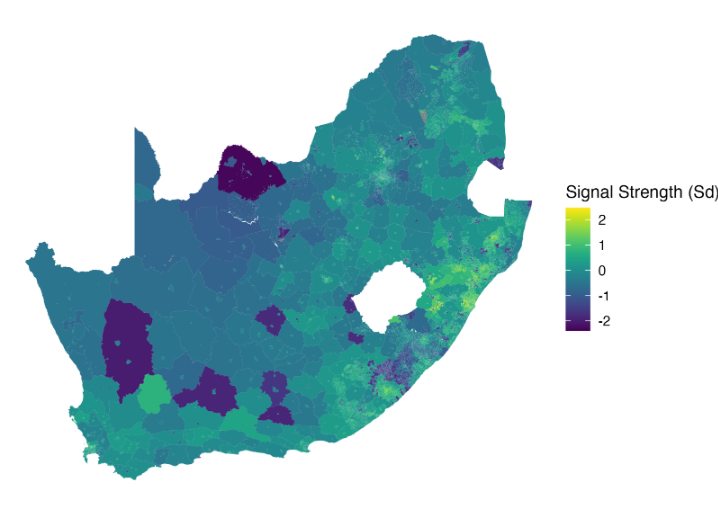
Note: Radio signal strength varied across South Africa partly because terrain blocked or amplified broadcasts.
The TRC brought Black South Africans together
The clearest evidence of reconciliation appears within the Black population. Areas more exposed to live TRC broadcasts experienced lower levels of violence after the hearings began. The effect persisted for roughly a decade, and deaths from violent events also declined: localities that received a higher quality signal had around 2 percentage point fewer violent events in the years following TRC inception (Figure 2). This reduction came mainly from lower interethnic violence within the Black population. Survey evidence points in the same direction: Black South Africans in areas more exposed to the TRC were more likely to identify primarily as South African rather than with their ethnic group. They were also less likely to describe their own group as ‘the best’ or ‘very different’ from others.
Figure 2: Effect of TRC exposure on the log number of violent events per municipality relative to 1996
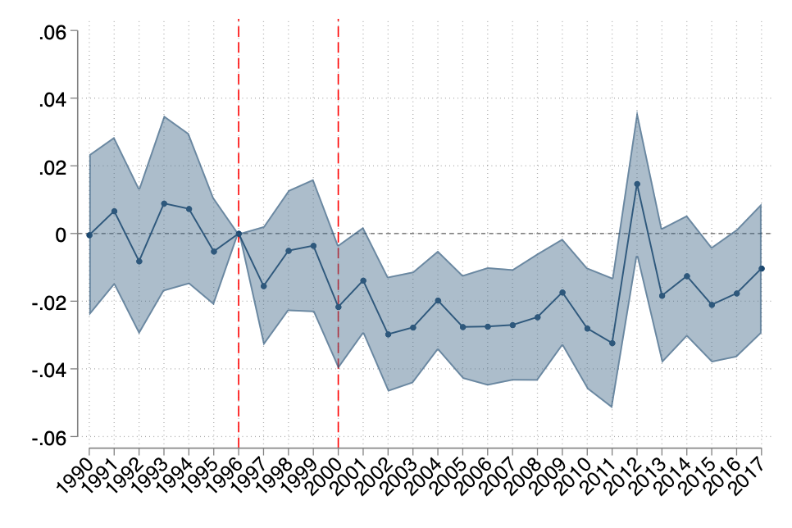
Notes: The right dashed line marks 2000, when hearings ended. Violence in high-exposure municipalities declines during the TRC period and remains lower for over a decade.
But racial divides intensified
These are meaningful changes in a country still emerging from apartheid, yet they did not extend evenly across South Africa’s other major divide. While the TRC softened divisions within the Black population, it hardened the racial boundary between Black and White South Africans (Figure 3). Using census data from 1996, 2001, and 2011, we find that areas more exposed to the TRC became more racially segregated over time. Black and White South Africans became less likely to live in integrated local areas, with a dissimilarity index 4 percentage points lower by 2011 relative to less exposed areas. Interracial marriages also declined by 0.3 percentage points, a sizable number in a country where only 2% of couples were marrying across racial lines in 2011.
Within the Black population, the opposite happened. Interethnic marriage increased by nearly 1 percentage point, again a sizable number given that only 12% of under-30 couples had spouses of different races in 2011. And ethnic residential segregation declined by 2 percentage points. The pattern is not one of general withdrawal from other groups. Rather, the TRC appears to have redrawn the boundaries of belonging: ethnic boundaries among Black South Africans weakened, while the racial boundary between Black and White South Africans strengthened.
Figure 3: Two divides, two effects
(A) Segregation (B) Intermarriage
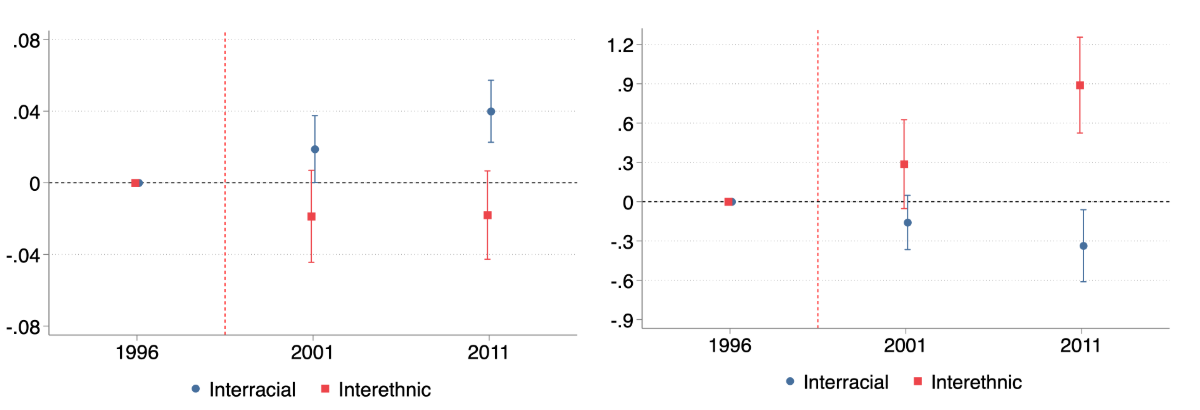
Notes: TRC exposure reduced divisions within the Black population, but increased distance between Black and White South Africans. Coefficients represent the effect of TRC exposure on segregation (Panel A) and the share of intermarriages (Panel B).
Live testimony delivered results, via emotion
Why did the TRC produce these asymmetric effects? One possibility is information: the hearings may have revealed facts about apartheid-era violence. Another is emotional engagement: live testimony may have turned known suffering into a shared public experience. Our evidence points mainly to emotion: during the amnesty hearings, both Black and White perpetrators testified. As a result, Black respondents became more likely to view the TRC as important for national unity when hearings featured Black rather than White perpetrators. This remained true even when the perpetrator and respondent belonged to different Black ethnic groups, suggesting that the effect was broader than narrow ethnic identification. This interpretation is consistent with evidence from other settings in which mediated narratives changed intergroup relations by making outgroups more vivid and human (Siddique et al. 2024).
The content of the hearings helps explain why. Black perpetrators often described violence within Black communities, used more violent language, and expressed more remorse and reconciliation language. Responses were also strongest in places with more local apartheid-era victims, where people were likely already familiar with the facts of repression. If new information was the main mechanism, effects should have been weaker in such places. Instead, live testimony seems to have mattered because it created emotional recognition and collective meaning. This matters for policy as truth commissions not only transmit facts, but stage facts publicly. Their emotional power can support healing, but it may not speak to all audiences in the same way.
Reconciliation shaped affirmative action
The social effects of the TRC also had economic consequences. After apartheid, South Africa introduced Broad-Based Black Economic Empowerment, a central affirmative action policy designed to redress racial inequalities in ownership, employment, training, and procurement. Firms above a key revenue threshold faced stronger incentives to comply, especially if they wanted access to public contracts.
Using administrative tax data from 2008 to 2018, we find that firms in areas more exposed to the TRC were more likely to remain just below this threshold. They were also less likely to grow past it over time. This pattern does not appear at other revenue cutoffs, suggesting that firms were avoiding affirmative action obligations rather than simply growing more slowly. These results suggest that the social effects of reconciliation can shape the implementation of future redistributive policies. In areas where the TRC increased racial separation, firms appear to have been more reluctant to cross into a regulatory category associated with stronger racial inclusion requirements. Restorative justice and redistribution were therefore not separate policy domains: the first changed the social conditions under which the second operated.
Reconciliation and redistribution should be designed together
South Africa’s TRC defies easy verdict. It reduced violence and strengthened national identification among Black South Africans, but also contributed to racial retrenchment, with consequences for social integration and affirmative action. Reconciliation, this suggests, is not a single national outcome; instead, it operates across specific identity boundaries. A truth commission may heal one cleavage while sharpening another, or even make it more salient.
For policymakers, three implications follow:
- Truth commissions should be designed with explicit attention to which divisions they are likely to address.
- The medium matters: live, emotional testimony is not equivalent to a written report.
- Reconciliation and redistribution should not be treated as separate stages. In unequal societies, truth-telling without credible material transformation may make later redistribution harder.
Truth commissions remain among the most important tools available to societies emerging from violence. The South African example shows why they matter, and why their design must account not only for the truth they reveal, but for the identities they reshape.
References
Cilliers, J, O Dube, and B Siddiqi (2016), "Reconciling after civil conflict increases social capital but decreases individual well-being," Science, 352: 787–794.
Gautier, T, D Horta Saenz, and G Russo (2026), "Nation-building through restorative justice," STEG Working Paper.
Gibson, J L (2004), "Does truth lead to reconciliation? Testing the causal assumptions of the South African Truth and Reconciliation process," American Journal of Political Science, 48: 201–217.
Hayner, P B (2011), Unspeakable Truths: Transitional Justice and the Challenge of Truth Commissions, 2nd ed., Routledge, New York.
Hultman, L, and S Mousa (2025), "From ceasefire to cohesion: An integrated review of peacemaking and peacebuilding," Economic Policy, 40(124): 931–967.
Olken, B A (2009), "Do television and radio destroy social capital? Evidence from Indonesian villages," American Economic Journal: Applied Economics, 1: 1–33.
Siddique, A, M Vlassopoulos, and Y Zenou (2024), "Leveraging edutainment and social networks to foster interethnic harmony," CEPR Working Paper No. 19034.
TRC Final Report (1998), Truth and Reconciliation Commission of South Africa Report, Volume 1, Truth and Reconciliation Commission of South Africa, Cape Town.
Verdoolaege, A (2005), "Media representations of the South African Truth and Reconciliation Commission and their commitment to reconciliation," Journal of African Cultural Studies, 17: 181–199.
Wiebelhaus-Brahm, E (2010), Truth Commissions and Transitional Societies: The Impact on Human Rights and Democracy, Routledge, London.
Wilson, R A, et al. (2001), The Politics of Truth and Reconciliation in South Africa: Legitimizing the Post-Apartheid State, Cambridge University Press.
Yanagizawa-Drott, D (2014), "Propaganda and conflict: Evidence from the Rwandan genocide," Quarterly Journal of Economics, 129: 1947–1994.
Yang, D, A Saia, A Kovvuri, R Ahmed, and P Brimble (2026), "Ancient epics in the television age: Religious identity and the rise of Hindu nationalism in India," Unpublished manuscript.