





Cold snaps increase domestic violence in the Peruvian Highlands by reducing agricultural income. Policies that improve households’ resilience to agricultural income losses can help mitigate this effect.
Editor’s note: For a broader synthesis of themes covered in this article, check out our VoxDevLit on Climate Adaptation. The authors have made slides available here.
Intimate Partner Violence (IPV) is a persistent and widespread problem, directly affecting one in four women globally (World Health Organization 2025), with profound consequences. Beyond the immediate physical and emotional harms, IPV also worsens health, reduces earnings, and contributes to intergenerational cycles of abuse (Adams et al. 2024, Campbell et al. 2002, Ehrensaft et al. 2003). For all these reasons, it is crucial to understand the conditions that increase vulnerability to IPV, and the programmes and policies that can reduce it.
Research shows that heightened stressors – economic, social, environmental, and the like – can increase IPV (Bhalotra et al. 2025, Díaz and Saldarriaga 2023, Erten and Keskin 2024). In the US, Henke and Hsu (2020) estimate that a 10-degree Celsius increase in the maximum daily temperature corresponds to an 8% increase in physical assaults against women. But what about on a cold day? Cold presents a serious hazard, especially in low-income communities; annually, ten times as many people die from cold exposure than from heat (Zhao et al. 2021). Even so, there has been minimal research to date on the comprehensive effects of the cold on violence.
In new work (Bollman, Chakraborty, Lakdawala, and Nakasone 2026), we measure the effect of cold exposure on IPV in the Peruvian Highlands. The Peruvian Highlands both are susceptible to cold temperatures and also experience high rates of IPV. In our sample of over 55,000 ever-partnered women surveyed between 2010 and 2018, nearly 70% reported that they experienced some form of IPV (including physical, sexual, or emotional aggression, or control issues) in the prior 12 months. When focusing on physical, sexual, or emotional violence, the proportion remains starkly high at one in five women surveyed.
Linking data on women’s experiences of violence to weather
Using GPS coordinates, we link this data (obtained from the Peruvian DHS) to local hourly temperature data from the European Centre for Medium-Range Weather Forecasts. This linked data allows us to identify the extent of each woman’s exposure to extreme cold in the year prior to her interview. We measure cold exposure by the ‘cumulative degree hours’ in which the temperature drops below a harmful threshold. This is calculated by adding up both the number of hours in which the temperature fell below a harmful threshold, and how far below the threshold it fell. So, for a threshold of -9°C, either two hours at -10°C or one hour at -11°C would produce 2 cumulative degree hours of extreme cold exposure.
While some places and months of the year are apt to get colder than others, after controlling for these and other factors that differ across areas and time, the precise extent of the cold a woman experiences in a given 12-month period fluctuates almost randomly. By comparing women who lived in the same districts but were interviewed at different times, and thus happened to experience a colder or warmer 12-month period before their interview, we can measure the effect of the cold on IPV.
Cold exposure increases women’s risk of experiencing violence
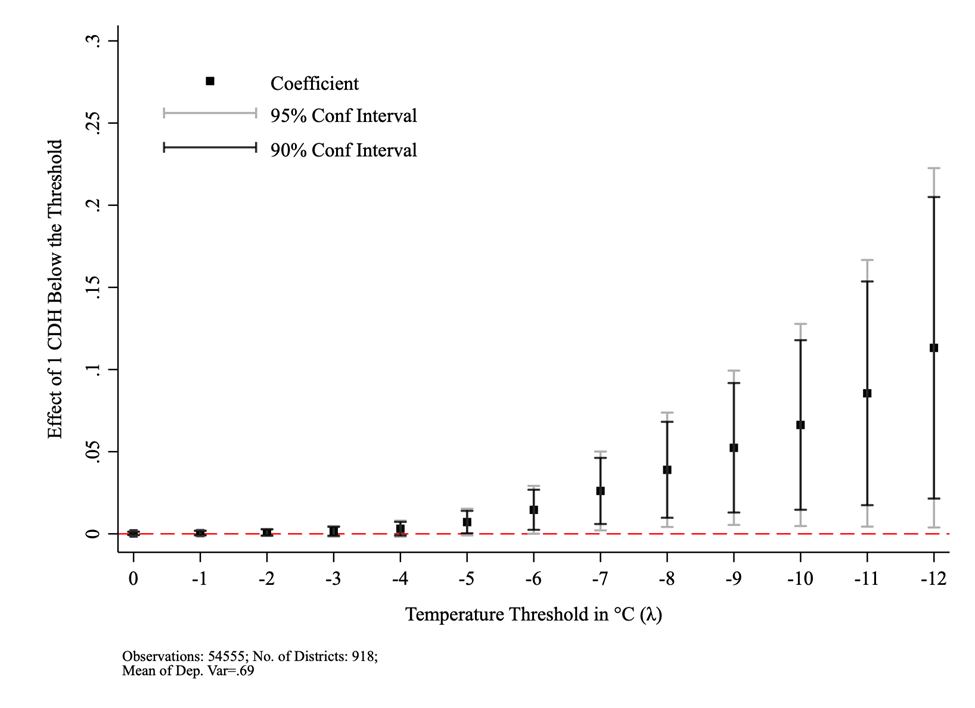
We find that extreme cold increases the prevalence of IPV: 10 ‘degree hours’ below -9°C increase the probability that a woman experiences any form of IPV by 0.5 percentage points, and physical violence by 0.3 percentage points. In other words, less than half a day’s -10°C temperatures throughout the year causes an additional one in 200 women to experience IPV. These effects are slightly smaller than the effect of heat on IPV and commensurate with effects of drought (although it is difficult to directly compare estimates due to differences in measurement and context). Moreover, the increases in IPV grow larger at more severe temperature thresholds (Figure 1) and double when we focus on households who rely on agriculture (whose incomes are more directly affected by cold exposure).
Figure 1: The effect of 1 CDH below various temperature thresholds on intimate partner violence
Reduced agricultural income plays a key role in linking weather to violence
Having shown that extreme cold increases IPV, we next ask why. Potential explanations include that the cold causes women to spend more time inside with their partner, or that extreme cold increases stress by reducing income. To disentangle these explanations, we turn to agricultural income and crop growing cycles. Using household survey data from the ENAHO, we show that cold shocks reduce household income, particularly through lost agricultural revenue when cold shocks take place in the crop growing season. Ten degree hours below -9°C reduce annual agricultural revenue by 1.35%.
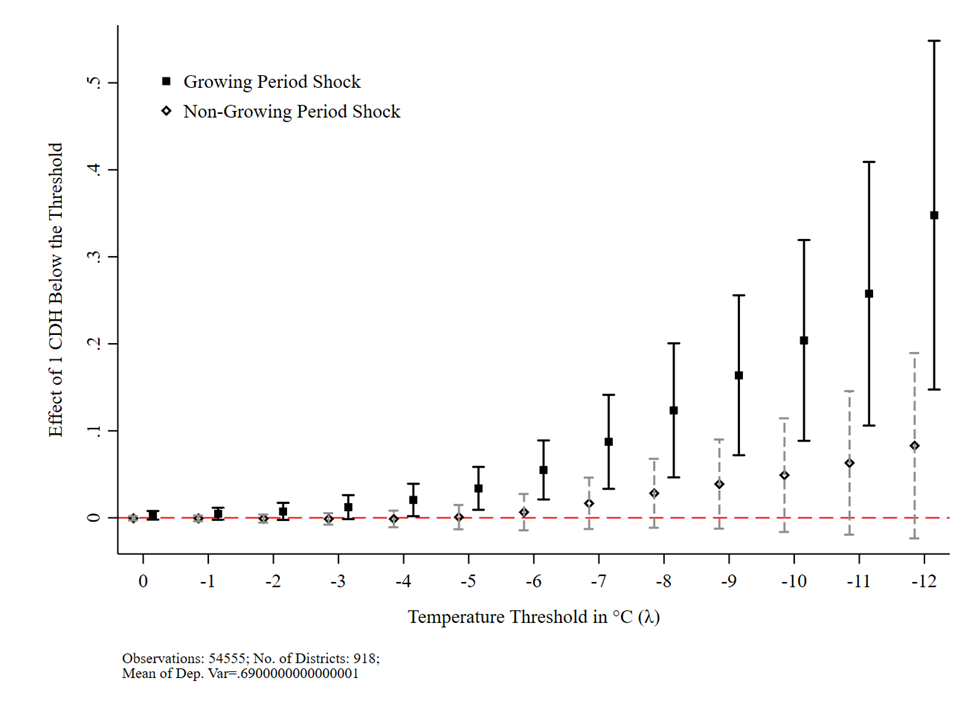
Then, we re-estimate the effects of the cold on IPV, separating cold shocks experienced during and outside the crop growing season. When we do so, we find that cold-induced increases in IPV are heavily concentrated amongst women who experienced cold shocks during the growing season. The probability that women would experience IPV increased by 1.6 percentage points for every 10 degree hours below -9°C that they experienced during the growing season – four times as large as the estimated effect for cold shocks during the rest of the year. From this, we estimate that income shocks account for at least three-quarters of the total increases in cold-induced IPV.
Figure 2: The effect of 1 CDH below various temperature thresholds in and out of the crop growing season on intimate partner violence
Policy can help: Providing households with public support lessens the effects of cold
That cold increases IPV primarily through lost income has relevant policy implications. Programmes designed to ameliorate income losses may offer a path towards limiting the detrimental effects of extreme cold on IPV. Consistent with this, we find that places in Peru with greater access to social programmes – which include income support and other forms of public assistance – attenuate, and in some cases fully eliminate, the observed effects of extreme cold on IPV.
References
Adams, A, K Huttunen, E Nix, and N Zhang (2024), “The dynamics of abusive relationships,” Quarterly Journal of Economics, 139(4): 2135–2180.
Bhalotra, S, D G C Britto, P Pinotti, and B Sampaio (2025), “Job displacement, unemployment benefits and domestic violence,” Review of Economic Studies.
Bollman, K, J Chakraborty, L Lakdawala, and E Nakasone (2026), “Frosty climate, icy relationships: Cold and intimate partner violence in Peru,” Journal of Development Economics, 103710.
Campbell, J C (2002), “Health consequences of intimate partner violence,” Lancet, 359(9314): 1331–1336.
Díaz, J-J, and V Saldarriaga (2023), “A drop of love? Rainfall shocks and spousal abuse: Evidence from rural Peru,” Journal of Health Economics, 89.
Ehrensaft, M K, P Cohen, J Brown, E Smailes, H Chen, and J G Johnson (2003), “Intergenerational transmission of partner violence: A 20-year prospective study,” Journal of Consulting and Clinical Psychology, 71(4): 741–753.
Erten, B, and P Keskin (2024), “Trade-offs? The impact of WTO accession on intimate partner violence in Cambodia,” Review of Economics and Statistics.
Henke, A, and L-C Hsu (2020), “The gender wage gap, weather, and intimate partner violence,” Review of Economics of the Household, 18: 413–429.
World Health Organization (2025), Violence against women prevalence estimates 2023: Global, regional and national prevalence estimates for intimate partner violence against women and non-partner sexual violence against women, WHO.
Zhao, Q, Y Guo, T Ye, A Gasparrini, S Tong, A Overcenco, A Urban, A Schneider, A Entezari, A M Vicedo-Cabrera et al. (2021), “Global, regional, and national burden of mortality associated with non-optimal ambient temperatures from 2000 to 2019: A three-stage modelling study,” Lancet Planetary Health, 5(7): e415–e425.