



COP30 presents an ambitious agenda for advancing climate goals amid unprecedented global uncertainty. How can the economic evidence covered on VoxDev since COP29 – on biodiversity, agriculture, cities, health, and renewables – and the subsequent gaps, help shape more effective policymaking?
In the run up to this year’s conference, it has been announced that COP30 aims to “inaugurate a framework capable of mobilizing all actors and efforts to accelerate the implementation of what has already been negotiated.” With a focus on six key themes that cover efforts on mitigation, adaptation, finance, technology, and capacity-building.
In advance of COP29 last year, we released a blog on the economic evidence necessary to support effective climate policy. Since then, there has been considerable research on the implications of climate change for developing countries – much of which has been covered on VoxDev. How can this evidence be used to guide policymaking at COP30, and where do the evidence gaps remain?
Figure 1: COP30's six thematic axes
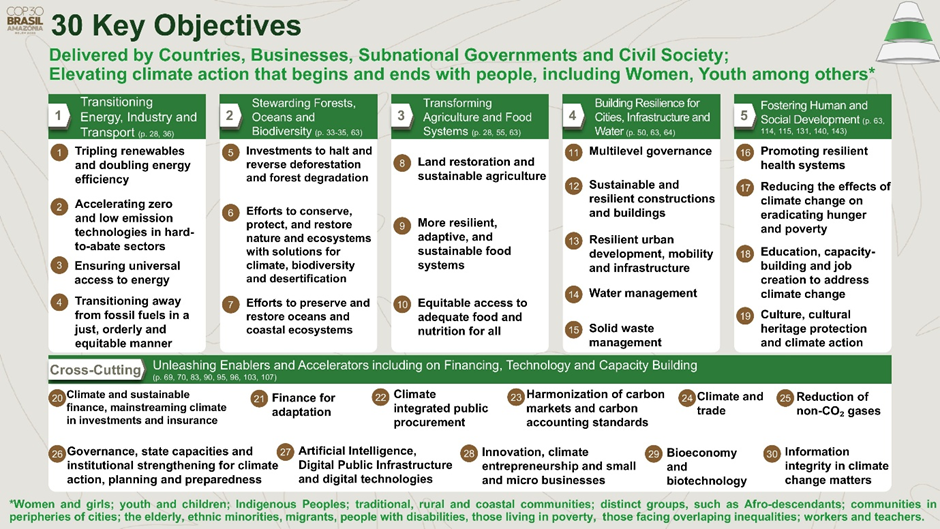
Source: COP30 (2025).
Stewarding forests, oceans, and biodiversity
It goes without saying that the consequences of biodiversity loss on economies and human well-being are immense. Efforts to curb deforestation rates have been especially challenging, while the extinction risks for numerous species rise as the policy response fails to keep pace (Costa et al. 2025, Taylor and Weder 2024).
Evidence on VoxDev emphasises the need to align incentives between various economic actors. For example:
- High external debt levels have forced ecologically rich nations to exploit their natural resources to generate revenue. Debt-for-nature swaps offer a promising solution – allowing countries to reduce debt obligations in exchange for commitments to conservation efforts – but remain challenging to implement in practice (Kumar 2025).
- Infrastructure expansion into forests substantially degrades biodiversity. However, involving forest-dependent communities in project planning can help mitigate species loss (Madhok 2025). For instance, in India, the large-scale transfer of political power to historically Scheduled Tribes has significantly enhanced forest conservation (Gulzar et al. 2024).
Our recent VoxDevLit on Deforestation further highlights the importance of market-based instruments such as conservation payments and land-use taxes – which can be very cost-effective and generate large welfare gains. Where these are infeasible, sectoral policies targeting the major drivers of deforestation (such as cattle ranching) can capture most of the same benefits (Costa et al. 2025).
Transforming agriculture and food systems
Climate change risks permanently degrading agriculture and, with it, global food systems. Evidence from Colombia suggests that weather shocks are exacerbating the prevalence of small farms, lowering agricultural productivity in the process (Arteaga et al. 2025). Similarly, in Nigeria, farms in proximity to gas flaring sites have experienced significant reductions in agricultural productivity – with those within 20 km of these sites suffering drops of up to 61% (Nwokolo 2025).
It thus comes at no surprise that the International Food Policy Research Institute (IFPRI) is calling for an urgent need to strengthen resilience across the entire food system – from prevention to response (Swinnen and Menon 2025). Evidence suggests that AI-driven early warning systems are effective in predicting food crises up to 12 months in advance (Balashakar et al. 2023). While results are promising, more research is needed to ensure the survival of food systems worldwide.
Building resilience for cities, infrastructure, and water
Cities are at the forefront of climate change: not only are urban areas responsible for 70% of global CO2 emissions, with infrastructure contributing largely, but also bear high costs from extreme weather events (UN n.d.).
Accountability matters, as evidenced in China by a city-level public rating system on pollution violations that enhanced regulatory efforts and improved air quality (Liu et al. 2025). Continued research on urban adaptation strategies is thus not only critical for quality of life in cities but for climate change mitigation more generally as well (Kahn and Zheng 2024).
Fostering human and social development
Pollution has a host of consequences for health, especially infants:
- In-utero exposure to microplastics are lowering birthweights, with pronounced effects in Africa and South Asia (Du et al. 2025).
- E-waste dumping in Ghana and Nigeria is also contributing to infant mortality, likely through water contamination and air pollution from burning this waste (Lovo and Rawlings 2024).
- Hazardous waste dumping near roads in Ethiopia is similarly resulting in infant deaths (Gennaioli and Narciso 2025).
Transiting energy, industry, and transport
Of the five main themes of COP30, the one with the most open questions is that relating to renewable energy, zero and low emissions technologies, and universal access to energy.
Despite the enthusiasm for the global energy transition, without adequate funding it remains highly unlikely in developing countries. In India, for instance, Anant Sudarshan notes that fossil fuel infrastructure would require substantial buyouts to decommission early (Bearak et al. 2025). And, in the age of aid cuts, adaptation will increasingly need to be funded via domestic sources such as corporate taxes, CSR spending, or carbon markets.
Although the costs of renewable energy have fallen dramatically in the last decade, many forms still remain unaffordable in developing countries (Ritchie et al. 2023). Despite this, evidence from Senegal suggests that third-party certificates and warranties can substantially increase consumers’ willingness to pay for high-quality solar lamps (Coville et al. 2025).
Source: Ritchie et al. (2023).
Unleashing enablers and accelerators including on financing, technology and capacity building
The final theme of COP30 identifies several cross-cutting issues concerning developing countries, such as trade, emissions reduction, and technological innovation.
For example, though the US, China, and EU are paving the way for the future of climate policy, this may come at the cost of trade opportunities for developing countries – highlighting the crucial balance policy must achieve between the environmental benefit and economic risk (Aldaz-Carroll et al. 2024).
What do we know about carbon offset programmes? Evidence suggests that Clean Development Mechanism (CDM) programmes in India and China have enabled some countries to ‘cheat’ on their Nationally Determined Contributions (Calel et al. 2025, Chen et al. 2025). These large-scale CDM programmes thus effectively subsidise carbon reductions that would have happened anyway, pointing to a crucial design flaw that must be rectified immediately (and ideally during COP30).
Climate change also presents an opportunity for innovation, particularly in the private sector. In China, rising temperatures have spurred innovation in climate adaptation and mitigation technologies (Long and Wang 2025). In Bangladesh, researchers find that training brick kiln owners and workers to stack bricks more efficiently not only reduces pollution but also boosts their bottom line (Brooks et al. 2025).
References
Aldaz-Carroll, E, E Jung, M Maliszewska, and I Sikora (2024), “Global ripple effects: Knock-on effects of EU, US, and China climate policies on developing countries’ trade,” World Bank.
Arteaga, J, N de Roux, M Gáfaro, A Ibáñez, and H S Pellegrina (2025), “Farm size distribution, weather shocks, and agricultural productivity,” Unpublished manuscript.
Balashankar, A, L Subramanian, and S P Fraiberger (2023), “Predicting food crises using news streams,” Science Advances 9(9): eabm3449.
Bearak, M, A Sudarshan, and J Seddon (2025), “Climate, capital, and conscience: Who will pay for the global energy transition?,” VoxDev.
Brooks, N, D Biswas, S Maithel, G Miller, A Mahajan, M R Uddin, S Ahmed, M Mazab, M Rahman, and S P Luby (2025), “Reducing emissions and air pollution from the informal sector: Evidence from Bangladesh,” Science 388: eadr7394.
Calel, R, J Colmer, A Dechezleprêtre, and M Glachant (2025), “Do carbon offsets offset carbon?,” American Economic Journal: Applied Economics 17(1): 1–40.
Chen, Q, N Ryan, and D Xu (2025), “Firm selection and growth in carbon offset markets: Evidence from the Clean Development Mechanism,” Unpublished manuscript.
COP30 (2025), “Action agenda.”
Costa, F, A Hsiao, H Pellegrina, and E Souza-Rodrigues (2025), “Deforestation,” VoxDevLit 18(1), September.
Coville, A, J Graff, A Reichert, and A-K Reitmann (2025), “Quality signaling and demand for renewable energy technology: Evidence from a randomized field experiment,” Journal of Development Economics 176: 103514.
Du, X, S Zhang, and E Zou (2025), “Marine microplastics and infant health,” NBER Working Paper 33094.
Gennaioli, C, and G Narciso (2025), “Toxic roads,” Environmental and Resource Economics 88(6): 1773–1803.
Gulzar, S, A Lal, and B Pasquale (2024), “Representation and forest conservation: Evidence from India’s scheduled areas,” American Political Science Review 118(2): 764–783.
Kahn, M, and S Zheng (2025), “How the urban environment can adapt to climate change,” VoxDev.
Kumar, P (2025), “Is debt leading to the unsustainable exploitation of natural resources?,” VoxDev.
Liu, M, M T Buntaine, S E Anderson, and B Zhang (2025), “Transparency by Chinese cities reduces pollution violations and improves air quality,” Proceedings of the National Academy of Sciences 122(14): e2406761122.
Long, X, and Z Wang (2025), “From heat to high-tech: How innovation responds to climate change,” Journal of Development Economics 103525.
Lovo, S, and S Rawlings (2024), “The health burden of e-waste: The impact of e-waste dumping sites on child mortality,” World Bank Economic Review lhae053.
Madhok, R (2025), “Infrastructure, institutions, and the conservation of biodiversity in India,” Journal of the Association of Environmental and Resource Economists 12(6).
Nwokolo, A (2025), “Gas flaring threatens agriculture and livelihoods in Nigeria,” VoxDev.
Ritchie, H, P Rosado, and M Roser (2023), “Energy,” Our World in Data.
Swinnen, J, and P Menon (2025), “Food policy: Lessons and priorities for a changing world,” VoxDev.
Taylor, M S, and R Weder (2024), “On the economics of extinction and possible mass extinctions,” Journal of Economic Perspectives 38(3): 237–260.
UN (n.d.), “Cities and climate change.”