







Field experiments in Lima, Peru show that correcting social misperceptions and sending SMS reminders can significantly boost recycling participation.
Many countries around the world are facing a growing waste crisis (UNEP 2024). Rapid urbanisation, rising consumption, and limited waste management capacity have led to increasing volumes of solid waste, much of which is not properly collected, treated, or recycled. This poses serious environmental and public health risks, particularly in low- and middle-income countries where municipal systems are often under strain and financial capacities are limited.
A key challenge for policymakers is that effective waste management does not depend on infrastructure alone – it also requires active participation from households. Many environmental policies, therefore, depend on citizens doing their part. In the context of waste management, this means households separating their waste, participating in recycling programmes, and complying with collection systems. Yet participation in municipal recycling programmes often falls short, even when public support for environmental protection is high (Knickmeyer 2020).
Why does this gap between intentions and actions persist? And what can policymakers do to close it?
Evidence from two field experiments in Lima, Peru, suggests that the answer lies in addressing two simple but powerful behavioural barriers: i) misperceptions about what others think and do, and ii) limited attention and lack of sustainable habits in everyday life. Together, these studies show how low-cost behavioural interventions can significantly increase participation in recycling programmes, first, by targeting misinformed households with norm-correction messages (Fuhrmann-Riebel et al. 2024) and second, by sending mobile text reminders (Fuhrmann-Riebel et al. 2026).
People may support recycling, but still don’t act
In many cities, recycling programmes struggle with low participation. A natural explanation may be that people do not care enough about the environment. Yet this assumption is often wrong. Our research shows that the problem often lies elsewhere: people may want to recycle but are held back by misperceptions and everyday frictions.
In our first study (Fuhrmann-Riebel et al. 2024), we show that in Lima, Peru, only 12% of households participated in a voluntary municipal recycling programme, despite 97% of residents believing that recycling was important. Moreover, participation in the programme had been steadily increasing over time (doubled from 6% to 12% over the last three years). Still, many residents underestimated how strongly others supported recycling and how quickly participation was increasing.
This creates a classic collective action problem. People may hesitate to participate if they believe that others are not doing so, even if support is widespread and participation is growing.
Correcting social misperceptions can unlock participation
Our field experiment tested whether correcting people’s misperceptions about high social approval (the ‘injunctive norm’) and the positive trend in recycling rates could encourage households to sign up for the recycling programme.
We split households into four groups:
- Control: A control group that did not receive any information
- Injunctive: A group that received information that most residents approved of recycling
- Trend: A group that learned that participation in the programme had doubled in recent years
- Combined: A group that received both messages
At first glance, the results appear rather modest: on average, the information campaign did not increase sign-ups. However, looking more closely reveals a very different story: the intervention was effective, but only among those who held inaccurate beliefs. Among households that underestimated the social approval or participation trend, sign-ups to the recycling programme increased substantially. The more people underestimated these norms, the larger the effect of the intervention on sign-ups. In contrast, individuals who already had accurate beliefs did not change their behaviour.
Figure 1: Variation in average sign-up decisions between people who under- or overestimate the positive trend
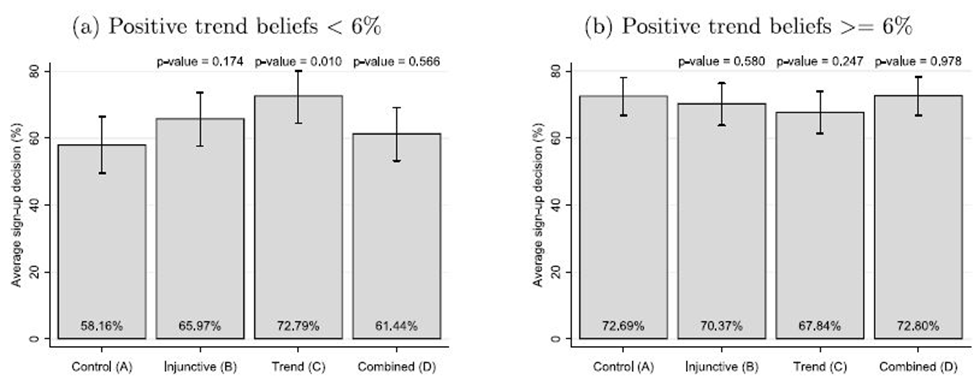
Notes: The figure shows how people who underestimate the positive trend in recycling rates in Panel (a) are significantly more likely to sign up to the recycling programme when they learn about the positive trend in the Trend treatment compared to people in Panel (b) who overestimate the trend.
This finding highlights an important lesson: information campaigns are not universally effective – they work when they correct incorrect beliefs. If people already know that others support recycling, telling them again has little impact. However, when people underestimate social support or momentum, correcting that misperception can unlock participation, even if current participation levels are still low.
Good intentions are not enough – reminders can help to follow through
In a second field experiment (Fuhrmann-Riebel et al. 2026), we addressed a different challenge. Even when people are motivated to recycle, another barrier remains: limited attention and cognitive overload in everyday life.
Recycling requires effort and attention: remembering collection days, sorting waste in the household throughout the week, and taking the recycling bags out at the right time. These small frictions can prevent people from acting on their pro-environmental intentions. People may simply forget about it if they lack well-established recycling routines.
In our field experiment, we examined whether simple mobile text reminders could help overcome this barrier. We randomly assigned households already enrolled in the recycling programme to receive SMS reminders at different frequencies over a nine-week treatment period, which we split into three distinct periods of three weeks each. We then tracked households’ weekly recycling behaviour over those periods of three weeks. Households were split into four groups:
- Control: A control group that did not receive any reminders
- Continuous: A group that received reminders continuously for the nine weeks
- Interrupted: A group that received reminders only for the first three weeks
- Restarted: A group that received reminders for the first and last three weeks, with three weeks pause in between
The results were clear: reminders significantly increased recycling activity. Importantly, the effects were strongest when reminders were repeated over time. As a result of our intervention, more households began recycling, and those who already recycled did so more frequently. Our findings showed that reminder effects emerged earlier among households that already recycled previously, and that new recyclers required prolonged reminder exposure to begin recycling. Sustained reminders helped households establish routines, suggesting that they may support habit formation in recycling practices.
Figure 2: Proportion of households that recycled at least once per period, by treatment
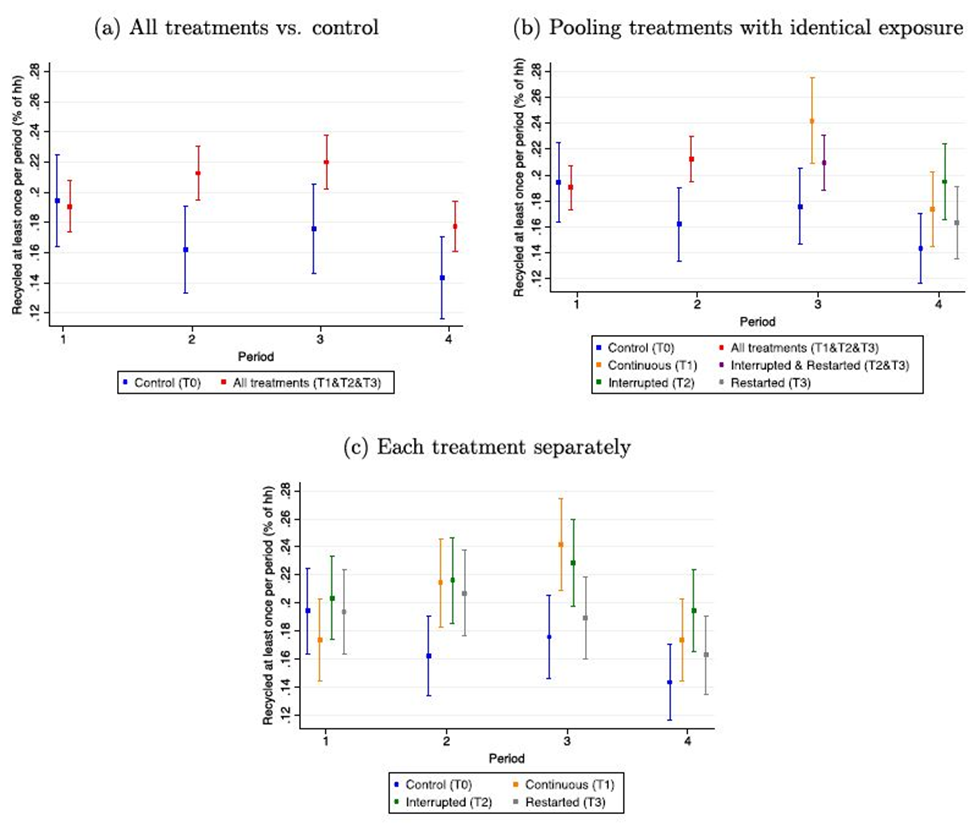
Notes: The figure shows how recycling levels are rather similar during the baseline period (period 1), while recycling levels in the treatment groups increase significantly compared to the control group in the treatment periods from period 2 onwards. Figure 2(a) pools all treatment groups together; Figure 2(b) pools treatments with identical reminder exposure; Figure 2(c) shows all treatments separately.
Two barriers, two solutions
Taken together, our research shows that low participation in environmental programmes is not driven by a single problem, but by multiple behavioural barriers. Some people do not act because they misjudge what others think or do. Others fail to act because they forget or lack established routines.
Each barrier requires a different solution:
- Misperceptions à Correct with targeted information
- Limited attention or missing routines à Address with repeated reminders
This distinction matters for policy design. A one-size-fits-all approach, such as a general awareness campaign, may miss the mark if it does not address the underlying constraint.
Designing smarter, more effective environmental policies
What do these findings imply for policymakers? Based on our research, we derive the following policy recommendations:
- If possible, measure beliefs before designing information campaigns. If people already know that recycling is socially supported, generic messaging will have little effect. Instead, policymakers should identify and target groups that underestimate prevailing norms or behavioural trends.
- Highlight positive social change. Communicating that participation is increasing can create momentum and encourage individuals to join emerging collective action, even when current participation is still low.
- Use digital tools to support behaviour. SMS reminders are inexpensive, scalable, and highly effective in promoting regular pro-environmental behaviour and support the establishment of sustainable habits.
- Combine interventions. Targeted information can motivate people to start recycling, while reminders help them continue. Together, they address both motivation and follow-through and can support long-lasting behavioural change.
In the context of growing environmental pressures, leveraging such low-cost tools can be an important step toward more effective and inclusive climate and environmental policy.
References
Fuhrmann-Riebel, H, B D'Exelle, K López Vargas, S Tonke, and A Verschoor (2024), "Correcting misperceptions about trends and norms to address weak collective action – experimental evidence from a recycling program," Journal of Environmental Economics and Management, 128: 103046.
Fuhrmann-Riebel, H, B D'Exelle, K López Vargas, S Tonke, and A Verschoor (2026), "Can reminders promote regular pro-environmental behavior? Experimental evidence from Peru," World Development, 203: 107369.
Knickmeyer, D (2020), "Social factors influencing household waste separation: A literature review on good practices to improve the recycling performance of urban areas," Journal of Cleaner Production, 245: 118605.
UNEP (2024), "Global waste management outlook 2024: Beyond an age of waste – turning rubbish into a resource."