





Political elites don’t just govern, many also own businesses. In Mozambique, public office is often converted into private business capital, highlighting how political power can be a direct route to economic influence, both for office holders and their families.
In many countries, the perceived divide between political elites and ordinary citizens appears to be widening – at times sparking outrage. In Nepal, recent attacks on official buildings and residences were driven by a complaint that 'politicians get rich while we suffer' (Parajuli et al. 2025). Similar protests have taken place in East Timor, Bangladesh, Sri Lanka, Indonesia, Kenya and Nigeria – mainly led by young people.
Of course, it is hardly news that some politicians use their influence for personal advantage. However, how they do so varies: beyond illegal bribes and backhanders, a rather modern – but often legal – form occurs when politicians or their families act as beneficial owners of private firms (e.g. as partners or directors), which in turn can benefit from political favours. For instance, the ‘Luanda Leaks’ from Angola detailed many ways in which businesses owned by the former president’s daughter benefited from her father’s patronage (Freedberg et al. 2020).
Politician-firm connections can also be highly valuable. For example, Fisman (2001) documents that concerns about the health of former Indonesian President Soharto led to large declines in the share prices of firms connected to his family. In India, political connections helped firms navigate the economic crisis following demonetisation (Chen et al. 2025).
Despite the importance of this issue, identifying and tracking the business interests of politicians can be hard. This is especially the case in low-income countries, where public information on firm performance is patchy and asset registers function poorly. As such, concerns about undue political influence in the private sector are frequently driven by anecdotes or scandals, rather than systematic evidence.
In new work, we circumvent these challenges using public registry data from Mozambique (Jones, Schilling, and Tarp forthcoming). We link the owners of all firms formally incorporated in the country since its independence to a bespoke list of politically exposed persons. This allows us to quantify the impact of holding political office on various metrics of their business capital.
Mozambique’s economic history
After gaining independence from Portugal in 1975, Mozambique's new leaders adopted a state-led (socialist) development model. This approach was unsuccessful, prompting a shift to a market economy in 1987, which involved the privatisation of state-owned enterprises. Mirroring developments in some post-Soviet Bloc contexts, these privatisations led to a new form of political influence over the economy. Directing privatisation to benefit its (top) political cadres, the ruling Frelimo party sustained control over key business sectors. As one piece put it: “business networks and the ruling Frelimo party have been closely interweaved for decades, leading to a risk of insider trading at all levels of power … [and giving] the Mozambican ruling class an air of a set of political-trading dynasties” (Indian Ocean Newsletter 2007).
Studying politically connected firms in Mozambique
To investigate these concerns, we constructed a unique dataset spanning over four decades (1975-2019), merging two key data sources:
- The universe of all formally registered firms in Mozambique taken from the official government gazette (the Boletim de República), which includes the names of the firms’ beneficial owners (natural and non-natural persons).
- A newly compiled list of politically exposed persons (PEPs), defined as individuals who have held high-level executive or political positions within the ruling party (Frelimo), which has been continuously in power since Independence.
To measure the returns to political office, we focus on various metrics of what we call ‘private business capital’, measured at the individual level. In addition to simple indicators of the number of firms in which a given person holds an ownership interest, as well as the real value of their equity investments, we construct the network of ties between firm owners. This allows us to assess the structural position of individuals within the firm network.
Based on the network of connections, we estimate each firm owner’s information capital (decay centrality), which captures the ability of an individual to send or receive valuable information across the network. We also calculate their brokerage capital (godfather centrality), which measures the extent to which they effectively broker relationships across business owners.
Politicians – and their families – gain privately
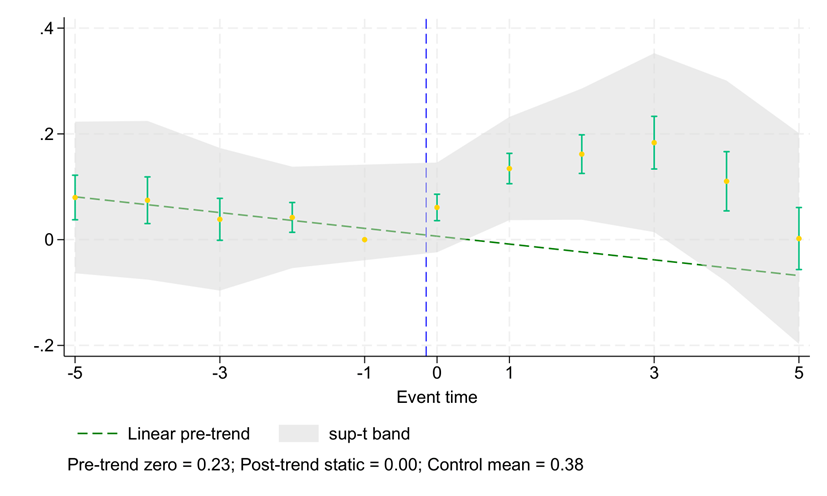
We implement a generalised event study analysis, controlling for individual-level and time fixed effects (as well as other controls). We find that becoming a PEP leads to a 24% increase in the likelihood of firm ownership and a 350% gain in their information capital (Figure 1). The latter gains are also particularly persistent, continuing beyond the period of holding office.
Figure 1: Event study results
(a) Dummy variable for being a firm owner
(b) Information capital (decay centrality)
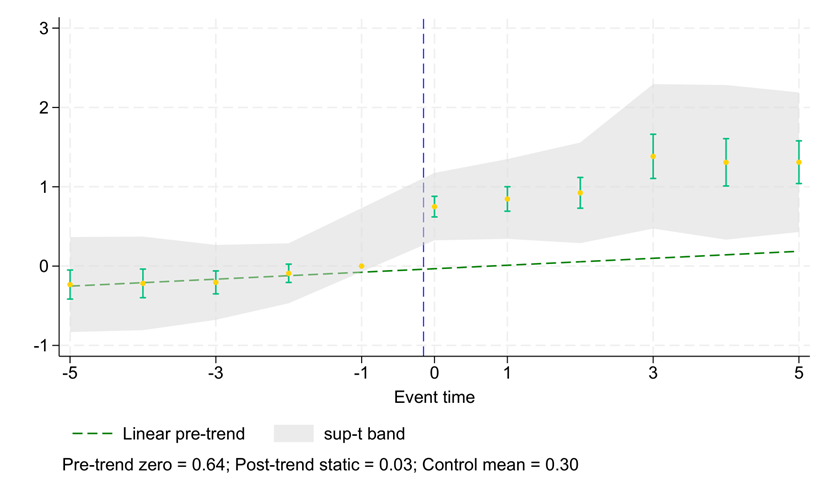
Notes: Figures plot dynamic (cumulative) event study coefficients relating to the fraction of each period an individual holds a political mandate (currently is a PEP); dependent variables are (a) being a firm owner, and (b) information capital, adjusted via a log-like transform; dots are point estimates and spikes are 95% confidence intervals; the dashed line is the linear pre-trend; grey shading is the sup-t (joint) confidence band; event time reflects panels of 5 years; time zero is the current period.
These results appear to be highly robust. We also document significant, though smaller, spillover effects among family members. Relatives of officeholders – proxied by sharing surnames and controlling for family sizes – appear to be more likely to become business owners and hold more equity capital, even when they do not themselves occupy political office. These results show that the business advantages of political power are not limited to individual incumbents, but extend to political families, suggesting the accumulation of economic influence has dynastic features.
Are politically connected firms important?
Our econometric results rigorously document the presence of close connections between the private and public sectors in Mozambique. Yet, this does not establish whether this phenomenon is material in a more aggregate sense, nor does it indicate whether it is a bug or a feature of the country’s developmental trajectory. Arguably, many of today’s high-income countries displayed somewhat similar tendencies in their not-too-distant past. Examples include the plutocratic tendencies of 19th century New York (Bridges 1982) and the role of Chaebols in South Korea (Caiden 1993).
To further investigate this, we took a firm-level view, estimating the distribution of firms with political connections across different sectors. As summarised in Table 1, we see that firms with political connections are indeed substantial – accounting for almost 10% of the cumulative equity investment in the private sector since independence. Furthermore, we find PEPs are relatively concentrated in sectors that tend to be more dependent on location-specific rents and financial intermediation, suggesting they may be leveraging privileged information or regulatory advantages.
Table 1: Firms established and registered in Mozambique (1975–2019), by sector
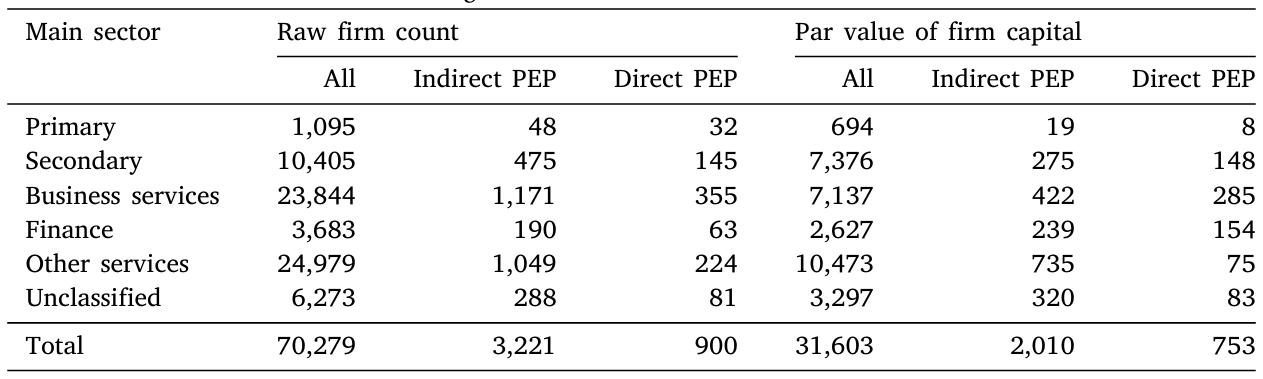
Note: Table reports information on the universe of firms established and registered in Mozambique from 1975–2019; columns indicate total firm counts and the cumulative sum of initial start-up capital values, stated in constant millions of MZN; sub-columns classify by: all firms, firms which have a family member of a PEP as an owner (indirect PEP), and firms which have a direct PEP as an owner.
Policy implications: Political interference in the private sector
One takeaway of our analysis is that the risk of political interference in the private sector remains high in Mozambique. While involvement of politicians in businesses is not necessarily illegal, entrepreneurs or investors without political connections may be at a disadvantage, undermining competition or raising pressures to invest in political rents. More broadly, we show that public registries – of firms, suppliers and license holders – can be used for political economy analysis. Indeed, quantifying the political connectedness of firms is feasible, even in data scarce contexts.
Our evidence points to several avenues for policy. While data on beneficial ownership exists, it is not easy to use. Enhanced transparency and inter-operability of different registries can reduce information asymmetries, support enforcement efforts, and discourage opaque deals. In this regard, building the capacity of civil society and investigative media to analyse registry data can complement state oversight, raising reputational costs for abuse of public office. Together, these can help level the playing field for businesses, curb rent-seeking, and promote a healthier investment climate.
References
Bridges, A B (1982), “Another look at plutocracy and politics in antebellum New York City,” Political Science Quarterly 97(1): 57–71.
Caiden, G E, and J H Kim (1993), “A new anti‐corruption strategy for Korea,” Asian Journal of Political Science 1(1): 133–151.
Chen, Y, G Chiplunkar, S Sekhri, A Sen, and A Seth (2025), “How do political connections of firms matter during an economic crisis?,” Journal of Development Economics 103471.
Fisman, R (2001), “Estimating the value of political connections,” American Economic Review 91(4): 1095–1102.
Freedberg, S P, S Alecci, W Fitzgibbon, D Dalby, and D Reuter (2020), “How Africa’s richest woman exploited family ties, shell companies and inside deals to build an empire,” International Consortium of Investigative Journalists.
Indian Ocean Newsletter (2007), “Everybody is doing business.”
Jones, S, F Schilling, and F Tarp (2026), “Politicians doing business: Evidence from Mozambique,” Journal of Development Economics 178 (103584) [forthcoming].
Parajuli, R, K Pariyar, and K Ng (2025), “Politicians get rich while we suffer – so I helped bring down our government in 48 hours,” BBC.