




Between 2009 and 2013, several Brazilian states and state capitals adopted strict smoking bans; this was followed by a national-level ban in 2014. Comprehensive bans and strict enforcement were crucial to the effectiveness of these policy efforts.
Editors' note: This column is published in collaboration with the International Economic Association’s Women in Leadership in Economics initiative, which aims to enhance the role of women in economics through research, building partnerships, and amplifying voices.
Smoking remains one of the leading preventable causes of death worldwide (Dai et al. 2022). Governments have implemented a range of policies to curb tobacco use, from cigarette taxes to public smoking bans. But how effective are these measures, especially in low- and middle-income countries?
Brazil’s experience offers important lessons. In recent research (Steffens and Pereda 2025), we examine how strict smoking bans affected smoking behaviour in Brazilian cities. Our findings strengthen the case for implementing well-enforced smoke-free laws to reduce both active smoking and second-hand smoke exposure—especially among young adults.
Why governments intervene: The economics of smoking policy
Tobacco control policies are rooted in correcting market failures. Smoking imposes not only private health risks but also public costs—through increased healthcare spending (direct healthcare cost of US$588 per smoker in Brazil), reduced worker productivity, and harm to others via second-hand smoke. These ‘externalities’ justify interventions such as taxes or public bans.
Cigarette taxes, for instance, are often considered Pigouvian—i.e. they raise prices to account for the social cost of smoking. But the effectiveness of such taxes in curbing behaviour is limited by the inelasticity of cigarette demand: many smokers continue to buy despite higher prices (DeCicca et al. 2022). Moreover, in countries with large informal markets—where untaxed cigarettes are widely available—price increases may simply lead smokers to buy cheaper alternatives.
Bans on smoking in public places offer a complementary approach. By restricting where people can smoke, these laws reduce non-smokers’ exposure and may make smoking less socially acceptable and more inconvenient—especially for younger smokers.
Studying the rollout of Brazil’s smoking bans
Brazil has long been recognised for its leadership in tobacco control. The country ratified the WHO Framework Convention on Tobacco Control in 2005 and subsequently implemented a suite of reforms, including graphic warnings, advertising restrictions, and smoke-free legislation. Between 2009 and 2013, several Brazilian states and state capitals adopted strict smoking bans, prohibiting smoking in all enclosed or partially enclosed public places, and eliminating designated smoking areas. A similar policy was implemented at the national level in 2014. These laws marked a significant shift from partial restrictions to truly comprehensive bans. Our research focuses on this period of staggered adoption, which allows for a comparison between cities that implemented strict bans early and those that had not yet done so, to identify causal effects.
How did smoking bans affect behaviour?
We find that, by 2013, smoking prevalence among young adults (ages 15–29) in cities with strict smoking bans had fallen by 18% relative to similar cities without such bans (Figure 1).
Why focus on young adults? There are two main reasons. First, smoking initiation typically occurs at young ages, making this group more sensitive to policies that alter the social environment. Second, younger smokers—who are less deeply addicted—may be more responsive to changes that increase the inconvenience or social stigma of smoking. Indeed, we find that 60% of the reduction in smoking came from increased cessation among young adults who had started smoking just before the bans were introduced. The remaining 40% was driven by reduced initiation (Figure 1). Moreover, the 18% effect represents more than 147,000 individuals treated by local smoking bans in 2009, resulting in an avoided healthcare cost of $86.6 million in 2015 US dollars.
Figure 1: Effects of smoking bans on smoking behaviour among young adults in Brazil
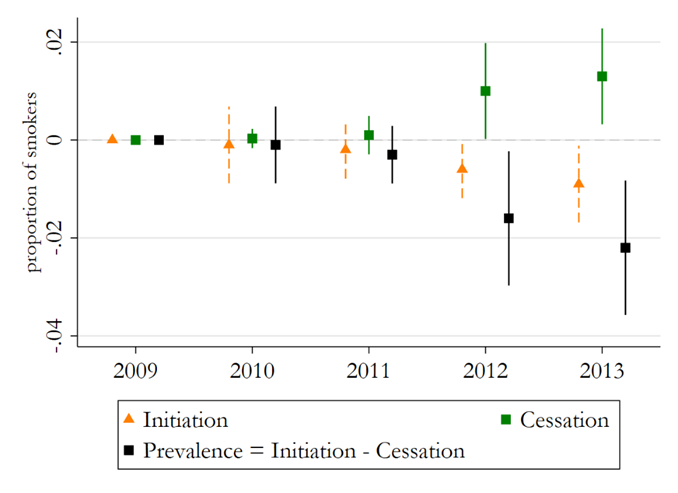
Note: Figure derived from Table 4 of Steffens and Pereda (2025). The reduction in prevalence is 2.2 percentage points, representing an 18% decrease from the baseline prevalence of 12%.
When and where people start smoking
Our data shows that smoking in Brazil often begins before the legal minimum age of 18. In 2013, nearly 73% of smokers had already started by that age (see Figure 2). This suggests that smoking bans may not strongly affect where or when people first try cigarettes—since experimentation often happens in informal, unsupervised settings.
Figure 2: Cumulative distribution of smoking initiation age in Brazil (2013)
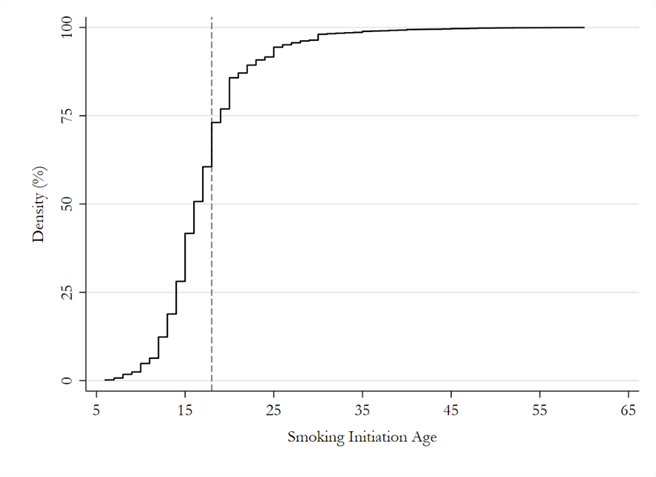
Note: Vertical dashed line indicates age 18.
Do smoking bans work everywhere?
The success of Brazil’s smoking bans depended heavily on enforcement. Cities that actively implemented or ‘highly enforced’ bans–i.e. monitored compliance and applied penalties–saw large reductions in smoking. In contrast, cities with weak enforcement saw little to no change, these had some surveillance but no penalties. This finding matters for policy design: bans need not only to exist on paper but also be backed by clear enforcement mechanisms. In Brazil, this included public campaigns, training for inspectors, and sanctions for noncompliant establishments.
Some previous studies have questioned whether smoking bans actually reduce smoking, or simply push it into private spaces. For example, research on the US found that bans reduced smoking in public but increased smoking at home, potentially harming children through second-hand smoke exposure (Adda and Cornaglia 2010).
However, our results from Brazil suggest that when bans are strictly enforced and well-targeted, they can reduce smoking overall—not just displace it. In addition, other research from Brazil (Da Mata and Drugowick 2024) shows that smoke-free laws led to improved birth outcomes among pregnant women working in the hospitality sector, supporting the conclusion that public exposure declined.
Anti-smoking policy: Lessons for developing countries
Despite facing a disproportionate share of smoking-related harm, many low- and middle-income countries (LMICs) lag behind high-income countries in implementing tobacco control policies. Our research adds to a small but growing body of evidence showing that smoke-free laws can work in LMICs.
In these settings, where tax-based interventions may be undermined by informal markets or weak institutions, smoking bans offer a more direct and enforceable tool. However, as our research highlights, the key to success lies in policy design and implementation—particularly enforcement.
Implications for anti-smoking policy
We recommend the following to policymakers:
- Implement comprehensive bans: smoking restrictions without exemptions or designated smoking lounges are more effective than partial restrictions.
- Target young adults: this group is especially responsive to bans, through both cessation and reduced initiation. However, due to early smoking initiation, enforcement efforts should also focus on areas not typically targeted, such as informal or youth-dominated spaces.
- Ensure strong enforcement: laws need institutional support and monitoring to be effective.
- Adopt complementary policies: measures such as anti-smoking campaigns and access to cessation services can enhance the impact.
Brazil’s case strengthens the argument for smoke-free legislation as a central tool in the fight against tobacco. As more countries consider or revise their tobacco control strategies, these findings offer evidence-based guidance on how to design bans that work.
References
Adda, J and F Cornaglia (2010), “The effect of bans and taxes on passive smoking”, American Economic Journal: Applied Economics, 2(1): 1–32.
Da Mata, D and P Drugowick (2024), “The consequences of health mandates on infant health: Evidence from a smoking-ban regulation”, Journal of Development Economics, 103171.
Dai, X, E Gakidou and A D Lopez (2022), “Evolution of the global smoking epidemic over the past half century: Strengthening the evidence base for policy action”, Tobacco Control, 31(2): 129–137.
DeCicca, P, D Kenkel and M F Lovenheim (2022), “The economics of tobacco regulation: A comprehensive review”, Journal of Economic Literature, 60(3): 883–970.
Steffens, C and P C Pereda (2025), “Dynamic responses to smoking bans: Evidence from young adults in a developing country”, Journal of Development Economics, 174: 103442.