





Policies based on providing information rely on people engaging with it. But how can we design effective information campaigns when people are tempted to ignore them? Evidence from India shows that when people perceive that they have control over outcomes, they are less likely to ignore distressing information.
Editor's note: The authors have made slides available here.
Governments and policymakers frequently use information campaigns to promote desirable behaviour. The expectation is that when people get useful information, they make better decisions and avoid risks to themselves and others. However, there is growing evidence that disagrees with this underlying assumption. When people anticipate receiving particularly bad news, they not only fail to act but deliberately ignore the information. This is problematic and can undermine the effectiveness of information campaigns.
The psychology of strategic ignorance
Research shows that people often avoid information, even when it is free and could improve their decision-making (Golman et al. 2017). Beyond avoidance, people may also choose to forget information they were exposed to (Zimmermann 2020, Huffman et al. 2022). Together, avoidance and forgetting form strategic ignorance, and both have a similar theoretical foundation: people prefer to hold positive beliefs about the future. When bad news threatens these beliefs, people may prefer to ignore it.
Strategic ignorance occurs more often when there are no coping mechanisms to address the underlying problem. And that can be a good thing, as exemplified by recent work on the perils of health screening when treatment is unavailable (Ciancio et al. 2025). But avoidance may also occur when people believe that there is not much they can do, even if that belief is not accurate. An example are the dramatic health risks of air pollution. In particular, in developing countries, air pollution causes catastrophic effects on health and economic productivity, and despite effective coping mechanisms like air purifiers or face masks, private protection against air pollution is not widespread (Chowdhury et al. 2025).
When people learn about the health risks of air pollution, such as a higher risk for pneumonia or lung cancer, they may feel distressed and powerless. If they do not believe they can do much to protect themselves, the information may be ignored. This suggests a potential policy solution: convincing them that protective action is effective.
Perceived control as a solution to strategic ignorance
In new work (Balietti, Budjan, Eymess, and Soldà 2026), we directly test this hypothesis. We study whether increasing perceived control – the belief that one’s actions can influence a specific outcome – reduces strategic ignorance, particularly whether people avoid and forget distressing health information.
Our work is based on an experiment with more than 2,000 participants from across India. Participants received general information about air pollution, including its causes, what illnesses it causes, and how it translates into a life expectancy loss. This last metric is tangible and consequential. While useful for choices like retirement planning and healthcare investments, learning that continuously breathing polluted air shortens one’s life can also be distressing and cause strategic ignorance.
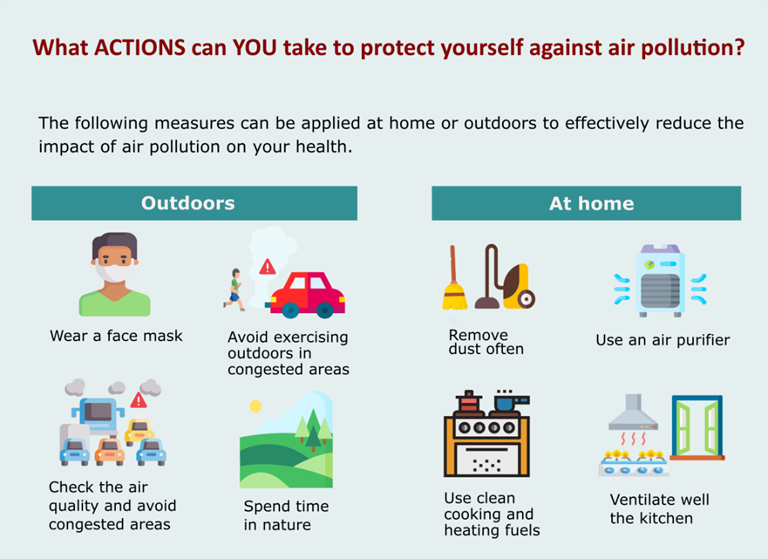
We randomly assigned participants to either a control or treatment group. Those in the treatment group were also presented with specific measures they could implement to protect themselves against air pollution (Figure 1). The goal of the treatment was to increase participants’ perceived control.
Figure 1: Treatment to increase perceived control
We then asked participants whether they wanted to receive personalised information about the life expectancy loss they face due to air pollution in their district. After receiving and studying that information, participants completed an unrelated effort task before being asked to recall the life expectancy loss they had just been informed about. This serves as a test of whether participants strategically forget.
Perceived control reduces strategic ignorance by improving recall
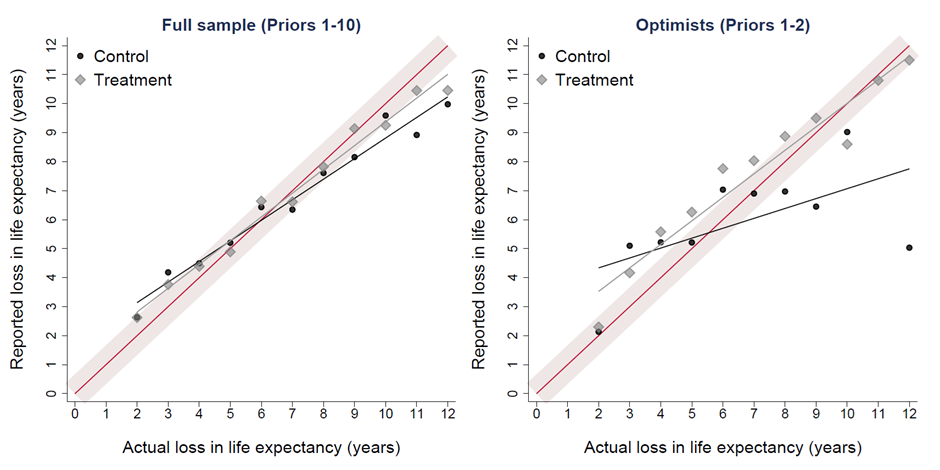
As expected, we find that presenting participants with actionable advice on how to protect themselves against air pollution significantly improved their ability to recall the information about the health risk they are exposed to. The treatment reduced forgetting by about 25%. This effect was strongest among optimists, participants who initially believed that they experience particularly good air quality where they live, regardless of the objective level of pollution. In the control group, 57% of these optimists forget the information, a substantially higher rate of ignorance than among all other participants. The intervention closes this gap as optimists become significantly more likely to recall the information.
Figure 2 illustrates the effect. Especially at a high actual life expectancy loss (the information that participants received), optimists recall values that are too low and consistent with their optimism. The treatment shifts recall towards the red shaded area, indicating an acceptable error margin around the correct recall.
Figure 2: Treatment effect on recall
To test the robustness of our findings, we conducted the same experiment with a sample of more than 2,000 participants from the US and found a similar pattern: optimists in the control group forgot the information at significantly higher rates than others and benefited most from the treatment. This replication highlights that our findings generalise to environments with varying degrees of air pollution.
Why optimists respond most
Why are optimists particularly responsive to the intervention? The intuition is simple: optimists face a trade-off between the psychological benefits of ignoring bad news (and maintaining positive beliefs about the future) and the economic costs of failing to accurately respond to the threat (e.g. suboptimal protective actions). As a result, they are the most likely to ignore the information.
By increasing perceived control, the treatment changes this trade-off. When effective actions are available, the bad news becomes less threatening and the outcome more manageable. Facing the truth is not as costly anymore, thereby reducing the incentives for strategic ignorance.
Policy implications
Our results challenge information campaigns that only focus on conveying the severity of a risk. We show that information about severity alone – without actionable advice – can be ineffective, as people may ignore the information provided. This has direct implications for the design of information campaigns. Policymakers should ensure that health information is paired with actionable advice for managing the associated risk.
The relevance extends beyond health. For example, in areas such as climate change, people are regularly confronted with alarming information, which is both distressing and outside their control. Our work provides a possible explanation for why such information campaigns struggle to induce behavioural change: people may choose to ignore the information. For example, Dechezleprêtre et al. (2025) find that a video about the adverse impacts of climate change largely fails to raise policy support unless people also get information on policies that can mitigate them. They do not go into depth about the underlying mechanism, but strategic ignorance offers a plausible explanation. Without a sense that the situation is manageable, people are not always willing to face the truth about the threat they face.
References
Balietti, A, A Budjan, T Eymess, and A Soldà (2026), "Strategic ignorance and the perceived efficacy of taking action," The Economic Journal, ueag022.
Chowdhury, A, T Garg, M Jagnani, and M Mattsson (2025), "Misbeliefs, experience, and technology adoption: Evidence from air purifiers in Bangladesh," Unpublished manuscript.
Ciancio, A, F Kämpfen, H-P Kohler, et al. (2025), "Surviving bad news: Health information without treatment options," American Economic Review: Insights, 7(1): 1–18.
Dechezleprêtre, A, A Fabre, T Kruse, B Planterose, A Sanchez Chico, and S Stantcheva (2025), "Fighting climate change: International attitudes toward climate policies," American Economic Review, 115(4): 1258–1300.
Golman, R, D Hagmann, and G Loewenstein (2017), "Information avoidance," Journal of Economic Literature, 55(1): 96–135.
Huffman, D, C Raymond, and J Shvets (2022), "Persistent overconfidence and biased memory: Evidence from managers," American Economic Review, 112(10): 3141–3175.
Zimmermann, F (2020), "The dynamics of motivated beliefs," American Economic Review, 110(2): 337–363.