



Radio programmes targeted at women in post-war Japan increased women’s political participation and accelerated fertility decline, but had limited impact on labour market outcomes where structural barriers persisted.
In recent years, war has returned to the centre of global attention. This has renewed interest in how societies rebuild after conflict, and how periods of reconstruction reshape political and social inclusion. In these moments, questions about integrating previously marginalised groups move from long-run goals to immediate policy concerns. Women’s empowerment is widely seen as central to long-run economic development (Duflo 2012), and international frameworks such as the Women, Peace, and Security agenda (UNSCR 1325) explicitly position women’s inclusion as a core component of post-conflict peacebuilding. Yet policymakers still face difficult choices about how to turn these commitments into effective policies on the ground.
One potentially powerful policy tool is mass media. A growing body of research shows that media exposure can shape attitudes and behavioural outcomes, sometimes with positive effects and sometimes with harmful ones, including in developing-country contexts (e.g. Jensen and Oster 2009, Olken 2009, La Ferrara et. al 2012, Yanagizawa-Drott 2014, Blouin and Mukand 2019). These findings suggest that mass communication may offer a scalable way to influence behaviour, raising the question of how such tools operate in post-conflict reconstruction, particularly in reaching marginalised groups.
In new research (Okuyama 2026), I study women-targeted radio programmes in Occupied Japan (1945–1952) and show that they increased women’s political participation and accelerated fertility decline, but had no effect on women’s employment, highlighting both the potential and the limits of mass media as a tool for post-conflict empowerment.
Women-targeted radio was an early occupation policy
After World War II, the Allied Occupation prompted a major shift in women’s legal and social status in Japan. One of the occupation’s five core reform directives explicitly aimed at raising the status of women. GHQ/SCAP viewed Japan’s prewar patriarchal system as a contributing factor to militarism and prioritised women’s empowerment as a key component of its peacebuilding strategy.
GHQ/SCAP saw changes in women’s attitudes and behaviour as central to this effort, and radio was one of its earliest policy tools. Beginning on October 1, 1945, the US-led authorities launched radio programmes targeted at women, with the aim of challenging prewar gender roles that women had largely internalised under that system. A textual analysis of GHQ/SCAP Weekly Radio Reports shows that these programmes focused on three areas: women’s political participation, economic rights, and bodily autonomy. The broadcasts explained women’s newly granted voting rights, encouraged independent voting, discussed labour laws and workplace rights, and addressed issues such as marriage choice, birth spacing, and maternal health. The programmes were produced jointly by American and Japanese women, allowing the content to be adapted to local language and social contexts rather than imported unchanged.
Radio signal strength created natural variation in listenership
The central question is whether women’s radio programmes empowered women. But in contexts where women faced strong social constraints, listening to radio may have been more feasible for women who were already more empowered. This makes simple comparisons misleading. To address this issue, I digitise historical maps of radio antenna locations and signal strength across Japan during the occupation (Figure 1). These maps were constructed using then state-of-the-art radio wave measurement technology introduced from the US. I combine this information with district-level radio listenership data drawn from the state-owned radio licensing system, along with other district-level statistics.
Figure 1: Original map of the radio signal strength
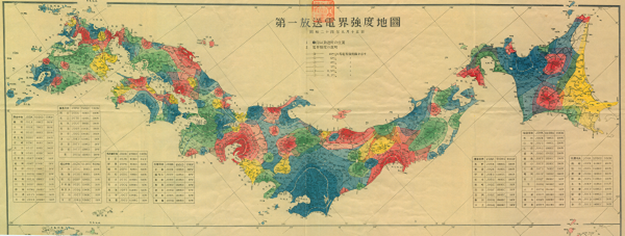
The assembled data allowed me to compare districts with similar characteristics that were equally distant from the same radio antenna but happened to receive stronger or weaker signals due to geological conditions. I show that signal strength strongly predicts radio listenership. Because signal strength was driven by geography rather than local demand, it creates variation in radio listening that is not tied to women’s pre-existing attitudes. I use this variation to examine how increased radio listenership affected women’s political, labour market, and fertility outcomes. In statistical terms, this is an instrumental variable approach.
Women who listened to radio became more politically engaged and had fewer births
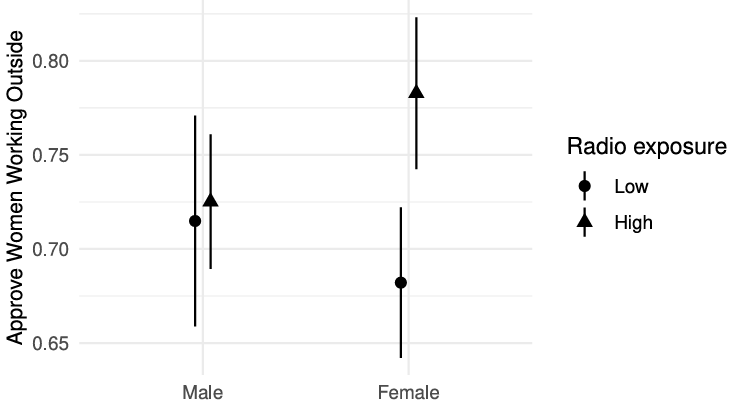
Figure 2 shows how the radio programmes worked, though this evidence is suggestive due to data limitations. Women who reported more frequent radio listening were more likely to endorse egalitarian gender views, whereas men’s views did not differ across levels of radio exposure. This pattern is consistent with the policy’s design: the radio programmes targeted women and sought to shift gender norms that women had internalised under the prewar system. The absence of corresponding changes in men’s attitudes further suggests that the broadcasts primarily affected women’s own beliefs rather than broader social norms.
Figure 2: Radio listening and gender norms by sex
When turning to behavioural outcomes, for which more credible evidence can be assembled, I find that women who listened to radio became more politically engaged. Exposure to women’s radio programmes increased women’s turnout in the first post-war election, when women were allowed to vote for the first time. Districts with stronger radio signals also saw higher vote shares for female candidates, translating into greater female representation in the national legislature. Simple counterfactual calculations suggest that, without radio exposure, women would have accounted for only 5.3% of elected candidates, compared with the actual 8.2%. These findings suggest that empowerment not only increased women’s participation but also that their votes mattered for electoral outcomes.
Women who listened to radio also had fewer births. This period marked the onset of Japan’s fertility transition from high prewar levels, following a brief post-war baby boom. My findings suggest that radio messages accelerated this transition. The decline was not driven by increased abortions or simple delays in childbearing, but likely reflected a reduction in lifetime fertility. Birth outcomes matter because they have important implications for women’s health.
By contrast, women’s labour force participation did not respond to radio listening. This may reflect post-war labour market conditions and the persistence of male-dominated workplace norms. It also points to a limitation of the radio policy: the campaigns targeted women but did not directly address men’s attitudes, suggesting that one-sided messaging may be insufficient to change some structural barriers.
Taken together, these findings show that mass media can shift norms and behaviour during periods of institutional flux, but also reveal clear limits. Media-based interventions appear most effective for outcomes driven by individual beliefs and choices, and less so where behaviour depends on changes in institutions or the broader economic environment.
Local partnerships were likely critical for the mass media campaign to work
My findings also speak to broader debates about the effectiveness of foreign-sponsored mass media in post-conflict reconstruction. Informational outreach to populations marginalised under the previous regime can reshape norms and attitudes that had been internalised prior to institutional change and that may otherwise continue to constrain behaviour.
Meanwhile, these findings should not be read as a blanket endorsement of foreign media intervention, nor as an argument for promoting gender equality through military occupation. Drawing on archival evidence and historical accounts, Japan’s experience instead suggests that foreign-sponsored media is more likely to be effective when marginalised groups themselves have meaningful autonomy in content production, and when interventions are implemented through locally embedded partnerships. In this case, collaboration between American and Japanese women allowed messages to be shaped, adapted, and contested rather than imposed. Designing media interventions as collaborative rather than unilateral projects may therefore be critical for their legitimacy and impact in post-conflict settings.
References
Blouin, A, and S W Mukand (2019), “Erasing ethnicity? Propaganda, nation building, and identity in Rwanda,” Journal of Political Economy, 127: 1008–1062.
Duflo, E (2012), “Women empowerment and economic development,” Journal of Economic Literature, 50: 1051–1079.
Jensen, R, and E Oster (2009), “The power of TV: Cable television and women’s status in India,” Quarterly Journal of Economics, 124: 1057–1094.
La Ferrara, E, A Chong, and S Duryea (2012), “Soap operas and fertility: Evidence from Brazil,” American Economic Journal: Applied Economics, 4: 1–31.
Okuyama, Y (2026), “Empowering women through radio: Evidence from occupied Japan,” Journal of Development Economics, 179: 103620.
Olken, B A (2009), “Do television and radio destroy social capital? Evidence from Indonesian villages,” American Economic Journal: Applied Economics, 1: 1–33.
Yanagizawa-Drott, D (2014), “Propaganda and conflict: Evidence from the Rwandan genocide,” Quarterly Journal of Economics, 129: 1947–1994.