


Myanmar’s 2016 mining moratorium substantially reduced violent conflict by cutting off armed groups’ access to resource rents and pushing workers into alternative livelihoods, demonstrating that deliberately restricting poorly governed extractive activity can be an effective tool for peacebuilding in fragile, resource-rich settings.
Natural resource extraction is an important source of income for many low- and middle-income countries, but it also increases the risk of violent conflict. High-value resources generate large rents that are often captured by elites or armed groups, providing both a prize worth fighting over and a source of financing for violence. A large body of research has established that expanding extraction leads to more violence (Collier and Hoeffler 2004, Fearon 2003, Ross 2006, Berman et al. 2017, Crost and Felter 2020). Yet a critical question remains unanswered: What happens to conflict when governments attempt to restrict mining activity?
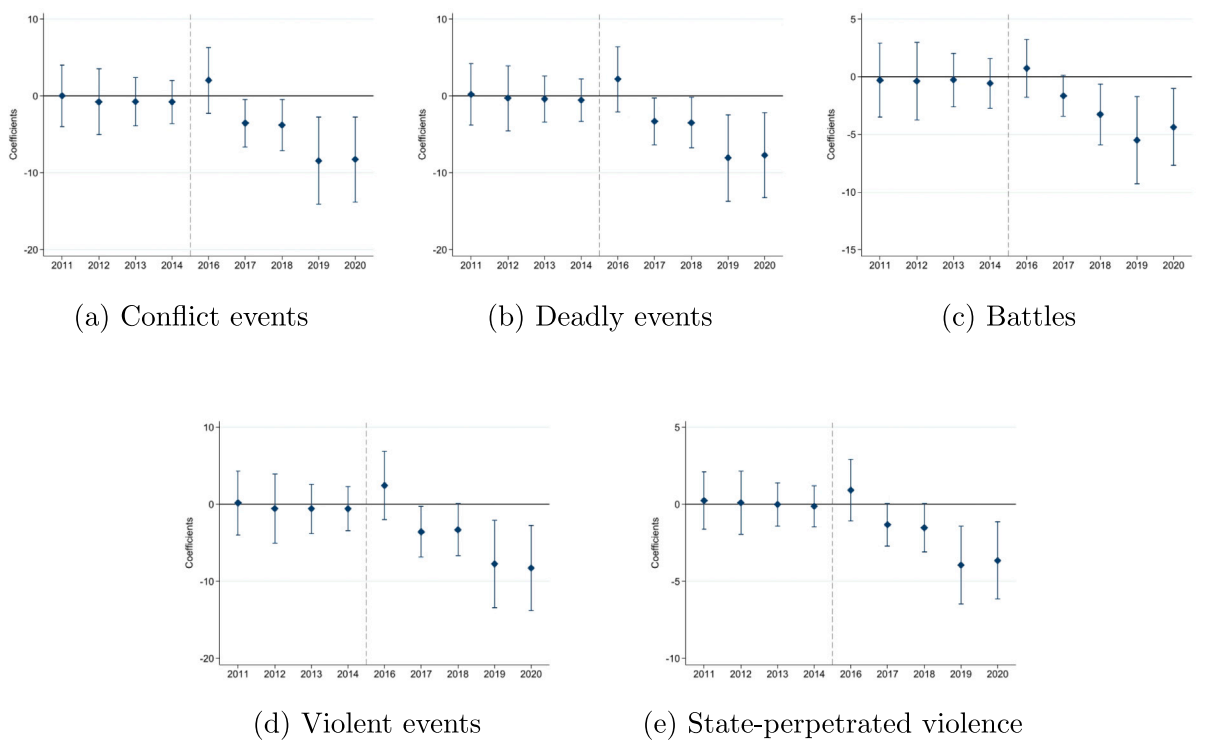
In new research (Sandi 2026), I examine Myanmar’s 2016 mining moratorium, which restricted new licences in an effort to promote more responsible mining. Comparing townships with and without mining licences over the period 2010 to 2020, I find that the mining ban is associated with a 69% reduction in conflict events in mining areas. The effects are concentrated in extreme forms of violence such as armed battles, deadly attacks, violent incidents, and state-perpetrated violence. The results suggest an important symmetry in the resource-conflict relationship: just as resource booms fuel violence, deliberate contractions of poorly governed extractive activity can reduce it by a comparable magnitude.
These findings highlight an overlooked opportunity for resource governance in fragile states. Where extraction revenues flow to elites or armed groups rather than benefiting local populations, and where conflict imposes severe social costs, contractions in extractive activity can improve welfare and serve as a potential tool for peacebuilding in mining-dependent regions.
Myanmar’s mining ban and civil conflict
To estimate the impact of the mining ban on civil conflict, I use a difference-in-differences (DID) strategy that compares townships with and without mining licenses before and after the mining policy ban. I construct a novel dataset by merging mining license records from Myanmar’s Ministry of Natural Resources and Environmental Conservation (MONREC) with spatially disaggregated conflict event data from the Armed Conflict Location and Event Data Project (ACLED) for 2011–2020. The identification strategy relies on the assumption that mining and non-mining townships would have followed similar conflict outcomes absent the policy change. The parallel trends assumption is supported by visual evidence: conflict trends were similar during 2011-2015, then diverged after the 2016 ban (Figure 1).
How the mining ban reduced conflict
The mining ban reduced conflict through two main channels: by limiting the financing available to armed groups and by shifting workers towards alternative economic opportunities.
First, by lowering rents from valuable commodities, the ban reduced the financial resources available to armed groups, making it harder to sustain violent activity. Consistent with this mechanism, the ban led to a statistically significant decline in the production of high-value minerals such as jade and gold, which represent key sources of extractable rents in conflict areas. Extreme forms of violence – including armed battles – fell immediately after the ban and remained persistent for several years, suggesting a sustained contraction in the economic base that funds violence.
Notably, this mechanism appears to have affected state actors as well. By reducing the value of contested mining areas, the ban likely lowered incentives for rent-seeking or coercive state intervention. Consistent with this interpretation, state-perpetrated violence also declined following the ban, suggesting that reductions in resource rents can constrain state violence just as resource abundance can intensify it.
Second, the ban appears to have shifted local economic opportunities in ways that increased the opportunity cost of joining armed groups. Myanmar’s mining sector was dominated by labour-intensive, small-scale operations operating under short-term licences. When licences expired and were not renewed, many displaced workers moved into agriculture and manufacturing – sectors with lower entry costs and accessible employment opportunities in rural mining areas. Employment data shows rising shares in these sectors two years after the ban, suggesting that alternative livelihoods became more accessible and potentially reduced incentives to participate in violence.
Figure 1: Mining reform and conflict: Event study estimates
Peace spills over to neighbouring areas
The mining ban not only reduced conflict in mining townships but also generated positive spillovers to neighbouring areas. Townships adjacent to mining areas experienced substantial declines in violence, mirroring the pattern observed in directly affected areas.
This spatial pattern is consistent with evidence that resource shocks spill over to neighbouring regions: just as resource expansion pushes violence into surrounding areas (Berman et al. 2017), resource contraction reduces it. When mining activity declined, surrounding areas appear to have lost their strategic value to armed groups – whether as potential extraction sites or supply routes – leading to broader reductions in violence. These findings suggest that well-designed resource governance policies can generate peace benefits extending well beyond directly targeted areas.
Where the ban had the strongest effects
The mining ban’s effects were strongest in ethnic homelands, poorer townships, and more remote areas with fewer roads – places where resource extraction has historically fuelled conflict and local grievances. However, ethnic representation in parliament surprisingly made little difference. Having lawmakers from the same ethnic background as local residents did not amplify the ban’s conflict-reducing impact. This suggests that symbolic representation alone is insufficient; marginalised groups also need real power to shape policy and decision-making.
Implications for mining policy and conflict
The findings offer important implications for policymakers in resource-rich conflict settings. The mining ban substantially reduced extreme violence by disrupting armed group financing, demonstrating that strategic contractions of poorly governed extraction can serve as an effective conflict-reduction tool. At the same time, for countries dependent on resource revenues, outright bans may involve significant fiscal and political trade-offs depending on the governance context.
More broadly, extraction policy is only one component of effective resource governance. The key is not whether extraction occurs, but who controls it and how its benefits are distributed. In Myanmar's case, small-scale mining under short-term licences generated rents that armed groups could easily capture while delivering minimal local development. Temporarily restricting this form of extraction reduced extreme violence without necessarily precluding future, better-governed resource development. This suggests that when governance frameworks are weak, regulatory reform or temporary suspension may be preferable to maintaining output at any cost.
Extraction policies alone, however, are insufficient to sustain peace gains without complementary measures. Marginalised groups must have substantive influence over resource decisions, not merely symbolic parliamentary representation. At the same time, supporting economic diversification – particularly through agriculture and manufacturing – can reduce dependence on extractive sectors and expand alternative livelihoods. Together, these findings suggest that in contexts where extraction primarily benefits armed actors and elites, strategically reducing extraction while building alternative economic opportunities may offer a more viable path to stability than attempting to sustain production under weak governance.
References
Berman, N, M Couttenier, D Rohner, and M Thoenig (2017), “This mine is mine! How minerals fuel conflicts in Africa,” American Economic Review, 107(6): 1564–1610.
Collier, P, and A Hoeffler (2004), “Greed and grievance in civil war,” Oxford Economic Papers, 56(4): 563–595.
Crost, B, and J H Felter (2020), “Extractive resource policy and civil conflict: Evidence from mining reform in the Philippines,” Journal of Development Economics, 144: 102443.
Fearon, J D (2003), “Ethnic and cultural diversity by country,” Journal of Economic Growth, 8: 195–222.
Ross, M (2006), “A closer look at oil, diamonds, and civil war,” Annual Review of Political Science, 9: 265–300.
Sandi, N (2026), “Mining policy reform and civil conflict: Evidence from Myanmar,” Journal of Development Economics, 179: 103608.