





Cocaine moves through the same global trade networks as legal goods, with violence rising where criminal groups fight over ports and other chokepoints.
Editor’s note: For a broader synthesis of themes covered in this article, check out our VoxDevLit on Organised Crime.
From Guayaquil to Antwerp, journalists and policymakers are learning that cocaine is not just a problem of Colombian coca farmers or a handful of users in wealthy nations. It is also a problem of global commerce: the same container ships, ports, and supply chains that underpin legal trade can also move cocaine. This broader lens matters. Economists have long shown that shocks in legal markets travel through trade networks, reshaping outcomes far from where they originate (Acemoglu et al. 2012, Donaldson 2018), but economists know far less about whether illicit markets work the same way. Can a local drug supply shock become a global crime shock?
Our research studies precisely that question and shows that it can: a local expansion in cocaine supply propagated through trade networks and generated downstream increases in crime. We trace the consequences of Colombia’s mid-2010s cocaine boom from production areas in Colombia to transit hubs in Ecuador and onwards to consumer markets in Europe. The central result is simple: shocks in illicit markets propagate much like shocks in legal trade, but with one crucial difference. In legal markets, adjustment occurs through prices and contracts, while in illicit ones, it often happens through criminal competition, corruption, and violence (Daniele, Soliman, and Vargas 2026).
The cocaine supply shock and its trade routes
During peace negotiations with the FARC, the Colombian government announced in 2014 that coca-growing farmers would be eligible for crop-substitution support once a final agreement was reached. Earlier work showed that the announcement encouraged anticipatory coca planting, sharply increasing coca cultivation even before the programme was implemented (Prem et al. 2023). By 2023, Colombia’s potential cocaine production had risen to more than seven times its level a decade earlier. In turn, this became a large illicit supply shock with consequences far beyond Colombia.
This matters because cocaine is deeply embedded in international trade infrastructure. Hollywood gives a misleading view of how cocaine moves. Smuggling mules and small planes may be more cinematic, but traffickers rely heavily on maritime shipping and concealment within legal cargo, especially high-volume perishable exports such as bananas. These shipments move quickly, face limited inspection time, and pass through major ports where screening cannot be exhaustive. That makes ports strategic chokepoints: they are hard to substitute, concentrate flows, and offer concealment opportunities inside legal trade. When cocaine supply expands, control over these chokepoints becomes more valuable. Where criminal groups can contest that control, violence rises.
Ecuador illustrates this point clearly. It produces almost no coca, yet it borders Colombia’s southern producing regions, is a major banana exporter, and is tightly connected to European ports. Once cocaine supply expanded in Colombia, routes shifted south and Ecuador became a major transit hub, increasing the value of controlling port-based trafficking rents. Violence rose as those rents became more valuable and contestable.
Violence rises where control is worth fighting for
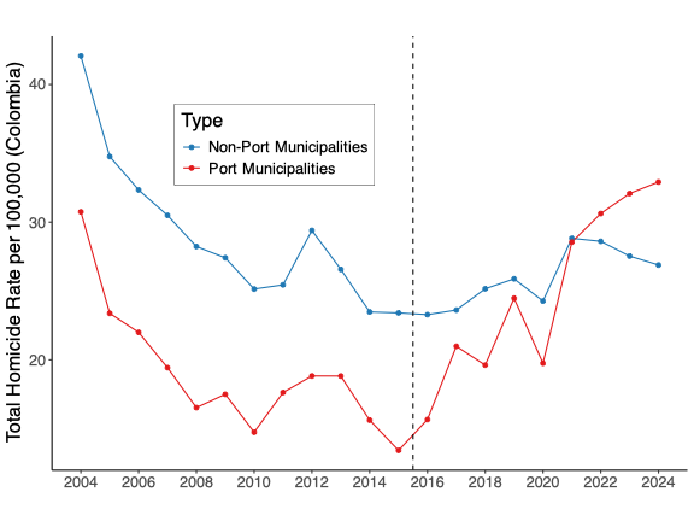
More cocaine does not automatically mean more violence everywhere. Violence rises where control over trafficking rents becomes more valuable, and where that control is contestable. In Colombia, we find that homicide rates rose most in two kinds of places: coca-producing municipalities and port municipalities. Figure 1 shows that homicide rates rose sharply in port municipalities after the supply shock, while remaining relatively flat in inland areas. Relative to pre-shock levels, homicide rates increased by about 26% in coca-producing municipalities and by about 41% in port municipalities. However, we do not find comparable increases along interior trafficking corridors. The logic is straightforward: inland routes are numerous and easier to substitute, while ports concentrate flows in a small number of locations and are hard to replace.
Figure 1: Colombian homicide rates rose sharply in port municipalities after the cocaine supply shock
Competition matters as much as geography. In Colombia, the post-shock rise in homicides was much stronger where multiple armed groups were already present. Where criminal control was more monopolistic, violence responded much less. Ecuador tells a similar story, albeit with a lag. Trafficking through Ecuador increased earlier, but large-scale violence erupted only after centralised criminal control fractured and rival groups began fighting over transit rents. This is consistent with a broader evidence base showing that violence responds to contestation over criminal rents, not simply to the scale of illegal activity (Castillo et al. 2020, Battiston et al. 2024).
This implication is straightforward but often underappreciated in policy: violence is not simply a function of trafficking volumes. It also depends on who is contesting control, and under what institutional conditions.
Downstream consequences in Europe
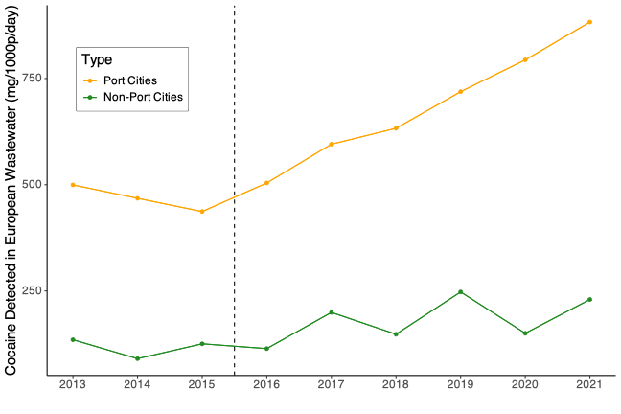
The shock did not stop in South America. European countries with stronger pre-shock maritime trade links to Colombia and Ecuador saw larger increases in cocaine seizures from those origins. Retail prices fell. Figure 2 shows that cocaine consumption increased substantially more in port cities than in non-port cities following the shock, with wastewater-based estimates suggesting roughly a 60% greater increase in port cities. Violent crime also rose in the most exposed port provinces. Effects were strongest in places with dense trade connectivity and ports with pre-existing criminal infiltration (Savona and Riccardi 2015, Europol 2025). Europe’s port cities, in other words, are not separate from the South American story. They are downstream nodes in the same transnational network.
Figure 2: Cocaine consumption rose more in European port cities after the supply shock
What should policymakers do differently?
Our findings suggest that the same infrastructure that lowers the cost of legal commerce can also lower the cost of smuggling. That does not make trade integration a mistake. But it does mean that trade policy, customs policy, and anti-organised-crime policy cannot be treated as separate silos.
- Policy should be more strategic. Broad interdiction campaigns spread enforcement across routes that traffickers can often substitute away from. Our findings instead point to high returns from focusing on chokepoints: major export ports in source and transit countries, high-volume perishable export chains, and the European import hubs most tightly connected to them. Better cargo intelligence and targeted screening are likely to matter more than simply inspecting more containers. This policy emphasis follows from our finding that violence and trafficking concentrate at scarce chokepoints rather than dispersing evenly through the network.
- European enforcement cannot be purely national. If pressure rises at one major port, some flow can shift to another. That makes information sharing across customs authorities and ports essential, especially around dispatch data, transshipment information, and container provenance.
- Transit-country governance deserves much more attention. Ecuador’s experience shows that a country can suffer enormous violence without producing the drug itself. Interdiction matters, but so do prison governance, corruption control, investigative capacity, and protection against criminal capture of logistics chains.
- Source-country supply policy has to be designed carefully. Colombia’s experience suggests that a promise of future compensation, if poorly designed, can induce strategic planting before any substitution programme begins. That does not imply that crop substitution is futile. It implies that programme design, credibility, targeting, and sequencing matter enormously.
The broader lesson is simple. Cocaine policy remains too compartmentalised for a market that is organised as a global supply chain. A better starting point is to treat cocaine not only as a rural development or policing problem, but as a logistics and governance problem that runs through global trade infrastructure.
References
Acemoglu, D, V M Carvalho, A Ozdaglar, and A Tahbaz-Salehi (2012), "The network origins of aggregate fluctuations," Econometrica, 80(5): 1977–2016.
Battiston, G, G Daniele, M Le Moglie, and P Pinotti (2024), "Fuelling organised crime: The Mexican war on drugs and oil theft," Economic Journal, 134(663): 2685–2711.
Castillo, J C, D Mejía, and P Restrepo (2020), "Scarcity without Leviathan: The violent effects of cocaine supply shortages in the Mexican drug war," Review of Economics and Statistics, 102(2): 269–286.
Daniele, G, A Soliman, and J F Vargas (2026), "Cocaine goes bananas: Global spillovers from an illicit supply shock," Unpublished manuscript.
Donaldson, D (2018), "Railroads of the Raj: Estimating the impact of transportation infrastructure," American Economic Review, 108(4–5): 899–934.
Europol (2025), "Criminal networks in EU ports: Risks and challenges for law enforcement."
Prem, M, J F Vargas, and D Mejía (2023), "The rise and persistence of illegal crops: Evidence from a naive policy announcement," Review of Economics and Statistics, 105(2): 344–358.
Savona, E, and M Riccardi (2015), "From illegal markets to legitimate businesses: The portfolio of organised crime in Europe," Transcrime.
Tobón, S, M M Sviatschi, and N Cabra-Ruiz (2025), "Organised crime," VoxDevLit, 17(1).