




Destroying illicit crops at the source is meant to weaken criminal economies and create space for development. Evidence from Colombia's aerial glyphosate programme tells a different story: eradication triggered income shocks that pulled children out of school, with lasting effects on education, child labour, early marriage, and living standards – while achieving limited reductions in coca cultivation.
Editor’s note: For a broader synthesis of themes covered in this article, check out our VoxDevLit on Organised Crime. The authors have made slides available here.
Production-side interventions have long dominated policy responses to illicit drug markets. Among them, forced crop destruction has stood out as one of the most widely used. Proponents argue that destroying crops at the source cuts supply, weakens criminal organisations, and creates space for legal economies to flourish (White House 2020). Critics warn, however, that when illicit crops are the main livelihood for poor rural households, forced eradication may instead generate large income shocks – deepening poverty while offering few viable alternatives (Crisis Group 2021).
In recent work (Horta-Saenz and Tami-Patiño 2026), we study Colombia’s aerial glyphosate spraying programme – one of the largest counter-narcotics interventions ever implemented – and provide causal evidence on its short- and long-run consequences for education, child labour, early marriage, and living conditions in rural communities.
Coca cultivation as a subsistence strategy
Coca is grown primarily by small-scale, impoverished farmers for whom it offers a rare combination of reliability and accessibility: it can be harvested every three to four months, requires minimal upfront investment, and comes with a guaranteed buyer – a combination few legal crops can match. Approximately 215,000 Colombian families depend on it as their main source of income (Crisis Group 2021).
This does not make farmers wealthy. Poverty in coca-growing areas far exceeds the national rural average: 57% of households were classified as poor in 2018, compared to 36% nationally (Garzón and Gelvez 2018). Coca is not a path to prosperity; it is a coping strategy for families with few alternatives. When eradication destroys that income without offering a replacement, the consequences can be severe and, as we show, long-lasting.
Colombia’s aerial eradication programme
Beginning in the 1990s, Colombia deployed aircrafts to spray glyphosate herbicide over coca-growing regions – a programme that would become the centrepiece of its counternarcotics strategy for two decades. Heavily backed by US foreign assistance under Plan Colombia, which channelled hundreds of millions of dollars into fumigation operations each year, the programme treated more than 1.7 million hectares before being suspended in 2015, after the WHO classified glyphosate as a probable carcinogen.
A natural experiment: The reach of eradication flights
Estimating the causal effect of eradication is challenging, as targeted areas tend to be poorer and more conflict affected. A naive comparison of sprayed and unsprayed communities would therefore conflate the effect of eradication with pre-existing differences between them.
To isolate causality, we exploit the operational constraints that shaped the precise reach of eradication flights. These operations depended on weather windows, helicopter escort range limited to just eleven airports nationwide, and idiosyncratic pilot decisions about whether to abort a run mid-flight. Together, these factors introduced quasi-random variation in which fields were sprayed – variation unrelated to the characteristics of the communities.
We digitised the precise geographic boundaries of all sprayed areas from UNODC maps (2000–2015), yielding a detailed record of the programme’s full spatial extent (Figure 1). We link this data to two complementary sources: (1) the universe of rural schools, used in a difference-in-differences design to estimate short-run effects on school dropout, and (2) the 2018 Population Census at the village level, used in a spatial regression discontinuity comparing villages just inside versus just outside eradication boundaries for medium- to long-run outcomes. Balance checks confirm that villages on either side of spraying boundaries are statistically indistinguishable on pre-existing characteristics.
Figure 1: Aerial spraying maps 2011
(a) UNODC aerial spraying (b) Digitised map
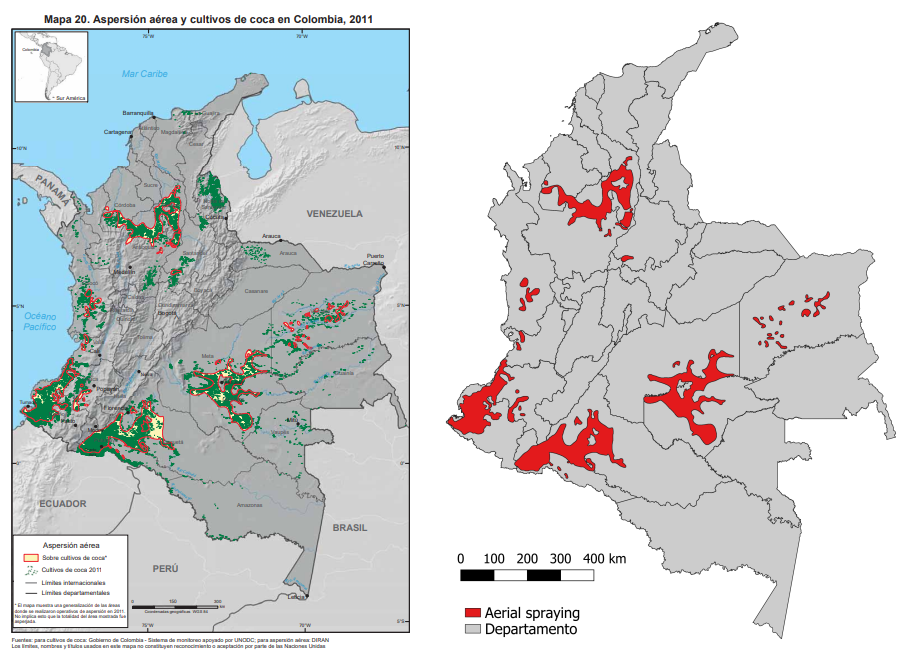
Notes: This figure shows the areas subjected to forced aerial eradication in 2011. Panel (a) displays the original map from UNODC, and Panel (b) shows its digitised version.
The short run: Eradication pushes children out of school
Schools within sprayed areas see dropout rates rise by 0.8 percentage points – a 12% increase relative to the control mean. The effect is similar for boys and girls and concentrated among younger children.
What is driving this increase in dropout rates? We examine three potential channels: income shocks, health effects of glyphosate, and conflict escalation. The evidence points clearly to income. After spraying, nighttime light density falls around affected schools – a signal of declining local economic activity. Farmers in sprayed villages report higher poverty and sell fewer crops, with yields of legal alternatives – potato, coffee, maize, sugar cane – all falling, alongside reports of water contamination and soil degradation.
Rather than pivoting to licit agriculture, farmers respond by concealing coca under plantain and oil palm. While glyphosate spraying destroys their income, it does not destroy the incentive to keep growing coca. Health effects and conflict escalation, by contrast, find little support in the data.
The longer run: Temporary shocks, permanent losses
The 2018 Population Census – collected three years after the spraying ban – reveals broad and lasting deterioration in villages exposed to eradication, relative to neighbouring villages that were never sprayed.
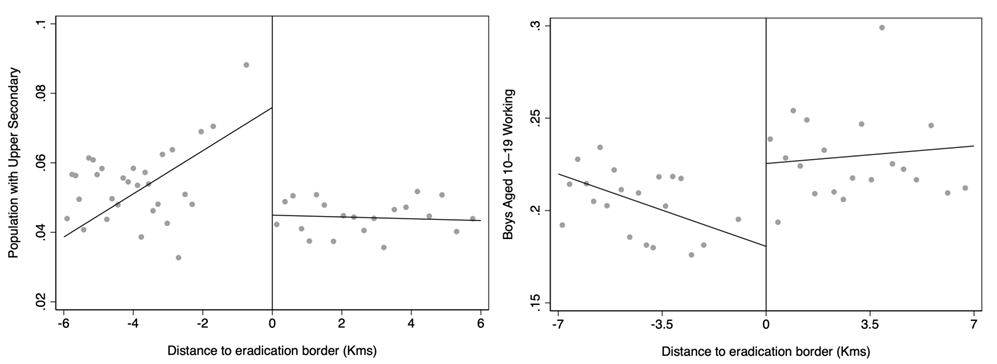
On education (Figure 2a), secondary completion rates are roughly 3 percentage points lower in exposed villages, suggesting that children who leave school after an income shock rarely return. What appears to be a temporary disruption instead becomes a permanent exit from schooling.
Beyond education, the data reveals gender-differentiated coping responses (Figure 2b–c). In exposed villages, boys aged 10–19 are more likely to engage in paid work, while girls show no comparable increase in employment but instead enter the marriage market earlier, with higher rates of marriage or cohabitation among those aged 15–19. These patterns are consistent with households adjusting to income loss in ways that disproportionately affect children.
Finally, households in sprayed villages are more likely to lack basic amenities – including durable housing materials (Figure 2d), electricity, internet, and gas for cooking – indicating persistent material deprivation even after spraying ended.
Figure 2: Effect of aerial spraying on development
(a) High school completion (b) Male youth employment
(c) Female youth marriage (d) Dwelling characteristics index
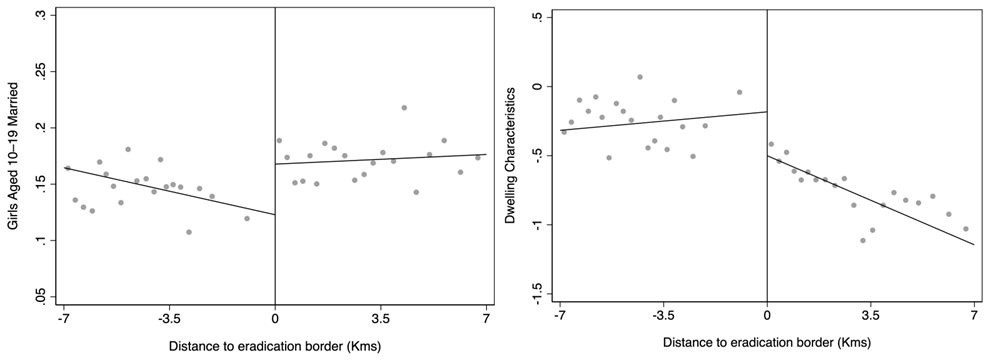
Notes: Regression discontinuity estimates comparing villages just inside (right) and just outside (left) eradication boundaries.
Supply-side eradication can impose large costs on the communities it targets
Our findings reveal a fundamental tension in counter-narcotics policy. Aerial eradication was designed to reduce cocaine production. Yet existing evidence suggests it had limited effectiveness in permanently curbing cultivation (Bogliacino and Naranjo 2012, Reyes 2014, Mejía et al. 2017). Our results show that it simultaneously imposed substantial and persistent costs on civilian populations.
Enforcement strategies that destroy livelihoods without providing alternatives entrench the very poverty that makes illicit cultivation attractive in the first place. Worse, they set back human capital accumulation – pushing boys into the labour market and girls into early marriage. Supply-side interventions should be evaluated not only by their effects on drug production, but by their broader welfare consequences for the communities that bear their costs.
References
Bogliacino, F, and A J Naranjo (2012), "Coca leaves production and eradication: A general equilibrium analysis," Economics Bulletin, 32: 382–397.
Crisis Group (2021), "Deeply rooted: Coca eradication and violence in Colombia."
Garzón, J, and J Gelvez (2018), "¿Quienes son las familias que viven en las zonas con cultivos de coca?" Bogotá, Colombia: UNODC – Fundación Ideas para la Paz (FIP).
Horta-Sáenz, D, and A Tami-Patiño (2026), "Supply-side drug enforcement and economic development," Unpublished manuscript.
Mejia, D, P Restrepo, and S V Rozo (2017), "On the effects of enforcement on illegal markets: Evidence from a quasi-experiment in Colombia," World Bank Economic Review, 31: 570–594.
Reyes, L C (2014), "Estimating the causal effect of forced eradication on coca cultivation in Colombian municipalities," World Development, 61: 70–84.
White House, The (2020), "United States and Colombian officials set bilateral agenda to reduce cocaine supply."