



As demand for heroin decreases in the US—driven by the growing dominance of synthetic opioids—drug cartels have pivoted to an unexpected but profitable venture: avocados. This has increased violence directed at civilians, presenting policymakers with the challenge of designing strategies that not only address the production of illegal drugs but also consider the potential spillover effects on other industries.
“Where there’s money, that’s where the bad guys go. With all the publicity that it’s going so well for us — this will be the sixth year that Mexican avocados have [been] advertised in the Super Bowl — it draws attention to us.”
– Avocado farmer from Michoacán, Mexico (Financial Times 2020)
For decades, drug trafficking was the primary source of income for criminal organisations in Mexico. However, in recent years, many cartels have shifted away from drugs, expanding their operations into the extortion of legal businesses, illegal mining, and fuel theft (Herrera and Martinez-Alvarez 2022, Jones and Sullivan 2019). One of the most lucrative targets has been the avocado industry, whose exports alone contribute over US$2.5 billion annually. Cartels extract rents from this sector through theft and the extortion of avocado producers, transporters, and packing houses.
In the municipality of Tancítaro—the main producer of avocados in the country—local authorities estimate that the Los Caballeros Templarios cartel obtained approximately $150 million annually from the extortion of the avocado sector in 2014 (de Cordobá 2014). This corresponded to nearly 10% of the country’s total avocado export value that year. Avocado theft also became widespread, with an average of 7 to 10 avocado truckloads stolen every week in the state of Michoacán (Agren 2019, García Tinoco 2019), resulting in annual losses of up to $5 million.
The diversification of drug trafficking organisations' activities has been driven by the emergence of new criminal groups and increased competition in drug markets. Cartels operate as profit-driven enterprises, conducting sophisticated operations across various sectors to offset losses in one area by exploiting opportunities in others. In this context, a fall in the demand for heroin in the US contributed to cartels shifting out of heroin into the extortion of the avocado sector.
The geographical proximity between the main poppy- and avocado-producing regions facilitated this shift. For instance, Michoacán—the leading state for avocado production and export—borders Guerrero, which is responsible for more than 60% of Mexico’s poppy cultivation (Le Cour Grandmaison et al. 2019). This geographical proximity, resulting from similar agroclimatic requirements for both crops, made it easier for cartels to diversify into the extortion of a nearby sector that, over the past decade, has experienced rapid growth due to rising global demand.
Why have cartels diversified beyond heroin?
Mexico is the world’s third-largest producer of heroin and the leading supplier to the US market. Yet, over the past decade, the profitability of heroin has collapsed with the emergence of fentanyl in the black market. Fentanyl is a synthetic opioid 50 to 100 times more potent than morphine, and 20 to 40 times more potent than heroin (CDC 2021). Fentanyl is cheaper to produce and easier to smuggle, making it increasingly attractive to traffickers. Its high potency and low cost also enable US-based drug dealers to lace drugs like heroin with fentanyl to stretch supply and increase profits (DEA 2020). The increasing use of fentanyl as a substitute for heroin drastically undercut demand for Mexican heroin, which provided 90% of the heroin consumed in the US (Le Cour Grandmaison et al. 2019). Figure 1 illustrates this dynamic: since 2013, fentanyl-related overdose deaths in the US have skyrocketed, while heroin-only overdoses have declined.
The decline in the demand for heroin negatively affected Mexican farmers in marginalised regions whose livelihood depended on poppy cultivation. Between 2017 and 2018, opium prices fell by 50- 80% (Le Cour Grandmaison et al. 2019), leading to the forced migration of hundreds of families (Semple 2019). As a consequence, between 2017 and 2020, the area cultivated with poppy declined by 47% (ONDCP 2021).
Figure 1: Opioid overdose deaths in the US (1999-2019)
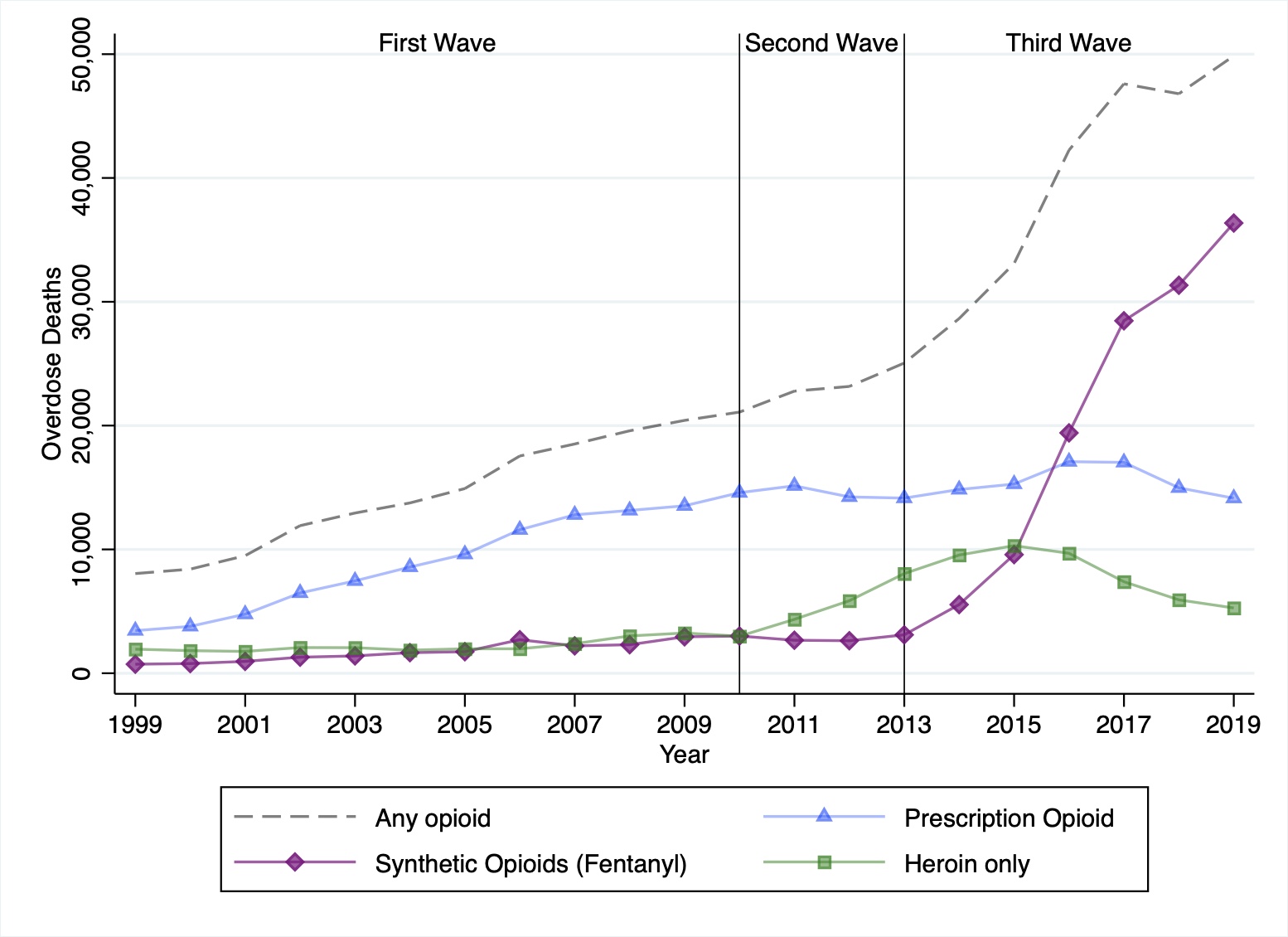
Notes: This figure shows the evolution in overdose deaths during three waves of the US opioid crisis. The first and second waves are characterised by an increase in overdoses from prescription opioids and heroin, respectively. The third wave is marked by the rise in synthetic opioid-related overdose deaths, primarily corresponding to fentanyl and excluding overdoses from methadone. Source: National Center for Health Statistics (NCHS).
Measuring the effect of heroin demand decline on violence in Mexico
In De Haro (2025), I examine whether the rise of fentanyl—and the corresponding fall in US heroin demand—prompted Mexican cartels to redirect their activities toward the avocado sector rather than continue specialising in the production and distribution of heroin. To test this, I analysed changes in violence across municipalities that differ in their suitability for avocado and poppy cultivation. If fentanyl is displacing heroin in the US market—and thereby reducing the profitability of poppy cultivation—cartels may respond by shifting toward the extortion of legal industries such as the avocado sector. This shift would result in increased violence in avocado-growing regions and reduced violence in areas suited for poppy cultivation.
To examine this, I constructed a municipal-level panel dataset covering the period from 2011 to 2019, using homicide and theft data from Mexico’s National Health Information System (SINAIS) and the Secretariat of Public Security (SSP), respectively. To identify municipalities suitable for avocado and poppy production, I built two agro-climatic suitability indices using the FAO’s EcoCrop model, which incorporates altitude, temperature, and precipitation data to assess a region’s potential to grow a given crop.
As a proxy for fentanyl availability in the US market, I use data on overdose deaths involving fentanyl. Because fentanyl is often used as a substitute for heroin, rising overdose rates signal its increasing dominance in opioid markets and the displacement of Mexican heroin. If cartels are adapting to this shift by turning to legal sectors like avocados, we should observe a geographic shift in violence: increasing in avocado-suitable areas relative to non-suitable areas.
As the demand for heroin decreases, avocado-growing municipalities suffer more violence
My results indicate that fentanyl’s emergence in the US opioid market has reshaped violence across Mexico’s agricultural regions. Estimates show that a 10% increase in fentanyl overdose deaths is associated with up to a 2% rise in homicide rates and 6% rise in theft rates in municipalities highly suitable for avocado cultivation. This pattern is consistent across murders of agricultural workers, violent thefts, and truckload robberies. The latter coincides with reports on thefts of trucks transporting avocados in Michoacán (Agren 2019, García Tinoco 2019). In contrast, poppy-suitable municipalities appear to have benefited from declining violence: estimates show statistically significant reductions in both homicide and theft rates in response to the rise of fentanyl.
Cartel violence was caused by a shift in the use of violence, rather than territorial competition
To explore whether these changes reflect broader territorial realignment, I used municipal-level data on cartel presence from the Mapping Criminal Organizations Project. My results show no evidence that cartels—including those previously involved in heroin—are relocating from poppy to avocado-growing areas. Instead, the increased violence in avocado-growing municipalities appears to be driven by cartels already operating in these areas, rather than by new entrants fighting for control. In the short run, cartels’ territorial expansion is costly, requiring substantial human and capital resources to challenge other groups. While extortion and theft in the avocado sector may compensate for falling heroin revenues, these gains are not large enough to justify the high cost of violent takeovers.
Policy implications for the war on drugs
The results show that the introduction of fentanyl—and the resulting decline in demand for heroin—has fundamentally altered the incentives for Mexican cartels, prompting them to seek profits from other sources such as the avocado sector. This shift has led to increased violence directed at civilians, as evidenced by a rise in homicides among agricultural workers and a growing number of violent robberies, including attacks on cargo trucks. However, the potential income generated from extortion and avocado theft has not been sufficient to trigger widespread territorial reorganisation among criminal groups in Mexico.
My findings suggest that when profits from illegal drug markets fall, criminal organisations may increasingly turn to extractive strategies targeting legal industries. It also raises important questions about the economic impact on communities that depend on the illicit drug trade for their livelihoods. The recent shift in cartel behaviour presents a new challenge for policymakers, who must now design broader strategies that address the production of illegal drugs while also considering the potential spillover effects on other industries.
Furthermore, the proliferation of synthetic drugs in the black market presents unique enforcement challenges. Unlike plant-based drugs such as heroin and cocaine, the production of synthetic opioids does not rely on climatic conditions, enabling criminal organisations to relocate closer to end markets or strategic areas with access to imported precursor chemicals. This spatial flexibility fundamentally alters drug trafficking dynamics and calls for a re-evaluation of current enforcement strategies.
References
Agren, D (2019), “Up to four avocado trucks stolen in Mexican state every day”, The Guardian.
CDC (2021), “Fentanyl”.
DEA (2020), “Facts about fentanyl”.
De Cordobá, J (2014), “La guerra de los aguacates que se consumen en EE.UU. se libra en México”, The Wall Street Journal.
De Haro, I (2025), “Avocados: Mexico’s green gold, drug cartel violence and the US opioid crisis”, World Development, 191: 106942.
Financial Times (2020), “Avocado crime soars as Mexican gangs turn focus from opium to ‘green gold’”.
García Tinoco, M (2019), “Robo de aguacate no para en Michoacán”, Excelsior.
Herrera, J S and C B Martinez-Alvarez (2022), “Diversifying violence: Mining, export-agriculture, and criminal governance in Mexico”, World Development, 151: 105769.
Jones, N P and J P Sullivan (2019), “Huachicoleros”, Journal of Strategic Security, 12(4): 1–24.
Le Cour Grandmaison, R, N Morris, and B Smith (2019), “The last harvest? From the US fentanyl boom to the Mexican opium crisis”, Journal of Illicit Economies and Development, 1(3): 312–329.
Semple, K (2019), “Mexican opium prices plummet, driving poppy farmers to migrate”, New York Times.
ONDCP (2021), “The Office of National Drug Control Policy announces the third consecutive year of reduction in poppy cultivation and potential heroin production in Mexico”, The White House.