



Evidence from Brazil highlights how tackling voter fraud can not only protect election integrity, but also enhance political accountability, improve leadership quality, and promote better governance outcomes.
Editor’s note: For a broader synthesis of themes covered in this article, check out our VoxDevLit on Bureaucracy.
Electoral fraud is a common challenge in many new democracies (Simpser 2013, Fortin-Rittberger et al. 2017). It can erode public trust in democracy and make leaders less accountable to the people, ultimately weakening how governments operate (Birch 2008, Rose and Mishler 2009, Fortin-Rittberger et al. 2017).
One form of electoral fraud is voter-buying, in which individuals are induced to change their voter registration to a different area in exchange for personal rewards (Ichino and Schündeln 2012, Hidalgo and Nichter 2016). These fraudulently imported voters artificially boost the politician’s support in a given area, undermining the fairness and accuracy of election results. Though historically observed in the US, voter-buying remains widespread in many countries today. In recent research (Karim 2025), I investigate how voter-buying affects the quality of governance and delivery of public goods. I examine these questions in the context of Brazil, where local politics is often shaped by clientelistic practices—that is, politicians offering private favours to voters in exchange for political support (Frey 2019, Bobonis et al. 2022). Official records also contain widespread allegations that mayors bring in voters from nearby municipalities to boost their electoral support (Hidalgo and Nichter 2016).
Studying a major electoral reform in Brazil
Brazil’s top electoral court introduced a major voter re-registration reform in 2007, with the explicit objective of cracking down on fraudulent voter registrations. The primary aim of the reform was to ensure that only genuine residents of a municipality could participate in local elections. In total, 1,186 municipalities were selected to implement the reform, representing slightly more than 20% of all municipalities in the country. In these municipalities, existing voter rolls were entirely voided, and all eligible citizens were required to re-register. To re-enrol, voters had to present valid identification and documented proof of residence at least five months before the 2008 municipal elections to remain eligible to vote. The re-registration process was publicised through national television and radio campaigns.
The reform provides a valuable setting to examine how the ability to engage in voter-buying influences political outcomes and policy decisions. Typically, estimating the effects of fraudulent voter transfers is difficult due to endogeneity concerns. Many of the factors that make vote-buying feasible, such as proximity to other municipalities, population size, urbanisation, and education levels, also influence local election results. This makes it difficult to disentangle cause from effect. In some cases, the direction of causality may even be reversed: for instance, evidence of corruption could lead voters to replace the incumbent party (Ferraz and Finan 2008). Additionally, selection bias arising from certain municipalities being more likely to be targeted for reforms can obscure causal relationships.
However, the way the 2007 reform was implemented helps to address these concerns. Brazil’s Superior Electoral Court used a clear and objective criterion to determine which municipalities would be subject to the reform: the ratio of registered voters in the 2006 federal elections to the municipality’s estimated population in that year. Municipalities where this ratio exceeded 80% were flagged for intervention, as such numbers were considered implausibly high given Brazil’s demographic profile. Because the policy was implemented in a way that introduces a clear cutoff for treatment, I use a regression discontinuity design (RDD) to identify the causal effects of the reform. This approach allows for a credible and transparent estimation of how restricting voter manipulation affects political outcomes.
The reform had far-reaching consequences for political outcomes
The first municipal elections affected by the reform took place in 2008. The reform led to a significant decline in the number of registered voters in treated municipalities, alongside a corresponding rise in registrations in neighbouring municipalities. This pattern is consistent with the idea that voters who were previously registered in municipalities where they did not actually live transferred their registration back to their true place of residence. The reform also made elections more competitive by reducing the re-election chances of incumbent mayors during the 2008 elections and lowering the margin of victory. This aligns with existing research showing that incumbents are typically better positioned to engage in clientelistic practices, including voter-buying, because they have greater access to public resources and control over municipal employment.
Figure 1 shows the re-election chances of incumbent mayors in municipal elections, based on how close a municipality was to the 80% cut-off used to determine whether it would undergo the reform. In the 2004 elections—before the reform was implemented—there is no visible change in re-election rates around the 80% threshold. But in the 2008 elections, after the reform took effect, there is a sharp drop of more than 25 percentage points in the likelihood that an incumbent mayor is re-elected.
Figure 1: Probability of an incumbent mayor being re-elected
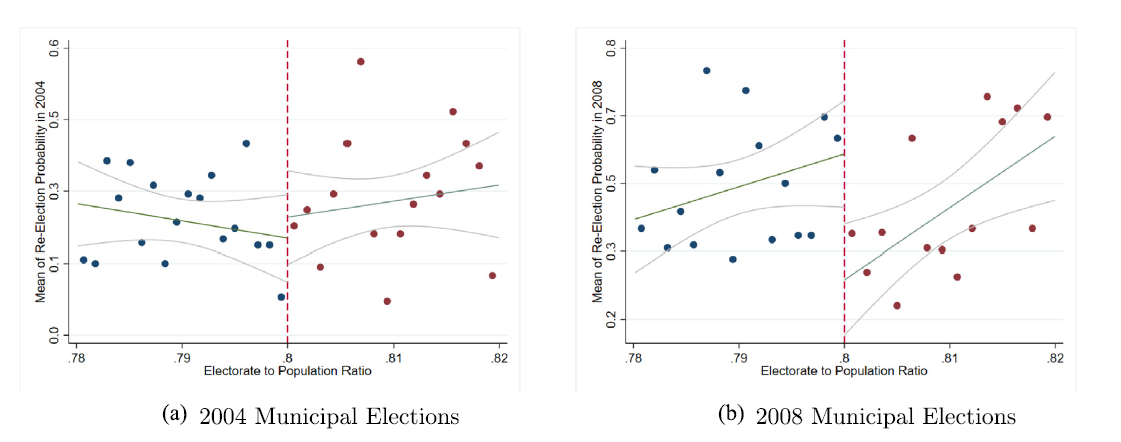
Notes: Figure 1 shows how likely incumbent mayors were to be re-elected, based on the ratio of registered voters to the total population in 2006 for each municipality. The solid line shows the overall trend in the data, with separate lines drawn on either side of the 80% cut-off.
Beyond these changes, the reform also improved the overall quality of political leadership. Candidates who were more educated, more experienced in public service, and less connected to corrupt political parties were more likely to run for office and more likely to win in the 2008 mayoral elections. These patterns suggest that by making voter-buying harder and more costly, the reform gave an advantage to candidates who relied less on fraudulent tactics and more on qualifications.
The reform had significant impacts on the provision and quality of public goods in the years that followed
The new political landscape created by the reform influenced local government policy decisions and citizens’ socioeconomic outcomes. In the three years following the 2008 election, municipal governments substantially increased spending in both public health (5.9-7.2 percentage points) and public education (4-8 percentage points).
Figure 2 shows the share of the municipal budget spent on healthcare, both before and after the reform. There is no noticeable difference in health spending in the years before the reform (2005–2007). However, following the 2008 municipal elections, there is a significant increase in health expenditure for municipalities just above the threshold. A similar pattern is observed for education expenditures.
Figure 2: Share of municipal budget spent on healthcare
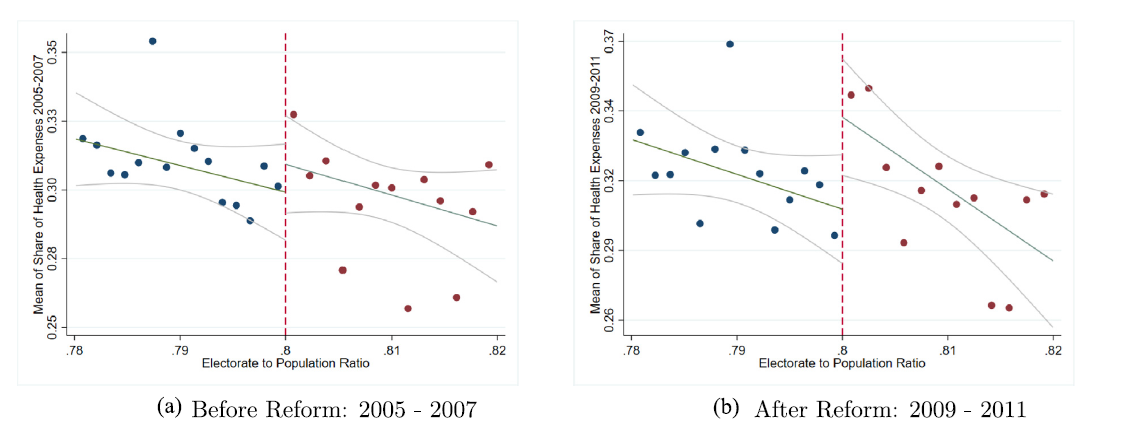
Notes: Figure 2 shows how much of each municipality’s budget was spent on healthcare before and after the reform, based on the ratio of registered voters to the total population in 2006. The data on budgets and healthcare spending come from Brazil’s National Treasury Database (FINBRA).
These increased expenditures in public health and educated translated into real improvements in people’s lives: infant mortality rates dropped, birthweights rose, and schools saw more classrooms, teachers, and students. Municipalities also invested in better school infrastructure, such as science labs and computer equipment.
Why did tackling voter fraud have such far-reaching effects?
My research provides evidence for several mechanisms that help explain the observed effects:
- By reducing voter fraud, the reform created opportunities for more competent and honest politicians to be elected.
- By increasing political competition, it gave politicians stronger incentives to respond to the needs of their constituents.
- By removing ‘imported’ voters, the reform changed the composition of the electorate: after re-registration, voters were more likely to be young, educated, and female—groups typically more supportive of social investments such as education and healthcare.
Taken together, my findings suggest that addressing voter fraud does more than safeguard the integrity of elections: it can also improve the quality of political leadership, shift public spending towards priority areas, and deliver better outcomes for citizens.
References
Birch, S (2008), “Electoral institutions and popular confidence in electoral processes: A cross-national analysis,” Electoral Studies, 27(2): 305–320.
Bobonis, G J, P J Gertler, M Gonzalez-Navarro, and S Nichter (2022), “Vulnerability and clientelism,” American Economic Review, 112(11): 3627–3659.
Ferraz, C and F Finan (2008), “Exposing corrupt politicians: The effects of Brazil's publicly released audits on electoral outcomes,” The Quarterly Journal of Economics, 123(2): 703–745.
Fortin-Rittberger, J, P Harfst, and S C Dingler (2017), “The costs of electoral fraud: Establishing the link between electoral integrity, winning an election, and satisfaction with democracy,” Journal of Elections, Public Opinion and Parties, 27(3): 350–368.
Frey, A (2019), “Cash transfers, clientelism, and political enfranchisement: Evidence from Brazil,” Journal of Public Economics, 176: 1–17.
Hidalgo, F D and S Nichter (2016), “Voter buying: Shaping the electorate through clientelism,” American Journal of Political Science, 60(2): 436–455.
Ichino, N and M Schündeln (2012), “Deterring or displacing electoral irregularities? Spillover effects of observers in a randomized field experiment in Ghana,” The Journal of Politics, 74(1): 292–307.
Karim, R M (2025), “Voter-buying, politician selection, and public good provision in Brazil,” Journal of Development Economics, 103507.
Rose, R and W Mishler (2009), “How do electors respond to an ‘unfair’ election? The experience of Russians,” Post-Soviet Affairs, 25(2): 118–136.
Simpser, A (2013), “Why governments and parties manipulate elections: Theory, practice, and implications,” Cambridge University Press.