


Ethnic diversity is often blamed for poor development outcomes. New evidence from colonial Peru shows that a history of economic exchange can sustain inter-ethnic cooperation and local trade in the long run.
Rising migration and forced displacement are bringing people from different ethnic backgrounds into closer contact. Whether ethnic diversity leads to conflict or cooperation is an important question for development policy. A large body of research documents that ethnic diversity is often a barrier to economic development and public good provision (Easterly and Levine 1997, Miguel and Gugerty 2005, Hjort 2014). Yet some studies find that economic complementarities can promote mutually beneficial coexistence (Jha 2013, Becker and Pascali 2019, Grosfeld et al. 2020), suggesting that context matters (Moscona et al. 2026). Why does ethnic diversity hurt more in some contexts than others?
New evidence from Andean Peru highlights the role of the economic history that ethnic groups carry with them before being brought together. In Artiles (forthcoming), I use a natural experiment from sixteenth-century colonial Peru to show that prior exposure to economic exchange mitigates the costs of ethnic diversity on economic development in the long run.
A natural experiment from Peru’s colonial history
I study a natural experiment from Peru’s colonial history: the forced resettlement of native populations in the sixteenth century. This resettlement accidentally created quasi-random variation in ethnic diversity across new districts, allowing me to study how pre-colonial exposure to economic exchange shaped the long-run consequences of ethnic diversity.
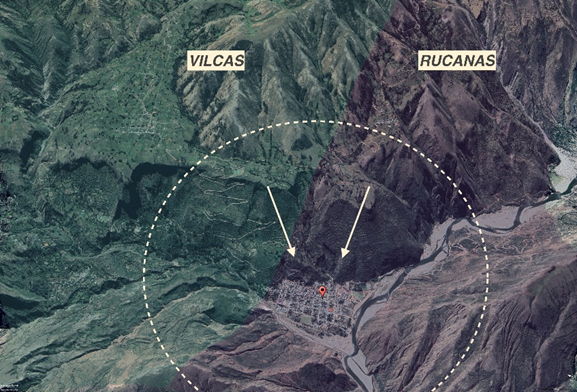
Before the Spanish conquest, the Andean highlands were home to distinct ethnic groups. Archaeological and anthropological researchers have highlighted that their economies were built around a vertical logic: each group managed population settlements across complementary altitude zones, exchanging different crops (e.g. maize, quinoa, lupins) to maximise their economic base. This system of internal crop exchange was central to pre-Inca and Inca subsistence (Murra 1956, 1975). When Spanish colonisers arrived in the sixteenth century, the new administration organised a forced resettlement of native populations into new, Spanish-style jurisdictions (called parishes and later renamed as districts). Importantly, these small-scale districts were based on a horizontal conception of the world, which pointed against the pre-colonial subsistence strategy of exchanging crops across altitude zones. Figure 1 illustrates the vertical layout of the pre-colonial homelands of two ethnic groups: the Vilcas (green) and the Rucanas (purple). The red marker indicates the location of one of the newly created colonial districts, which concentrated populations from the two groups.
Figure 1: Buffer exercise
The colonial intervention also created quasi-random variation in ethnic diversity. The key identifying assumption is that proximity to ethnic boundaries when choosing locations for new districts was ‘as good as random’, conditional on pre-colonial characteristics of the land and native populations (including pre-colonial exposure to crop exchange). This assumption, supported by balance tests across a range of geographic and pre-colonial characteristics, is consistent with the historical narrative that colonial officials were not fully aware of the vertical distribution of co-ethnic settlements across space. As a result, districts located near pre-colonial ethnic boundaries (displayed in yellow; Figure 2) were more likely to concentrate ethnically diverse populations; those located in the interior of a single ethnic homeland (displayed in blue; Figure 2) were more likely to have ethnically homogeneous founding populations. I validate this contrast using native surnames from colonial baptism records, which show systematically higher surname diversity in ‘border’ districts than in ‘interior’ ones.
Figure 2: Colonial parishes
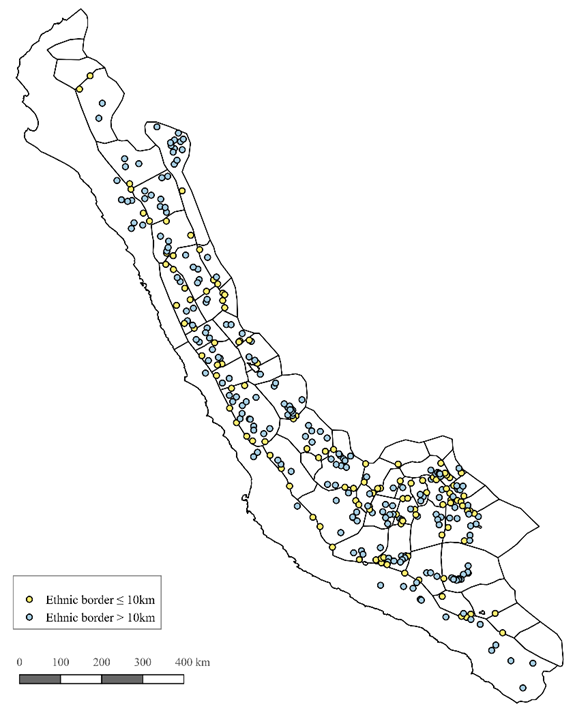
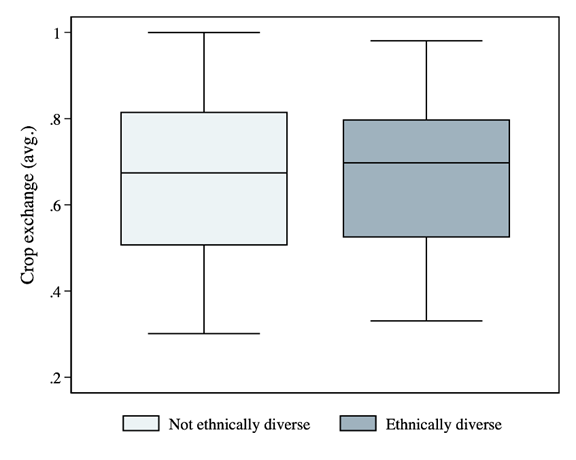
Figure 3 shows that the distribution of average exposure to crop exchange (a pre-resettlement variable) is strikingly similar across ethnically diverse and non-diverse districts. This suggests that ethnic groups with higher exposure to crop exchange did not systematically succeed in negotiating locations in the interior of ethnic homelands. The lack of correlation between the two key variables of the natural experiment allows me to study their interaction (i.e. the consequences of ethnic diversity across districts with varying levels of historical exposure to crop exchange).
Figure 3: Ethnic diversity and historical crop exchange
A history of economic exchange mitigates the long-run costs of ethnic diversity
I find that ethnic diversity reduces contemporary living standards, on average. Districts with ethnically diverse founding populations score lower on a composite index of living standards, compared with ethnically homogeneous districts. This result is consistent with the broader literature on the costs of ethnic diversity (Easterly and Levine 1997, Miguel and Gugerty 2005, Hjort 2014), and highlights the lasting impact of the forced resettlement on local economic development in the long run.
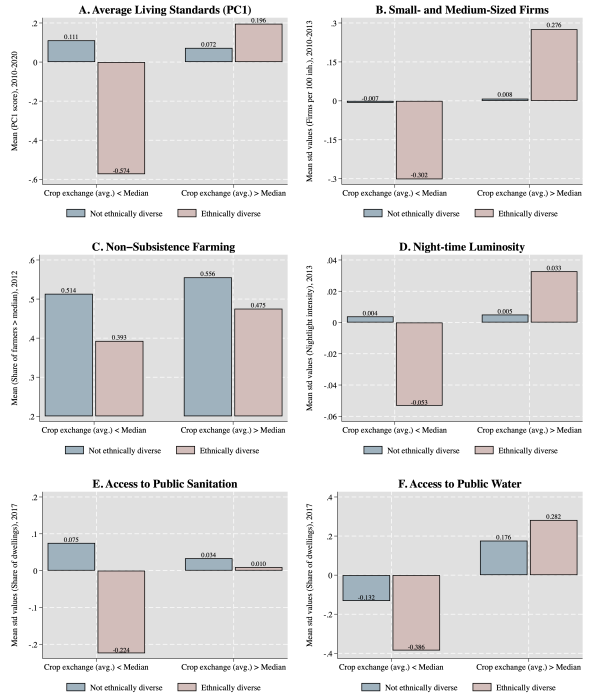
The key finding comes from the interaction with historical exposure to crop exchange. The negative effect of ethnic diversity on long-run development is substantially mitigated in districts where ethnic groups had a stronger tradition of internal crop exchange prior to resettlement. Figure 4 shows this pattern across four development outcomes for the 2010–2020 period. In districts below the median level of crop-exchange exposure, ethnically diverse districts consistently underperform their homogeneous counterparts across all measures – average living standards, number of firms (per 100 inhabitants), non-subsistence farming, night-time luminosity, access to public sanitation, and access to public water. This negative correlation largely disappears in districts above the median.
Figure 4: Ethnic diversity, historical crop exchange, and contemporary development
Channels of persistence: Inter-ethnic cooperation and local trade in a predominantly agricultural economy
What drives this long-run differential effect? Historical and modern data point to two reinforcing channels:
- A history of internal crop exchange shaped more open attitudes towards out-group members, increasing the likelihood of inter-ethnic interaction after resettlement and fostering a trend towards a more integrated society. Colonial records allow me to explore inter-ethnic marriages, a widely used proxy for societal integration, providing consistent evidence. Contemporary data also tells a consistent story. Where the resettlement concentrated groups with a stronger history of internal crop exchange, the data shows higher rates of participation in voluntary neighbourhood associations and voter turnout in presidential elections, pointing towards a more nation-oriented society. This evidence is consistent with research showing that exposure to economic exchange can promote pro-social attitudes more broadly (Enke 2023).
- Economic complementarities helped sustain market-oriented cooperation in a predominantly agricultural economy. Where the historical ethnic minority complemented the majority group in terms of historical exposure to crop exchange, contemporary populations show higher living standards, on average. The data also shows that minority groups tended to specialise in intermediary services related to agriculture (e.g. retailing), rather than competing directly with the majority for land and resources. Census data from the late 19th century shows that this translated into higher rates of employment in local trade, a pattern that persists into the twenty-first century, alongside higher rates of non-subsistence farming.
Policy implications
As shown by research on the long-term consequences of partitioning India (Bharadwaj and Jha 2017), the drawing of new administrative boundaries can have consequences that echo for generations in the context of multi-ethnic societies. My findings shed light on the economic factors that can promote inter-ethnic coexistence, demonstrating the role of historical exposure to economic exchange. Understanding these factors is important for contemporary policy. My findings suggest that the long-run consequences of ethnic diversity operate through cultural and economic channels that policy can engage with. Policies that create opportunities for inter-ethnic economic interaction, rather than treating ethnically diverse societies as inherently conflict-prone, may help build the conditions for long-run coexistence, as well as supporting minority entrepreneurship in complementary economic sectors (Jha 2025). More broadly, my results suggest that development policy should attend to local heterogeneity in the conditions that determine whether ethnic diversity becomes a barrier or whether its costs can be mitigated.
References
Artiles, M (forthcoming), "Ethnic diversity, historical economic exchange, and development: Evidence from Andean Peru," American Economic Journal: Applied Economics.
Becker, S, and L Pascali (2019), "Religion, division of labor, and conflict: Anti-Semitism in Germany over 600 years," American Economic Review, 109(5): 1764–1804.
Bharadwaj, P, and S Jha (2017), "Drawing the line: The short- and long-term consequences of partitioning India," VoxDev.
Easterly, W, and R Levine (1997), "Africa's growth tragedy: Policies and ethnic divisions," Quarterly Journal of Economics, 112(4): 1203–1250.
Enke, B (2023), "Market exposure and human morality," Nature Human Behaviour, 7(1): 134–141.
Grosfeld, I, S O Sakalli, and E Zhuravskaya (2020), "Middleman minorities and ethnic violence: Anti-Jewish pogroms in the Russian Empire," The Review of Economic Studies, 87(1): 289–342.
Hjort, J (2014), "Ethnic divisions and production in firms," The Quarterly Journal of Economics, 129(4): 1899–1946.
Jha, S (2013), "Trade, institutions, and ethnic tolerance: Evidence from South Asia," American Political Science Review, 107(4): 806–832.
Jha, S (2025), "Promoting development in ethnically divided societies: Historical lessons on peace and prosperity," VoxDev.
Miguel, E, and M K Gugerty (2005), "Ethnic diversity, social sanctions, and public goods in Kenya," Journal of Public Economics, 89(11-12): 2325–2368.
Moscona, J, N Nunn, and J Robinson (2026), "Searching for fish in trees (緣木求魚)? Economic development when context matters," Unpublished manuscript.
Murra, J V (1956), "The economic organization of the Inca state," Unpublished manuscript.
Murra, J V (1975), Formaciones Económicas y Políticas del Mundo Andino, Instituto de Estudios Peruanos.