




While gig drivers' demographic profiles, earnings, and work experiences differ markedly across India, Indonesia, and Kenya, a common thread emerges: the flexibility to work more hours allows drivers to increase their monthly earnings, and, in some contexts, earn more than other in low-skill full-time employment.
Editor’s note: For a broader synthesis of themes covered in this article, check out our VoxDevLit on Barriers to Search and Hiring in Urban Labour Markets. The authors have made slides available here.
The debate over platform work tends to generate more heat than light. Critics characterise platforms as exploitative; defenders characterise them as empowering and innovative. However, both arguments are typically grounded in anecdotes rather than evidence. That's a problem, because the stakes are high – India alone is projected to have over 23 million gig workers by 2030 (Niti Aayog 2022) and similar growth trajectories are expected in other low- and middle-income countries.
We seek to fill this knowledge gap in new work (Adhvaryu et al. 2026a). We partnered with one leading delivery and ride-hailing platform in each of our three study countries – India, Indonesia, and Kenya – combining administrative data with detailed surveys of thousands of two-wheeler drivers. The goal was simple: to understand who the workers are and what platform work actually looks like – the money, hours, costs, and what happens when workers leave. We note upfront that there is, of course, possible variation in compensation and work conditions of drivers, and our findings from three particular platforms (though they are major players in the platform economy) may not generalise to all platform workers operating in these countries.
Hourly earnings are lower/similar to those of other similar low-skilled work, but monthly earnings can be higher due to drivers’ ability to work more hours
Let's start with money, the part that likely matters most to drivers. We present both nominal values and Purchasing Power Parity (PPP)-adjusted figures that account for cost-of-living differences, improving comparability across contexts.
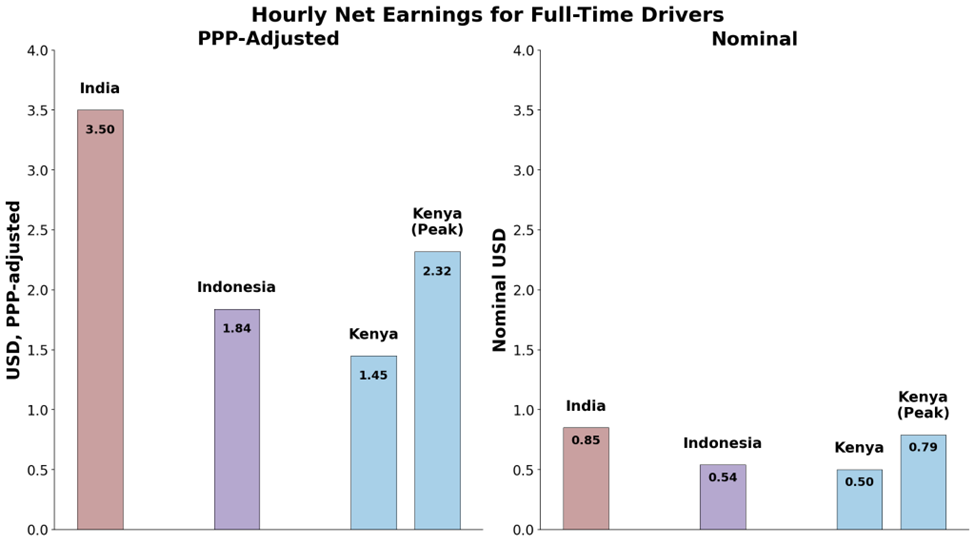
In PPP-adjusted terms, typical net hourly earnings are US$3.5 in India, $1.84 in Indonesia, and $1.45 in Kenya (Figure 1). In Kenya, we observe significant differences in gross hourly earnings at $5.39 prior to the Christmas holidays. The differences in net earnings between countries are explained by (1) differences in gross earnings – they are highest in India, due to lower idle time between orders, (2) differences in operating costs, which are highest in Kenya due to high motorcycle rental costs, and (3) differences in costs of living, which are lowest in India. These hourly rates are similar to other low-skilled jobs in India, but lower in Indonesia and Kenya. Offline drivers in Indonesia, however, earn less due to shorter wait times resulting from algorithmic customer matching.
Figure 1: Platform hourly net earnings from platform work for full-time drivers in PPP-adjusted USD (left) and nominal USD (right)
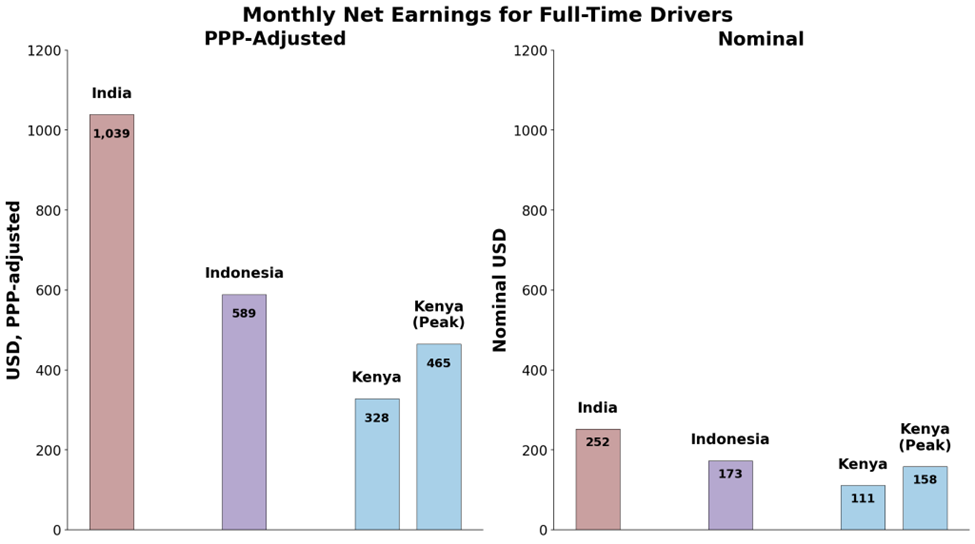
There's a crucial difference between platform gig driving and other work: drivers have the flexibility to choose how much they work. Full-time drivers work 72 hours/week in India, 77 in Indonesia, and 59 in Kenya. This allows them to increase monthly earnings. In India and Indonesia, this meaningfully exceeds what comparable casual or informal work in major cities can provide on a monthly basis. In Kenya, the high-earning periods (before the winter holidays) offer more than some other low-skilled full-time work, potentially explaining why workers choose platform work over full-time employment.
The lesson cuts across borders: platform work can deliver a higher monthly income because workers can scale up their hours.
Figure 2: Monthly platform net earnings for full-time drivers in PPP-adjusted USD (left) and nominal USD (right)
Three countries, three very different worker profiles
Worker profiles and conditions differ across these three contexts, despite the surface similarity of the work itself.
India is the most favourable environment for platform drivers. Net earnings are the highest, and workers have the most positive overall perception of the job: 40% of Indian drivers report no downsides at all (compared to 12% in Indonesia and 11% in Kenya). Indian drivers are younger and more educated than their counterparts in Indonesia and Kenya. For many of them, platform work looks less like a career and more like an entry into the labour market. Many who leave get better-paid full-time jobs.
Indonesian drivers are older than those in India and Kenya (average age of 38) and are far more dependent on the platform. They allocate 91% of their total working hours to platform work, compared to 60% in India and 71% in Kenya. Many Indonesian drivers treat gig work as a longer-term profession, with 79% reporting they do not see themselves leaving the platform, possibly because alternatives remain limited.
Kenya’s drivers face the highest operating costs, consuming 57% of gross earnings (30% in India, 33% in Indonesia), driven by high fuel prices and vehicle rental costs. Kenyan drivers are also the most likely to work on multiple platforms simultaneously, which likely suggests a more hectic working day. Perhaps most critically, drivers who leave the platform in Kenya often do so involuntarily, and 48% of inactive Kenyan drivers were terminated by the platform, compared to just 7% in India and 2% in Indonesia. After exiting, many are financially worse off, often returning to offline driving work.
Flexibility is a feature that is valued by many
Part-time work (<40 hours/week) is prevalent across all three countries: 78%, 49%, and 81% of drivers in India, Indonesia, and Kenya work fewer than 40 hours/week, suggesting many take advantage of the flexibility platform work offers. In India, about half are migrants from rural areas who value the ease of entry/exit from the platform (Brailovskaya et al. 2025), allowing them to visit their families. In all three countries, around 30% of those who exit eventually come back, usually when money is tight, suggesting that the platform works like an income shock absorber.
Where policy should focus
The discussion on improving workers’ welfare should acknowledge the diverse profiles and goals of platform workers. Blanket requirements, such as price floors on services, may not deliver the income gains workers need if higher prices drive down consumer demand (Nakamura and Siregar 2025). Caps on working hours, while well-intentioned, risk taking away the flexibility that many workers might enjoy: working more during peak seasons, during which the return per hour worked is higher or using gig work as insurance to meet urgent financial needs. Based on our findings and conversations with various stakeholders, we suggest the following areas for focus:
- Policies that reduce costs, such as subsidising the adoption of electric vehicles and improving charging infrastructure, can increase net pay without undermining platform viability. In both India and Kenya, we found that electric vehicle drivers earned higher net income by lowering operating costs.
- Platforms should experiment aggressively with low-cost benefits that improve retention and well-being, such as earned wage access (Adhvaryu et al. 2025), grievance redressal systems (Adhvaryu et al. 2026b), safety standards (Boudreau 2024), peer support (Adhvaryu et al. 2026c), or timely cash transfers (Chen et al. 2025). These aren't just good for workers; they're good business.
- Financial inclusion remains an area of untapped potential. For example, using earnings records to build alternative credit scores and expand access to low-cost credit can help drivers deal with various income shocks. While still nascent, some of these efforts are starting to shape up (Yadav 2024).
- There are ongoing debates about whether platforms should be required to provide benefits to their workers, as employers typically are (ILO 2021). Our view is that platform regulation should be ‘smart’ and respond to the realities of how workers choose to work, while maintaining financial sustainability. For example, platforms may be required to provide a benefit package to workers who have worked full-time for three months to reach a status that guarantees benefits for the following three months. Experimentation is key, and the impacts of this type of policy should be studied.
The choices policymakers and platforms make now will shape the livelihoods of tens of millions of workers across low- and middle-income countries. These choices should be informed by data and innovative thinking. Our data suggests a more nuanced picture than critics or defenders of the platform economy typically present.
References
Adhvaryu, A, S Dhanaraj, A Nyshadham, S Gade, and A Somanchi (2025), “The impacts of earned wage access on low-income women workers,” Unpublished manuscript.
Adhvaryu, A, M Atela, V Brailovskaya, P Dua, J S John, P Joshi, and R Royono (2026a), “Platform work: Evidence from drivers in India, Indonesia, and Kenya,” Unpublished manuscript.
Adhvaryu, A, S Gade, T Molina, and A Nyshadham (2026b), “Sotto voce: The impacts of technology to enhance worker voice,” Economic Journal, 136(674): 798–812.
Adhvaryu, A, A Aiyer, I Chhatwani, A Nyshadham, A Russell, H Schofield, P C L Souza, and H Wang (2026c), “Alleviating loneliness among migrant garment workers in India,” Good Business Lab.
Boudreau, L (2024), “Multinational enforcement of labor law: Experimental evidence on strengthening occupational safety and health committees,” Econometrica, 92(4): 1269–1308.
Brailovskaya, V, J S John, P Joshi, and L Singh (2025), “On the move: Qualitative study on migrant drivers in India’s digital gig economy,” Unpublished manuscript.
Chen, Y, M A Hossain, and S Sekhri (2025), “Liquidity constraints and real-time adaptation to extreme heat: Evidence from gig workers,” Unpublished manuscript.
International Labour Organization (2021), "World employment and social outlook: The role of digital labour platforms in transforming the world of work."
Nakamura, S, and R Siregar (2025), “Gig economy regulation meets flexible supply: Evidence from a price floor policy in Indonesia,” Unpublished manuscript.
NITI Aayog (2022), "India’s booming gig and platform economy: Perspectives and recommendations on the future of work," Government of India.
Yadav, P (2024), “RBI innovation hub pilots unsecured loan offerings for gig workers,” Inc42.