



Ethiopia’s large-scale road expansion cut travel times to markets – boosting farm productivity, reshaping cropping patterns, and accelerating structural change.
Editor’s note: For a broader synthesis of themes covered in this article, check out our VoxDevLits on Land Transport Infrastructure and Agricultural Technology in Africa.
Road network expansion is critical to closing Africa’s infrastructure deficit, which remains a major barrier to growth and inclusion (Briceno-Garmendia and Foster 2010). In agriculture, new roads help connect farmers in dispersed rural communities to crop and input markets. Can road investments help improve farming productivity and move workers out of agriculture and into other sectors? Ethiopia’s comprehensive road expansion since the late 1990s provides a rare natural experiment on the difference connectivity can make when done at scale.
When countries develop, workers move out of farming and into other sectors (Herrendorf et al. 2014). Agricultural productivity plays an important role in early stages of this process of structural change (Restuccia et al. 2008, Caselli 2005). Important recent work, using both empirical (Asher and Novosad 2020, Shamdasani 2021) and structural approaches (Costinot and Donaldson 2016, Sotelo 2020) shows that roads matter for agricultural productivity. In recent work (Adamopoulos 2025), I quantify the effects of Ethiopia’s large-scale road development programme not only for agricultural productivity but also for structural transformation and development, accounting for the reallocation of crop production and workers across space and sectors.
From isolation to integration: Ethiopia’s road network
Ethiopia offers a paradigmatic context to study the role of transport improvements for agricultural productivity and structural change. In the 1990s, Ethiopia was a low-income country, featuring poor agricultural productivity and widespread isolation of rural farming communities from markets. Rural roads and main arteries were either non-existent or of low quality. In 1997, Ethiopia embarked on an extensive road expansion programme, upgrading existing roads and adding new roads over several phases. From 1997 to 2014, this revolutionary road building programme transformed Ethiopia’s network (see Figure 1). The total network expanded threefold, with the rural network growing by 4.7 times. The proportion of asphalt roads in good condition increased from 17% to 73%.
Figure 1: Roads in Ethiopia
Panel A: Before the programme Panel B: After the programme
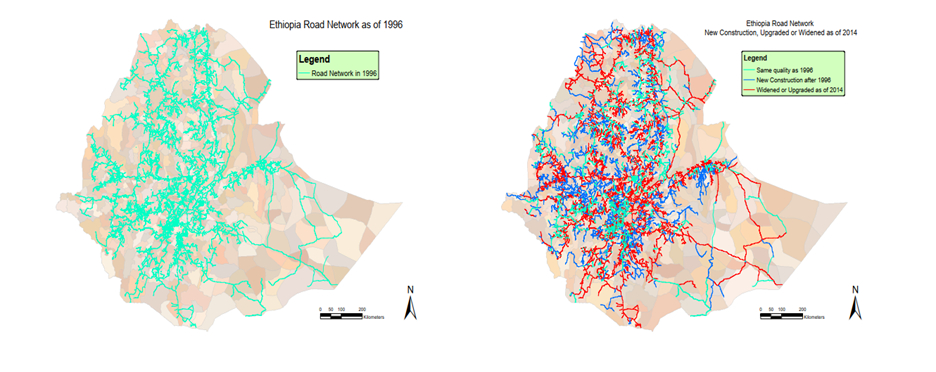
Notes: In Panel B, the network links in blue represent newly constructed roads after 1996; the network links in red represent rehabilitation or quality upgrade of pre-1996 network links.
I construct a novel panel dataset across districts in Ethiopia, from 1996 to 2014, consisting of agricultural production data and geo-coded travel time data. The agricultural production component uses household data from the Ethiopian Agricultural Sample Survey to aggregate district-level data on crop types and quantities, land allocation, and input use. To estimate travel times between districts and crop markets, I use data on GIS road network updates and terrain topography along the routes to markets. By 2014, both the level and variation in travel times to markets dropped.
Road expansion improved market access at the local level
I first use this data to estimate relative local effects of improved market access using a difference-in-differences approach, exploiting the staggered roll-out of the programme and its differing intensity across districts. I find that districts with improved access to grain markets experienced significant increases in productivity, with a 1 percentage point increase in market access resulting in a 0.1 percentage increase in the grain yield. I also find evidence of more fertiliser use and increased crop specialisation.
Evaluating the economy-wide effects of road expansion
To quantify the aggregate-level effects of the road expansion programme, I develop a spatial equilibrium model of structural change – a model of how regions and sectors interact as workers and crops shift in response to lower transport costs. In this model, regions differ in how productive they are in producing food and cash crops, and the transport costs in delivering crops to markets. Region-specific transport costs also affect the cost of intermediate inputs, such as fertiliser. In my framework, when transportation costs fall, they induce: (a) a reallocation of food production across space, with more productive regions increasing their share; (b) districts to specialise more in crops they are relatively better at; (c) an increase in intermediate input use; (d) a shift of workers out of agriculture, as the demand for food is inelastic. These shifts manifest into structural change and productivity effects at the aggregate and local level.
I empirically ground the model to 1996, pre-road expansion. I then ask: what would Ethiopia’s economy have looked like if the only change between 1996 and 2014 were the drop in transport costs brought about by the new roads?
Lower transport costs improve agricultural productivity and facilitate structural change
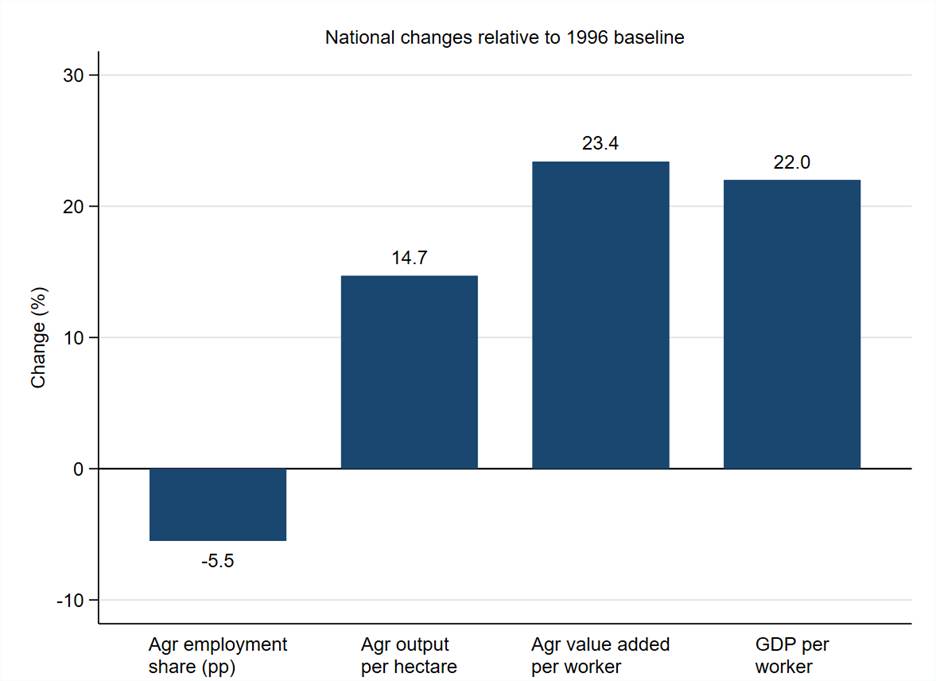
At the aggregate level, the road network overhaul implies substantial structural change, with a drop in the employment share in agriculture by 5.5 percentage points, reflecting a shift of workers into non-agriculture (see Figure 2). Overall, the aggregate yield (output per unit of land) increases by 14.7%, with additional direct resource savings from lower transport costs. To put these gains into perspective, they account for about one-tenth of the overall yield gain over the study period. These changes result in a substantial increase – 23.4% – in agricultural value added per worker. What underlies the agricultural productivity boost? The lower transport costs make intermediate inputs cheaper and even the playing field across districts, inducing an uptake in crop production by the more productive regions. Given the inelastic demand for food, freed up agricultural land shifts to cash crops. Given the size of the agricultural sector in Ethiopia, this structural transformation implies a 22% increase in aggregate real income.
Figure 2: Aggregate effects of new roads
Does everyone gain from building roads?
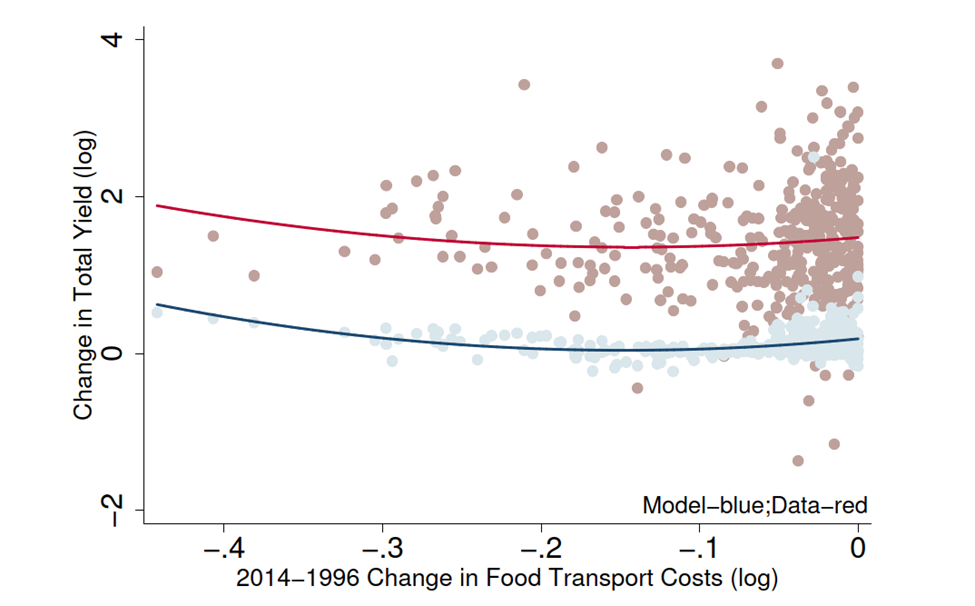
Despite the sizable aggregate effects, in terms of local outcomes, I find that the gains from lower transport costs are uneven across districts. As shown in Figure 3, there is a U-shaped pattern of district-level yield gains with respect to food transport cost changes across districts, a relationship that is also present in the data. Districts that mainly grow food crops gained the most when their travel times dropped sharply, as cheaper access reinforced their advantage in food production. But in districts that grew both food and cash crops, the biggest winners were often those with only small reductions in travel time. For them, even though food transport became a bit cheaper, cash crops became relatively more attractive, shifting production to the latter.
Figure 3: District effects of new roads
Policy lessons on transport infrastructure and agriculture
The key lesson is that transport investments can do far more than raise yields: they can catalyse structural transformation – fewer farmers, larger farms, more export-oriented crops, and a shift of workers into more productive sectors. Given the importance of agriculture for lower-income countries, productivity gains have reverberating effects on aggregate income. Road infrastructure investments can be part of an inclusive-growth strategy to reduce spatial inequality. But policymakers should not expect uniform gains.
Some districts will benefit more than others, depending on their initial crop mix, inherent productivities, and location. Transport costs remain a binding constraint. Even after major progress, average travel times and dispersion across districts are still high, highlighting the need for further improvements in the road network. These lessons are relevant for other sub-Saharan African economies facing similar challenges, looking to better integrate farmers with crop and input markets. Finally, though not examined here, transportation improvements can also improve the crop-specific productivities within districts – a potential direction for future research.
References
Adamopoulos, T (2025), “Spatial integration and agricultural productivity: Quantifying the impact of new roads,” American Economic Journal: Macroeconomics 17(1): 343–378.
Asher, S, and P Novosad (2020), “Rural roads and local economic development,” American Economic Review 110(3): 797–823.
Briceno-Garmendia, C M, and V Foster (2010), “Africa’s infrastructure: A time for transformation,” World Bank.
Caselli, F (2005), “Accounting for cross-country income differences,” in P Aghion and S Durlauf (eds.), Handbook of Economic Growth 1: 679–741.
Costinot, A, and D Donaldson (2016), “How large are the gains from economic integration? Theory and evidence from US agriculture, 1880–1997,” NBER Working Paper.
Herrendorf, B, R Rogerson, and A Valentinyi (2014), “Growth and structural transformation,” in P Aghion and S Durlauf (eds.), Handbook of Economic Growth 2: 855–941.
Restuccia, D, D T Yang, and X Zhu (2008), “Agriculture and aggregate productivity: A quantitative cross-country analysis,” Journal of Monetary Economics 55(2): 234–250.
Shamdasani, Y (2021), “Rural road infrastructure and agricultural production: Evidence from India,” Journal of Development Economics 152: 102686.
Sotelo, S (2020), “Domestic trade frictions and agriculture,” Journal of Political Economy 128(7): 2690–2738.