






In-person household surveys measuring women’s empowerment encounter difficulties collecting data on sensitive questions, particularly those related to domestic violence. New research on Ethiopia reveals minimal differences, if any, between phone vs. in-person surveys or male vs. female enumerators, offering reassurance to survey efforts with thin budgets.
Measuring women's experiences and views on sensitive gender norms and outcomes is essential for tracking gender equality progress (UN n.d.). However, certain questions can be deeply sensitive in nature—for example, asking whether a husband is justified in hitting his wife if she burns the food. In some cases, answering these questions can be difficult, or even dangerous, for female survey respondents. Alternatively, a respondent may tell an enumerator what she believes the enumerator wants to hear, rather than what she actually believes (Seymour and Peterson 2018).
Although enumerators are trained on how to mitigate reporting bias (Glennerster et al. 2018), implementing these best practices is often difficult and/or expensive. To make sure women feel comfortable answering truthfully, enumerators might make multiple visits, ensuring women provide accurate answers when their husbands or other people are not around. Even then, women may still fear that someone may overhear the interview, and answer differently than they would if privacy were a guarantee.
It may also be unsafe for female enumerators to travel in the most remote or insecure areas. When budgets are tight, or pandemics or civil conflict breaks out, a shift to remote methods may be required mid-survey. Phone surveys can maintain continuity, but concerns about data quality and comparability arise if a switch is made mid-survey.
In Kadam et al. (2025), we examine whether the identity of the interviewer (men or women) and mode of interview (by phone or in-person) affect women’s responses to sensitive questions. Results from our randomised survey experiment offer some reassurance that these design choices may matter less than commonly thought. In fact, we find that phone surveys may even allow the least empowered women to more comfortably speak their minds.
The importance of studying women’s empowerment in Ethiopia
Rural Ethiopia was an ideal setting to study the impact of survey privacy and enumerator gender for sensitive questions on women’s experiences, where poor women are among the least empowered in the world. According to the Demographic and Health Surveys (DHS) from 2016, 77% of married women in our study area agreed that husbands are justified in beating their wives under certain conditions (CSA and ICF 2016). This rate far exceeds the average in Ethiopia (63%), across Sub-Saharan Africa (45%), and globally (41%) (Head et al. 2014).
In this context, ensuring privacy during interviews indeed seems to be difficult. The DHS protocol requires female enumerators to confirm that they are alone with the respondent during sensitive modules. Despite this, 4% of interviews were interrupted by someone, usually the woman’s husband. Since women may fear being overheard even if they’re not aware of an interruption, this represents a lower bound on the extent of the issue.
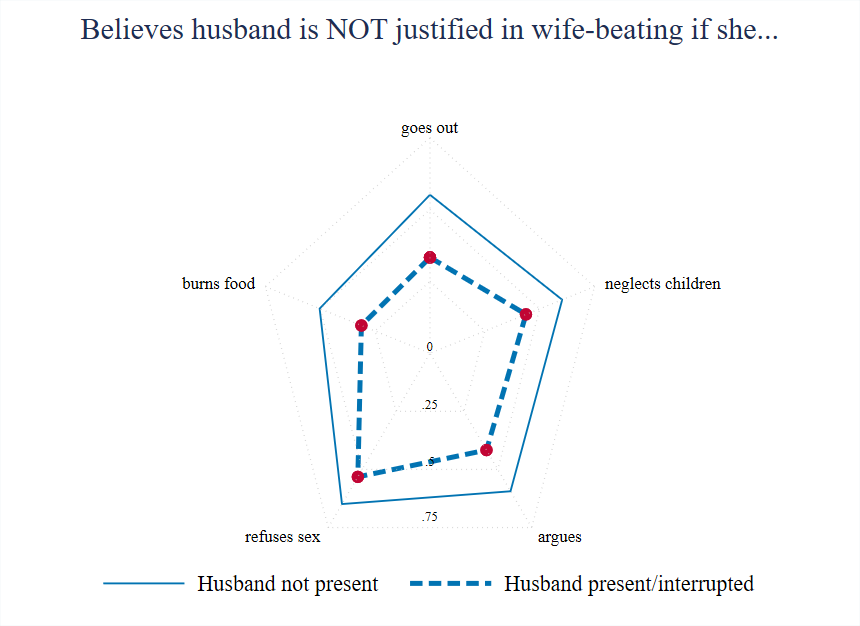
Privacy also matters for women’s responses. Figure 1 shows that interrupted DHS interviews were more likely to record a respondent saying they think domestic violence by a husband toward a wife can be justified. But it is not clear whether these women were expressing their genuine views or responding in a way that would protect them should their husband overhear.
Figure 1: Interview interruptions may yield inaccurate results if women don’t speak their mind
Alternative survey methods can introduce complications, additional costs, and even error
Some alternatives to the ‘best practice’ of in-person interviews conducted by female enumerators have been tested, but these approaches also face significant challenges.
For example, ‘list experiments’ identify the prevalence of a sensitive behaviour in a group by randomly including a sensitive question in a list of otherwise straightforward ones and comparing the responses. Although this anonymity can induce disclosure, the information is only known at the group level—there is no guarantee that a particular respondent’s experience can be pinned down this way. This method may also unnecessarily lengthen interviews.
Alternatively, a ‘garbling’ technique can be used to introduce plausible deniability, which can be useful for reporting on harassment, for example. This may be helpful for targeting an intervention, but has the same issue of uncertainty for the enumerator, making targeting imperfect (Boudreau et al. 2023).
Researchers could instead pass a tablet to a respondent for them to complete the survey on their own, but in contexts with low literacy rates this may be impossible and/or require a specially designed user interface. Even a survey that overcomes literacy issues may suffer from misreporting issues if respondents are not familiar with the system (Park et al. 2023). These interviews still require field visits, tablets, and software design and testing—logistics that are complex and costly.
Survey mode and enumerator gender have negligible effect on women’s responses to sensitive questions
We tested three different methods for administering a 15-minute sequence of sensitive questions on women’s life experience, covering topics such as physical safety, emotional well-being, and freedom of movement:
- Face-to-face interviews with a male enumerator
- Phone interviews with a male enumerator
- Phone interviews with a female enumerator
We note that in our setting, it was not possible to conduct in-person interviews with female enumerators, as our implementing partner did not feel it was safe for female enumerators to work in remote areas at the time.
First, we tested whether a phone interview generates different responses compared to an in-person interview, using responses from women interviewed by male enumerators (B vs. A). We find that responses were similar on average, regardless of survey mode.
Second, we tested whether female enumerators receive different answers compared to male enumerators, when interviews are conducted by phone (C vs. B). Again, we find that responses are similar on average, regardless of enumerator gender.
In summary, we found that for the average respondent in our sample of ultra-poor women in rural Ethiopia, survey method (phone vs. in-person) and enumerator gender (male vs. female) did not seem to be important.
Figure 2: Effect of survey mode (panel a) and enumerator gender (panel b) on reporting of each individual question
Panel a
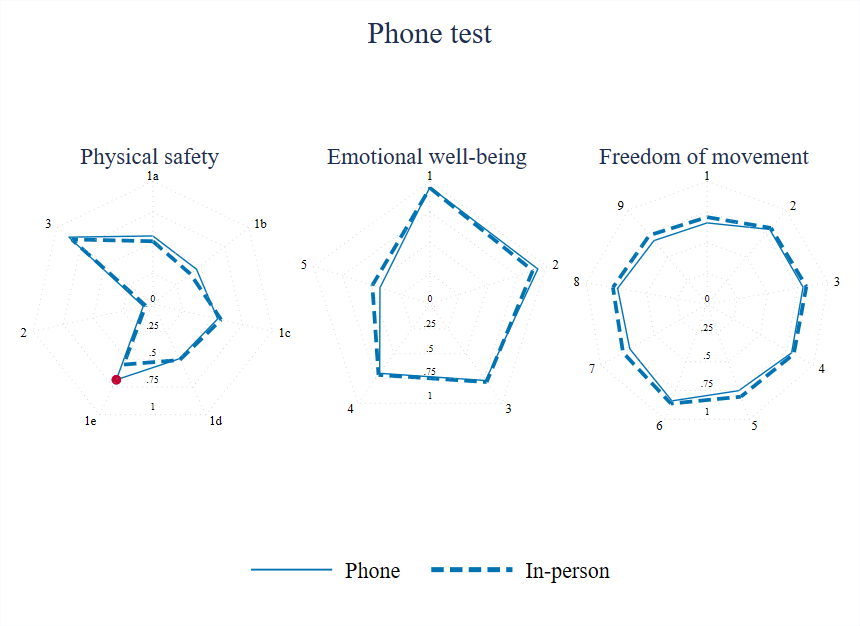
Panel b
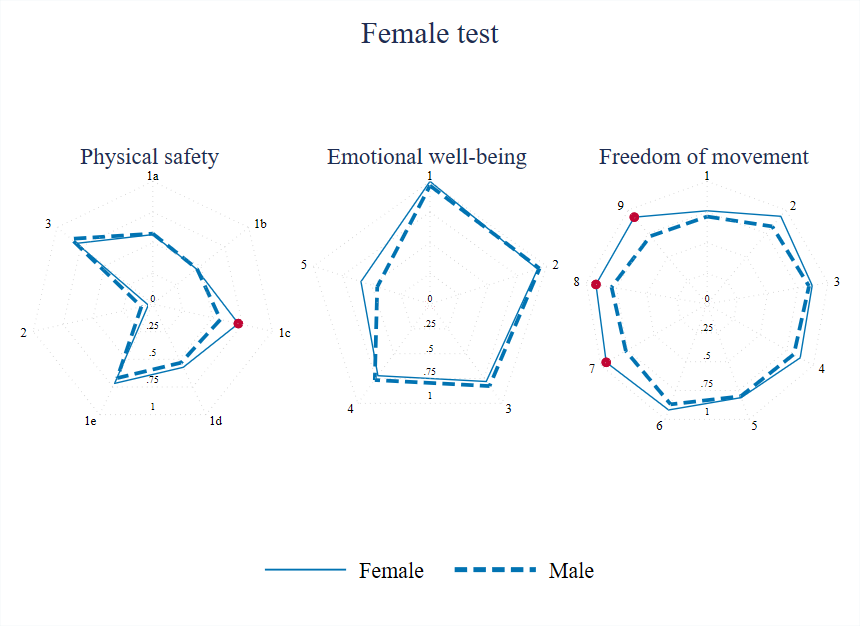
Note: Higher values indicate relatively more empowered responses.
However, the least empowered women do answer some questions differently when afforded the privacy of a phone survey. Using a baseline measure collected in person for all women, we found that those with the lowest levels of independence and asset control were significantly more likely to oppose domestic violence when interviewed via phone rather than in person. These women may have felt more comfortable expressing these beliefs knowing that, even if someone could hear their yes/no response, the question was only audible to the respondent. That is, the added confidentiality may have created a safer space to express controversial views. However, for respondents interviewed by phone the enumerator’s gender still did not matter.
Figure 3: Women’s reported disapproval of domestic violence, by interview type
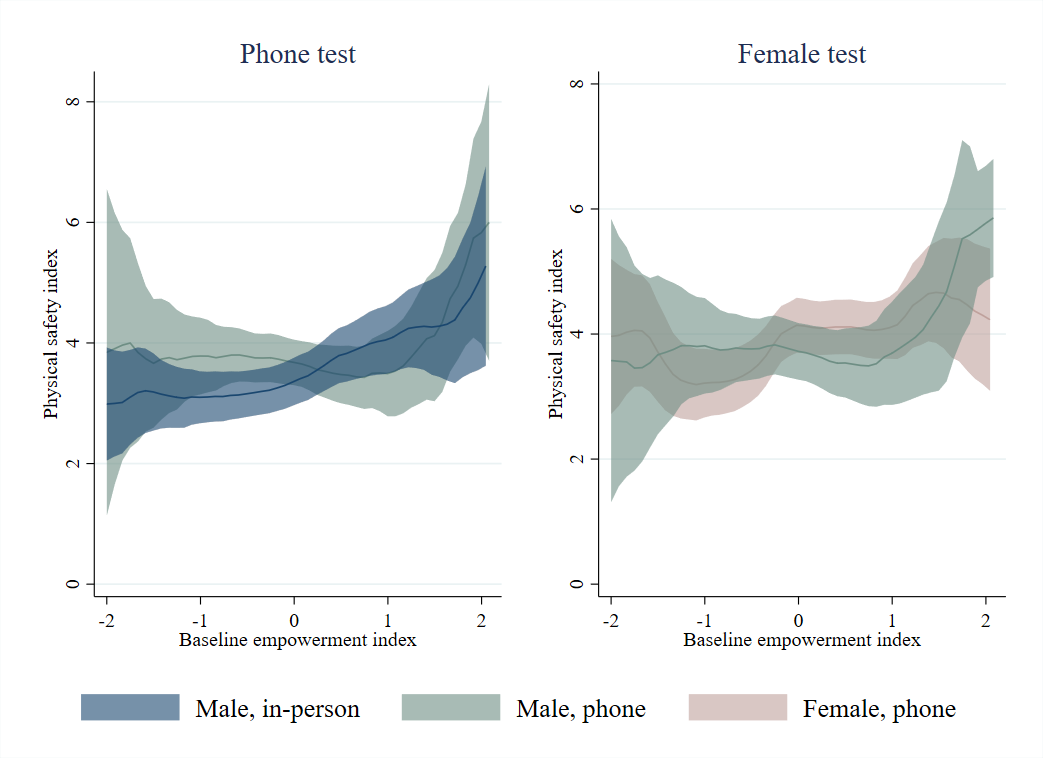
Note: Women with the lowest baseline empowerment (horizontal axis) are more likely to say that husbands are not justified in beating their wives during phone interviews (green) compared to in-person interviews (blue). There is no difference in responses for female enumerators (pink) compared to male enumerators by phone (see right panel).
These results offer good news: phone-based interviews can get the same information, or perhaps even more accurate information, than in-person interviews—which require high costs in remote areas. Since interviewer gender does not appear to affect responses in phone surveys, teams may have greater flexibility, potentially lowering staffing costs.
Making progress on equality requires good measurement and context consideration
Sustainable Development Goal (SDG) 5—to achieve gender equality and empower all women and girls—requires measurable indicators and reliable tools to track progress. Our findings suggest that phone surveys, though relatively impersonal, can offer a cost-effective alternative to in-person interviews without compromising data quality. In rural Ethiopia, where mobility may be restricted by conflict or health crises (e.g. COVID-19), phone-based surveys present a promising approach—especially for collecting sensitive data from women.
Despite concerns that survey modality and enumerator characteristics shape self-reported outcomes (Beegle et al. 2024, De Weerdt et al. 2020, McKenzie and Rosenzweig 2012), our results suggest these factors may matter less than expected. We find little evidence that survey mode or enumerator gender systematically influences women’s responses on gender-sensitive topics.
Still, successful implementation depends on careful design. Phone surveys require reliable mobile networks, widespread phone ownership, and high-quality enumerator training. Ensuring that women have the opportunity and confidence to speak freely remains essential. Context matters: survey instruments must reflect local norms and constraints, and enumerator teams must be equipped to navigate them.
As development organisations face increasingly thin budgets, the need for scalable, low-cost data collection methods is increasingly urgent. Our results offer encouraging evidence that phone-based surveys can support this goal, allowing us to track progress toward gender equality without sacrificing data quality.
References
Beegle, K, A Dillon, D Karlan and C Udry (2024), “Introduction to the Journal of Development Economics special issue on methods and measurement,” Journal of Development Economics, 170: 103303.
Boudreau, C, M Callen, J Dunning, M Gulzar, and C Martinez (2023), “Providing plausible deniability empowers workers to report harassment,” VoxDev.
Central Statistical Agency (CSA) [Ethiopia] and ICF (2016), "Ethiopia Demographic and Health Survey 2016".
De Weerdt, J, J Gibson and K Beegle (2020), “What can we learn from experimenting with survey methods?” Annual Review of Resource Economics, 12: 431–447.
Glennerster, R, C Walsh and L Diaz-Martin (2018), "A practical guide to measuring women’s and girls’ empowerment in impact evaluations", J-PAL.
Head, S K, S Zweimueller, C Marchena and E Hoel (2014), "Women’s lives and challenges: Equality and empowerment since 2000".
Kadam, A, E B McCullough, T McGavock and N P Magnan (2025), “Who is asking and how? Effects of survey mode and enumerator gender on measuring women’s life experience,” World Development, forthcoming.
McKenzie, D and M Rosenzweig (2012), “Preface for symposium on measurement and survey design,” Journal of Development Economics, 98(1): 1–2.
Park, A, M Dey, R Field and A Miquel (2023), “The challenge of measuring intimate partner violence via self-interviewing,” VoxDev.
Seymour, G and A Peterman (2018), “Context and measurement: An analysis of the relationship between intrahousehold decision-making and autonomy,” World Development, 111: 97–112.
United Nations (UN) (n.d.), “Goal 5: Achieve gender equality and empower all women and girls,” United Nations Sustainable Development Goals.