






Evidence on the impact of NAFTA in Mexico shows that Mexican consumers benefited through lower prices, while Mexican producers benefited from larger profit margins due to lower input prices and higher markups.
Editor’s note: For a broader synthesis of themes covered in this article, check out Issue 2 of our VoxDevLit on International Trade.
Tariffs have dominated headlines recently, igniting debates over who ultimately bears the costs and reaps the benefits when policy shifts. To address this key question, we must first consider those that are immediately affected by tariffs: importers and exporters. For instance, when an importing country raises or lowers tariffs, how much of that change is reflected in import prices? Do these import prices shift one-for-one, placing the burden entirely on local importing firms, and ultimately domestic consumers? Or do foreign exporters adjust their prices to absorb some of these price changes? Further, when import prices change due to tariffs, how do importers react in their output prices? Do they pass-on the input price change entirely downstream or do they absorb part of the input price change by adjusting markups? Given the complexity of supply chains, understanding how firms respond via price adjustments is crucial––not just for determining who pays, but for understanding the broader welfare effects and informing trade policies.
Given the centrality of this question, the evidence on the impact of tariffs is extensive. For instance, in India, De Loecker et al. (2016) find that trade liberalisation increased firms’ markups via access to cheaper foreign inputs. In comparison, in the US, tariffs implemented during the first Trump administration increased import prices one-for-one, suggesting that exporters did not adjust their markups on goods sold to the US (Amiti et al. 2019, Fajgelbaum et al. 2020, Cavallo et al. 2021).
While much of the evidence centres around episodes of unilateral trade liberalisation (or unilateral increases in tariffs), reciprocal trade liberalisations (i.e. bilateral and regional agreements among groups of countries) have also been a key driver; for example, the North American Free Trade Agreement (NAFTA) in 1994. Reciprocal trade liberalisation differs from unilateral trade liberalisation as it involves reductions in tariffs on both exports to and imports from participating countries. These tariff reductions may affect domestic firms’ prices and the competition they face through multiple channels. As tariffs on imports fall, domestic firms face more competition but can simultaneously take advantage of cheaper imported inputs. In addition, as foreign tariffs on exported goods fall, exporters may enjoy greater access to foreign markets.
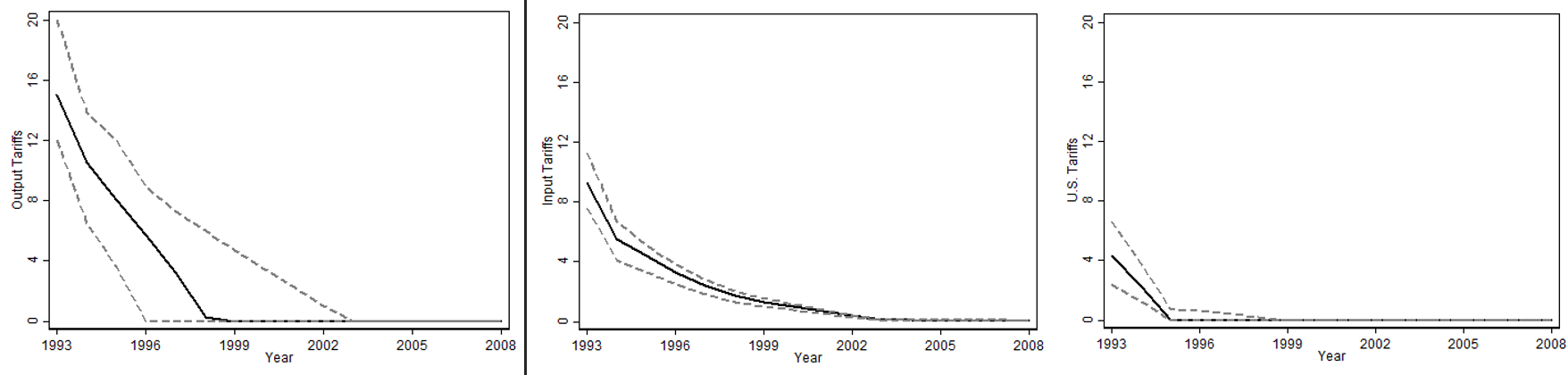
In a recent paper (Brugués et al. 2025), we empirically analyse the impact of reciprocal trade liberalisations, focusing on the price response of Mexican manufacturing plants to NAFTA. Following the empirical framework developed by De Loecker et al. (2016), we derive estimates of markups and marginal costs for each plant-product-destination combination. There are multiple channels through which tariff reductions under NAFTA affected markups and marginal costs, and hence prices, of Mexican manufacturing plants. We illustrate these by examining three separate series of tariffs: Mexican tariffs on goods that Mexican manufacturers produce (output tariffs), Mexican tariffs on goods that Mexican manufacturers use as inputs (input tariffs), and US tariffs on Mexican exports by these manufacturers. Figure 1 presents the median as well as the 25th and 75th percentiles of these tariffs over time, showing a substantial decline in all three tariffs after NAFTA came into effect in 1994.
Figure 1: Time series of output tariffs, input tariffs, and US tariffs
Panel A: Output tariffs Panel B: Input tariffs Panel C: US tariffs
Tariff reductions increased competition for domestic goods
We first focus on the impact of these tariff reductions on products that are domestically sold. Since US tariffs would not have had a direct impact on domestic prices, we focus here on the output and input tariffs. Using data provided by INEGI (National Institute of Statistics and Geography of Mexico), we find that Mexican plants reduced the prices of domestically sold products in response to the reductions in Mexican output tariffs, through increased competition. This pro-competitive channel is also corroborated by our finding that the decline in output tariffs under NAFTA led these plants to increase future productivity.
Meanwhile, reductions in input tariffs affected the prices of domestically sold products through two channels. First, they directly reduced the costs of inputs, thereby reducing prices. Second, the reduction in costs enabled plants to increase markups. We find that the first channel dominated the second, resulting in a slight reduction in prices. Overall, our estimates imply that the input and output tariff declines combined led to an average reduction in prices of Mexican domestic products by around 11.3%. This was the result of the decline in marginal costs being partially offset by the increase in markups.
Tariff reductions led to lower export prices via greater market access
For exported products, we investigate the effects of the reductions in the input tariffs and US tariffs. Input tariffs had a similar effect on export prices as on domestic prices: export prices decreased as the direct effect of cost reduction dominated the markup increase. Furthermore, we find that US tariff reductions have also led Mexican manufacturers to increase their markups on exports, taking advantage of greater access to the US market; this anti-competitive behaviour is in line with previous research (De Blas and Russ 2015). Because of these increases in markups, prices of exported products decreased only slightly despite the tariff reductions: the input and US tariff reductions combined led to an average reduction in prices of Mexican exports by only around 2.4%.
Implications for trade policy
Taken together, these results suggest that Mexican consumers benefited from NAFTA through lower prices. Mexican producers, at the same time, benefited from larger profit margins realised through lower input prices and higher markups. Our results suggest incomplete pass-through of tariff changes to import prices, as exporters took advantage of the reduction in tariffs they faced in the destination market by increasing markups.
While these results shed light on how firms adjust their prices in response to tariff changes, it is important not to generalise too quickly across different episodes. In response to ongoing US tariff increases, it is tempting to predict that foreign exporters will cut prices, thereby preventing US consumers to bear the full burden. Yet, as mentioned above, evidence from the tariff increases during the first Trump administration suggests that this is not always the case. These mixed results highlight the complexity of trade and firms’ pricing decisions, calling for more research to better understand the mechanisms behind firms’ responses to tariff changes.
References
Amiti, M., Redding, S. J., and Weinstein, D. E., 2019, “The impact of the 2018 tariffs on prices and welfare,” Journal of Economic Perspectives, 33(4): 187–210.
Brugués, F., Kikkawa, A. K., Mei, Y., and Robles, P., 2025, “The impact of NAFTA on prices and competition: Evidence from Mexican manufacturing plants,” Journal of International Economics, 155: 104085.
Cavallo, A., Gopinath, G., Neiman, B., and Tang, J., 2021, “Tariff pass-through at the border and at the store: Evidence from US trade policy,” American Economic Review: Insights, 3(1): 19–34.
De Blas, B., and Russ, K. N., 2015, “Understanding markups in the open economy,” American Economic Journal: Macroeconomics, 7(2): 157–180.
De Loecker, J., Goldberg, P. K., Khandelwal, A. K., and Pavcnik, N., 2016, “Prices, markups, and trade reform,” Econometrica, 84(2): 445–510.
Fajgelbaum, P. D., Goldberg, P. K., Kennedy, P. J., and Khandelwal, A. K., 2020, “The return to protectionism,” Quarterly Journal of Economics, 135(1): 1–55.