






Evidence from Sierra Leone shows that digital participatory budgeting can increase government legitimacy in weak states but only increases tax compliance for supporters of the incumbent government.
Editor’s note: For a broader synthesis of themes covered in this article, check out our VoxDevLit on Taxation.
Governments in low-income countries often struggle to raise adequate tax revenues to fund national development (Bachas et al. 2022), undermining economic development and political stability (Besley and Persson 2011). This problem is particularly acute at the local level, as property taxes—the backbone of subnational revenue raising around the world—are by far the most underperforming major tax types across lower-income countries (Brockmeyer et al. 2021).
While the problem is widely recognised, governments have frequently remained trapped in a vicious cycle of limited capacity, low public trust, and low compliance. In Grieco, Kamara, Meriggi, Michel, and Prichard (2025), we study the possibility that governments can advance efforts to build fiscal capacity—and state capacity more broadly—by increasing their legitimacy. Such improvements in legitimacy have the potential to both (a) strengthen quasi-voluntary tax compliance, and (b) increase public support and reduce political opposition to government efforts to strengthen tax collection.
Participatory budgeting as a means of improving voluntary tax compliance
Specifically, we study the impact of implementing a process of participatory budgeting, as part of a broader property tax reform programme in Freetown, Sierra Leone. The idea that participatory budgeting may increase perceptions of government legitimacy is reflected in the widespread adoption of these budgeting models since gaining popularity in Porto Alegre, Brazil, in the 1990s (Sintomer et al. 2010). In turn, the potential link between public participation and tax compliance is central to seminal accounts of the development of fiscal capacity in early modern Europe (North and Weingast 1989), as well as the American Revolution’s rallying cry of “no taxation without representation”. Yet despite this enthusiasm, rigorous evidence on participatory budgeting's impacts on legitimacy—and on tax compliance specifically—remains surprisingly limited.
The participatory budgeting intervention we study was implemented as part of an ambitious property tax reform that aimed to transform Freetown’s revenue landscape (The Economist 2020). The reform fully digitalised the property tax system, broadened the tax base—less than 50% of the approximately 105,000 properties had been registered previously—and made the tax burden more equitable through a transparent property valuation scheme (Grieco et al. 2019). Assessed tax liabilities increased fivefold, concentrated among higher-value properties, and revenue collection tripled in the first year (Prichard et al. 2020).
As part of this high-stakes tax reform, we partnered with the Freetown City Council to launch a large-scale participatory budgeting policy experiment, with the aim of increasing voluntary tax compliance and building the municipal government’s legitimacy. We invited 1,809 property owners to participate in Digital Town Halls—interactive WhatsApp forums where they could discuss local priorities with neighbours and politicians, propose development projects, and vote on how funds should be spent. The winning projects, valued at around US$1,500 each, were then implemented in participants’ neighbourhoods. This approach allowed us to isolate the effects of participation itself, as both treatment and control groups received the same public services, but only participants engaged in the deliberative process were notified when projects were completed.
Figure 1: Elements of the Digital Town Hall intervention
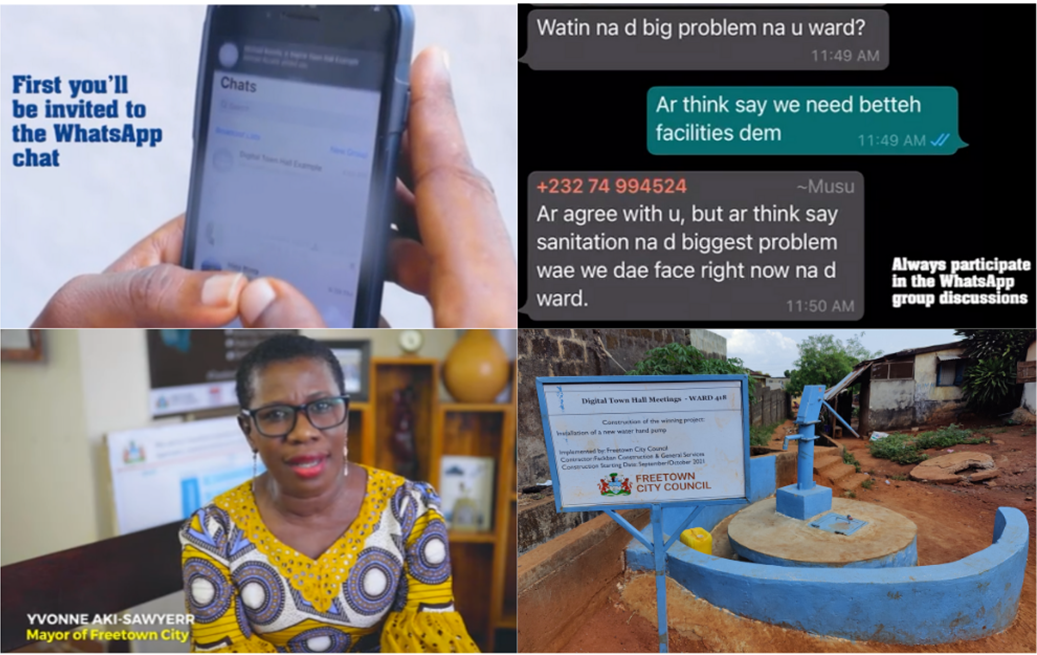
Notes: Participants were invited to join WhatsApp chat groups (top left), where they discussed local development challenges with neighbours (top right), communicated these challenges to local politicians (bottom left), and then voted on public services to be implemented in their neighbourhoods (bottom right).
Citizen participation in policymaking improves perceptions of government legitimacy
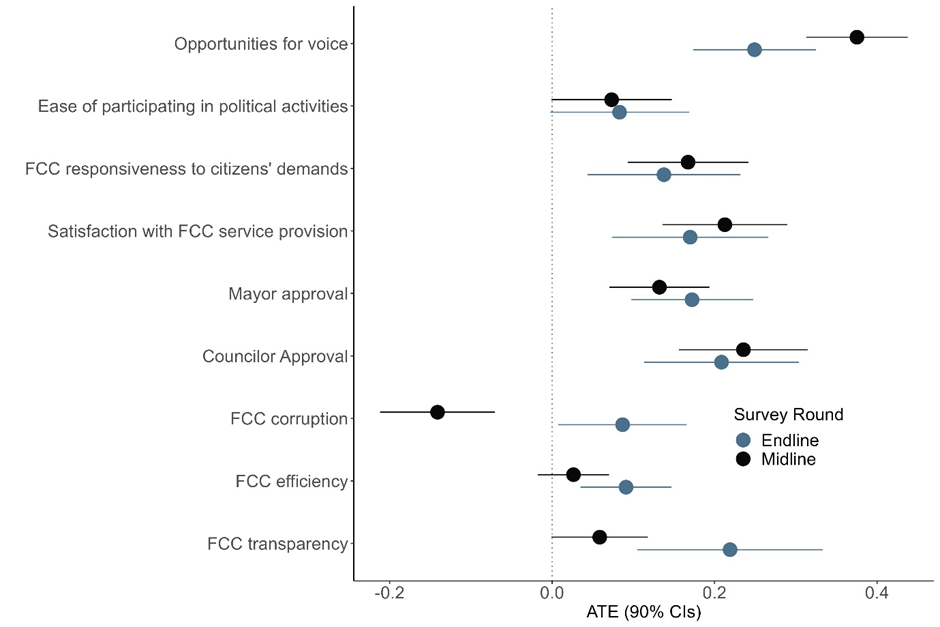
The Digital Town Halls substantially increased participants' perceptions of government legitimacy across multiple dimensions. Treated citizens reported feeling significantly more heard by government, satisfied with service delivery, and trusting of local politicians and institutions. These gains persisted months after the intervention ended, and positive effects on perceptions of city council corruption and efficiency were strongest in the endline survey, after participants observed that promised services had actually been delivered.
The results confirm a core insight of democratic theory: when citizens feel they have a meaningful voice in governance, governments gain credibility. Importantly, these legitimacy gains occurred across the political spectrum, with both supporters and opponents of the mayor's party reporting more positive views of government after participation.
Figure 2: Treatment effects on legitimacy outcomes
The impact of participation on tax compliance is moderated by political partisanship
Despite the substantial gains in government legitimacy, we found no overall impact of the Digital Town Halls on property tax compliance. Treated property owners were no more likely to pay their taxes than those in the control group—a surprising result given increases in legitimacy and strong theoretical predictions linking participation and legitimacy to voluntary compliance.
However, this null average effect masks striking heterogeneity along political lines. Among supporters of the mayor's party, participation in the Digital Town Hall led to a 7.4 percentage point increase in tax compliance—a substantial 32% boost relative to their baseline rate. In contrast, compliance among opponents of the mayor's party decreased by 4 percentage points following the Digital Town Halls. This same polarising pattern appears in participants’ attitudes toward taxation. Supporters of the mayor's party became more willing to support expanding taxation for improved services, while opposition supporters became less supportive of tax increases. These results prove robust to a wide variety of checks, including confirming that the two groups do not differ significantly in economic characteristics or service preferences.
Figure 3: Tax compliance treatment effects conditional on partisan affiliation
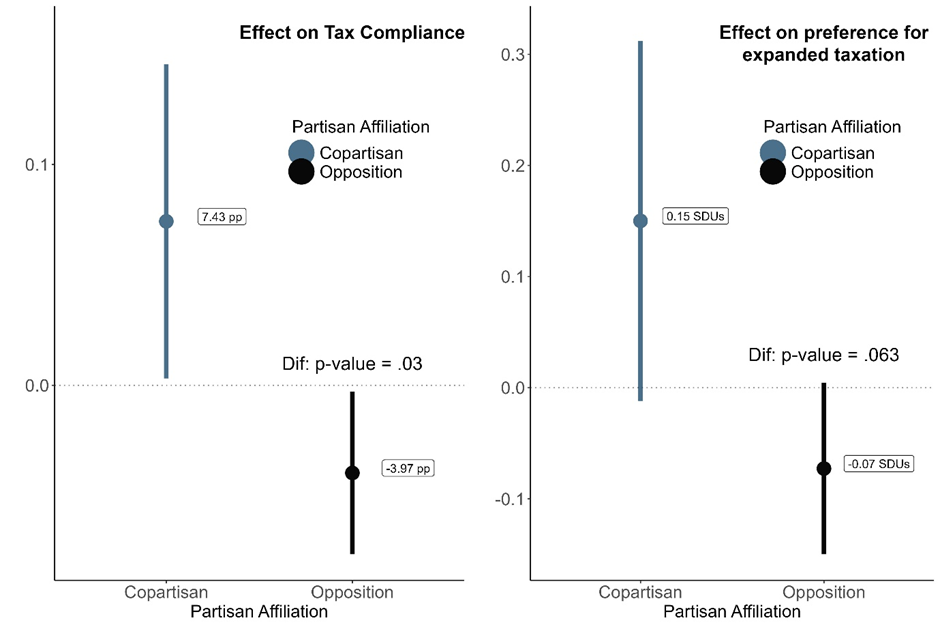
Why does participation generate these opposing effects? We argue this reflects partisan cue exposure: through the Digital Town Halls, citizens learned more about where political parties stood on the controversial property tax reform. The mayor and her party strongly advocated for expanding taxation through the reform, while other parties actively opposed this reform. When participants were exposed to these competing messages, they updated their preferences and behaviours to align with their preferred party's position—supporting the tax if they backed the mayor, opposing it if they supported the opposition.
Policy implications: Participatory state-building in politicised contexts
Our findings offer nuanced insights for donors and policymakers considering participatory budgeting as a tool for strengthening fiscal capacity in weak states. On the upside, participatory budgeting can deliver on its democratic promise: citizens in Freetown who joined the Digital Town Halls viewed the government as more legitimate, across many dimensions, and those gains persisted months after the intervention and occurred across political divides. This suggests that participation can indeed build the foundation for stronger state-society relations and contribute to opening political space for contentious tax reform efforts. These results are particularly encouraging because the digital nature of the intervention means it was simple and cost-effective to implement and administer. The Digital Town Hall is an exciting example of how technology can engage citizens in public-policy processes.
However, our results also reveal an important caveat: in politically contested environments, participation can polarise compliance behaviour in the short term even as it builds legitimacy. When policy reforms become entangled with partisan competition—as was the case with Freetown's property tax reform—participatory interventions may deepen existing political divisions rather than bridge them. While supporters of the governing party increased their tax compliance substantially, opposition supporters reduced theirs. This resulted in no net revenue gains, as the design of the intervention—which proactively invited a random sample of taxpayers—ensured relatively equal representation of political supporters and opponents of the governing party.
These results suggest that the design and timing of participatory interventions matter enormously. Policymakers should carefully consider the political context when implementing such programmes, particularly during periods of policy reform. In the short term, the challenge is to design participatory institutions that enhance citizen voice while avoiding the politicisation that can undermine their fiscal objectives. In the longer term, however, the legitimacy gains we document may create more supportive environments for governments pursuing ambitious state-building reforms—even if the immediate compliance effects are mixed.
References
Bachas, P J, M Fisher-Post, A Jensen, and G Zucman (2022), “Capital taxation, development, and globalization: Evidence from a macro-historical database”, Unpublished manuscript.
Besley, T and T Persson (2011), Pillars of Prosperity: The Political Economics of Development Clusters, Princeton University Press.
Brockmeyer, A, A Jensen, L Gadenne and M Singh (2021), “Taxing property in developing countries: Theory and evidence from Mexico”, Unpublished manuscript.
Economist, The (2020), “A mayor is reforming Sierra Leone’s rotten property tax”, The Economist.
Goldfrank, B (2012), “The World Bank and the globalization of participatory budgeting”, Journal of Deliberative Democracy, 8(2).
Grieco, K, A B Kamara, N F Meriggi, J Michel, W Prichard, and G Stewart-Wilson (2019), “Simplifying property tax administration in Africa: Piloting a points-based valuation in Freetown, Sierra Leone”, Unpublished manuscript.
Grieco, K, A B Kamara, N F Meriggi, J Michel, and W Prichard (2025), “Participation, legitimacy and fiscal capacity in weak states: Evidence from participatory budgeting”, Unpublished manuscript.
Jensen, A, A Brockmeyer, and L Gadenne (2024), “Taxation and development”, VoxDevLit, 12(1).
North, D C and B R Weingast (1989), “Constitutions and commitment: The evolution of institutions governing public choice in seventeenth-century England”, Journal of Economic History, 49(4): 803–832.
Prichard, W, A B Kamara, and N Meriggi (2020), “Freetown just implemented a new tax system that could quintuple revenue”, African Arguments.
Sintomer, Y, C Herzberg, G Allegretti, and A Röcke (2010), “Learning from the South: Participatory budgeting worldwide – An invitation to global cooperation”, InWent.