





Does the widespread availability of ride-hailing services in fast growing, congested cities in the developing world undermine the viability of potential investments in public mass rapid transit (MRT) systems? New evidence from Indonesia suggests that ride-hailing services significantly improve MRT systems’ ability to attract customers by boosting first/last-mile connectivity.
Editor’s note: For a broader synthesis of themes covered in this article, check out our VoxDevLit on Land Transport Infrastructure.
For years, the narrative around ride-hailing services in congested developing cities has been fraught with tension. On the one hand, they offer convenient, reliable, and affordable transport to millions of commuters navigating chaotic urban landscapes. On the other, there is persistent concern that these services threaten the viability of public transit investments, which are crucial for alleviating congestion and improving air quality in these cities.
A rapidly expanding body of research examining the relationship between ride-hailing services and public transit offers inconclusive evidence on this issue. Hall et al. (2018) find UberX to be a complement for the average public transit agency, but with considerably stronger complementarity in larger cities. In contrast, Graehler et al. (2019), Erhardt et al. (2021), and Diao et al. (2021) find ride-hailing to be a substitute for public transport in the US. While Nelson and Sadowsky (2018), Babar and Burtch (2020), and Cairncross et al. (2021) find mixed or statistically insignificant results.
We set out to answer this important question in Bosker, Roberts, Tiwari, and Wibisana (2025), which departs from the existing literature in two important ways:
- In contrast to the developed economies on which much of the existing research is focused, our research is based on Jakarta, a heavily congested city in a developing country, where fewer people own their own transport, ride-hailing services are primarily motorbike-based, and less well-developed public feeder transport options are available.
- Our extremely granular data allows us to provide much more fine-grained, and, therefore, in-depth, evidence on the relationship between ride-hailing services and public transport than other studies.
Studying the rollout of Jakarta’s mass rapid transit
Jakarta presents a unique context for a quasi-natural experiment to examine this question. Phase 1 of its first mass rapid transit (MRT) line, constructed along its main North-South commuting corridor, a long-awaited solution to the city's gnarly traffic, officially opened on March 24, 2019. Its opening was gradual, starting with a limited public trial and followed by periods of discounted fares before full fares were introduced on May 13, 2019. This phased rollout provides us an ideal setting to observe how ride-hailing activity responded to the gradual introduction of a new public transport option.
Figure 1: Phases 1 and 2a of Jakarta MRT
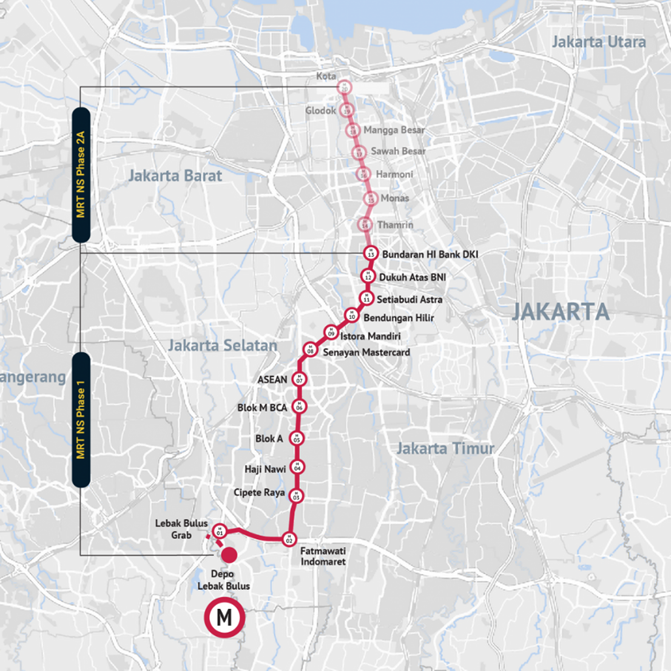
Using an event study design that leverages rich, high-frequency data from Gojek, Indonesia’s largest ride hailing service, we track ride-hailing activity – both the number of trips originating and ending, and the average distance of those trips – within 50- and 100-metre radii of the newly opened MRT stations. Comparing the activity in these ‘treated’ locations to two sets of carefully chosen control locations – the planned, but not yet opened, Phase 2A stations on the future extension of the North-South Line (see Figure 1), and ‘in-between’ locations along the existing MRT line that were not designated as stations – we are able to isolate the impact of the MRT opening from other confounding factors.
Going the first-/last-mile: More ride-hailing, shorter trips
We find a very large, positive impact on ride-hailing trip volumes in the immediate vicinities of the newly opened MRT stations. The number of ride-hailing trips starting or ending within 50 metres of an MRT station increased by 86% within 20 days of the public trial's start, after which it continued to grow, levelling off at a 215% increase after around two months. We also find a strong positive relationship between ride-hailing drop-offs and pick-ups, and station-specific entry and exit into the MRT, respectively – suggesting that the increase in ride-hailing trips is indeed related to the MRT.
Figure 2: The opening of the MRT and ride-hailing activity near the newly opened stations
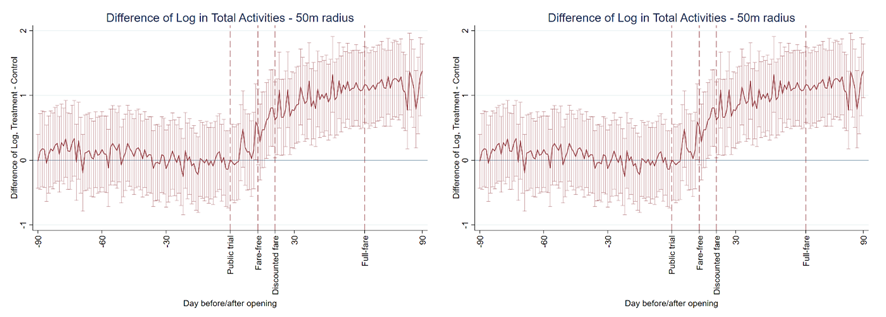
This surge in activity was accompanied by a significant decline in the average distance of these ride-hailing trips. Within the first 20 days, average distance dropped by 16%, eventually settling at a 23% decrease after two months. This combination – a massive increase in trip volume coupled with a decrease in average trip distance – strongly suggests that people were not abandoning ride-hailing for the MRT; instead, they were using ride-hailing to get to and from the MRT stations for shorter, more efficient connections. Ride-hailing services provide essential feeder transport, thereby extending the reach of the MRT system far beyond the immediate walking distance of its stations. This is particularly vital in a city like Jakarta, where walking infrastructure can be challenging, and alternative public transport options for the ‘first-/last-mile’ may be limited, less reliable, and less comfortable.
We also show that our main findings hold for both rush-hour and non-rush-hour trips during weekdays, as well as on weekends and public holidays. Ride-hailing not only facilitates work commutes, it also provides crucial first- and last-mile connectivity for leisure, study, and other non-commuting purposes.
More pronounced impacts on commuters living outside central Jakarta
Moreover, the impact of the MRT's opening on ride-hailing activity is much more pronounced in areas outside Jakarta's Central Business District (CBD). The CBD already had a relatively robust public transport network, including the Bus Rapid Transit (BRT) system and better feeder transport services. It is also generally much more pedestrian friendly. In non-CBD locations, the MRT often represented the first significant rapid public transport option, and the areas near the newly built stations were much less suitable for walking and lacked (reliable) feeder transport services. This created a greater demand for ride-hailing to bridge the gap between home and the new MRT stations.
Finally, we also find that the two end stations of the MRT line, which serve as major entry and exit points for commuters traveling longer distances, experienced a larger increase in ride-hailing volume, while the average trip distance to these end stations did not fall as dramatically as intermediate stations. These end stations attract users from a wider catchment area, compared to the intermediate stations on the line.
Our findings are robust to our (crucially important) choice of control locations, including an entirely different set of locations using an alternative ‘ring-based’ spatial difference-in-difference design as adopted in Gonzalez-Navarro et al. (2021), as well as to several placebo tests. We even look for additional evidence into the relationship between ride-hailing services and the MRT, analysing travel patterns following the unexpected two-day closure of MRT stations in Jakarta’s CBD during the May 2019 riots, though the widespread disruption during that period makes it difficult to isolate the specific impact on ride-hailing.
Implications for urban planning and policy
Our findings suggest that fears of ride-hailing undermining public transport viability are largely unfounded, at least in the context of Jakarta's MRT. Instead, ride-hailing services are boosting demand for mass rapid transit, contributing to its long-term financial viability. By providing convenient and reliable first- and last-mile connectivity, these services are expanding the MRT's reach, making it accessible to a larger segment of the population, including those who may not own private vehicles, live far from traditional public transport hubs, or in places lacking adequate public feeder transport options. This improved access to jobs and services, in turn, has broader positive implications for allocative efficiency, employment rates, and wages.
Our findings also offer valuable lessons for future urban development. Many cities in developing or emerging economies, with well-established ride-hailing markets (e.g. Dhaka, Lagos, Lima, Phnom Phen, Nairobi, or Haiphong) are (considering) investing in MRT systems. In doing so, they should anticipate and plan for a significant increase in ride-hailing activity around new stations. This foresight can inform infrastructure design, such as dedicated pick-up and drop-off zones, and encourage the development of integrated multi-modal platforms that seamlessly combine ride-hailing and public transport.
One key limitation of our research is that we are not able to account for the possibility that the MRT may have substituted for longer ride-hailing trips that did not start or end in the near vicinity of the newly opened stations. Future research, perhaps using even more granular data like anonymised smartphone location data, could provide a more complete picture of how (ride-hailing) travel patterns shift in response to an expansion of MRT options. Also, we did not delve into potential negative externalities, such as increased congestion or pollution around stations due to the surge in ride-hailing activity – important questions for future inquiry.
References
Babar, Y, and G Burtch (2020), “Examining the heterogeneous impact of ride hailing services on public transit use,” Information Systems Research 31(3): 820–834.
Bosker, M, M Roberts, S Tiwari, P Sanjiwacika Wibisana (2025), “Going the first/last-mile: Ride-hailing services and mass rapid transport,” CEPR Working Paper.
Cairncross, J, JD Hall, and C Palsson (2021), “VancUber: The effect of ride-hailing on public transportation, congestion, and traffic fatalities.”
Diao, M, H Kong, and J Zhao (2021), “Impacts of transportation network companies on urban mobility,” Nature Sustainability 4: 494–500.
Erhardt, GD, RA Mucci, D Cooper, B Sana, M Chen, and J Castiglione (2021), “Do transportation network companies increase or decrease transit ridership? Empirical evidence from San Francisco,” Transportation 49: 313–342.
Graehler, M, RA Mucci, and GD Erhardt (2019), “Understanding the recent transit ridership decline in major US cities: Service cuts or emerging modes?.”
Hall, JD, C Palsson, and J Price (2018), “Is Uber a substitute or complement for public transit?,” Journal of Urban Economics 108(1): 36–50.
Nelson, E, and N Sadowsky (2018), “Estimating the impact of ride-hailing app company entry on public transportation use in major US urban areas,” B.E. Journal of Economic Analysis & Policy 19(1).