






Competing for development grants helped divided communities in Indonesia work together – and fight less.
In many conflict-prone communities, policy debates focus on reducing tensions through dialogue, aid, or policing. But what if structured competition between communities could reduce violence within them, by uniting people across ethnic and social divides?
In new research on Indonesia (Garg et al. forthcoming), we find that when villages competed with each other for development funds, they experienced less violent conflict within their own communities. This is because the process of preparing for competition required residents – often across divided ethnic groups – to engage, deliberate, and collaborate.
Turning rivalry into unity
Two strands of research explain why this mechanism may work, particularly in contexts of low-intensity violent conflicts, such as clashes between non-state or regional groups, which remain common in fragile settings (Ray and Esteban 2016, World Bank 2018). First, diverse communities face greater coordination challenges and a heightened risk of low-level frictions (Alesina and La Ferrara 2002, Montalvo and Reynal-Querol 2005, Esteban et al. 2012). Second, when interaction is structured around shared goals, cooperation can increase in such settings – as shown via evidence on contact interventions and in team competition experiments (Bornstein et al. 2002, Paluck and Green 2009, Bazzi et al. 2019, Depetris-Chauvin et al. 2020, Mousa 2020, Lowe 2021, Ghosh et al. 2025).
A participatory contest for development funds
In Indonesia, ethnic divisions have fuelled recurrent episodes of local violence (Bazzi and Gudgeon 2021). In 1998, Indonesia launched the Kecamatan Development Program (KDP), a nationwide community-driven development (CDD) initiative with the primary aim of improving rural infrastructure and local governance. The design of the KDP created a natural experiment in inter-village competition. Each sub-district received a fixed block grant from the central government. Villages within each sub-district could submit proposals for projects such as roads, schools, or health clinics – but not all could be funded. Crucially, the design implied that the number of villages in a sub-district determined the intensity of competition. Proposal preparation required open village meetings, bringing together members of different ethnic and social groups – sometimes for the first time – to deliberate and coordinate. More villages meant greater rivalry for the same fixed funding pot, yet also stronger incentives for each village to organise and present a compelling, unified proposal.
External competition, internal cooperation
We study whether this externally induced competition affected violent conflict within villages. To do so, we use a triple differences estimation strategy, combining variation in:
- Whether a sub-district was included in the KDP,
- Before versus after the programme’s introduction, and
- The number of villages in the sub-district (a proxy for competition intensity).
This design allows us to isolate the effect of competition – distinct from broader trends or regional characteristics – on violent incidents, particularly those involving group-based, intra-village conflict.
Figure 1: The impact of competition in KDP on within-village conflict
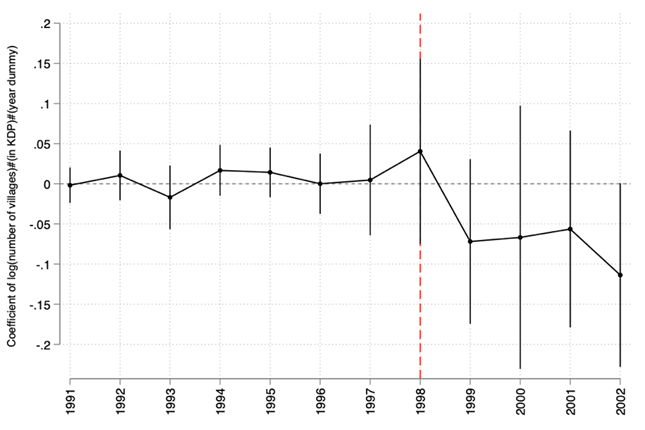
Competing for development grants reduced conflict
- Competition for funding reduced within-village conflict: Villages in more competitive sub-districts experienced significantly fewer episodes of low-intensity violence. For example, increasing the number of competing villages from 10 to 11 resulted in an 11% decline in conflict (Figure 1). These benefits only arise up to a certain level of competition: once competition becomes too stiff, villages stop participating and there are no additional gains (an inverted-U pattern).
- The effect did not depend on winning: Even villages that ultimately did not win funding still witnessed a reduction in violence, underscoring that the participatory process – rather than the payout – was key.
- Effects were strongest in divided communities: Conflict reductions were most pronounced in villages that were more ethnically fractionalised and segregated – places where cooperation is often most difficult (Figure 2).
- Civic engagement increased: Attendance at village meetings rose in more competitive settings, consistent with a mechanism in which external rivalry motivated greater internal cooperation.
- No spillover to inter-village violence: The programme did not affect inter-village clashes.
Figure 2: The impact of competition for KDP on within-village conflict, by average of within-village ethnic fractionalisation
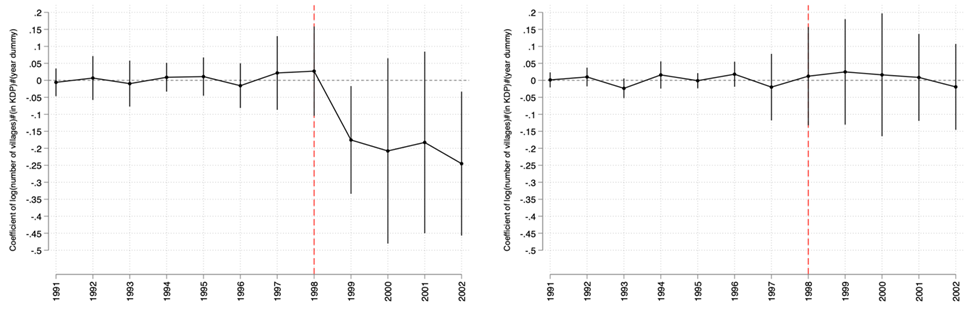
Note: The left plot shows the relationship in areas with high fractionalisation, the right plot in areas with low fractionalisation.
Implications: Designing funding programmes for cohesion
Our findings show that competition – when paired with inclusive, participatory processes – can encourage civic engagement and reduce friction within communities. In ethnically diverse or divided settings, shared efforts towards a collective external goal can help bridge internal divides and build a shared identity.
This insight has broader implications for how governments design funding programmes. Beyond economic efficiency, development contests like KDP can foster social cohesion and even reduce the risk of conflict. Especially in fragile or post-conflict settings, such mechanisms can help build common identity from the ground up – one meeting at a time.
References
Alesina, A, and E La Ferrara (2002), “Who trusts others?,” Journal of Public Economics 85(2): 207–234.
Bazzi, S, and M Gudgeon (2021), “The political boundaries of ethnic divisions,” American Economic Journal: Applied Economics 13(1): 235–266.
Bazzi, S, A Gaduh, A D Rothenberg, and M Wong (2019), “Unity in diversity? How intergroup contact can foster nation building,” American Economic Review 109(11): 3978–4025.
Bornstein, G, U Gneezy, and R Nagel (2002), “The effect of intergroup competition on group coordination: An experimental study,” Games and Economic Behavior 41(1): 1–25.
Depetris-Chauvin, E, R Durante, and F Campante (2020), “Building nations through shared experiences: Evidence from African football,” American Economic Review 110(5): 1572–1602.
Esteban, J, L Mayoral, and D Ray (2012), “Ethnicity and conflict: An empirical study,” American Economic Review 102(4): 1310–1342.
Garg, T C, S Gennaioli, S Lovo, and G Singer (forthcoming), “Fostering cooperation: The conflict reducing effects of inter-village competition for government transfers,” American Economic Journal: Applied Economics.
Ghosh, A, P Kundu, M Lowe, and G Nellis (2025), “Creating cohesive communities: A youth camp experiment in India,” The Review of Economic Studies.
Lowe, M (2021), “Types of contact: A field experiment on collaborative and adversarial caste integration,” American Economic Review 111(6): 1807–1844.
Montalvo, J G, and M Reynal-Querol (2005), “Ethnic polarization, potential conflict, and civil wars,” American Economic Review 95(3): 796–816.
Mousa, S (2020), “Building social cohesion between Christians and Muslims through soccer in post-ISIS Iraq,” Science 369(6505): 866–870.
Paluck, E L, and D P Green (2009), “Prejudice reduction: What works? A review and assessment of research and practice,” Annual Review of Psychology 60(1): 339–367.
Ray, D, and J Esteban (2016), “Understanding conflict and development,” VoxDev.
World Bank (2018), “Pathways for peace: Inclusive approaches to preventing violent conflict.”