





Workers at exporting firms experience more rapid skill and productivity growth, especially when firms export to high-income destinations, thereby amplifying the overall gains from trade.
Editor’s note: For a broader synthesis of themes covered in this article, check out Issue 2 of our VoxDevLit on International Trade.
Policymakers worldwide frequently adopt measures aimed at boosting exports, such as free trade agreements and subsidies for exporting firms. A key rationale behind these efforts is that increased export activity can enhance firm productivity. Supporting this view, trade economists have provided substantial evidence that firms often experience productivity gains after entering export markets (Atkin et al. 2017), particularly when exports are directed toward high-income countries (De Loecker 2007).
Promoting exports may also have important implications for workers. Evidence shows that employees at exporting firms tend to earn higher wages than those working at non-exporting ones (Bernard and Jensen 1995, Atkin et al. 2025), suggesting that export activity may benefit the workforce. However, the sources of this wage premium remain uncertain – whether it arises from rent-sharing or enhanced learning opportunities within exporting firms. If the latter is the case, export activity could generate broader human capital spillovers, as workers move from exporters to non-exporters. This channel can offer an additional, yet currently overlooked, justification for export promotion policies.
In Ma, Muendler, and Nakab (2025), we examine how export activity influences workers’ human capital. Using data from Brazil, we find that workers employed at exporting firms experience steeper wage growth over their careers compared to those at non-exporting firms – particularly when the exporters serve high-income markets. To understand the drivers of this pattern, we develop a dynamic model that separates the effects of human capital accumulation from changes in rent-sharing between firms and workers following export entry. Our analysis quantifies the human capital gains associated with trade and offers insights for the design of trade liberalisation policies.
Export activity and life-cycle wage profiles
Economic research commonly uses life-cycle wage profiles to infer the extent of human capital accumulation (Deaton 1997). Following this approach, we estimate life-cycle wage profiles separately for workers at exporting and non-exporting firms. A key challenge, however, is that exporters and non-exporters may exhibit fundamentally different wage patterns over time due to the distinct markets they serve. These differences can complicate the estimation of life-cycle wage profiles, which also rely on tracking wage growth across periods. We resolve this issue by relying on the assumption that there are no wage returns at the end of the working life (Rubinstein and Weiss 2006), so that wage growth among old workers allows us to isolate wage patterns specific to exporters and non-exporters.
Figure 1: Log hourly wage increase by exporters and non-exporters
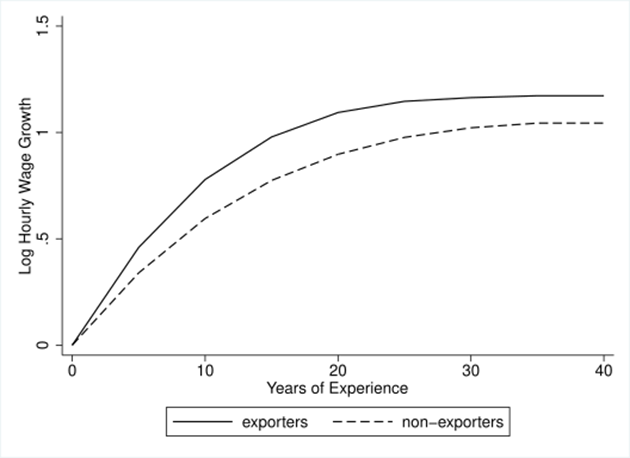
Figure 1 presents the estimated experience-wage profiles of exporters and non-exporters, using Brazilian employer-employee and customs data, controlling for industry effects. We find that, for a hypothetical individual who remains in the same job for 20 years from the start of her career, wage growth is 19 percentage points higher at exporters than at non-exporters. This difference declines slightly to 14 percentage points after 40 years of experience.
To understand what drives differences in experience returns between exporters and non-exporters, we construct life-cycle wage profiles for each firm and year, and associate them with firm characteristics. We have several key findings:
- Firm productivity and firm fixed effects explain most of the differences in wage profiles between exporters and non-exporters, hinting that exporters essentially provide higher returns to experience.
- After controlling for productivity, workforce composition, and firm fixed effects, wage profiles are steeper when firms export to high-income destinations.
- We find that the increase in wage profiles materialises immediately following a firm’s entry into a high-income destination, and this result is robust when we apply a propensity-score matching approach or exploit a substantive currency devaluation to address the endogeneity concern of export decisions.
To assess whether the experience gained at exporting firms is transferable, we construct a panel of young workers who can be tracked from early in their careers. This allows us to observe their complete work histories. We find that prior experience at exporters – particularly those serving high-income markets – is more valuable than experience at non-exporters, and that these gains are largely portable when workers move to other firms.
Isolating human capital gains from wage growth
The impact of export activity on wage profiles can reflect human capital accumulation as well as changes in worker-firm rent sharing, as suggested by a large body of quantitative research studying earnings components (Rubinstein and Weiss 2006, Burdett et al. 2011, Bagger et al. 2014, Helpman et al. 2017, Gregory, 2021). Therefore, we develop and quantify a dynamic model of multi-worker firms with export-market entry, worker-firm wage bargaining, and human capital accumulation to interpret the data and conduct experiments.
In our model, firms meet workers randomly. When matched, workers and firms negotiate the portion of revenues paid to the worker, and workers and firms renegotiate the piece rate when workers are being poached. Workers divide their time between working and human capital accumulation. Guided by our evidence, we embed two novel features into the model:
- The increment in human capital per time increases with firm productivity and with the sales-weighted average knowledge about firms’ markets. Staying at highly productive firms (which tend to select into exporting) and being exposed to destinations with abundant knowledge can therefore generate faster human capital growth.
- We consider destinations to be different in their knowledge stocks so that different combinations of destinations lead to varying learning opportunities for workers.
Figure 2: Decomposing differences in wage profiles between exporters and non-exporters
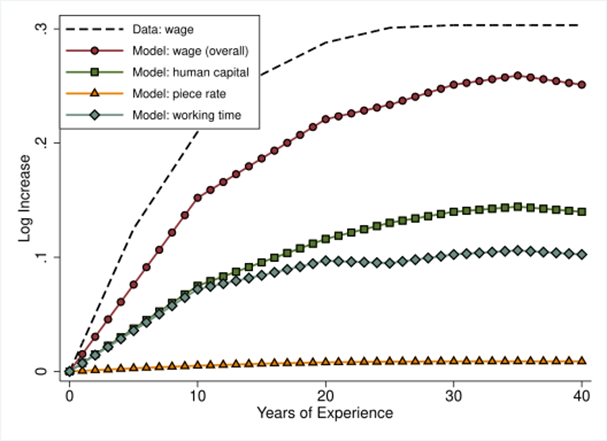
In the model, workers’ wage profiles reflect human capital growth, changes in time allocated to working, and wage renegotiations. To understand the relative contributions, we quantify our model using Brazilian manufacturing data. Figure 2 shows that human capital growth accounts for 50% of the differences in wage profiles between exporters and non-exporters. We find a similar contribution of human capital to the differences in wage profiles between exporters that ship to high-income destinations and those that do not. Diminishing returns to human capital investment mitigate the learning effect.
We then apply our calibrated model to understand the quantitative effects of trade openness.
Table 1 shows that the gain in real income from moving from a closed economy to the observed economy is 7.78%, with human capital formation being a major contributor: workers experience a 3.98% increase in labour efficiency due to trade openness. We then perform a decomposition of the trade-induced increase in workers’ human capital. Consistent with our empirical evidence, the labour efficiency increase is mostly driven by increased knowledge after firms’ entry into high-income destinations.
Table 1: Gains from trade

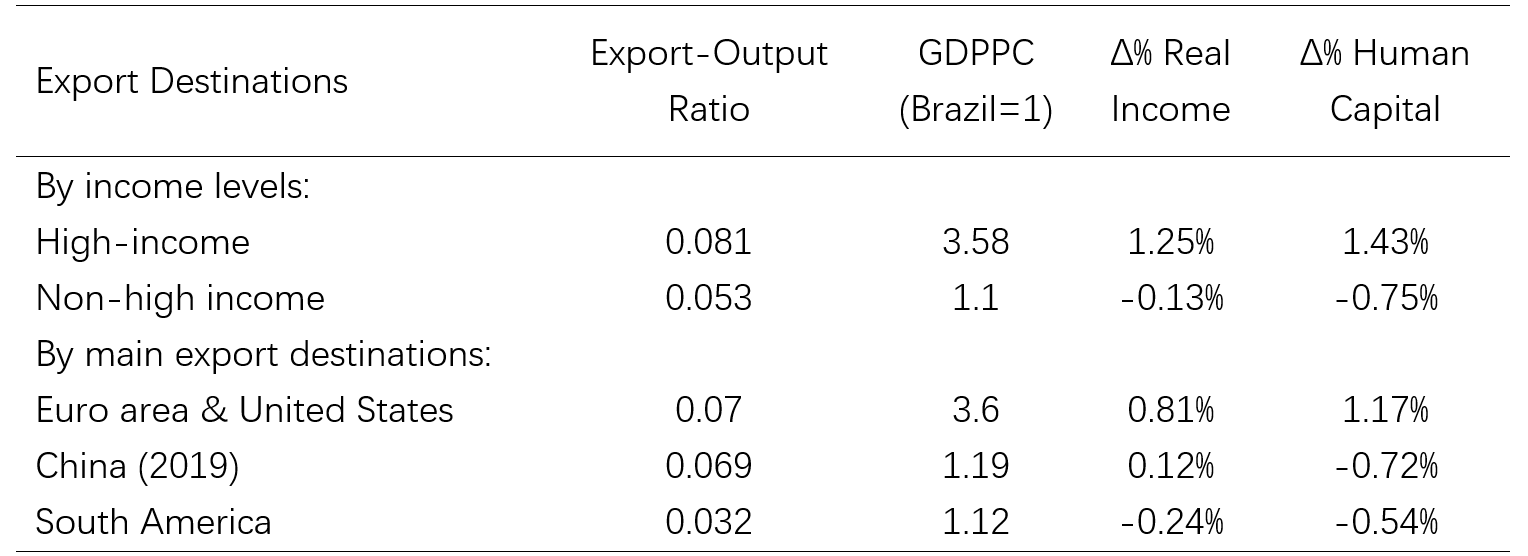
In Table 2, we compute changes in real income and human capital after a 10% decline in Brazil’s variable trade costs to specific destinations. Lowering trade costs to high-income destinations by 10% would increase Brazil’s real income by 1.25%, largely due to a 1.43% increase in workers’ human capital. In contrast, lowering trade costs to non-high-income destinations by 10% would reduce Brazil’s real income by 0.13%, mainly driven by a 0.75% decline in workers’ human capital as firms enter product markets with low knowledge stocks.
Table 2: Gains from 10% decline in variable export costs
Policy implications: Trade and wages
Our findings suggest that trade can significantly boost workers’ human capital accumulation, particularly through greater exposure to high-income export destinations. In the case of Brazil, increased human capital per worker explains roughly half of the total real income gains from trade. These results highlight the importance of incorporating human capital considerations in the design of trade promotion policies.
References
Atkin, D, A K Khandelwal, and A Osman (2017), “Exporting and firm performance: Evidence from a randomized experiment,” Quarterly Journal of Economics 132(2): 551–615.
Atkin, D, A Khandelwal, L Boudreau, R Dix-Carneiro, I Manelici, P Medina, B McCaig, A Morjaria, L Pascali, H Pellegrina, B Rijkers, and M Startz (2025), “International trade,” VoxDevLit 4(2).
Bagger, J, F Fontaine, F Postel-Vinay, and J-M Robin (2014), “Tenure, experience, human capital, and wages: A tractable equilibrium search model of wage dynamics,” American Economic Review 104(6): 1551–1596.
Bernard, A, and B Jensen (1995), “Exporters, jobs, and wages in U.S. manufacturing: 1976–1987,” Brookings Papers on Economic Activity: Microeconomics 26: 67–119.
Burdett, K, C Carrillo-Tudela, and M G Coles (2011), “Human capital accumulation and labor market equilibrium,” International Economic Review 52(3): 657–677.
De Loecker, J (2007), “Do exports generate higher productivity? Evidence from Slovenia,” Journal of International Economics 73: 69–98.
Deaton, A (1997), “The analysis of household surveys: A microeconometric approach to development policy,” World Bank.
Gregory, V (2021), “Firms as learning environments: Implications for earnings dynamics and job search,” Unpublished manuscript.
Helpman, E, O Itskhoki, M-A Muendler, and S J Redding (2017), “Trade and inequality: From theory to estimation,” Review of Economic Studies 84(1): 357–405.
Ma, X, M-A Muendler, and A Nakab (2025), “Exporting, wage profiles, and human capital: Evidence from Brazil,” Review of Economics and Statistics 107(5): 1371–1387.
Rubinstein, Y, and Y Weiss (2006), “Post schooling wage growth: Investment, search, and learning,” in Handbook of the Economics of Education, 1(1): 1–67.