




Internal migration in Indonesia raises wages and improves access to formal employment for the workers left behind, particularly lower-educated workers, by easing labour supply pressures and reallocating jobs across the formal and informal sector.
Editor’s note: For a broader synthesis of themes covered in this article, check out Issue 2 of our VoxDevLit on Informality. The authors have made slides available here.
Emigration is often feared to negatively affect origin areas through ‘brain drain’, whereby higher-educated workers leave, causing declines in the productivity of the origin areas’ labour markets. The evidence on emigration has primarily focused on the effects of international migration into high-income countries (see Docquier and Rapoport 2012, and Batista et al. 2025, for detailed reviews). However, we know very little about how origin labour markets – particularly in developing countries – respond to increases in internal migration, even though internal migration is estimated to be about four times more common globally than migration across national borders (UNDP 2009). The effects of this type of emigration may differ substantially, since internal migration is less costly, involves different types and numbers of migrants, and often generates fewer remittances. Furthermore, labour markets in developing countries such as Indonesia tend to be characterised by high levels of informality, and interactions between formal and informal sectors may shape impacts on those who stay behind (Ulyssea 2020).
Addressing selection bias in the choice to emigrate
The main challenge of estimating the causal effects of emigration on origins is that the choice to migrate away may itself depend on labour market conditions at the origin. To address this concern, we (Buller and Kleemans 2026) use an instrumental variables approach that is motivated by two commonly observed migration patterns: migrants are attracted to destinations with favourable economic conditions and are more likely to move to areas where they have pre-established migrant networks (Munshi 2003). Specifically, we interact destination-level Bartik shift-share labour demand shocks with historical origin-destination migration patterns. We implement this strategy using detailed longitudinal data from the Indonesia Family Life Survey that tracks over 36,000 individuals during a 28-year period. The first stage demonstrates that these interacted shocks predict emigration away from origins, which we then use to study the impact of emigration on non-migrants aged 36–60 who are least likely to migrate away themselves.
A large increase in the hourly income of workers in origin communities
We find that a one percentage point increase in the emigration rate causes a 3.42% increase in hourly incomes of non-migrant workers in origin areas. The average emigration rate is 20%, so a 1% increase in the emigration rate causes a 0.68% increase in non-migrants’ hourly incomes in origins. We also find modest but statistically insignificant increases in the employment of workers who stay in origin areas. These findings are broadly consistent with the evidence on the labour market effects of international emigration that generally finds that emigration leads to increased wages for workers who remain in the origin (Mishra 2007, Elsner 2013, Dustmann et al. 2015, Khanna et al. 2022). Figure 1 shows the effects on hourly income (Panel A) and employment (Panel B), and shows how these effects differ by the sector and educational attainment of non-migrant workers.
Figure 1: Labour market response to emigration
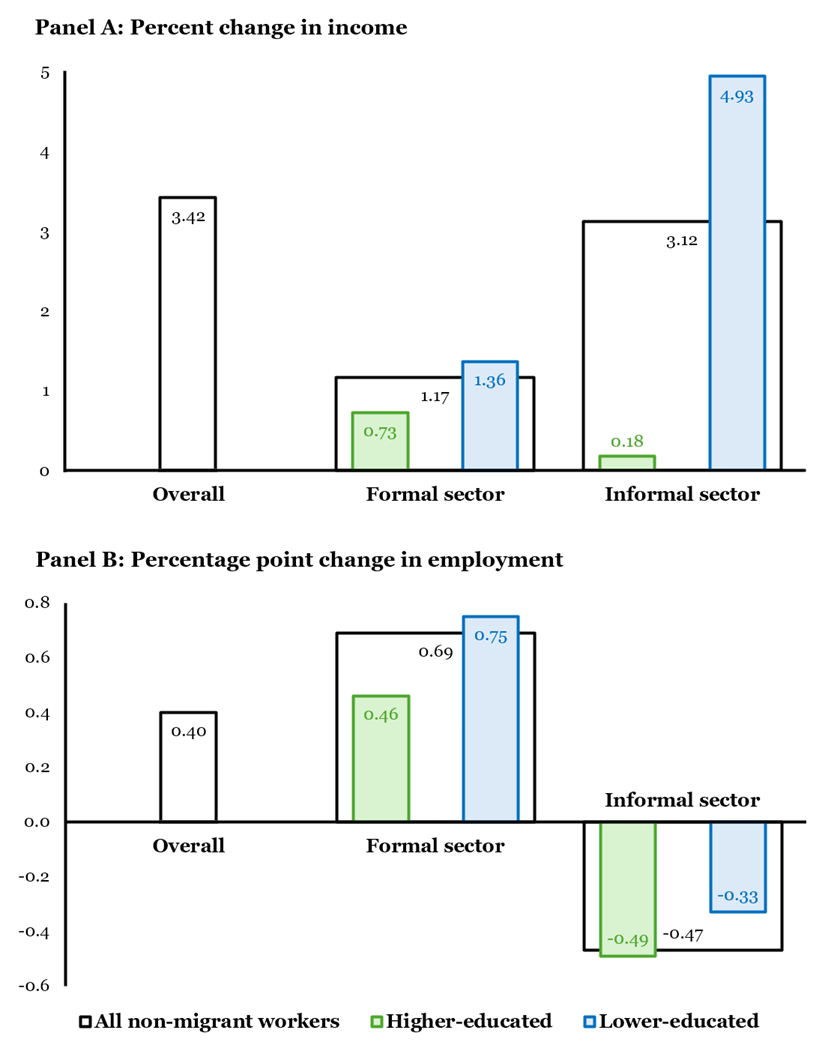
Notes: Estimates shown are in response to a one percentage point increase in the stock of internal emigrants leaving origin districts in Indonesia, using data from the Indonesia Family Life Survey and the 1985 Intercensal Population Survey. Please see Buller and Kleemans (2026) for further details about the data and analysis.
Who is most affected by internal emigration in a dual sector labour market?
The coexistence of a large informal sector alongside a formal one may shape how migration impacts local workers. To develop intuition for the potential labour market effects of emigration in a dual-sector economy, we build on the framework developed by Kleemans and Magruder (2018), used to study immigration, and adapt it to analyse labour supply reductions due to emigration. In this setting, employment in the formal sector is limited but tends to be more stable and desirable, while the informal sector is largely unregulated and therefore subject to stronger wage competition.
In line with the model, we find that the formal and informal sectors respond differently to increases in internal emigration. In terms of employment, internal emigration causes significant increases in formal sector employment while appearing to decrease informal sector employment, as shown in Panel B of Figure 1. Prior to departure, migrants are more likely to be formally employed than non-migrants, so their emigration leaves vacancies in the formal sector that can then be filled by non-migrant workers. This allows for movement from the informal sector to the more desirable formal sector. Consistent with these employment shifts, Panel A of Figure 1 shows that increases in income are concentrated in the informal sector. The lack of regulation in the informal sector creates a high degree of wage competition, and as workers move from the informal to the formal sector, labour supply in the informal sector contracts. This reduction in labour supply places upward pressure on wages within the informal sector.
Internal migrants in Indonesia tend to be better educated than non-migrants, so we also study effects on higher- and lower-educated non-migrants separately to see if those who are more or less similar to emigrants are most affected. We define ‘higher-educated’ as having received at least some secondary education, and ‘lower-educated’ as not having received any secondary education, because this cut-off yields the most even division of the sample. We find that employment gains in the formal sector are concentrated mostly among the lower-educated non-migrants, who see a 0.75 percentage point increase in formal sector employment from a one percentage point increase in the emigrant share. Since higher-educated workers are more likely to already be employed in the formal sector, the vacancies left by emigrants allow lower-educated workers to enter the formal sector. Increases in income in the informal sector are also driven by lower-educated non-migrant workers, who experience a 4.93% increase in hourly income from a one percentage point increase in the emigration rate. Taken together, these results indicate that lower-educated workers benefit disproportionately from internal emigration through both improved access to formal employment and higher earnings in the informal sector.
Policy implications for internal migration
Our results indicate that internal emigration in Indonesia leads to positive labour market effects for workers who stay in origin areas. Increases in earnings and improved access to formal employment suggest that internal migration can ease labour market pressures rather than exacerbate them, even when migrants are positively selected on education.
Importantly, these effects depend on the underlying labour market structure. In a dual-sector labour market – typical of many developing countries – the interaction between formal and informal employment is key to understanding how emigration affects non-migrants. These results suggest that migration policy should account not only for the scale of emigration and the characteristics of migrants, but also for the way migrants and non-migrants interact within segmented labour markets.
References
Batista, C, D Han, J Haushofer, G Khanna, D McKenzie, A M Mobarak, C Theoharides, and D Yang (2025), “Brain drain or brain gain? Effects of high-skilled international emigration on origin countries,” Science, 388: eadr8861.
Buller, D, and M Kleemans (2026), “Effects of emigration on labor markets in migrant origin areas: Evidence from internal migration in Indonesia,” Journal of Development Economics, 179: 103623.
Docquier, F, and H Rapoport (2012), “Globalization, brain drain, and development,” Journal of Economic Literature, 50: 681–730.
Dustmann, C, T Frattini, and A Rosso (2015), “The effect of emigration from Poland on Polish wages,” Scandinavian Journal of Economics, 117: 522–564.
Elsner, B (2013), “Emigration and wages: The EU enlargement experiment,” Journal of International Economics, 91: 154–163.
Khanna, G, E Murathanoglu, C Theoharides, and D Yang (2022), “Abundance from abroad: Migrant income and long-run economic development,” Unpublished manuscript.
Kleemans, M, and J Magruder (2018), “Labour market responses to immigration: Evidence from internal migration driven by weather shocks,” Economic Journal, 128: 2032–2065.
Mishra, P (2007), “Emigration and wages in source countries: Evidence from Mexico,” Journal of Development Economics, 82: 180–199.
Munshi, K (2003), “Networks in the modern economy: Mexican migrants in the US labor market,” Quarterly Journal of Economics, 118: 549–599.
Ulyssea, G (2020), “Informality: Causes and consequences for development,” Annual Review of Economics, 12: 525–546.
UNDP (2009), “Human development report 2009: Overcoming barriers: Human mobility and development.”