


New evidence from Africa shows that aid reduces conflict when projects are well managed, but increases violence when management and monitoring are weak.
The relationship between development aid and violent conflict remains a source of contentious debate (Child et al. 2024). Recent research argues that aid can cause conflict; for example, by inadvertently funding or prompting backlash from local armed groups (Crost et al. 2014, Nunn and Qian 2014, Trisko Darden 2020). Other work, however, suggests that aid can reduce conflict by raising incomes and support for the local government (Collier and Hoeffler 2002, De Ree and Nillesen 2009, Crost et al. 2016).
The reasons for these strikingly different results across contexts are poorly understood. While some work suggests that differences in recipient countries’ political institutions drive the varying effects of aid (Svensson 1999, Burnside and Dollar 2000), these findings provide policymakers with little guidance beyond avoiding unstable regions, where the potential returns to development assistance could be the highest. Especially in a world of shrinking budgets for development assistance, understanding when and why aid leads to violence – as well as what can be done to prevent it from doing so – is of central importance. Is there a way to minimise aid’s potential harm and thereby maximise its net benefit?
Case studies on aid delivery suggest that the management practices of aid organisations can be critical for determining whether a given aid project spurs conflict (Prendergast 1996, Anderson 1999). For example, improved monitoring strategies can determine whether or not aid resources are diverted by armed groups, and the approach to project implementation can shape local support for the programme. Highlighting the importance of project supervision, Prendergast (1996) recalls:
“One agency delivering large amounts of food to Rwanda increased its monitoring rapidly just after the emergency erupted in 1994. ‘We went from 120 tons per month diversion to five tons’ [...] recalls a representative of that international agency. ‘We did it through monitoring. It’s monotonous, boring, but critical in cutting down mis-management.’”
While well-managed projects may increase local well-being and support for the government, thereby reducing violent conflict, poorly-managed projects could be accompanied by local looting and appropriation, fuelling violent conflict and local instability.
Does aid management affect conflict?
In recent research (Moscona 2025), I investigate whether the management of aid design and delivery systematically mediates the relationship between aid and conflict, focusing on all World Bank projects to Africa. Even within the World Bank, there are substantial differences in management quality across projects; for example, faulty monitoring of World Bank reconstruction aid in Afghanistan likely exacerbated corruption and conflict (SIGAR 2018).
To measure this variation in project management comprehensively, I make use of the fact that all completed World Bank projects are accompanied by detailed evaluation reports produced by the Independent Evaluation Group (IEG), providing a unique window into the quality of project implementation. To study the relationship between management quality and conflict, I link all aid projects as well as all conflict events from the Armed Conflict Location and Event Data (ACLED) project to one-by-one degree grid cells covering all of Africa. I then investigate how the arrival of aid projects of varying management quality affects local conflict activity, conditional on grid cell and country-by-year fixed effects. Figures 1a and 1b show the number of conflict events and conflict deaths that took place in each grid cell during the study period (1997–2014), and Figure 1c displays the average quality of all projects that took place in each cell, as determined by the IEG.
Figure 1: Geographic distribution of conflict and aid quality
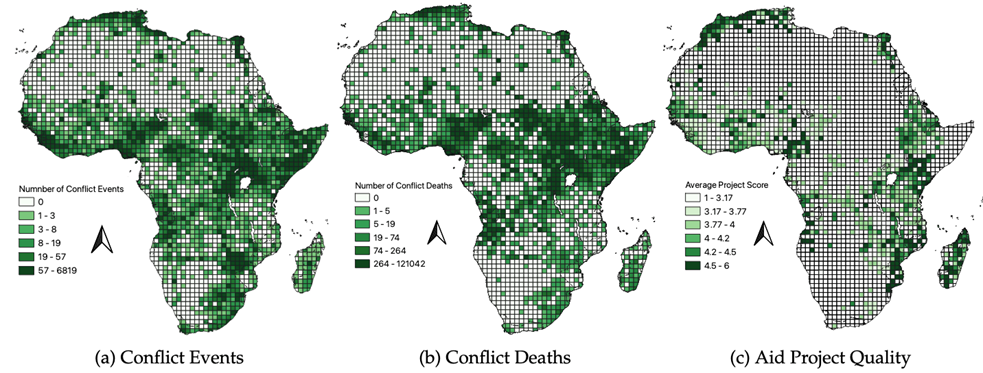
Notes: Figure 1a displays the number of conflict events in each grid cell and Figure 1b displays the number of conflict deaths in each grid cell, summing over all years from 1997-2014. In both cases, all cells with positive conflicts or positive deaths were divided into quintiles, and all cells with zero conflict events or deaths are coloured white. Figure 1c displays the average aid project quality of each grid cell over the entire sample period (1997-2014). Grid cells coloured white had no aid projects.
To identify the causal effect of project management quality on local conflict, I exploit variation in management quality driven by the assignment of project leaders of varying quality. Project leaders are assigned during each project’s ‘Implementation’ stage, before detailed project characteristics or project site have been determined by the borrowing government. Nevertheless, project leaders make many day-to-day decisions that shape project quality as the “Bank’s principal point of contact for the borrower for [each] project” (World Bank 2003), including “regularly monitor[ing] their project[‘s] contracts, disbursements, technical progress, and risk flags” (World Bank 2013). Indeed, Anderson (1999) argues that project field staff make “local, specific, daily, and ongoing decisions about how they do their work [that] can affect the impacts of aid on conflict”. Consistent with this, I find that project leader fixed effects explain a substantial share of variation in project management scores. To causally identify the effect of aid regardless of management quality – thus making it possible to compare the effect of a well- or poorly-managed project to no project at all – I use a shift-share design, in the spirit of Nunn and Qian (2014) and Dube and Vargas (2013), that exploits aggregate fluctuations in total World Bank aid outside of Africa alongside cross-sectional variation in the propensity to receive aid across grid cells.
How management quality shapes conflict
My main finding is that well-managed aid projects reduce local conflict while poorly-managed projects do the opposite. My estimates imply that an aid project with the lowest management score (on the IEG’s six-point scale) increases the probability of conflict by 6% while a project with the highest score reduces the probability of conflict by 9%. Consistent with a causal interpretation of the findings, I find no evidence of pre-existing trends in the relationship between aid management quality and conflict. However, lagged effects remain significant for 2–3 years, suggesting that the effect of aid management on conflict has some persistence. The effects remain similar if I weight each conflict by the number of resulting fatalities or focus only on more violent forms of conflict as categorised by ACLED (e.g. battles, instances of violence against civilians, etc.). Moreover, differences in project leader quality explain a larger share of the variation in local conflict than differences across lending sectors or differences across borrowing governments. Management quality – which is in the control of aid organisations themselves – plays a major role in determining whether aid causes conflict or not.
I then investigate the mechanisms underpinning the main result. First, using more disaggregated project ratings from the IEG, I find that the quality of project supervision is particularly impactful, consistent with qualitative accounts of the importance of monitoring. Second, I find that all effects are stronger during later stages of project delivery when a larger share of project resources would have already been disbursed. This is consistent with a role for direct resource predation (Findley 2018) rather than an attempt by armed groups to undermine the project or local government legitimacy, in which case violence might be most extreme during the early stages of project implementation (as argued in Crost et al. 2014). Finally, I show that the results are largest for projects that involve larger financial flows and for lending sectors involving more ‘divertible’ resources. All estimates are also largest in areas with a recent history of violence, where armed groups may be most likely to divert project resources, indicating that management quality may be most important in conflict zones.
Implications for foreign aid
Together, these results highlight that the policymakers and bureaucrats who comprise development agencies play an important role in determining the consequences of development aid. Reform and accountability within aid organisations themselves could potentially go a long way towards limiting the violent side effects of development assistance, even in the most conflict-prone regions. Rachel Glennerster recently reflected on her experience as former Chief Economist of the UK’s FCDO, arguing that development assistance should be directed towards simple, smart, and well-executed programmes: “Given the reality of smaller aid budgets, it is imperative we use them to best effect. We need to focus on a select number of simple, cost-effective, large-scale interventions” (Glennerster and Haria 2025). Reforms like these may also reduce conflict and, over time, the violent reputation of development aid may become a thing of the past.
References
Anderson, M B (1999), Do no harm: How aid can support peace—or war, Lynne Rienner Publishers.
Burnside, C, and D Dollar (2000), “Aid, policies, and growth,” American Economic Review, 90: 847–868.
Collier, P, and A Hoeffler (2002), “Aid, policy and peace: Reducing the risks of civil conflict,” Defence and Peace Economics, 13: 435–450.
Crost, B, J Felter, and P Johnston (2014), “Aid under fire: Development projects and civil conflict,” American Economic Review, 104: 1833–1856.
Crost, B, J H Felter, and P B Johnston (2016), “Conditional cash transfers, civil conflict and insurgent influence: Experimental evidence from the Philippines,” Journal of Development Economics, 118: 171–182.
De Ree, J, and E Nillesen (2009), “Aiding violence or peace? The impact of foreign aid on the risk of civil conflict in sub-Saharan Africa,” Journal of Development Economics, 88: 301–313.
Dube, O, and J F Vargas (2013), “Commodity price shocks and civil conflict: Evidence from Colombia,” Review of Economic Studies, 80: 1384–1421.
Findley, M G (2018), “Does foreign aid build peace?” Annual Review of Political Science, 21: 359–384.
Glennerster, R, and S Haria (2025), “Radical simplification: A practical way to get more out of limited foreign assistance budgets,” Center for Global Development Blog.
Moscona, J (2025), “The management of aid and conflict in Africa,” American Economic Journal: Economic Policy, 17: 228–259.
Nunn, N, and N Qian (2014), “US food aid and civil conflict,” American Economic Review, 104: 1630–1666.
Prendergast, J (1996), Frontline diplomacy: Humanitarian aid and conflict in Africa, Lynne Rienner Publishers.
SIGAR (2018), “Afghanistan Reconstruction Trust Fund: The World Bank needs to improve how it monitors implementation, shares information, and determines the impact of donor contributions,” Unpublished manuscript.
Svensson, J (1999), “Aid, growth and democracy,” Economics & Politics, 11: 275–297.
Trisko Darden, J (2020), Aiding and abetting: US foreign assistance and state violence, Stanford University Press.
World Bank (2003), "World Bank annual report," Unpublished manuscript.
World Bank (2013), "Task team leader toolkit: Investment project financing – the project cycle," Unpublished manuscript.