






China’s rise was powered by an export-led growth model reinforced by trade liberalisation, place-based and industrial policies, massive infrastructure investment, and a governance system that strongly incentivised local growth.
Editor's note: This article has been adapted from Chapter 3 - Trade and Industrial Policy - of our VoxDevLit on Industrial Development.
China’s rise in the global economy provides the most consequential contemporary example of export-led industrialisation shaped by active state intervention. Unlike earlier East Asian industrialisers, China’s integration into global markets occurred at unprecedented scale and under late-starter conditions, combining labour-intensive export growth and extensive use of place-based and sectoral policies. As such, China offers a unifying case for mechanisms such as the interaction between trade liberalisation and firm upgrading, the role of industrial policy in shaping specialisation and scale, and the evolving limits of export-led growth as capital deepening and technological upgrading progress over time.
We trace China’s development from its early integration into international trade to its emergence as a global industrial powerhouse, highlighting how export expansion, place-based industrial policies, and firm upgrading interacted over time. The discussion emphasises both the sources of China’s rapid industrial growth and the tensions that emerged as the economy scaled up and deepened its technological capabilities.
Early industrialisation
China’s first steps towards industrialisation (1840–1949) took place under highly adverse conditions. Following military defeats in the Opium Wars and related conflicts, China was compelled to sign a series of unequal treaties with foreign powers that granted extensive commercial and legal privileges. These treaties led to the forced opening of treaty ports – coastal cities opened to foreign trade – which constrained China’s policy autonomy but also fostered coastal industrial development and deeper integration of domestic markets, leaving durable regional legacies (Brandt et al. 2014, Keller et al. 2017, Jia 2014). Efforts at ‘Self-Strengthening’ during the late Qing dynasty, though motivated by military needs, created important industrial spillovers (Bo et al. 2023). The defeat in the Sino-Japanese War (1894–95) further legitimised modern enterprises and spurred the rise of private firms.
By the early 20th century, a golden age of industry emerged, fuelled by institutional modernisation inspired by foreign settlements (Ma 2008) and the state’s efforts during the interwar years to build a modern economic system (Chang 1967). Trade disruptions during World War I temporarily sheltered local industries such as textiles, but shortages of machinery and finance constrained growth (Liu 2020).
With the founding of the People’s Republic in 1949, China shifted to a Soviet-style centrally planned economy. The state embarked on a massive industrial ‘Big Push’, relying on Soviet technology and know-how to build heavy industry through the “156 Projects” (Giorcelli and Li 2021). Embargoes by Western countries reinforced China’s move towards near-autarky. While this strategy created a heavy-industry base of state-owned enterprises (SOEs), it also produced severe distortions, including a catastrophic misallocation of resources during the Great Leap Forward (Li and Yang 2005). By the 1970s, the economy was dominated by inefficient SOEs, with institutional rigidities that later became the primary targets of reform (Khandelwal et al. 2013, Bai et al. 2017).
Global integration
The lifting of Western embargoes in the 1970s marked China’s tentative re-entry into global markets. The decisive turning point came in 1978, when reforms initiated a gradual opening of the economy. While tariffs remained high in the 1980s, they fell sharply in the 1990s as China sought accession to the WTO, which it joined in 2001. WTO membership catalysed unprecedented trade expansion, fuelled by lower trade costs, improved productivity, capital deepening, and greater access to imported intermediates (Huang et al. 2024, Brandt and Lim 2024). Figure 1 illustrates this integration process, showing the evolution of imports, exports, and tariff rates over time.
Figure 1: China's integration with the global economy
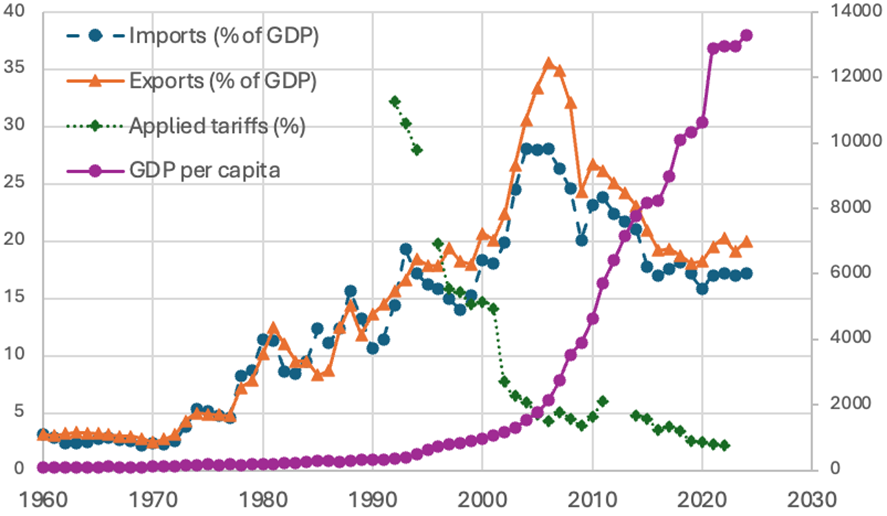
Notes: Imports and exports include both goods and services; applied tariff rates are weighted averages across all traded products; GDP per capita is in current USD. Source: World Bank Open Data.
The US normalised trade relations with China in 1980 and made them permanent in 1999, a shift that greatly reduced trade policy uncertainty and accelerated China’s trade expansion (Handley and Limão 2017, Alessandria et al. 2025). The simultaneous reduction in both import and export tariffs enhanced firm productivity, intensified domestic competition, and pushed markups downward (Yu 2015, Brandt et al. 2017).
A key aspect of the productivity growth and capital deepening was the dual-track approach, which preserved state control over SOEs while permitting private firms to flourish. However, this coexistence of market and state systems introduced institutional frictions, notably credit misallocation favouring SOEs that constrained private sector growth. Despite these inefficiencies, resource reallocation from low-productivity state sectors to high-productivity private firms boosted productivity, while high savings rates and FDI fuelled capital accumulation (Song et al. 2011).
Further reforms also dismantled key institutional barriers. SOEs lost their monopoly on trading rights (Bai et al. 2017), quotas were phased out (Khandelwal et al. 2013), and new trade agreements were signed (Li et al. 2016). These steps, combined with surging global demand, entrenched China’s role in world trade.
Place-based policies and transportation infrastructure
China’s liberalisation went far beyond tariff reductions. A central innovation was the introduction of processing trade in 1978, which allowed firms to import inputs duty-free, assemble or process them domestically, and then re-export the finished goods. This system enabled China to integrate quickly into global supply chains, particularly in labour-intensive industries such as electronics, textiles, and toys. Because it required little working capital, processing trade thrived in an economy constrained by financial frictions (Manova and Yu 2016). At its peak in the 1990s and 2000s, it accounted for more than half of China’s exports (Feenstra and Wei 2010). However, processing firms were typically less productive and captured less value than ‘ordinary’ exporters (Dai et al. 2016, Yu 2015). As domestic capital markets developed and firms became more sophisticated, the share of processing trade gradually declined.
Industrial and place-based policies reinforced trade growth. Starting in 1979, special economic zones proliferated, offering firms tax breaks, reduced duties, cheaper land, and easier access to credit. These policies increased investment and raised wages, output, and productivity, while encouraging firm entry (Wang 2013, Lu et al. 2019). At the same time, the state targeted strategic industries, such as shipbuilding and renewable energy with a broad toolkit of subsidies, R&D incentives, and consolidation policies. Evidence shows these interventions boosted innovation, productivity, and exports, though effectiveness varied across instruments (Banares-Sanchez et al. 2024, Barwick et al. 2025).
Critical to China’s industrial ascent was its massive investment in infrastructure, made possible by the state’s ability to mobilise resources at scale – through public finance, state-owned enterprises, and coordinated planning. Over the past four decades, the country has built world-class ports, highways, railways, and airports, drastically reducing trade costs and enabling firms to integrate into global production networks (Fan et al. 2023, Huang et al. 2025).
Institutions and governance
China’s industrial policies have been embedded in a distinctive institutional framework. Unlike electoral democracies, Chinese officials are accountable to higher party-state authorities rather than voters. Career advancement is tied to a “regional tournament” system in which local leaders compete on measurable economic outcomes, historically GDP growth (Li and Zhou 2005, Xu 2011, Li et al. 2019, Qian et al. 2006). This system incentivised officials to actively support firms – by attracting foreign direct investment, expanding trade, or building economic zones – aligning political goals with corporate interests (Ang 2020, Bai et al. 2019, Jia et al. 2015, Lei 2021). Recent research adds nuance to this view: Chen (2025) shows that GDP growth targets – central to cadre evaluation – create strong incentives for local officials to induce firm-level production responses precisely at the threshold where targets are met, leading to spikes in output, inventories, energy use, and pollution, and thus driving real activity but also risking misallocation and overproduction.
Local governments played a central role by controlling access to land, capital, and subsidies. For example, Wuhu’s support for Chery Automobile – with land, credit, and infrastructure – enabled the firm to become a leading exporter (Bai et al. 2019).
Policy design followed an “experimentation under hierarchy” model (Heilmann 2008). Top-down pilot programmes tested centrally driven initiatives, though they often suffered from political bias and limited replicability (Wang and Yang 2025). Bottom-up innovations, in contrast, emerged from local experimentation, particularly in politically peripheral areas, and proved more effective for productivity growth (Chen et al. 2025). The interaction between these two pathways created a dynamic feedback loop, balancing central strategy with local adaptation (Fang et al. 2025).
Almost 200 years of industrialisation in China: Taking stock and looking forward
China’s ascent has been powered by a distinctive nexus of policy and institutions – a blend of trade liberalisation, industrial and place-based interventions, massive infrastructure investment, and a bureaucratic system structured around strong growth incentives. Like earlier East Asian tigers, China relied on export-led growth and technology adoption, but its sheer scale and adaptive institutions set it apart.
Looking forward, China faces a more challenging environment, with heightened trade frictions and geopolitical tensions. Sustaining growth will require deepening trade integration, diversifying export markets, and reorienting bureaucratic incentives to help firms navigate rising economic nationalism in the US and other high-income countries.
Although China’s governance model is not fully transferable, other emerging economies can draw valuable lessons from both its successes and its pitfalls. The “regional tournament” system, which rewarded local officials for rapid economic expansion, has also encouraged the pursuit of measurable short-term targets at the expense of unmeasured externalities, such as pollution (Zheng et al. 2014, Carattini et al. 2025) and inequality (Han et al. 2012). Frequent official turnover has further fostered short-termism, fuelling local deficits through debt-funded projects (Song and Xiong 2024).
Yet China’s policy experimentation under hierarchy offers an alternative model for balancing innovation with control. By encouraging local governments to pilot new reforms within a framework of central oversight, China has institutionalised a process for testing and scaling policy innovations while mitigating systemic risk (Wang and Yang 2025, Chen et al. 2025, Fang et al. 2025). While local short-term pressures persist, centralised long-term planning has ensured strategic continuity in areas such as infrastructure and sectoral upgrading. Other economies – facing distinct institutional constraints – can adapt this experimental, iterative approach to their own contexts. The key lesson lies not in replicating China’s system, but in crafting mechanisms that combine local learning with long-term vision, enabling sustained structural transformation and inclusive growth.
References
Alessandria, G, S Y Khan, A Khederlarian, K J Ruhl, and J B Steinberg (2025), "Trade policy dynamics: Evidence from 60 years of US–China trade," Journal of Political Economy, 133(3): 713–749.
Ang, Y Y (2020), China’s gilded age: The paradox of economic boom and vast corruption, Cambridge University Press.
Bai, S, K Krishna, and H Ma (2017), "How you export matters: Export mode, learning, and productivity in China," Journal of International Economics, 102: 122–137.
Bai, C, C T Hsieh, and Z Song (2019), "Special deals with Chinese characteristics," NBER Macroeconomics Annual, 34.
Banares-Sanchez, I, R Burgess, D Laszlo, P Simpson, and J Van Reenen (2024), "Chinese innovation, green industrial policy, and the rise of solar energy,” Unpublished manuscript.
Barwick, P J, M Kalouptsidi, and N B Zahur (2025), "Industrial policy implementation: Empirical evidence from China’s shipbuilding industry," Review of Economic Studies, 92(6): 3611–3648.
Bo, S, C Liu, and Y Zhou (2023), "Military investment and the rise of industrial clusters: Evidence from China’s self-strengthening movement," Journal of Development Economics, 161.
Brandt, L, D Ma, and T G Rawski (2014), "From divergence to convergence: Reevaluating the history behind China’s economic boom," Journal of Economic Literature, 52(1): 45–123.
Brandt, L, J Van Biesebroeck, L Wang, and Y Zhang (2017), "WTO accession and performance of Chinese manufacturing firms," American Economic Review, 107(9): 2784–2820.
Brandt, L, and K Lim (2024), "Opening up in the 21st century: A quantitative accounting of Chinese export growth," Journal of International Economics, 150.
Carattini, S, H Huang, F Pisch, and T P Singh (2025), "Trade and the scopes of pollution: Evidence from China’s world market integration," CESifo Working Paper, 12119.
Chang, J K (1967), "Industrial development of mainland China 1912–1949," Journal of Economic History, 27(1): 56–81.
Chen, H, B Li, and X Zhu (2025), "Bottom-up institutional change and growth in China," Unpublished manuscript.
Chen, K (2025), "Growth at the margin: Political incentives and firm behavior in China," Unpublished manuscript.
Dai, M, M Maitra, and M Yu (2016), "Unexceptional exporter performance in China? The role of processing trade," Journal of Development Economics, 121.
Fan, T, M Peters, and F Zilibotti (2023), "Growing like India: The unequal effects of service-led growth," Econometrica, 91(4): 1457–1494.
Fang, H, M Li, and G Lu (2025), "Decoding China’s industrial policies," NBER Working Paper, 33814.
Feenstra, R C, and S Wei (2010), China’s growing role in world trade, University of Chicago Press.
Giorcelli, M, and B Li (2021), "Technology transfer and early industrial development: Evidence from the Sino-Soviet alliance," NBER Working Paper, 29455.
Han, J, R Liu, and J Zhang (2012), "Globalization and wage inequality: Evidence from urban China," Journal of International Economics, 87(2): 288–297.
Handley, K, and N Limão (2017), "Policy uncertainty, trade, and welfare: Theory and evidence for China and the United States," American Economic Review, 107(9): 2731–2783.
Heilmann, S (2008), "From local experiments to national policy: The origins of China’s distinctive policy process," China Journal, 59: 1–30.
Huang, H, J Ju, and V Yue (2024), "Accounting for the evolution of China’s production and trade patterns," NBER Working Paper, 32415.
Huang, H, Y Lei, and Y-H Lei (2025), "Dam good for trade,” Unpublished manuscript.
Jia, R (2014), "The legacies of forced freedom: China’s treaty ports," Review of Economics and Statistics, 96(4): 596–608.
Jia, R, M Kudamatsu, and D Seim (2015), "Political selection in China: Complementary roles of connections and performance," Journal of the European Economic Association, 13(4).
Keller, W, J Andres Santiago, and C H Shiue (2017), "China’s domestic trade during the treaty-port era," Explorations in Economic History, 63: 26–43.
Khandelwal, A K, P K Schott, and S-J Wei (2013), "Trade liberalization and embedded institutional reform: Evidence from Chinese exporters," American Economic Review, 103(6): 2169–2202.
Lei, Y-H (2021), "Quid pro quo? Government–firm relationships in China," Journal of Public Economics, 199: 104427.
Li, W, and D T Yang (2005), "The Great Leap Forward: Anatomy of a central planning disaster," Journal of Political Economy, 113(4): 840–877.
Li, H, and L-A Zhou (2005), "Political turnover and economic performance: The incentive role of personnel control in China," Journal of Public Economics, 89(9–10): 1743–1762.
Li, T, L Qiu, and Y Xue (2016), "Understanding China’s foreign trade policy: A literature review," Frontiers of Economics in China, 11(3): 410.
Li, X, C Liu, X Weng, and L-A Zhou (2019), "Target setting in tournaments: Theory and evidence from China," Economic Journal, 129(623): 2888–2915.
Liu, X, A Mattoo, Z Wang, and S-J Wei (2020), "Services development and comparative advantage in manufacturing," Journal of Development Economics, 144: 102438.
Lu, Y, J Wang, and X Zhu (2019), "Place-based policies, creation, and agglomeration economies: Evidence from China’s economic zone program," American Economic Journal: Economic Policy, 11(3): 325–360.
Ma, D (2008), "Economic growth in the lower Yangzi region of China in 1911–1937: A quantitative and historical analysis," Journal of Economic History, 68(2): 355–392.
Manova, K, and Z Yu (2016), "How firms export: Processing vs. ordinary trade with financial frictions," Journal of International Economics, 100: 120–137.
Qian, Y, G Roland, and C Xu (2006), "Coordination and experimentation in M-form and U-form organizations," Journal of Political Economy, 114(2): 366–402.
Song, Z, K Storesletten, and F Zilibotti (2011), "Growing like China," American Economic Review, 101(1): 196–233.
Song, Z, and W Xiong (2024), "The Mandarin model of growth,” Unpublished manuscript.
Wang, J (2013), "The economic impact of special economic zones: Evidence from Chinese municipalities," Journal of Development Economics, 101: 133–147.
Wang, S, and D Y Yang (2025), "Policy experimentation in China: The political economy of policy learning," Journal of Political Economy, 133(7).
Xu, C (2011), "The fundamental institutions of China’s reforms and development," Journal of Economic Literature, 49(4): 1076–1151.
Yu, M (2015), "Processing trade, tariff reductions and firm productivity: Evidence from Chinese firms," Economic Journal, 125(585): 943–988.
Zheng, S, M E Kahn, W Sun, and D Luo (2014), "Incentivizing China’s urban mayors to mitigate pollution externalities: The role of the central government and public environmentalism," Regional Science and Urban Economics, 47: 61–71.