





In rural India, subsidising family planning services gets women to the clinic, but pairing subsidies with a ‘Bring-a-Friend’ voucher changes who accompanies them, reduces stigma, and delivers meaningful gains in contraceptive use.
Women’s ability to decide whether and when to have children is fundamental to their well-being, yet only 55% of women in developing countries report having a say in decisions about their own reproductive health care, and an estimated 270 million women worldwide have an unmet need for modern contraception (UNFPA 2021, Kantorová et al. 2020). A growing body of research shows that financial barriers – such as the cost of contraceptive methods and transport to clinics – are only part of the problem (Ashraf et al. 2014, Bellows et al. 2015). Social constraints matter as well; in many settings, restrictive gender norms prevent women from visiting health facilities independently, and household members, particularly mothers-in-law in patrilocal societies, can exercise significant influence over women’s reproductive decisions (Anukriti et al. 2020).
These dynamics are especially acute in rural Uttar Pradesh (UP), India’s most populous state, where fewer than half of married women of reproductive age use any form of contraception and only 23% use a modern method other than sterilisation (Government of India 2022). In our baseline data, more than half of women reported not being allowed to visit a health facility alone, and over a third said they had never discussed family planning with anyone beside their husband and mother-in-law (Anukriti et al. 2020). Among women who had previously visited a family planning clinic, 86% said they would be more likely to go if they were accompanied by a friend or relative. These women would typically not travel to a clinic by themselves and would most likely be accompanied by their husbands or mother-in-law.
In this context, the question we set out to answer was: can combining peer support with financial incentives help women overcome intrahousehold and social barriers to family planning access (Anukriti, Herrera-Almanza, and Karra 2026)?
Vouchers alone versus vouchers with peer support
We conducted a randomised controlled trial with 671 married women aged 18–30 across 28 villages in Jaunpur, Uttar Pradesh. Women were assigned to one of three groups:
- The control group received an information brochure about family planning methods.
- The ‘own voucher’ group, in which women received a personalised voucher worth INR 2,000 (US$24) that subsidised family planning services at a local private clinic over a 10-month period, along with reimbursements to cover the cost of transport. This package was designed to reduce financial barriers and give women greater financial autonomy in accessing contraception.
- The ‘Bring-a-Friend’ (BAF) group, which received the same personal voucher and transport reimbursement as the own voucher group, but with an additional feature: if women brought peers to the clinic, those peers would receive their own voucher for family planning services during the first joint visit. The idea was simple but powerful: rather than requiring women to navigate the stigma and social barriers of visiting a clinic for family planning services alone, or with potentially unsupportive household members, the BAF design enabled them to go with more supportive peers.
Both vouchers got women to the clinic, but peer support changed what happened next
Both vouchers significantly increased women’s clinic visits, both to our partner clinic and to any clinic, for family planning, but not differentially so. Women in the own and BAF voucher groups were 18 and 13 percentage points more likely, respectively, to have visited a clinic during the intervention period compared to the control group, where 19% of women visited a clinic.
Figure 1: Treatment effects on key outcomes
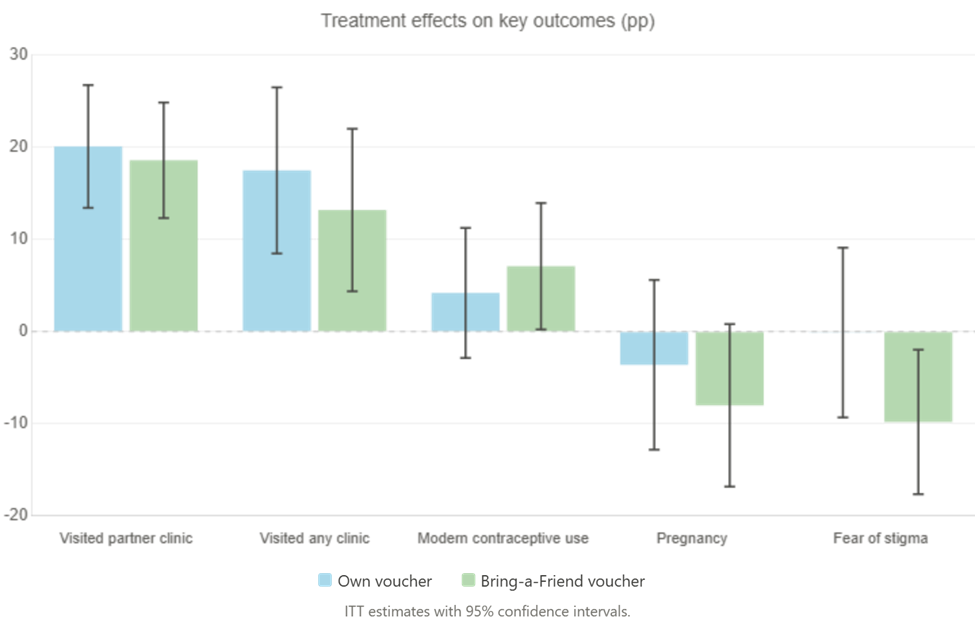
Notes: ITT estimates with 95% confidence intervals.
The real divergence emerged in downstream reproductive outcomes. The BAF voucher increased modern contraceptive use by 42% and reduced the probability of pregnancy by 21% relative to the control group. The own voucher’s effects on these outcomes were smaller and statistically insignificant. This gap is particularly striking given that both groups visited the clinic at similar rates. The critical difference was who accompanied women to the clinic. BAF women were far more likely to attend with supportive female peers, especially sisters-in-law, rather than with their husbands or mothers-in-law, whose preferences on fertility often diverged sharply from what women themselves wanted. In our sample, 82% of mothers-in-law wanted more grandchildren than their daughters-in-law desired.
Strikingly, both vouchers also increased the likelihood that women visited our partner clinic entirely on their own, suggesting that the financial support alone helped some to bypass the social norm of visiting clinics accompanied.
Figure 2: Impact of own vs. BAF voucher
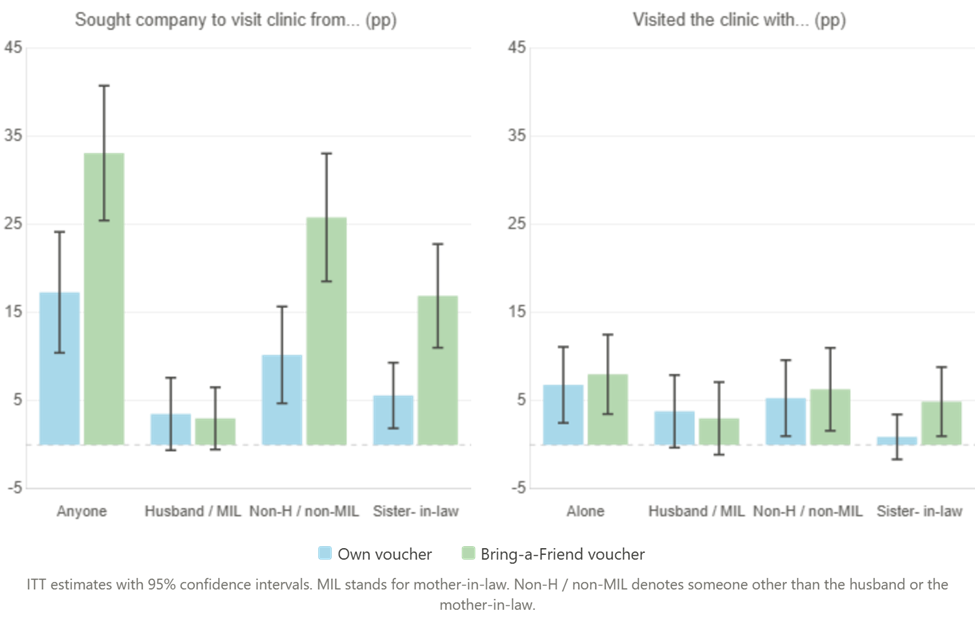
Notes: ITT estimates with 95% confidence intervals. MIL stands for mother-in-law. Non-H/non-MIL denotes someone other than the husband or the mother-in-law.
Peer support reduced stigma and expanded social networks
The BAF voucher reduced women’s fear of being seen at a family planning clinic by 42%, while the own voucher had no such effect. This reduction in anticipated stigma is likely one mechanism through which peer companionship translated into actual contraceptive adoption. Prior research has shown that fear of stigma is a major barrier to contraceptive use in developing countries (Jain et al. 2019), and that peer support can help overcome it (Burke et al. 2019, Castro and Mang 2022).
Beyond the clinic visit itself, the BAF voucher expanded women’s social networks. BAF women reported having more close peers outside their household with whom they discussed family planning – a 24% increase relative to the control group. The gains were especially large for the most isolated women; those whose existing peers were not using contraception saw their number of close peers double relative to the control group. These new connections were not just nominal. BAF women’s peers were significantly more likely to have accompanied them to a health facility and advised them to use family planning.
Peer support was most effective where mother-in-law opposed family planning
For women whose mothers-in-law opposed contraception at baseline, the BAF voucher increased clinic visits by 32 percentage points, significantly more than the own voucher, which had no statistically significant effect for this subgroup. The own voucher, which addressed financial barriers alone, proved insufficient for women facing active household opposition. By enabling women to visit the clinic with supportive peers rather than resistant family members, the BAF voucher provided a means for women to bypass these intrahousehold constraints.
Reassuringly, we found no evidence of backlash. Almost all treated women who visited the clinic informed their husbands and mothers-in-law about their visits, and there were no increases in reported negative experiences related to family planning.
Policy implications: Pairing financial with social support
Vouchers and subsidies are widely used to improve women’s access to reproductive health services. Our findings suggest that these programmes can get women through the clinic door but may not, on their own, translate into meaningful improvements in reproductive well-being, particularly for socially isolated women who face household opposition to family planning. Adding a peer-support component changed the social environment in which women made reproductive decisions, transforming clinic visits into opportunities for sustained engagement with supportive peers.
The intervention cost approximately $27 per woman over a 10-month period, which is comparable to or lower than many integrated family planning programmes (Dulli et al. 2016, Glennerster et al. 2024). Each pregnancy averted cost an estimated $228–$333, a figure that compares favourably with alternative approaches.
More broadly, our results point to a general lesson: wherever women’s access to services is constrained by norms around mobility, stigma, or household gatekeeping – whether in education, employment, or healthcare – enabling peer support may be a cost-effective complement to financial interventions. Although our evidence comes from a single Indian district, the underlying barriers are common across South Asia and beyond. Sisters-in-law, friends, and neighbours can become powerful allies in expanding women’s agency, but only if programmes are designed to actively cultivate these connections.
References
Anukriti, S, C Herrera‐Almanza, P K Pathak, and M Karra (2026), "Bring a friend: Leveraging financial and peer support to improve women's reproductive agency in India," Journal of Development Economics, 180: 103706.
Anukriti, S, C Herrera‐Almanza, P K Pathak, and M Karra (2020), "Curse of the mummy-ji: The influence of mothers-in-law on women in India," American Journal of Agricultural Economics, 102(5): 1328–51.
Ashraf, N, E Field, and J Lee (2014), "Household bargaining and excess fertility: An experimental study in Zambia," American Economic Review, 104(7): 2210–37.
Bellows, B, A Bajracharya, C Bulaka, and S Inambwae (2015), "Family planning vouchers to improve delivery and uptake of contraception in low and middle income countries: A systematic review," Unpublished manuscript.
Burke, E, M Pyle, K Machin, F Varese, and A P Morrison (2019), "The effects of peer support on empowerment, self-efficacy, and internalized stigma: A narrative synthesis and meta-analysis," Stigma and Health, 4(3): 337–56.
Castro, S, and C Mang (2022), "Breaking the silence – Group discussions, social pressure, and the adoption of health technologies," Unpublished manuscript.
Dulli, L S, M Eichleay, K Rademacher, S Sortijas, and T Nsengiyumva (2016), "Meeting postpartum women's family planning needs through integrated family planning and immunization services: Results of a cluster-randomized controlled trial in Rwanda," Global Health: Science and Practice, 4(1): 73–86.
Glennerster, R, J Murray, and V Pouliquen (2024), "Mass media and contraception use: An experimental test of modernization theory in Burkina Faso," Unpublished manuscript.
Government of India (2022), "National family health survey (NFHS - 5), 2019–21," Ministry of Health and Family Welfare.
Jain, A, H Ismail, E Tobey, and A Erulkar (2019), "Stigma as a barrier to family planning use among married youth in Ethiopia," Journal of Biosocial Science, 51(4): 505–19.
Kantorová, V, M C Wheldon, P Ueffing, and A N Z Dasgupta (2020), "Estimating progress towards meeting women's contraceptive needs in 185 countries: A Bayesian hierarchical modelling study," PLOS Medicine, 17(2): e1003026.
UNFPA (2021), "State of the world's population 2021."