



In Colombia, municipalities subjected to the Spanish encomienda – a colonial system of forced indigenous labour – are wealthier and better governed today, in spite of the extractive institution imposed on them.
Editor’s note: This is the second of two articles on the paper Encomienda, the Colonial State, and Long-Run Development in Colombia. Read the first article here.
The authors have made slides available here.
The Spanish encomienda extended from the south-western US to the bottom of South America. This was a colonial institution by which Spanish conquerors extracted labour from the indigenous masses, allowing the former to lead seigneurial lives of ease and abundance while natives worked their farms, mines, and houses. For empirical purposes, we focus on the important case of Colombia (Faguet, Matajira, and Sánchez 2025).
That the encomienda was extractive, oppressive, and cruel is unarguable. That it incentivised the conquerors to take immense risks, and then structured the colonial societies that resulted, is also unarguable. So, how did this process work? And how can we make sense of the long run impacts of institutions on development?
Early Spanish colonisation
First, consider how precarious the colony of New Granada initially was, and how close the entire imperial project came to collapse. Spain’s early settlements were few, small, and precarious. Settlers were surrounded and under constant attack by fierce indigenous warriors who knew the plants, terrain, and fought with poison arrows. By 1535, a decade after its founding, Santa Marta was little more than a trading post protected by nine horsemen and 40 foot-soldiers. Gold, which the Spanish largely obtained by marauding and digging up graves, had become scarce. And the Great Death was decimating the local population.
With the colony facing extinction, Gonzalo Jiménez de Quesada hatched a plan to lead 800 Spaniards – equal to almost the entire population of Santa Marta – on an arduous, 11-month expedition of conquest along the Magdalena River and up into the highlands. It was a final, desperate roll of the dice. Francisco Pizarro had found unimaginable quantities of gold in Peru, which Jiménez knew lay somewhere to the south. So, the Spaniards set out walking.
Strictly speaking, the expedition was a miserable failure. The best route to Cusco today, five centuries later, would stretch 4,700 km. Jiménez’s party did not get close. After 11 months, they had fought, rafted, and climbed their way through 1,000 km of dense vegetation and impossible geography onto the Bogotá Savannah (Figure 1). Over 600 men died of hunger, disease, drowning, indigenous ambushes, and jaguar and alligator attacks. The remaining 173 arrived emaciated and sick, their clothing in shreds. They nonetheless managed to defeat a much larger Muisca army, who had never seen horses, steel weapons, or firearms; many apparently believed the mounted knights were messengers from the gods. The Spanish took food and succour from the Muisca, assassinated their leader, Tisquesusa, and declared the founding of Bogotá.
Figure 1: Gonzalo Jiménez de Quesada’s expedition of 1536
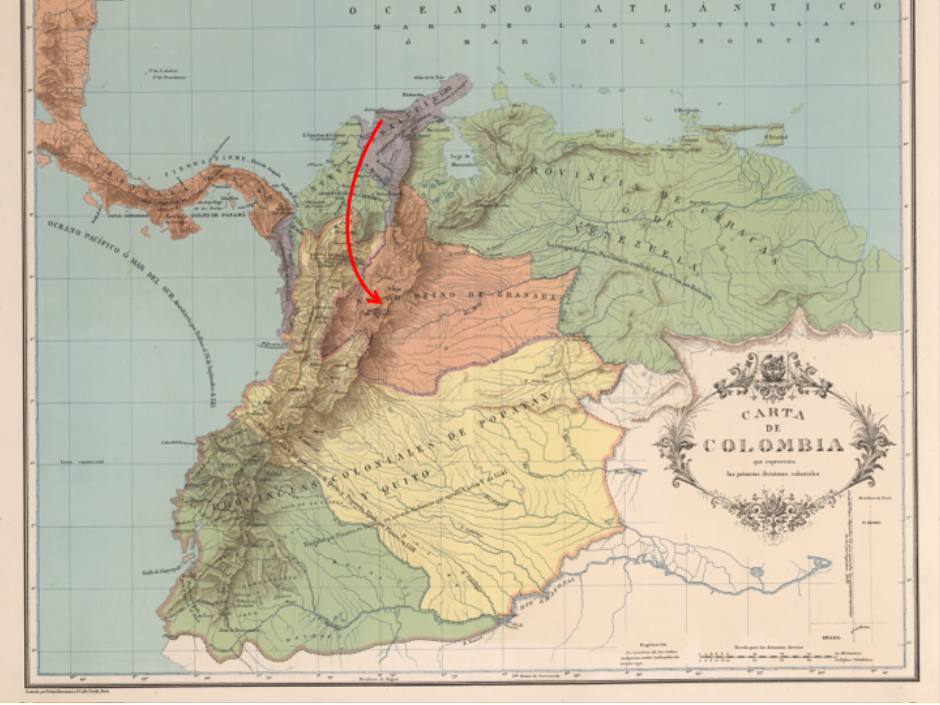
Source: Codazzi (1889).
Why would the Spanish undertake such enormous risks? Their ‘gold fever’ is well-known; conquering parties divided up the treasure they seized formulaically amongst all members. But the other motive that drove them into the jungle and up the sides of mountains was the encomienda. This was a colonial institution that granted conquerors the right to extract both labour and tribute payments of goods, metals and money from the indigenous populations they conquered, with 20% going to the Crown. In exchange, Spanish lords taught natives the Catholic faith and ‘defended them from outside threats’. Despite some similarities, this was not slavery. Natives could not be bought and sold, meaning they were not stores of value in the eyes of the Spanish. Paradoxically, this encouraged the Spanish to extract as quickly as they could, making natives arguably worse off than chattel slaves (Yeager 1995).
We still remember our first phone call to discuss early indications that encomienda-affected municipalities were richer and more developed hundreds of years later. “It can’t be true”, we agreed. It was the heyday of research that argued large and persistent negative effects of slavery on current development outcomes, in both African regions from which slaves were taken, and areas of the Americas that received them (Acemoglu et al. 2012, Nunn 2008, Nunn and Wantchekon 2011, Michalopoulos and Papaioannou 2020). But our early results were right. We spent most of the following decade trying to find flaws, or something we’d missed, but our results stood the test of time.
Encomienda and long-run development in Colombia
By digitising a great deal of historical data from the mid-1500s, and merging that with data from the 1700s through to the present day, we are able to show that the one-third of Colombian municipalities that had encomienda in 1560 have higher levels of economic development, human development, and state capacity today. To better compare like with like, our method focuses on municipal neighbour-pairs, one with encomienda and the other without. Our evidence shows that encomienda municipalities have higher municipal GDP per capita, higher tax receipts, and higher educational attainment; lower infant mortality, poverty, and unsatisfied basic needs; larger populations; and superior fiscal performance and bureaucratic efficiency, but also higher inequality, versus neighbouring municipalities that lacked encomienda.
Studying encomienda empirically
Our method blends econometric evidence from a modern database of 1,122 municipalities’ economic, political, social, institutional and other characteristics, to which we added the historical data mentioned above, with deep historical research into the people, events, and contexts of the Spanish conquest and the early society they built. The latter benefits from decades of painstaking historiographical research by scholars of Colombia (Colmenares 1999 , 2015, Meisel and Ramírez 2015, Safford and Palacios 2002, Tovar 2013, Wiesner 2008), as well as original sources from the colonial period (Durán y Díaz 1794, Perdices De Blas and Ramos-Gorostiza 2015, Tovar 1988).
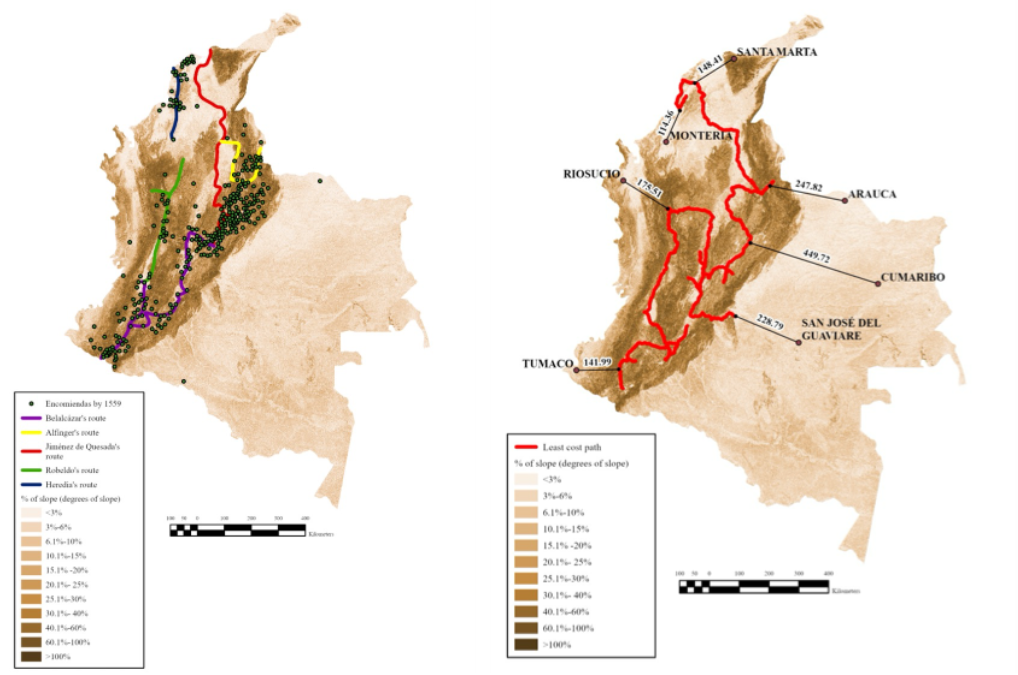
A side-benefit of our quest for causality is that we combine our rich municipal-historical data with detailed topographical information from NASA on elevation, slope and natural barriers to provide a better estimate of the conquerors’ routes through Colombia. Early 1500s’ Spaniards did not know where they were, did not know what South America looked like, and kept no maps of their travels. The earliest attempt to map their journeys are chronicled in Codazzi (1889), which has formed the basis of our understanding ever since. But these routes do not capture all the colonial settlements documented by imperial agents in the 1500s. Using 21st-century methods, we can now calculate the least-cost path through Colombia’s difficult terrain that the conquerors most likely took to reach the settlements we know they founded. Figure 2 compares Codazzi’s account of the conquerors’ routes with our least-cost estimate.
Figure 2: Route of the conquerors: Least-cost vs. Codazzi (1889)
How colonial institutions affect development today
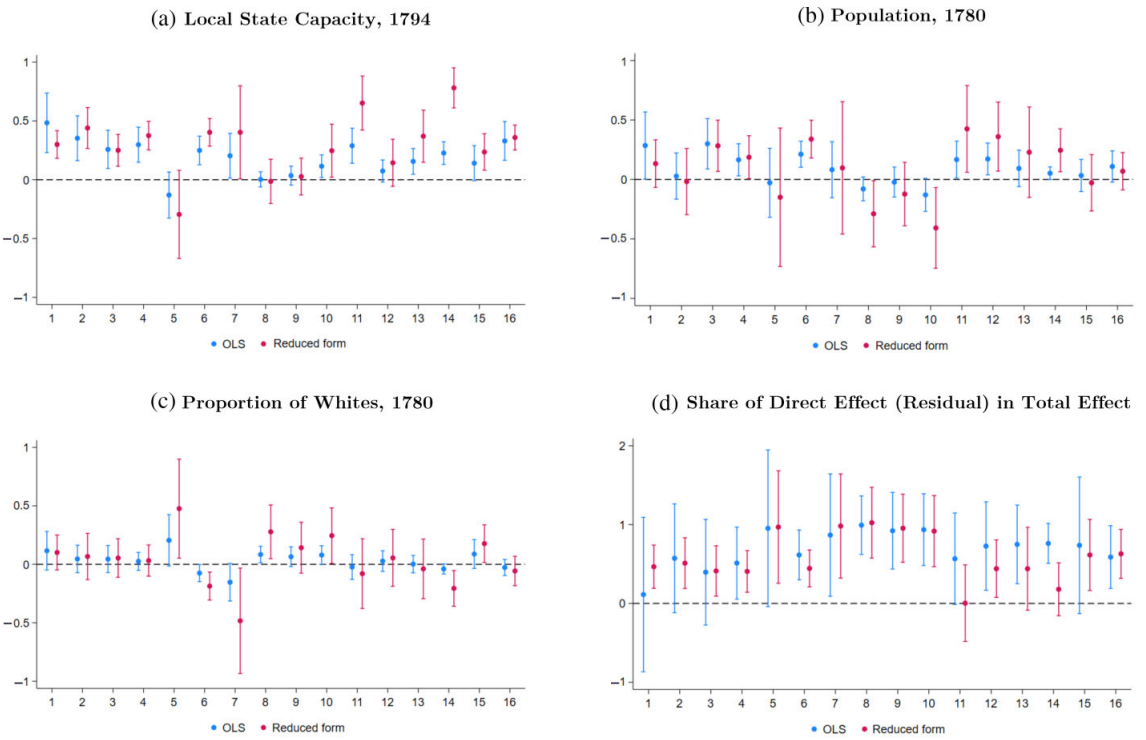
By the early 1700s, many encomiendas were extinct, and those that survived were formally abolished at independence. Through what mechanism might their effects persist into the 21st century? Our historical data shows that the encomienda had three distinct effects: a higher share of Spanish descendants (white population), more general population growth, and the construction of local state institutions.[1] Evidence in Figure 3 shows that encomienda impacts current levels of economic and human development, as well as state capacity, most strongly through its contribution to building the colonial local state. Estimates in Panel 1 are larger and statistically more significant than Panels 2 or 3. Panel 4 estimates, included for completeness, capture residual effects that cannot be disaggregated for lack of data.
Figure 3: Share of total effect mediated by state capacity, population and racial composition
Implications for long-run development
The Spanish conquest destroyed indigenous society and eventually killed off the lion’s share of its people. Surveying a tabularasa, conquerors sowed the seeds of what would become the colonial, and then republican, local state in the places they occupied. And they occupied places where they could establish encomiendas. In these places, they quickly established town councils, notaries, jails, and other local institutions, and invested time and resources building them up. Many, if not most, of these resources were extracted from natives.
The presence of encomienda thus prompted the inception of a strong local state with capacities in different government tasks, which persisted over time. Where encomiendas were missing, by contrast, such powerful rural interests were absent. In those places, the institutions of the local state were founded far later – many well into the 20th century. Over centuries, absent or less capable local states mobilised fewer resources, invested less in the local economy, and spurred less development.
Our findings underline the role of accumulation in long-run development, something that was at the core of development thinking mid-20th century but is often overlooked now. Areas lacking encomienda suffered less extraction from the 16th century onwards. But they are worse off today. In encomienda areas, some of the resources extracted were used to build the local state, which provided public goods, and the combination spurred development. This suggests that we refocus our attention on resource mobilisation and investment in public goods. But not with the oppressive, cruel methods of the conquerors. In a modern context, democratic tools can generate the consensus required to more effectively mobilise resources and invest in subnational institutions as a means of accelerating development.
References
Acemoglu, D, C García-Jimeno, and J A Robinson (2012), "Finding Eldorado: Slavery and long-run development in Colombia," Journal of Comparative Economics, 40: 534–564.
Codazzi, A, M M Paz, and F Pérez (1889), Atlas Geográfico e Histórico de la República de Colombia (Antigua Nueva Granada), el cual comprende las Repúblicas de Venezuela y Ecuador. Paris: A. Lahure.
Colmenares, G (1999 [1973]), Historia Económica y Social de Colombia, Tomo 1. Bogotá: Tercer Mundo.
Colmenares, G (2015), "La formación de la economía colonial," in J A Ocampo (ed), Historia Económica de Colombia. Bogotá: Fedesarrollo.
Durán y Díaz, J (1794 [2012]), Estado General de Todo el Virreynato de Santafé de Bogotá en el Presente Año de 1794. Bogotá: Banco de la República.
Faguet, J P, C Matajira, and F Sánchez (2025), "Encomienda, the colonial state, and long-run development in Colombia," Economic Journal, ueaf108.
Meisel R, A, and M T Ramírez G (eds) (2015), La Economía Colonial de la Nueva Granada. Bogotá: Banco de la República.
Michalopoulos, S, and E Papaioannou (2020), "Historical legacies and African development," Journal of Economic Literature, 58(1): 53–128.
Nunn, N (2008), "The long-term effects of Africa's slave trades," Quarterly Journal of Economics, 123: 139–76.
Nunn, N, and L Wantchekon (2011), "The slave trade and the origins of mistrust in Africa," American Economic Review, 101(7): 3221–52.
Perdices De Blas, L, and J L Ramos-Gorostiza (2015), "Rediscovering America: Political economy of Spanish colonies according to the explorers Juan-Ulloa, Malaspina and Humboldt," Revista de Historia Económica / Journal of Iberian and Latin American Economic History, 34(1): 135–159.
Safford, F, and M Palacios (2002), Colombia: Fragmented Land, Divided Society. New York: Oxford University Press.
Tovar P, H (1988), No Hay Caciques Ni Señores: Relaciones y Visitas a los Naturales de América. Siglo XVI. Barcelona: Sendai Ediciones.
Tovar P, H (2013), La Estación del Miedo o la Desolación Dispersa: El Caribe Colombiano en el Siglo XVI. Bogotá: Ediciones Uniandes.
Wiesner, L E (2008), Tunja: Ciudad y Poder en el Siglo XVII. Tunja: Universidad Pedagógica y Tecnológica de Colombia.
Yeager, T J (1995), "Encomienda or slavery? The Spanish Crown's choice of labour organization in sixteenth-century Spanish America," Journal of Economic History, 55(4): 842–859.