





A national extension programme in Uganda raised farmers’ expectations and adoption of oilseed crops – revealing how beliefs, not just knowledge, drive agricultural transformation.
Despite decades of investment in agricultural extension, the adoption of profitable crops and technologies in sub-Saharan Africa remains low (Suri et al. 2024). Smallholders often continue cultivating subsistence staples, even when more profitable alternatives exist (Suri and Udry 2022, Barrett et al. 2022). Understanding why has been a central puzzle for economists and policymakers.
In new research (Bonan, Kazianga, and Mendola 2025), we present experimental evidence from Uganda that shows the crucial role of information and expectations. Using a nationwide randomised rollout of Uganda’s Vegetable Oil Development Project Phase 2 (VODP2), we find that improving farmers’ technical and market information significantly increases adoption of oilseed crops, primarily by shifting their beliefs about yields and prices.
Our research highlights an often-overlooked channel in technology adoption: ex-ante farmers’ expectations – what they think new crops will yield and sell for matters as much as actual (ex-post) profitability. Moreover, how farmers update these beliefs depends on their initial outlook: optimists and pessimists react very differently to new information.
A large-scale experiment in agricultural extension
Since the late 1990s, Uganda has aimed to move smallholders from subsistence to commercial agriculture. The programme, implemented by the Ministry of Agriculture and international partners, promoted the cultivation of soybean, sunflower, groundnut, and sesame – all of which have high market value and demand from domestic processors.
Between 2016 and 2018, 86 rural sub-counties were randomly assigned to receive the full programme package. The intervention included:
- Technical training on oilseed cultivation and input use.
- Marketing support, such as information on prices and buyer linkages.
- Demonstration plots to showcase improved varieties and practices.
Researchers surveyed over 2,700 farmers before and after implementation, asking detailed questions about yield and price expectations before and after the intervention – a novel feature allowing direct measurement of belief changes.
Expectations: From confusion to confidence
Collecting data on expectations in rural settings is notoriously difficult, as many farmers have limited experience or numeracy skills. We treat the probability of reporting expectations as a sign of awareness – the extensive margin of expectations – while the levels of reported expectations represent the intensive margin (Figures 1 and 2).
The intervention significantly increased the likelihood that farmers reported yield and price expectations, particularly for soybean and sunflower. The probability of reporting expectations rose by around 15% overall, and up to 46% for sunflowers, suggesting that extension improved farmers’ understanding of oilseed profitability (Figure 1).
Figure 1: Treatment effects on reporting expectations (extensive margin)
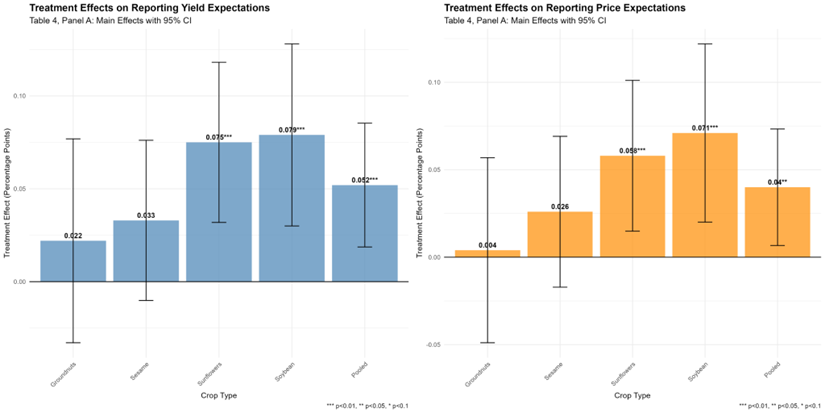
Figure 2: Treatment effects on expectation levels (intensive margin)
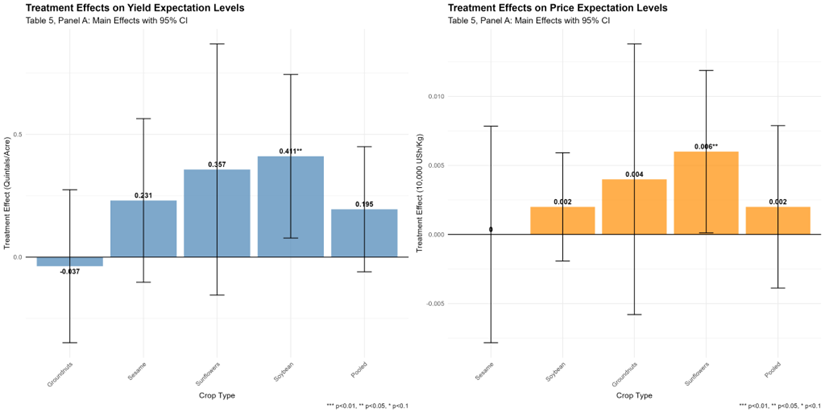
At the intensive margin, yield expectations increased significantly – particularly for soybeans (+0.41 quintals/acre, or +12% relative to the control mean). Price expectations also rose modestly, with significant gains for sunflowers (+6%) (Figure 2). These shifts indicate that farmers who learned from the programme expected higher returns to oilseed production.
Do all farmers respond to new information in the same way? We show that they do not.
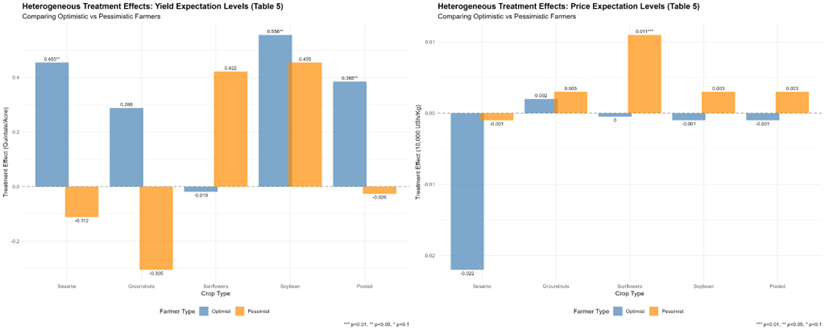
The extension information caused optimistic farmers – those who already believed yields would be high – to revise their expectations upwards even further. Pessimists, by contrast, showed little or no updating (Figure 3), widening the expectation gap between the two groups. This finding fits a behavioural model of confirmation bias: optimists interpret new information as validation, while pessimists discount it. In other words, the same message from an extension officer can strengthen pre-existing beliefs rather than harmonise them.
Figure 3: Heterogeneous treatment effects on expectation levels
Turning beliefs into behaviour: Adoption of oilseeds
Did higher expectations translate into real changes in farming decisions? Yes, and quite substantially.
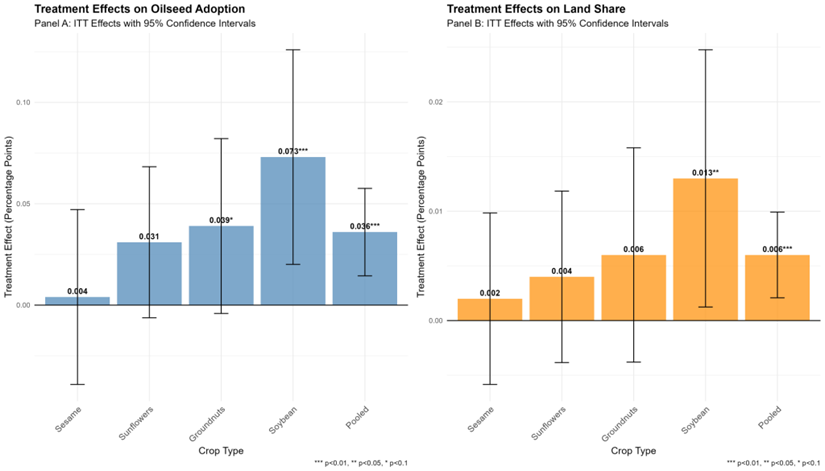
Farmers in treated areas were 3.7 percentage points more likely to adopt oilseeds – a 15% increase relative to the control mean. The effects were strongest for soybeans (+25%), followed by sunflowers (+33%) and groundnuts (+9%). The share of land allocated to oilseeds also increased by around 17%, showing that adoption extended beyond experimentation into genuine reallocation of production (Figure 4).
Figure 4: Treatment effects on oilseed adoption (ITT)
Beyond adoption: Market access and productivity
The programme also boosted input use, labour allocation, and market participation for oilseed farmers. Treated farmers were more likely to use improved seeds and fertilisers and sell collectively through marketing groups.
While these intermediate outcomes are encouraging, short-run household welfare effects – such as income and consumption – were limited. This suggests that the benefits of adoption may take time to materialise as farmers learn and markets deepen.
Policy lessons: Managing expectations for agricultural transformation
The Ugandan experiment offers several key lessons for agricultural policy and extension design:
- Beliefs matter. Information interventions can powerfully influence farmers’ expectations and, through them, adoption decisions.
- Targeted communication. Because optimistic and pessimistic farmers respond differently, communication strategies should be tailored to ensure that more sceptical farmers are not left behind.
- Sustained engagement is essential. While expectations and adoption rose quickly, income effects did not – follow-up support is needed.
- Expectation data enrich evaluation. Measuring beliefs directly helps unpack adoption mechanisms and guide future policy.
Policy implications: Agricultural transformation in Africa
Uganda’s Vegetable Oil Development Project Phase 2 programme shows that agricultural transformation requires more than just providing new technologies – it requires changing minds. When farmers gain reliable information about yields and prices, they adjust their expectations and invest accordingly. Yet belief heterogeneity – especially the persistence of pessimistic priors – remains a key challenge.
References
Barrett, C B, A Islam, A M Malek, D Pakrashi, and U Ruthbah (2022), “Experimental evidence on adoption and impact of the System of Rice Intensification,” American Journal of Agricultural Economics 104(1): 4–32.
Bonan, J, H Kazianga, and M Mendola (2025), “Agricultural transformation and farmers’ expectations: Experimental evidence from Uganda,” Review of Economics and Statistics (forthcoming).
Suri, T, and C R Udry (2022), “Understanding agricultural inaction in Sub-Saharan Africa,” Annual Review of Economics 14: 225–252.
Suri, T, C Udry, J C Aker, C B Barrett, L Falcao Bergquist, M Carter, L Casaburi, R Darko Osei, D Gollin, V Hoffmann, T Jayne, N Karachiwalla, H Kazianga, J Magruder, H Michelson, M Startz, and E Tjernström (2024), “Agricultural technology in Africa,” VoxDevLit 5(2), March.