





Ethiopia’s fertiliser blending initiative shifted farmers to new products but failed to boost yields or incomes – underscoring that fertiliser supply reforms must be paired with broader investments in seeds, water, soils, and markets to raise productivity.
Editor’s note: For a broader synthesis of themes covered in this article, check out our VoxDevLit on Agricultural Technology in Africa.
The challenge of low fertiliser use in sub-Saharan Africa
Fertiliser has been one of the most powerful tools for boosting agricultural productivity worldwide (Evenson and Gollin 2003, Pingali 2012). Yet in sub-Saharan Africa, its use remains stubbornly low (Sheahan and Barrett 2017). Governments and multilateral agencies have invested upwards of US$100 million annually in programmes to encourage more widespread and intensive use of fertiliser (Druilhe and Barreiro-Hurle 2012).
Governments and international organisations have tried almost every lever imaginable: making fertiliser cheaper through subsidies or loans (Giné and Yang 2009, Tarozzi et al. 2015, Carter et al. 2021), improving farmer knowledge through training and plot-specific recommendations (Conley and Udry 2010, Maertens et al. 2021, Harou et al. 2022, Tjernström et al. 2021), ensuring fertiliser quality (Michelson et al. 2021, Bold et al. 2017), and even using behavioural nudges to encourage timely use (Duflo et al. 2011). These efforts have sometimes raised adoption, but not enough to overcome the deeper problem: fertiliser use is often unprofitable for African farmers (Suri et al. 2024).
The main reason that fertiliser is often unprofitable is simple: it costs too much to get fertiliser to farmers compared with the value of crops they produce (Aggarwal et al. 2024, Porteous 2020, McCullough et al. 2022). Poor market access raises transport costs, which keeps fertiliser prices high and profits low.
Did Ethiopia’s big bet on fertiliser plants pay off?
Ethiopia took a different approach. After mapping its soils in 2012 and identifying widespread nutrient deficiencies, the government built five fertiliser blending facilities (2014–2016) to produce customised blends. At the same time, it set up more than 30,000 demonstration plots to showcase the new fertilisers against the standard DAP and urea farmers had previously used.
The hope was simple: farmers would switch to these blends, apply more fertiliser overall, and see higher yields and incomes.
But did this bold experiment deliver on its promise?
Studying the phased rollout of fertiliser blending facilities
The staggered rollout of Ethiopia’s blending facilities created a rare natural experiment. Because the timing of facilities opening was determined by construction delays – rather than farmer demand – we could credibly compare outcomes in areas that gained early access with those in areas that had to wait.
Our research (Assefa, McCullough, and Berhane 2025) uses a multi-period difference-in-difference design (Callaway and Sant’Anna 2021). We control for background differences between farms close to and far from the blending facilities.
We defined farmers as having access if they lived within a travel time of around four hours to a facility – a distance that could be travelled in one day. Our results do not depend on the exact cut-off: the conclusions are the same if we use tighter or looser definitions of access.
To make sure our findings are not an artifact of one dataset, we ran the analysis across three different large-scale, nationally representative surveys: the Ethiopia Rural Socioeconomic Survey panel, Feed the Future panel, and annual Agricultural Sample Survey.
What changed? Displacement without new adoption
The facilities achieved their narrowest goal: they got farmers to use the new blends. Farmers living nearby were around 22 percentage points more likely to adopt the newly blended fertiliser (NPS; nitrogen, phosphorus, and sulphur), and just as less likely to use the old DAP fertiliser (Figure 1).
However, overall fertiliser use did not increase. Farmers close to the facilities simply swapped one product for another: more NPS, less DAP, with no change in the share of farmers using fertiliser or in total application rates.
Figure 1: Effect of fertiliser blending facilities on fertiliser adoption
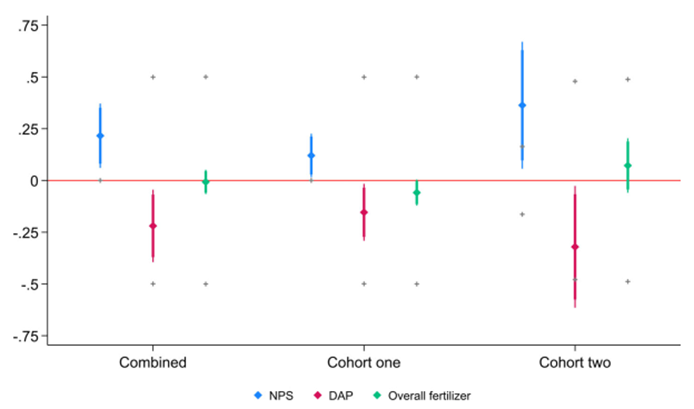
Notes: The combined estimate summarises the effect of the blending facilities established across both waves of rollout, while the cohort one focuses on the first wave and cohort two estimate on the second. The outcome is a binary measure of fertiliser adoption. Cohort 1 includes not-yet-treated and never treated households as controls, Cohort 2 includes never treated households as controls. The plus signs depict one standard deviation of the control group’s outcome variable during the base period. The bars surrounding each coefficient depict 90% and 95% confidence intervals. These results use the Feed the Future dataset.
This pattern highlights a broader lesson: because smallholders face many constraints that simultaneously bind productivity (Deutschmann et al. 2025, Magruder 2018), reducing the cost of access to one input alone is not enough to catalyse widespread adoption.
Blended fertiliser had no effect on crop yields or farm profits
If the new blends truly delivered higher returns, we may have expected to see higher yields and incomes – even without an overall increase in fertiliser use. But the evidence shows otherwise. Across Ethiopia’s main staples – teff, wheat, and maize – yields and the value of production did not improve. Nor did we see any impact on household consumption, a proxy for farm profits. Farmers living near the blending facilities were no better off than those living farther away.
Complementary interventions matter
Alongside the rollout of the blending facilities, the Ministry of Agriculture established more than 30,000 demonstration plots to show farmers how the new NPS fertilisers compared with traditional DAP and urea. Some farmers lived in areas with demonstration plots, while others did not – allowing us to test whether farmers who also had access to the demonstration plots experienced different outcomes.
Our results point to complementarities. Where demonstration plots were present, farmers adopted NPS and dis-adopted DAP more strongly, with no net change in overall fertiliser adoption. Farmers close to demonstration plots did apply overall fertiliser with around 10% higher intensity compared to those without demonstration plots. Yet even with this boost in overall fertiliser application rates, farmers near demonstration plots did not achieve higher yield growth.
Why did blended fertiliser not deliver welfare gains?
If the new blends were truly better suited to local soils, why did we not see more fertiliser use, higher yields, or better farm incomes? While we cannot test every possible explanation directly, several concerns stand out.
One concern is the quality of the new blended fertilisers. Media reports at the time raised allegations of mismanagement in procuring raw ingredients for the blends, which could have reduced their effectiveness. Another possibility is delivery. Because the fertilisers travelled through new distribution channels, delays may have blunted their impact, though we did not find any public reports of delayed fertiliser delivery.
Farmers’ lack of specific knowledge about how to use these new fertilisers may also have limited the impacts on productivity. Yet the absence of yield gains, even in areas with demonstration plots, makes this a less likely explanation.
A likely contributing factor is that farmers faced other binding constraints – such as limited water, poor seed quality, and missing soil micronutrients – that prevented them from fully benefiting from the blended fertiliser products.
Lessons for promoting fertiliser adoption
Ethiopia’s experience shows that supply-side interventions can matter. By lowering transaction costs, the blending facilities succeeded in shifting farmers towards a new, untested product at scale. In a context where uncertainty and knowledge barriers are high, achieving that level of adoption within such a short period of time is commendable.
But the bigger lesson is about limits. As Ethiopia’s experience shows, expanding fertiliser supply alone is unlikely to transform rural livelihoods if deeper agronomic and economic constraints remain. For fertilisers to raise productivity and incomes, supply reforms must be paired with policies that improve profitability – through better seeds, water access, infrastructure, and markets.
References
Aggarwal, S, B Giera, D Jeong, J Robinson, and A Spearot (2024), “Market access, trade costs, and technology adoption: Evidence from northern Tanzania,” Review of Economics and Statistics 106(6): 1511–1528.
Assefa, T, E McCullough, and G Berhane (2025), “Evaluating large-scale government investments in fertilizer adoption: The Ethiopian experience,” American Journal of Agricultural Economics: 1–27.
Bold, T, K C Kaizzi, J Svensson, and D Yanagizawa-Drott (2017), “Lemon technologies and adoption: Measurement, theory and evidence from agricultural markets in Uganda,” Quarterly Journal of Economics 132(3): 1055–1100.
Callaway, B, and P H C Sant’Anna (2021), “Difference-in-differences with multiple time periods,” Journal of Econometrics 225(2): 200–230.
Carter, M, R Laajaj, and D Yang (2021), “Subsidies and the African Green Revolution: Direct effects and social network spillovers of randomized input subsidies in Mozambique,” American Economic Journal: Applied Economics 13(2): 206–229.
Conley, T G, and C R Udry (2010), “Learning about a new technology: Pineapple in Ghana,” American Economic Review 100(1): 35–69.
Deutschmann, J W, M Duru, K Siegal, and E Tjernström (2025), “Relaxing multiple agricultural productivity constraints at scale,” Journal of Development Economics 174: 103409.
Dinkelman, Z, and J Barreiro-Hurlé (2012), "Fertilizer subsidies in sub-Saharan Africa," Food and Agriculture Organization of the United Nations.
Duflo, E, M Kremer, and J Robinson (2011), “Nudging farmers to use fertilizer: Theory and experimental evidence from Kenya,” American Economic Review 101(6): 2350–2390.
Evenson, R, and D Gollin (2003), “Assessing the impact of the Green Revolution, 1960–2000,” Science 300(5620): 758–762.
Giné, X, and D Yang (2009), “Insurance, credit, and technology adoption: Field experimental evidence from Malawi,” Journal of Development Economics 89(1): 1–11.
Harou, A P, M Madajewicz, H Michelson, C A Palm, N Amuri, C Magomba, J M Semoka, K Tschirhart, and R Weil (2022), “The joint effects of information and financing constraints on technology adoption: Evidence from a field experiment in rural Tanzania,” Journal of Development Economics 155: 102707.
Maertens, A, H Michelson, and V Nourani (2021), “How do farmers learn from extension services? Evidence from Malawi,” American Journal of Agricultural Economics 103(2): 569–595.
Magruder, J R (2018), “An assessment of experimental evidence on agricultural technology adoption in developing countries,” Annual Review of Resource Economics 10: 299–316.
McCullough, E B, J D Quinn, and A M Simons (2022), “Profitability of climate-smart soil fertility investment varies widely across Sub-Saharan Africa,” Nature Food 3(4): 275–285.
Michelson, H, A Fairbairn, B Ellison, A Maertens, and V Manyong (2021), “Misperceived quality: Fertilizer in Tanzania,” Journal of Development Economics 148: 102579.
Pingali, P (2012), “Green Revolution: Impacts, limits, and the path ahead,” PNAS 109(31): 12302–12308.
Porteous, O (2020), “Trade and agricultural technology adoption: Evidence from Africa,” Journal of Development Economics 144: 102440.
Sheahan, M, and C Barrett (2017), “Ten striking facts about agricultural input use in Sub-Saharan Africa,” Food Policy 67: 12–25.
Suri, T, C Udry, J C Aker, C B Barrett, L Falcao Bergquist, M Carter, L Casaburi, R Darko Osei, D Gollin, V Hoffmann, T Jayne, N Karachiwalla, H Kazianga, J Magruder, H Michelson, M Startz, and E Tjernström (2024), “Agricultural technology in Africa,” VoxDevLit 5(2).
Tarozzi, A, J Desai, and K Johnson (2015), “The impacts of microcredit: Evidence from Ethiopia,” American Economic Journal: Applied Economics 7(1): 54–89.
Tjernström, E, T J Lybbert, R Frattarola-Hernández, and J S Correa (2021), “Learning by (virtually) doing: Experimentation and belief updating in smallholder agriculture,” Journal of Economic Behavior and Organization 189: 28–50.