




Evidence from Vietnam shows that institutional barriers not only misallocate resources but also discourage farmers from investing in productivity improvements, compounding the losses from misallocation.
Why are some countries so much more productive in agriculture than others (Gollin et al. 2002, Restuccia et al. 2008)? A growing body of research points to the misallocation of resources – land, labour, and capital – across farms (Adamopoulos and Restuccia 2014, Adamopoulos et al. 2022, Chen et al. 2023). When productive farmers cannot expand and unproductive farmers do not contract, aggregate productivity suffers.
But this misallocation is only part of the story. In new research (Ayerst, Brandt, and Restuccia forthcoming), we show that barriers to resource allocation also have dynamic effects: they discourage farmers from making productivity-enhancing investments, which magnifies the productivity losses over time. Using detailed panel data from Vietnam and exploiting historical differences in institutions between the north and south, we quantify these effects and find that dynamic losses more than double the cost of misallocation.
Vietnam's natural experiment
Vietnam offers a unique laboratory for studying these questions. Since the late 1980s, the country has undergone major agricultural reforms – decentralising farm production to households and liberalising markets. But due to different historical legacies, these institutional changes have been uneven across regions (Ho 2023).
In the north, agriculture was collectivised for more than three decades after the country's division in 1954. Land was allocated by communes, and markets were suppressed. In the south, farming continued at the household level, with private land ownership and more active land markets. These differences persist today: in the Red River Delta in the north, over 80% of agricultural land was allocated by the state; in the Mekong Delta in the south, less than 5% was (Benjamin and Brandt 2003).
These regional differences allow us to compare otherwise similar agricultural environments with different institutional barriers.
What the data shows
Using the Vietnam Access to Resources Household Survey (VARHS) – a rich panel of over 2,100 households surveyed biennially from 2006 to 2016 – we document striking differences between north and south.
First, agricultural productivity is much higher in the south. Total factor productivity (TFP) in the south is more than twice that in the north. Value added per hectare is 64% higher, and value added per worker is nearly three times higher. Figure 1 shows why: as farms get larger, output in the south rises much more steeply than in the north. The most productive farms in the south can expand and produce more; in the north, they cannot.
Figure 1: Land use and output by farm size
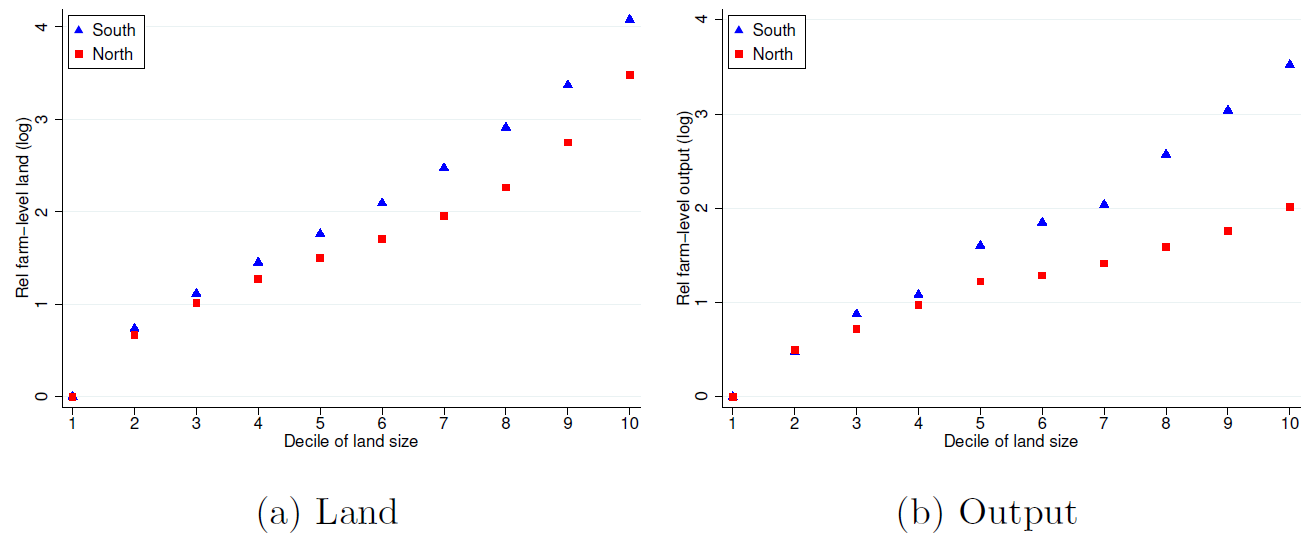
Notes: Farm deciles are constructed by the land used for each farm by region and year. Average output and land are then normalised by the bottom decile in each year. The figure reports average output and land across years.
Second, resources are allocated much more efficiently in the south. When we look at how land is allocated across farms, we find that a 10% increase in a farm's productivity is associated with a 5.5% increase in its land in the south – but only a 1.5% increase in the north. In other words, productive farms in the south can expand to match their ability; in the north, they are stuck.
Third, farms in the south are more dynamic. Young farmers in the south see their productivity grow much faster than their northern counterparts – about twice as fast over the farm life cycle. Figure 2 tracks farm productivity over the life cycle. In the south (darker line), productivity rises steeply as farmers gain experience. In the north (lighter line), productivity barely grows at all. These differences are closely linked to investment: farmers who invest in irrigation, soil conservation, or participate in agricultural extension services see faster productivity growth, especially in the south.
Figure 2: Farm-level productivity by age
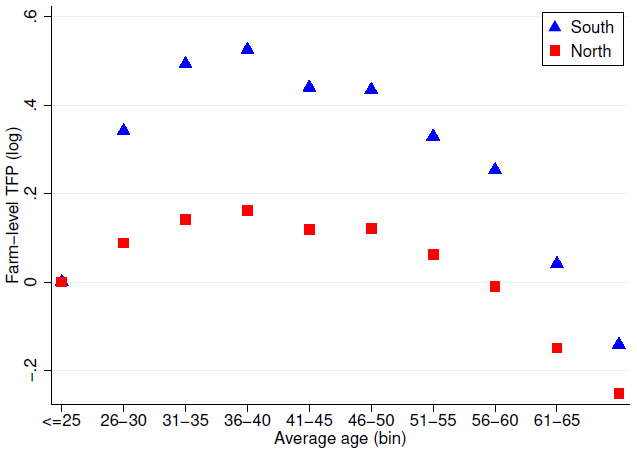
Notes: The figure reports estimated age bin fixed effects from a regression log farm TFP on age bin controlling for region and time fixed effects. The coefficient estimates reported are normalised such that the youngest bin has value zero in each region.
A model of farm dynamics with investment
To understand what drives these differences, we develop a model of heterogeneous farms that can invest in improving their productivity. In the model, farmers face idiosyncratic barriers – ‘wedges’ between their marginal products and factor prices – that capture institutional frictions like insecure property rights or land rental restrictions. Figure 3 shows the distribution of these wedges (barriers) in the north and south. Both regions exhibit dispersion, meaning barriers exist everywhere. But the key difference – captured in our model – is how these barriers are correlated with productivity. In the north, productive farmers are more constrained by barriers on their output, discouraging both expansion and investment.
Figure 3: TFP and wedge distribution
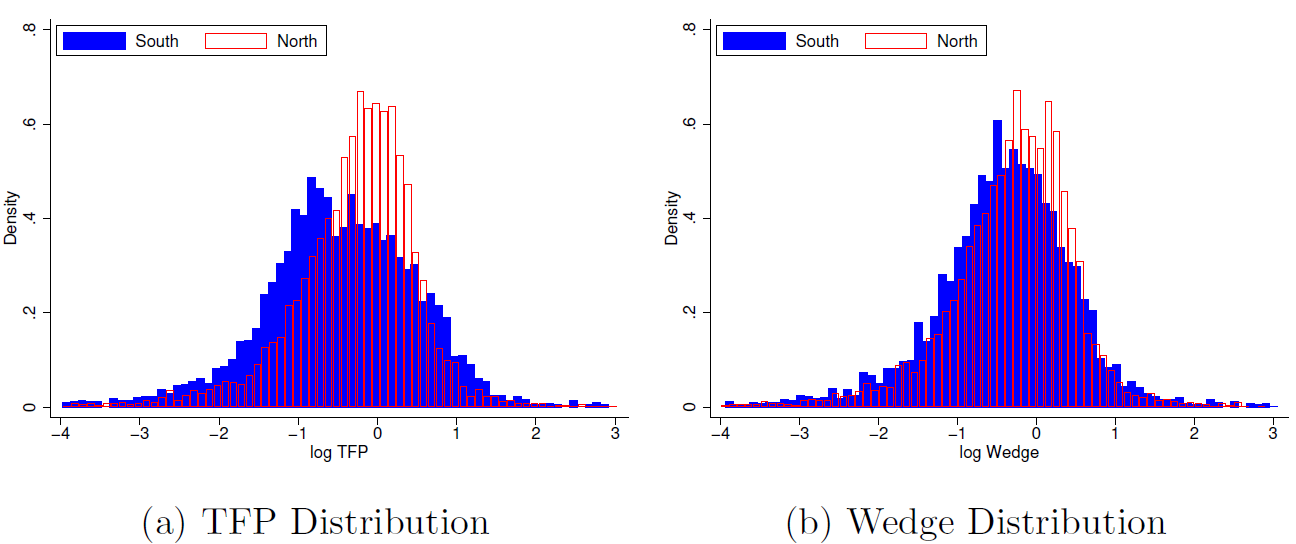
Notes: Histogram of farm TFP and farm wedges (barriers) for farm-year observations in north and south Vietnam. Farm TFP and farm wedges are normalised by the mean in each region (North/South) year.
Crucially, these barriers affect not only how farmers allocate resources today, but also whether they invest to become more productive tomorrow. A farmer who faces high barriers – who cannot expand even if she becomes more productive – has less incentive to invest in the first place.
We calibrate the model to match the farm productivity distribution and dynamics in south Vietnam, including the dispersion of productivity, the rate of farm growth, and the relationship between farm size and productivity.
Quantifying the role of barriers
Our main experiment takes the calibrated south Vietnam economy and imposes the barriers measured in the north – where barriers are more highly correlated with farm productivity, meaning productive farmers are penalised more heavily.
The results are striking (see Figure 4). Aggregate agricultural productivity falls by 38% relative to south Vietnam. This accounts for 55% of the observed 2.5-fold productivity gap between the two regions. Average farm TFP growth falls by 1.6 percentage points – nearly half the gap between north and south. And both farm-level TFP and farm land dispersion fall, matching the lower dispersion observed in the north.
Figure 4: The effect of barriers on productivity and growth
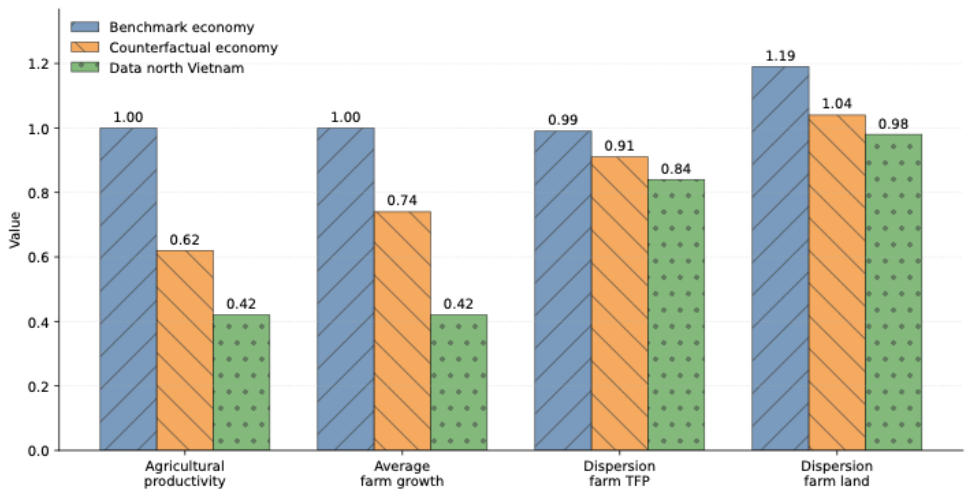
Notes: Comparing results of the benchmark economy calibrated to south Vietnam with a counterfactual economy with barriers measured in the north and data for north Vietnam. Productivity and growth refer to TFP and are normalised to one for the benchmark economy. Dispersion is measured as the standard deviation of the log of each variable.
Perhaps most importantly, we decompose this productivity loss into two channels. The first is static misallocation: holding farm-level productivities fixed, resources are allocated less efficiently. This accounts for about one-third of the loss.
The second channel is dynamic: because barriers reduce the returns to becoming more productive, farmers invest less. The resulting shift in the farm productivity distribution – fewer highly productive farms – accounts for the remaining two-thirds of the loss. In other words, the dynamic effects of barriers more than double the static losses.
Robustness and extensions
We test these results in several ways. Could measurement error in our data be driving the results? We find relatively limited measurement error in the VARHS data compared to manufacturing surveys, and our focus on differences between regions rather than absolute levels mitigates this concern.
We also extend the model to incorporate crop choice, which is important in Vietnam. Farms in the south are much more likely to grow high-value perennial crops, and we find that barriers help explain these differences. Adding crop choice to the model accounts for about one-sixth of the productivity gap, with the split between static and dynamic channels remaining similar.
Other extensions – allowing for a hump-shaped productivity life-cycle pattern or intergenerational spillovers in farming ability – leave our main results largely unchanged.
Policy implications
Our findings have important implications for agricultural policy in developing countries. They suggest that reforms aimed at improving the allocation of resources – such as strengthening property rights, liberalising land markets, or removing size-dependent policies – have benefits that go beyond the immediate efficiency gains.
By raising the returns to becoming more productive, these reforms can also encourage farmers to invest, adopt new technologies, and improve their practices. These dynamic effects compound over time, meaning the full benefits of reform may be substantially larger than static estimates suggest.
The Vietnam context also highlights that institutional legacies matter. The historical differences between north and south continue to shape agricultural productivity decades later, not just through current misallocation but through their persistent effects on farm investment and dynamics.
Using detailed micro data from Vietnam and a model of farm dynamics with endogenous investment, we show that institutional barriers have both static and dynamic effects on productivity. The dynamic effects – operating through reduced investment by farmers – more than double the productivity losses from misallocation. Our findings underscore the importance of considering not just how resources are allocated today, but how barriers shape the incentives that determine tomorrow's productivity.
References
Adamopoulos, T, and D Restuccia (2014), “The size distribution of farms and international productivity differences,” American Economic Review, 104(6): 1667–1697.
Adamopoulos, T, L Brandt, J Leight, and D Restuccia (2022), “Misallocation, selection, and productivity: A quantitative analysis with panel data from China,” Econometrica, 90(3): 1261–1282.
Ayerst, S, L Brandt, and D Restuccia (forthcoming), “Distortions, producer dynamics, and aggregate productivity: A general equilibrium analysis,” American Economic Journal: Macroeconomics, forthcoming.
Benjamin, D, and L Brandt (2003), “Agriculture and income distribution in rural Vietnam during reform: A tale of two regions,” in D Dollar and P Glewwe (eds), Economic growth, poverty and household welfare: Policy lessons from Vietnam, World Bank.
Chen, C, D Restuccia, and R Santaeulàlia-Llopis (2023), “Land misallocation and productivity,” American Economic Journal: Macroeconomics, 15(2): 441–465.
Gollin, D, S Parente, and R Rogerson (2002), “The role of agriculture in development,” American Economic Review, 92(2): 160–164.
Ho, H A (2023), “Land rights in historical Vietnam: Theory and evidence,” Explorations in Economic History, 90: 1–16.
Restuccia, D, D T Yang, and X Zhu (2008), “Agriculture and aggregate productivity: A quantitative cross-country analysis,” Journal of Monetary Economics, 55(2): 234–250.