





Easing the barriers to renting land could boost agricultural productivity by encouraging the most productive farmers to expand.
Agriculture remains central to livelihoods in India with more than half its population still engaged in this sector (Timmer et al. 2015), yet productivity on Indian farms lags far behind global benchmarks. Farm labour productivity is only around 5% of the US level, and most Indian farmers cultivate less than 2 hectares of land (Agriculture Census Division 2011). Large productivity gaps across Indian states mirror differences seen across countries. In Punjab, India’s most productive state, farms are almost four times larger than those in Kerala.
A central question in development economics is why resources fail to flow to more productive farms. A key line of research highlights the role of land institutions, especially the functioning of land rental markets, in shaping agricultural and economic outcomes (Deininger and Feder 2011). India offers a particularly compelling setting to study these issues because its states differ markedly in their land institutions – differences that trace back to historical variation in British-era land revenue systems as well as divergent trajectories in post-independence land reforms (Besley and Burgess 2000, Banerjee and Iyer 2005).
In Bolhuis, Rachapalli and Restuccia (forthcoming), we present new evidence that barriers in India’s land-rental markets are a major source of misallocation, and that relaxing these barriers could deliver large gains in agricultural productivity. The paper combines household-level panel data with a structural model to quantify how much more India could produce if land were allocated to the most productive farms. Efficient land reallocation could raise productivity by 65% nationally, and more than double in some states.
Land rental markets vary dramatically across states
Despite common national institutions, Indian states regulate land markets very differently. Some states effectively prohibit land leasing, while others only allow restricted forms such as sharecropping. Historical colonial land systems and post-independence tenancy reforms shaped these institutions.
These differences matter. Using nationally comparable farm-level data from the India Human Development Survey (IHDS), we document large dispersion in farm total factor productivity – a measure of efficiency from the amount of output produced given inputs, comparable to other developing countries. In principle, rental markets should allow land to move from low- to high-productivity farms. In practice, many farms avoid rental markets altogether: in some states more than 90% of farms neither rent in nor rent out land (see Figure 1).
Figure 1: Land rental market activity
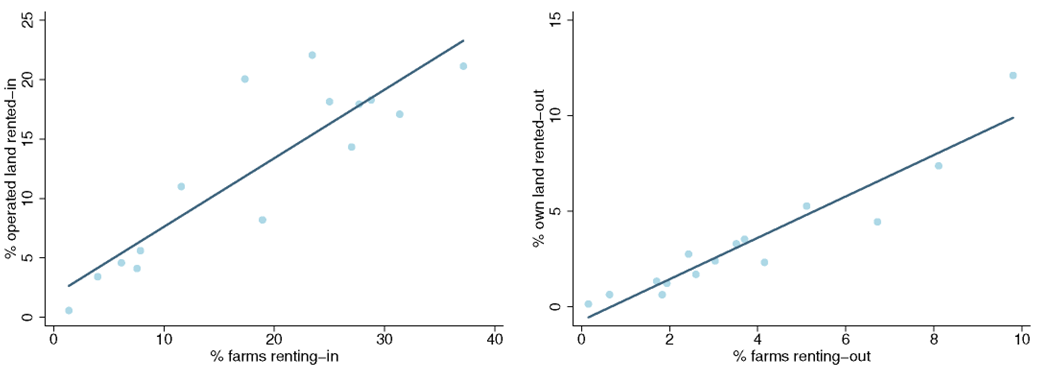
Notes: Percentage of land rented in (out) against percentage of farms renting in (out). Blue circles represent each of the 15 Indian states in the sample.
States with more restrictive land-leasing environments display the expected patterns: smaller average farm sizes, lower land-rental activity, and greater misallocation (see Figure 2).
Figure 2: Misallocation and land-rental markets
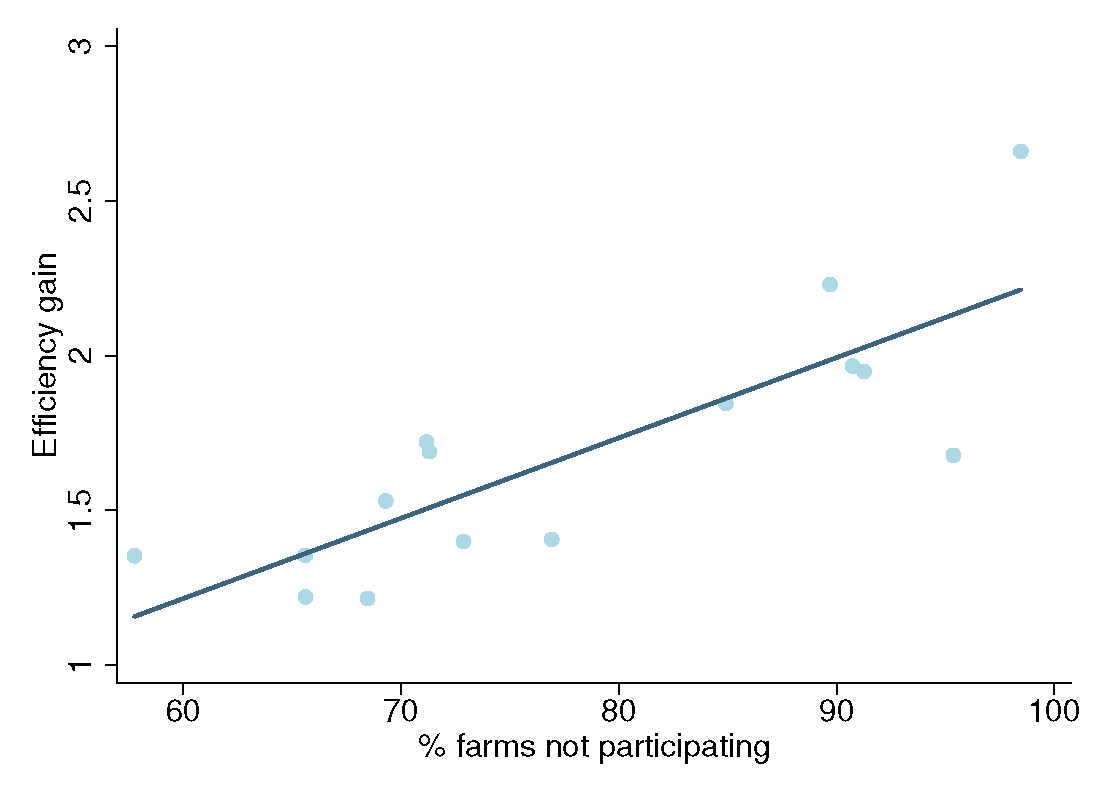
Notes: Efficiency gain is the productivity gain from eliminating misallocation in each state against the percentage of farms not participating in the land rental market. Blue circles represent each of the Indian states in the sample.
Measuring misallocation using household panel data
We exploit two waves of the IHDS panel (2004–05 and 2011–12), which report the amount of land operated, owned, rented in, and rented out. Combined with information on crop sales and inputs, we estimate farm-level total factor productivity (TFP) using a common production function approach. The panel nature of the data allows us to separate a permanent component of farm productivity from time-varying shocks to farm outcomes.
Two key stylised facts emerge. First, we observe very large dispersion in productivity within each state. The standard deviation of log farm TFP ranges from 0.37 (West Bengal) to 0.89 (Kerala) – estimates comparable to the levels of productivity dispersion documented in agriculture and manufacturing sectors in other countries. A second stylised fact is that productive farms do not operate more land. In an efficient allocation, more productive farms should cultivate more land. But in India, the elasticity of operated land with respect to TFP is often close to zero.
Together, these patterns signal severe misallocation.
A model to quantify land-market distortions
To understand the sources of productivity differences across states, we develop a model of farms that face two types of distortions. First, we introduce a state-level ‘rental barrier’, which generates a ‘wedge’ (think of this as equivalent to a tax that discourages renting land) between the price of renting in and renting out. The wedge captures legal restrictions to leasing land, tenancy insecurity, and costly land titling. This distortion discourages participation in the rental market.
A second set of distortions are specific distortions at the farm level, which capture constraints on the trading of land even for farms that participate in the rental market. These distortions create differences across farms in the effective rental price they face leading to differences in the extent to which farms want to trade land. More productive farms tend to face larger distortions, limiting their ability to scale up.
The model generates a key feature observed in the data: an ‘inaction zone’ where farms choose not to participate in rental markets because effective rent-in and rent-out prices differ too much. The bigger the state-level rental barrier, the wider the inaction zone leading to more non-participation.
We then estimate the model state-by-state. Our model matches the microdata well, including non-targeted features such as the distribution of operated farm sizes and the share of land cultivated by the most productive farms.
How much productivity is lost? A state-by-state picture
The results show substantial variation across states. In Tamil Nadu, where rental barriers imply a tax equivalent of more than 95% on rental income (see Figure 3), eliminating barriers alone would raise productivity by 139%. In Punjab, India’s least distorted state, removing rental barriers would increase productivity only by 14%. The average potential gain for India is 29%.
Figure 3: Land rental-market distortions--state-level effective tax rate
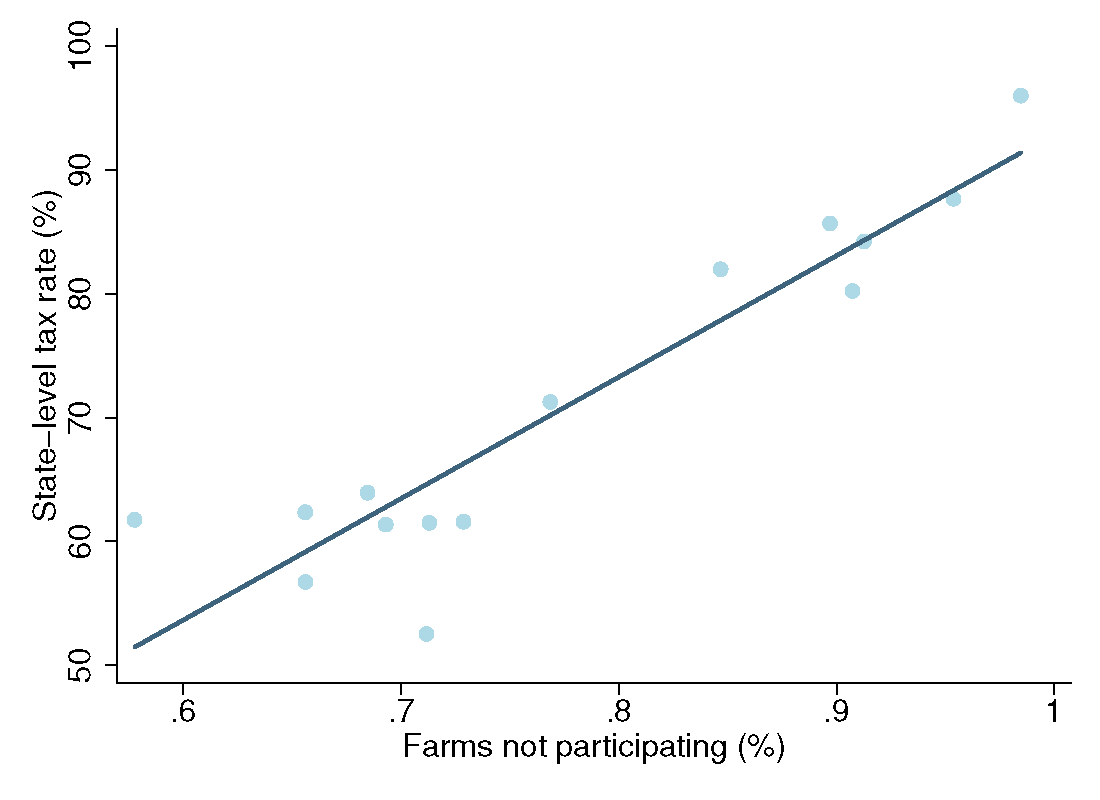
Notes: State-level rental barrier as an effective tax rate on the rent-in rate of land against the percentage of farms not participating in the land rental market. Blue circles represent each of the 15 states in the sample.
Nationally, more than half of all misallocation losses stem from state-level rental barriers rather than farm-level distortions (see Figure 4). Eliminating all distortions would raise productivity by 65% on average and could more than double productivity in several states, including Karnataka and Tamil Nadu.
Figure 4: Efficiency gains from easing land rental barriers
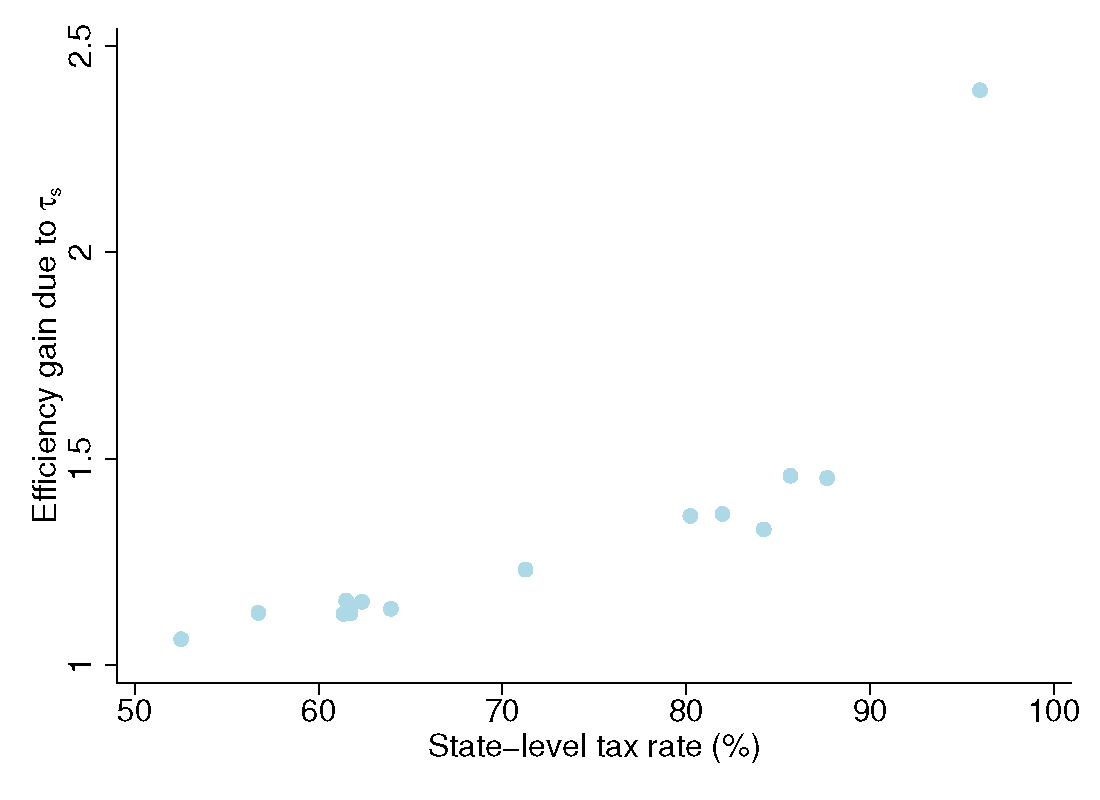
Notes: Efficiency gain represent the productivity gain from removing land rental barriers expressed as percentage effective tax rate. Blue circles represent each of the 15 states in the sample.
These findings suggest that inflexible land markets, originally designed to protect vulnerable tenants, now prevent land from flowing to the most efficient users. Restrictions meant to preserve equity are instead suppressing productivity and incomes.
Why do rental barriers hurt productivity so much?
Land rental barriers create a large group of non-participating farms who neither rent in nor rent out land. Because inherited land is only weakly correlated with farm productivity, this prevents the movement of land from low- to high-productivity farms.
The model replicates a key empirical fact, providing evidence of binding rental barriers. In states with more non-participation, the gaps between the productivity of land-renters and land-rentees are larger.
Rental-market reform has high returns
In India, where productivity gaps are vast and rental markets heavily restricted, the scope for improvement is enormous. A more flexible rental system could allow the most productive farms to operate more land, strengthening rural incomes and fostering structural transformation. The paper’s results underscore that land-rental market reforms could generate very large productivity gains, even without altering land ownership. Policy tools that could encourage more flexible rental market include relaxing or updating restrictive tenancy laws, modernising and digitising land records, reducing uncertainty in land disputes and contract enforcement, and lowering transaction taxes and administrative burdens on leases.
References
Agriculture Census Division (2011), “Agriculture census of India 2010–11.”
Banerjee, A, and L Iyer (2005), “History, institutions, and economic performance: The legacy of colonial land tenure systems in India,” American Economic Review, 95: 1190–1213.
Besley, T, and R Burgess (2000), “Land reform, poverty reduction, and growth: Evidence from India,” Quarterly Journal of Economics, 115: 389–430.
Bolhuis, M A, S R Rachapalli, and D Restuccia (forthcoming), “Misallocation in Indian agriculture,” American Economic Journal: Macroeconomics.
Deininger, K, and G Feder (2001), “Land institutions and land markets,” in Handbook of Agricultural Economics, 1: 287–331.
Timmer, M, G J de Vries, and K de Vries (2015), “Patterns of structural change in developing countries,” in Routledge Handbook of Industry and Development: 65–83.