



In Burkina Faso, input diversion from cotton to maize is widespread but ultimately lowers maize productivity, highlighting the need for broader input credit access and better resource allocation policies.
Editor’s note: This column is published in collaboration with the International Economic Association’s Women in Leadership in Economics initiative, which aims to enhance the role of women in economics through research, building partnerships, and amplifying voices.
In much of sub-Saharan Africa, improving smallholder productivity remains a key pathway out of rural poverty (Suri et al. 2024). Yet yields remain far below global averages: in 2012, cereal yields in the region averaged just 1,476 kg per hectare, compared to nearly 6,000 kg in the US and China (World Bank 2013). Farmer organisations and producer organisations have been promoted as institutional innovations that help farmers pool resources, access inputs, and overcome market failures (Hazell et al. 2010). But their impact on productivity has been mixed. While some studies find positive effects on farmers’ income and input use, others point to limited gains due to weak agricultural policies or unequal participation within producer organisations.
In Burkina Faso, where 40.1% of the population lives below the poverty line, agricultural productivity remains low – averaging just 860 kg/ha for cereals. Maize represents only 21% of cereal output but offers high value-added potential. Since 1999, cotton farmers have benefited from a formal input credit system managed by a public cotton company. In contrast, no comparable scheme exists for maize or other staple crops. Given these constraints, some members of producer organisations divert a portion of their cotton inputs (fertilisers and pesticides) to maize cultivation as a coping strategy. My research investigates whether this widespread practice improves or undermines productivity for maize farmers (Traore 2020).
Assessing the impact of diversion on agricultural productivity
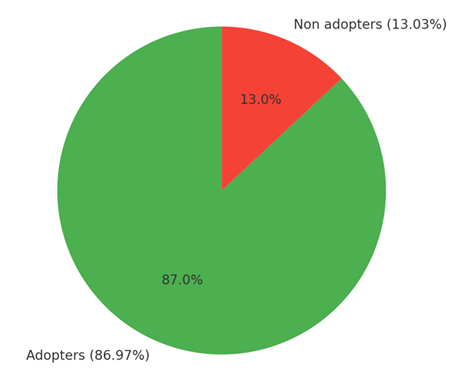
I draw on data from 261 maize and cotton producers across Burkina Faso’s 13 regions, comparing two groups: producer organisation members who use cotton inputs solely for cotton production, and those who divert part of these inputs to maize. The analysis accounts for potential selection bias to estimate the causal impact of diversion on maize productivity. Almost all households in the sample are headed by men (99.6%). The average age of household heads is 44 years, and more than 60% have no formal education. A striking 87% of households report diverting cotton inputs, highlighting the scale of this adaptive strategy in the absence of alternative credit systems.
Figure 1: Distribution of households by adoption strategy
Diversion lowers yields
Maize producers who do not divert cotton inputs achieve yields that are 59% higher than those who do divert input. Although cotton input credit systems aim to support production and exports, misallocating inputs reduces efficiency in maize cultivation. This may be partly explained by Burkina Faso’s cereal input subsidy policies, which already benefit some farmers. In addition, the cotton company provides credit only to solvent farmers who comply with repayment rules, leaving little room for informal diversion to succeed. As maize is more input-intensive and less tolerant to soil depletion than millet or sorghum, reallocating inputs results in suboptimal outcomes. In short, while producer organisation membership facilitates access to resources, the way members use those resources matters greatly for productivity.
Adoption of the diversion strategy depends on household characteristics, resources, and technology use. The age of the household head has a non-linear effect: older farmers are generally less likely to divert inputs, though long experience can increase the likelihood beyond a certain threshold. Education enhances the likelihood of adoption by improving managerial and technical understanding. Similarly, use of animal traction – a proxy for technological adoption – raises the likelihood of diversion, while a higher level of equipment provision reduces it, as capitalised households can afford separate inputs. Larger cultivated areas encourage the strategy to maximise input loans, whereas owning many smaller plots – an indicator of better economic standing – tends to limit it. Overall, input diversion reflects a trade-off between resource constraints, risk management, and technological capacity.
Policy implications of crop diversion strategies
My findings highlight the unintended consequences of partial input credit coverage across crops. To reduce inefficiencies and support food security, policymakers could extend input credit systems to cereals such as maize, modelled on the cotton scheme. This would enable farmers to access essential inputs without resorting to diversion. Credit constraints could be eased by improving rural collateral systems and diversifying sources of agricultural credit outside a public cotton company. In parallel, producer organisations could play a stronger monitoring role to ensure that inputs and funds reach their intended purposes and crops. Such measures could enhance both productivity and trust in collective financing mechanisms.
Rethinking input diversion
Ultimately, my research highlights the ambivalent but strategic role of cotton input credit. Designed to strengthen the export chain, it indirectly contributes to the food security of rural households through the practice of reallocation. Far from being a simple diversion, this practice appears to be a peasant adaptation strategy in the face of resource scarcity and food insecurity – thus revealing the coexistence of two logics: that of agricultural policies, focused on the performance of cash crops, and that of households, guided by the security of their means of existence. Recognising this reality and integrating it into agricultural and social policies could transform an apparent constraint into a lever for innovation for more inclusive and resilient rural development.
References
Bernard, T, A S Taffesse, and E Gabre-Madhin (2008), “Impact of cooperatives on smallholders’ commercialization behavior: Evidence from Ethiopia,” Agricultural Economics 39(2): 147–161.
Bernard, T, and A S Taffesse (2012), “Returns to scope? Smallholders’ commercialisation through multipurpose cooperatives in Ethiopia,” Journal of African Economies 21(3): 440–464.
Coase, R H (1960), “The problem of social cost,” Journal of Law and Economics 3(October): 1–44.
Dowd-Uribe, B (2014), “Engineering yields and inequality? How institutions and agro-ecology shape Bt cotton outcomes in Burkina Faso,” Geoforum 53: 161–171.
Greenwald, B, and J E Stiglitz (1986), “Externalities in economies with imperfect information and incomplete markets,” Quarterly Journal of Economics 101(2): 229–264.
Hazell, P, C Poulton, S Wiggins, and A Dorward (2010), “The future of small farms: Trajectories and policy priorities,” World Development 38(10): 1349–1361.
Herbel, D, E Crowley, N Ourabah Haddad, and M Lee (2012), “Des institutions rurales innovantes pour améliorer la sécurité alimentaire,” FAO.
MAFAP (2013), “Revue des politiques agricoles et alimentaires au Burkina Faso.”
North, D C (1992), “Institutions and economic theory,” The American Economist 36(1): 3–6.
Ragasa, C, I Lambrecht, and D S Kufoalor (2018), “Limitations of contract farming as a pro-poor strategy: The case of maize outgrower schemes in Upper West Ghana,” World Development 102: 30–56.
Shiferaw, B, G Obare, G Muricho, and S Silim (2009), “Leveraging institutions for collective action to improve markets for smallholder producers in less-favored areas,” African Journal of Agricultural and Resource Economics 3(1): 1–18.
Suri, T, C Udry, J C Aker, C B Barrett, L Falcao Bergquist, M Carter, L Casaburi, R Darko Osei, D Gollin, V Hoffmann, T Jayne, N Karachiwalla, H Kazianga, J Magruder, H Michelson, M Startz, and E Tjernström (2024), “Agricultural technology in Africa,” VoxDevLit 5(2).
Traoré, S (2020), “Farmer organizations and maize productivity in rural Burkina Faso: The effects of the diversion strategy on cotton input loans,” Review of Development Economics 24(3): 1150–1166.
World Bank (2013), “Improving nutrition through multi-sectoral approaches.”