




In Mexico, children in safe areas suffer lasting academic harm when peers who fled local violence transfer to their schools – even though they were never directly exposed to that violence themselves. This hidden cost of violence is especially pronounced for girls, highlighting the need for support in receiving schools, not just those in conflict-affected areas.
Editor’s note: For a broader synthesis of themes covered in this article, check out our VoxDevLit on Organised Crime.
Research on the economic consequences of exposure to local violence focuses predominantly on the effects of violence in places where it occurs. For example, exposure to violence has been associated with adverse consequences on educational outcomes in areas directly exposed to local violence (e.g. Brown and Velásquez 2017, Koppensteiner and Menezes 2021, Chang and Padilla-Romo 2023). However, an additional channel may operate, as areas that do not directly experience local violence may still be indirectly affected by its consequences. Our research provides evidence on the educational consequences of such negative spillover effects in areas not directly exposed to local violence (Padilla-Romo and Peluffo 2023, Padilla-Romo and Peluffo 2026).
During Mexico’s war on drugs, many students left violent municipalities and moved to safer ones – switching schools. In receiving elementary schools, students who were not directly exposed to local violence and had not switched schools saw their test scores drop when peers who had experienced local violence transferred to their schools. Having such peers continues to shape later educational outcomes, including performance on a high school admission exam and high school placement.
Migration as a response to local violence in Mexico
In Mexico, local violence rose sharply from 2007 to 2011, with the homicide rate increasing from 8.7 to 24.3 per 100,000 people – more than 2.5 times its 2007 level (Herre et al. 2013). However, violence did not affect all places in the same way or at the same time. Some municipalities experienced very large increases in homicide rates, while many others remained relatively safe (Figure 1). Because violence increased unevenly across space and time, families could respond by moving away from violent municipalities and towards safer ones (Padilla-Romo and Peluffo 2023, Aldeco Leo et al. 2024).
Figure 1: Violent municipalities by year
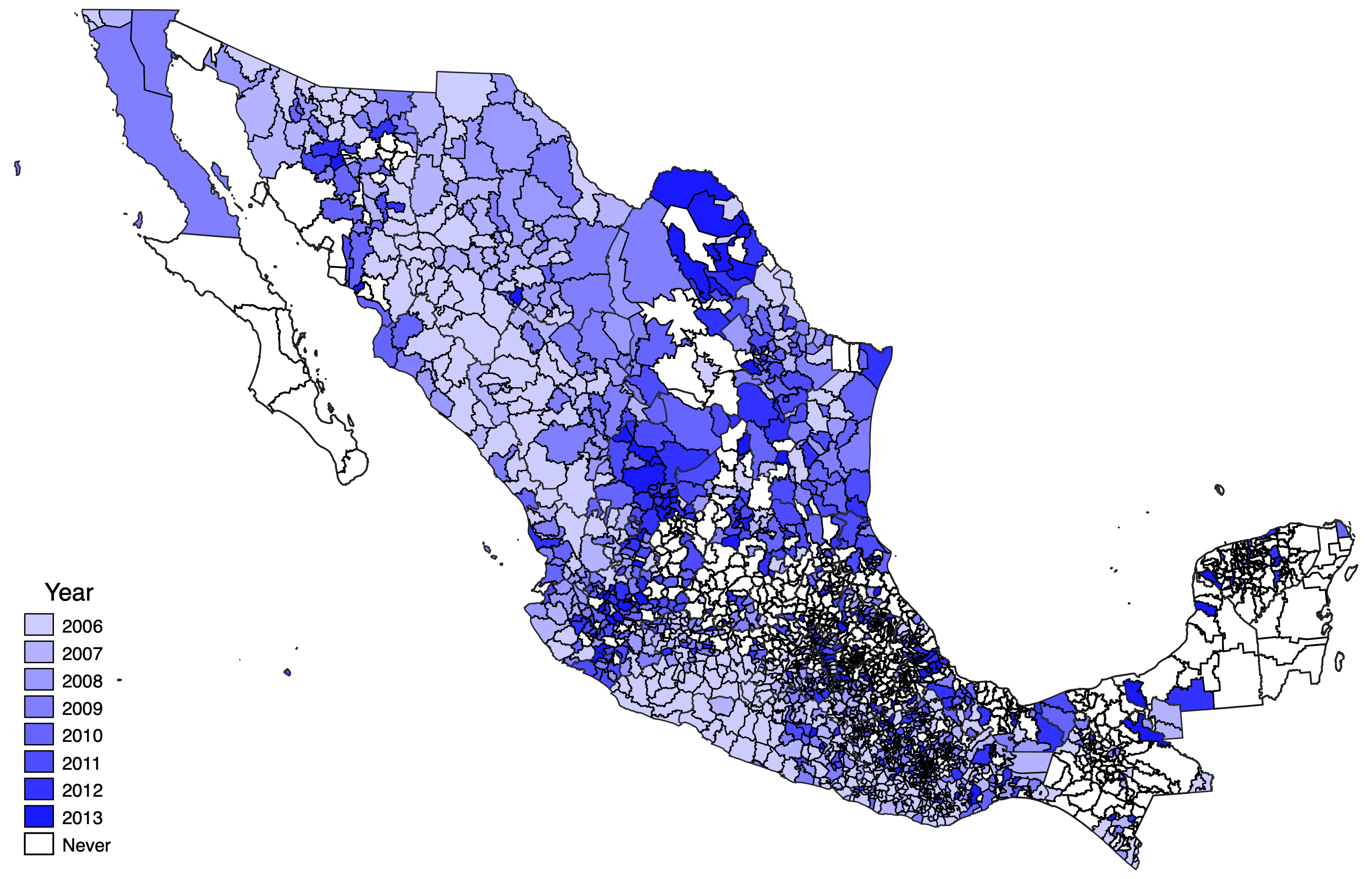
In Padilla-Romo and Peluffo (2023), we show that increases in local violence changed migration decisions. Focusing on elementary school students, we show that once a municipality becomes violent (defined in our analysis as having homicide rates above 18.01 per 100,000 people), students are more likely to relocate to municipalities that remained relatively safe. This response, in terms of moving to safer areas, increased over time, whereas migration to other violent municipalities decreased.
This migration is selective: students with higher prior test scores and more educated parents were more likely to relocate. This pattern suggests that migration is a strategy for mitigating exposure to local violence and that students who move to safer places are not negatively selected academically. Rather, migration appears to be a coping strategy that is more accessible to some families than to others. This matters because students who move from violent to safer municipalities tend to outperform other movers by pre-migration academic achievement.
Spillover effects of violence in nonviolent areas in the short run
In Padilla-Romo and Peluffo (2023), one of our central results is that students already enrolled in relatively safe municipalities perform worse in school after peers arrive from violent municipalities. This is a spillover effect; children who were not directly exposed to local violence still experience lower test scores. Importantly, the negative effects are larger for girls than for boys.
This effect is not only driven by student turnover. The arrival of other new students (for example, from safer municipalities or from another school in the same municipality) has a smaller effect on incumbent students’ test scores. Our findings indicate that what matters is not just students’ mobility, but prior exposure to local violence.
A plausible mechanism is the disruption of the school environment. Students in receiving schools report a deterioration in the school climate following the arrival of peers from violent municipalities, including more incidents of students making fun of teachers, damaging school property, and a decline in perceived safety near the school.
The effects persist over time
The next question is whether these effects disappear as schools adjust or students adapt. Our newer evidence shows that they do not. In Padilla-Romo and Peluffo (2026), we focus on students in Mexico City’s metropolitan area and ask whether exposure to violence-exposed peers in elementary school continues to matter later, when students apply to high school.
Specifically, we consider incumbent students in municipalities in Mexico City’s metro area who were not exposed to high levels of local violence while enrolled in elementary school. In Mexico City’s metro area, access to public high schools is competitive and goes through a centralised admission system, COMIPEMS. Students aiming to enrol in a public high school rank schools, take a common admission exam, and are assigned to schools based on exam scores and their ranked preferences. This is a consequential stage because, in this system, even modest score losses can have long-lasting consequences for school assignment, a margin that may have long-term consequences for subsequent educational attainment and labour market outcomes.
We find that students who, in elementary school, were exposed to peers arriving from violent municipalities later perform, on average, worse on the COMIPEMS exam. They are also less likely to take the COMIPEMS exam on time, which is consistent with slower grade progression. Again, girls are especially affected (Figure 2).
Figure 2: Effects on test scores by gender
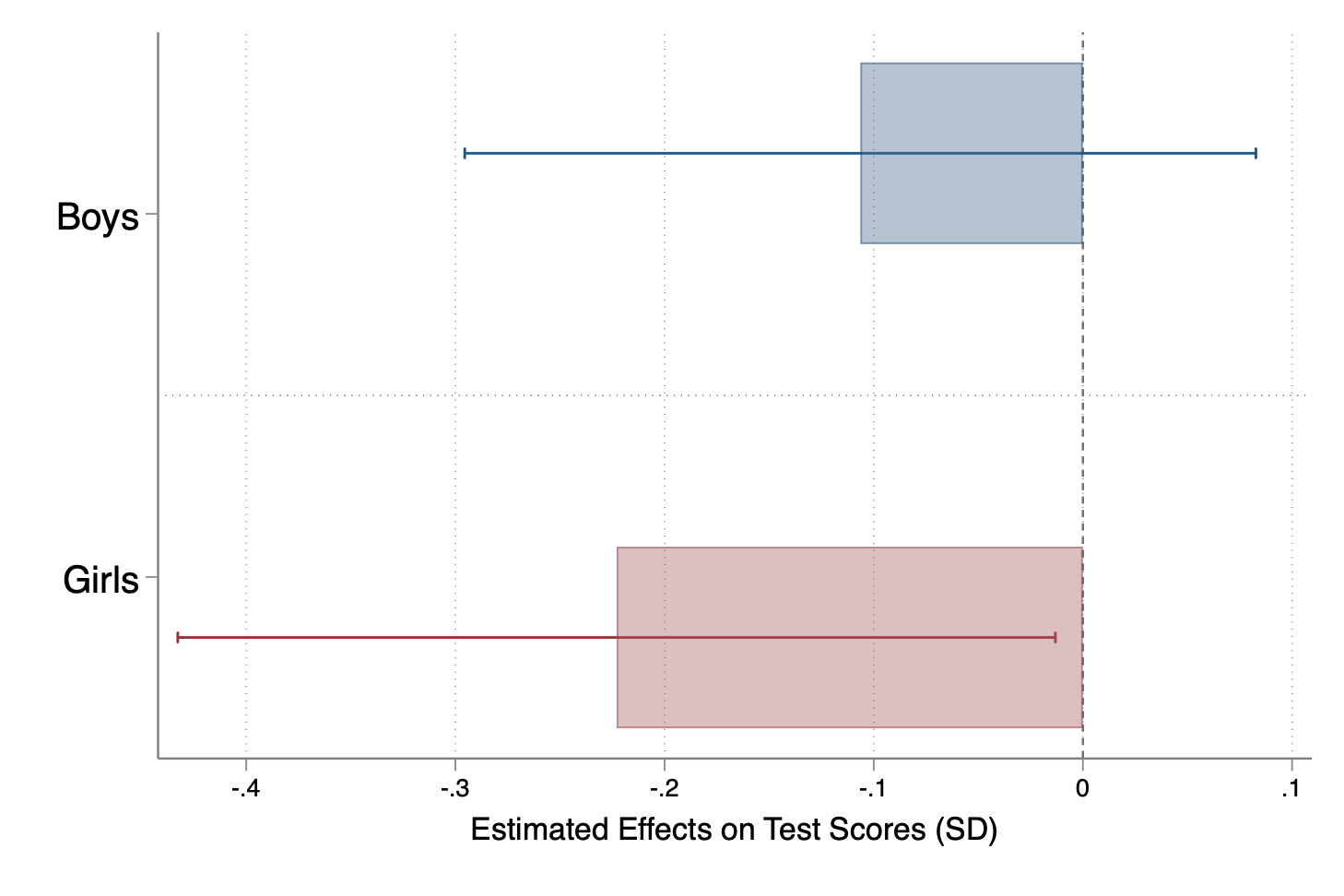
Because COMIPEMS determines access to public high schools, lower exam scores can result in placements in schools that are less preferred by the applicants. In our estimates, an inflow of 100 students from violent municipalities into safe municipalities in the Mexico City metro area translates into roughly 17 incumbent students being assigned to schools they rank lower on their own preference lists than those they would otherwise have attended. This is a hidden cost of local violence: it harms even those who were never directly exposed, and the damage is long-lasting.
Are there positive effects?
When focusing on the performance of incumbent students in relatively safe areas, we find that violence-induced migration imposes costs on those students in destination schools. However, out-migration from a violent place can also generate academic benefits for those students who are induced to migrate. In related work (Padilla-Romo and Peluffo 2025), we examine the outcomes of students who relocated to safer municipalities. We find that students who move from violent places to safer ones perform better after the move. These academic gains are larger when the move produces a greater improvement in safety.
Together, these findings document that violence-induced migration is not just a channel through which local violence generates negative externalities in safer areas. In this context, migration also works as a mechanism that potentially shields children from further academic loss. Moving to a safer environment can help mitigate the educational effects of earlier exposure to local violence.
References
Aldeco Leo, L, A Jurado, and AA Ramírez-Alvarez (2024), "Internal migration and drug violence in Mexico," Journal of Development Economics 171: 103334.
Brown, R, and A Velasquez (2017), "The effect of violent crime on the human capital accumulation of young adults," Journal of Development Economics 127: 1–12.
Chang, E, and M Padilla-Romo (2023), "When crime comes to the neighborhood: Short-term shocks to student cognition and secondary consequences," Journal of Labor Economics 41(4): 997–1039.
Koppensteiner, MF, and L Menezes (2021), "Violence and human capital investments," Journal of Labor Economics 39(3): 787–823.
Padilla-Romo, M, and C Peluffo (2023), "Violence-induced migration and peer effects in academic performance," Journal of Public Economics 217: 104778.
Padilla-Romo, M, and C Peluffo (2025), "Moving for good: Educational gains from leaving violence behind," Unpublished manuscript.
Padilla-Romo, M, and C Peluffo (2026), "Persistence of the spillover effects of violence and educational trajectories," Journal of Development Economics 181: 103759.
Tobón, S, M MSviatschi, and N Cabra-Ruiz (2025), “Organised Crime” VoxDevLit, 17(1).