





Exporting factories in India employ more women and pay smaller gender wage gaps than non-exporters, but these gains erode as capital intensity rises – because women lack access to the technical skills that technology-intensive production demands.
Editor’s note: For a broader synthesis of themes covered in this article, check out Issue 2 of our VoxDevLit on International Trade.
India’s remarkable economic transformation from a US$0.47 trillion economy in 1991 to a US$3.48 trillion economy in 2024 (World Bank 2026a) is largely attributed to export-led growth propelled by its 1990s liberalisation policy (Chatterjee and Subramanian 2020). Yet, the striking paradox of persistently low female labour force participation and gender inequality remains a puzzle for economists. India’s female labour force participation stands at 32% in 2025, well below the global average of 49% (World Bank 2026b), along with a gender wage gap of 34.5%, more than double the world average of 15.6% (ILO 2018).
Trade economists have argued that global competition from trade makes gender discrimination costly (Black and Brainerd 2004). Consequently, export-led growth should improve prospects for women’s employment and wages. Why then has trade-driven growth not translated into greater gender parity in labour markets for Indian women?
The answer is more nuanced than a simple story of trade failing Indian women. Our recent research (Kumari, Agarwal Goel, and Jena 2026) reveals that the gains from trade for female workers depend not just on a factory’s export intensity but on how it produces. Greater export orientation is associated with higher female employment and wage share. However, these gains are conditional on the technological and skill adaptability of female workers and weaken with a rise in factory-level capital intensity.
Female employment in exporting factories
Analysing ASI data on over 650,000 registered factories, between 2008–09 and 2022–23, we find support for the beneficial impact of factories’ participation in trade on female labour outcomes (Chen and Hu 2023, Amin and Islam 2023). As compared to non-exporting factories, female employment and wage shares are higher among exporting factories, while the wage gap is lower (Table 1).
Table 1: Female employment share, wage share and gender wage gap based on exporting status
| Female Employment Share | Female Wage Share | Wage Gap | ||||
| Non-Exp | Exp | Non-Exp | Exp | Non-Exp | Exp | |
| 2009-2013 | 12.24 | 16.42 | 11.36 | 15.44 | 0.21 | 0.18 |
| 2014-2018 | 12.14 | 17.1 | 11.31 | 16.07 | 0.19 | 0.16 |
| 2019-2023 | 11.87 | 18.24 | 11.14 | 17.26 | 0.16 | 0.14 |
Nonetheless, there is marked variation within factories, depending on whether their production process is capital- or labour-intensive. Labour-intensive exporting factories have the highest female employment shares and smallest wage gaps. Exporting factories that are highly capital-intensive witness lower female employment shares and higher wage gaps, closer to that of non-exporters (Figure 1).
Figure 1: Female employment share and wage gap for different levels of capital intensity and export status
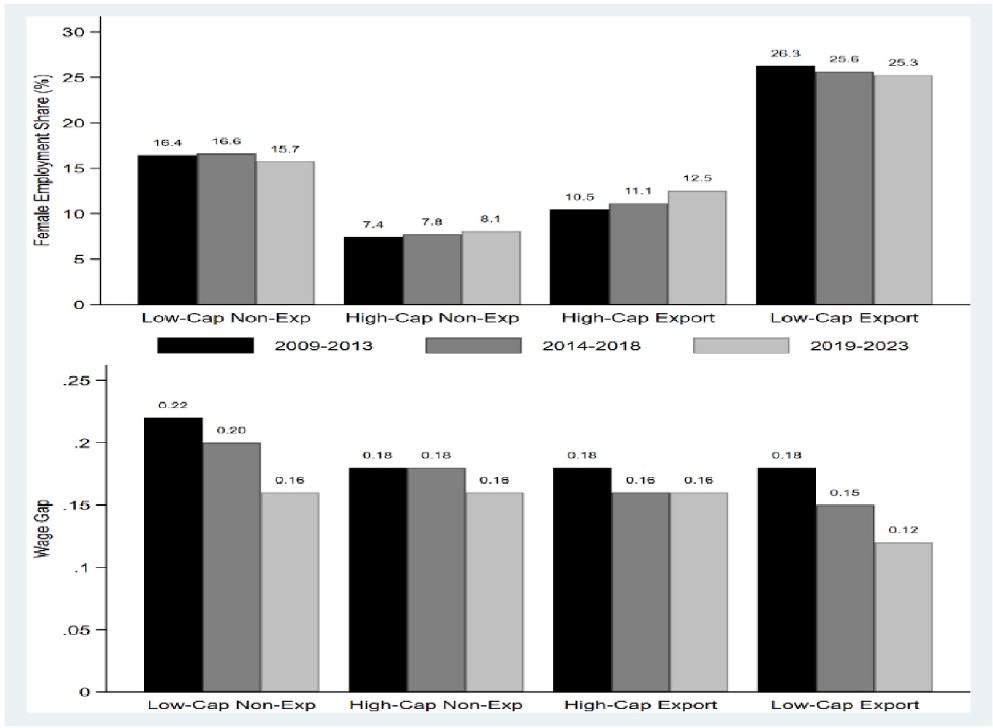
Trend analysis shows that the capital intensity in Indian manufacturing more than doubled from INR 1,261 per worker in 2009 to INR 2,951 per worker in 2023, with exporting factories consistently being more capital-intensive than non-exporters. At first glance, this might suggest that trade worsens female labour market outcomes by driving up capital intensity. But the picture is more layered.
Our results show that higher export intensity of manufacturing firms is associated with better labour market outcomes for women, in terms of both increased employment and reduced gender wage gap. However, these benefits are conditional on the capital intensity of firms. We find that a one-percentage-point increase in export intensity increases female employment share by 1.42 percentage points. This effect weakens by 0.19 percentage points for every percentage point increase in capital intensity.
Why did capital intensity create a wedge in gains from trade for women?
One possible mechanism is the mismatch between the skills demanded by technology-intensive production and the skills available to workers. Exporting firms often adopt advanced technologies and production processes, increasing the demand for technically trained and highly skilled labour (Bustos 2011). However, women in many developing countries continue to face disadvantages in access to education, technical training, and STEM-related fields (Sahoo and Klasen 2021). The pattern emerging for India suggests that access to the skills demanded by technology-intensive production is an important determinant of whether women benefit from trade expansion (Figure 1).
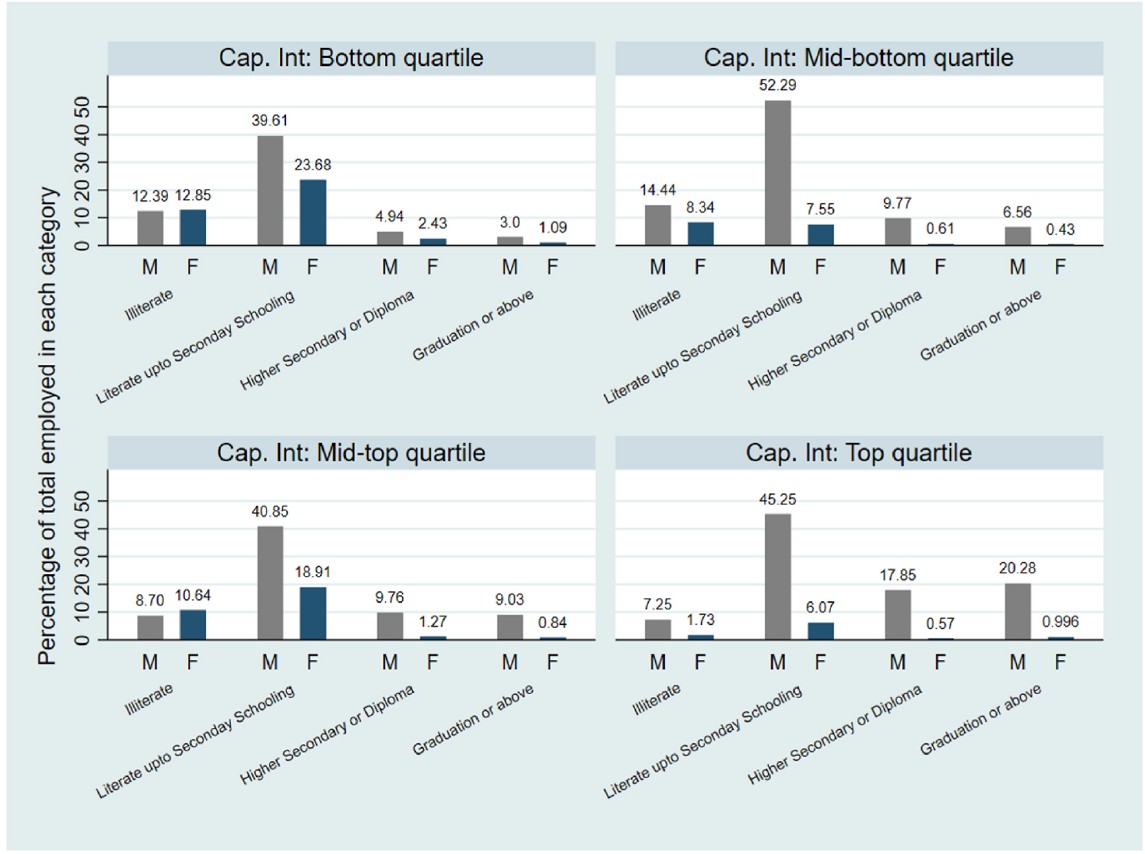
Further, Figure 2 shows that women in India are significantly over-represented among low-educated workers and in less capital-intensive firms. As the capital intensity grows, men account for a greater share in the workforce, particularly among workers with higher education levels. This gap intensifies further with rising education levels and capital intensity. Technological advancement and greater capital intensity require specific skills and training to which women are at a disadvantage due to occupational segregation and gendered educational biases that may limit their representation in technology-intensive manufacturing occupations.
Figure 2: Women’s share of employment in high and low intensity firms by education levels
The drivers of gendered skill gaps and unequal access to trade gains
The unequal gains from trade reflect the gendered structural barriers in most developing nations. In countries historically characterised by patriarchal social norms, women are caught in a vicious cycle of low socio-economic status, poor investment in health and education, low levels of employment, persistent gender-wage gaps, and poor bargaining power (Jayachandran and Pande 2017). Patriarchal norms treat daughters as liabilities while viewing sons as assets. Sons are expected to support elderly parents whereas daughters are associated with marital expenditure and safety concerns (Barua et al. 2023). There is also insufficient investment in building women’s skills, particularly in STEM fields.
In India, approximately 42.5% of those enrolled in STEM are women, yet women comprise only 18.6% of the STEM workforce (Ministry of Education 2024, Ministry of Science and Technology 2026). As the capital and technological intensity of trade grows, women remain at a disadvantage. Thus, as technology expands, the gains from trade may not only weaken for women, but actively undermine the gender parity benefits that globalisation might otherwise deliver.
Implications for trade and labour policy
Our findings suggest that trade policy alone is unlikely to deliver broad-based improvements in gender equality. As exporting firms increasingly adopt advanced technologies, policymakers must complement export-led growth strategies with investments in women's human capital. Expanding access to technical and vocational training, strengthening women's participation in STEM education, and encouraging firms to invest in on-the-job training can help women access opportunities created by technologically advanced export sectors. Without such complementary policies, technological upgrading risks limiting the potential of trade to reduce gender disparities in employment and wages.
Author’s note: Slides are available upon request.
References
Amin, M, and A M Islam (2023), "Export intensity and its effect on women's employment," Kyklos, 76(4): 676–704.
Barua, R, P A Goel, and R Sane (2023), "Son preference and crime in India," Review of Economics of the Household, 21(3): 1127–1151.
Black, S E, and E Brainerd (2004), "Importing equality? The impact of globalization on gender discrimination," ILR Review, 57(4): 540–559.
Bustos, P (2011), "Trade liberalization, exports, and technology upgrading: Evidence on the impact of MERCOSUR on Argentinian firms," American Economic Review, 101(1): 304–340.
Chatterjee, S, and A Subramanian (2020), "India's export-led growth: Exemplar and exception," Ashoka Center for Economic Policy Working Paper No. 1.
Chen, Y, and D Hu (2023), "Why are exporters more gender-friendly? Evidence from China," Economic Modelling, 118: 106087.
ILO (2018), Global Wage Report 2018/19: What Lies Behind Gender Pay Gaps, International Labour Organization.
Jayachandran, S, and R Pande (2017), "Why are Indian children so short? The role of birth order and son preference," American Economic Review, 107(9): 2600–2629.
Kumari, R, P A Goel, and D Jena (2026), "More jobs, lesser gaps? Unpacking the gendered effects of export and capital intensity in India's manufacturing sector," International Economics, 100698.
Ministry of Science & Technology, Government of India (2026), "Women in STEM," Press Information Bureau, 29 January.
Ministry of Education, Government of India (2024), All India Survey on Higher Education 2021–22, Government of India.
Sahoo, S, and S Klasen (2021), "Gender segregation in education: Evidence from higher secondary stream choice in India," Demography, 58(3): 987–1010.
World Bank (2026a), "GDP (constant 2015 US$) – India," World Bank Open Data.
World Bank (2026b), "Labor force participation rate, female (% of female population ages 15+) – India, World," World Bank Open Data.