





The language used in job adverts steers young Indian women towards low-paying and stereotypical job roles.
Editor's note: The authors have made slides available to accompany this research here.
Women from across the world continue to earn far less than comparable men (Figure 1). Familiar explanations include job sorting and constraints to female work such as inflexible hours (Goldin 2014), long commutes and safety fears (Borker 2021, Siddique 2022), domestic responsibilities (Afridi et al. 2022) and restrictive social norms (Bursztyn et al. 2020). A recent paper by Fluchtmann et al. (2024) finds that a sizeable part of the gender wage gap arises not just from what men and women earn after being hired but also from the kinds of jobs they apply to in the first place. They find that differences in applied-for jobs explain 79% of the residual gender wage gap in typical earnings and 73% of the residual gap in realised starting wages. Understanding what shapes gender differences in applications is, therefore, of first-order importance.
Figure 1: Difference in average gross hourly earnings of men and women
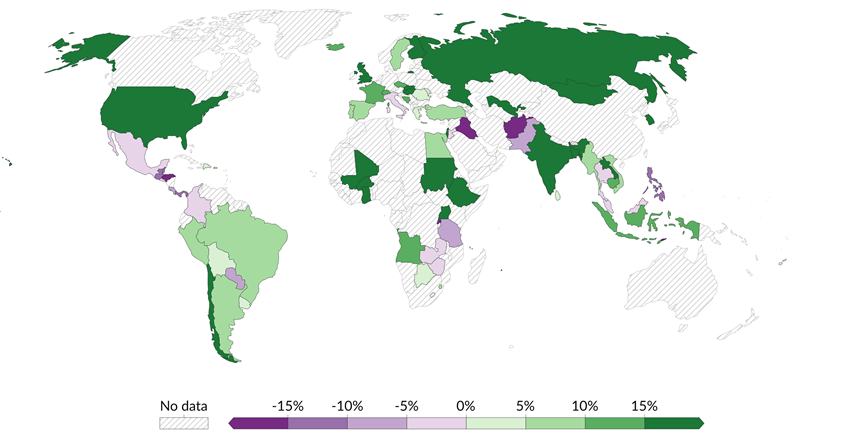
Notes: Including both full-time and part-time workers, expressed as a percentage of average earnings of men, without adjusting for worker characteristics. Source: Our World in Data. Data Source: International Labour Organization (2025).
Data on job ads in India
In our work (Chaturvedi, Mahajan and Siddique 2025), we ask how the language used in job adverts (job ads) – both explicit gender requests and implicit gender associations – is linked with who applies to a job and how this contributes to the gender wage gap. We analyse 157,888 job ads (July 2018 - February 2020) on a major Indian online job portal, together with 6.45 million applications to these ads. The job postings in our dataset are for relatively high-skill roles, with average posted wages about 21% higher than those of comparable urban workers in the 2017-18 Periodic Labour Force Survey (PLFS). Jobseekers on the platform are also younger (with an average age of 24 versus 36 years in the PLFS), and more educated (86% hold a graduate degree or higher compared with 32% in the PLFS sample).
Explicit preferences and implicit gender cues in job ads
Although institutional and legal reforms have strengthened formal prohibitions against gender discrimination, online job boards in India continue to host ads that explicitly state a preference for male or female candidates. In our data, 7.7% of job ads explicitly request a male (3.5%) or female (4.2%) candidate, often preferring women in stereotypically female occupations such as beautician, personal secretary, or schoolteacher, and men in roles such as cargo loader, delivery executive, or network engineer. Even among jobs with the same title, employers that request women often emphasise attributes related to appearance or communication, while those that request men disproportionately stress travel and fieldwork. We find that ads that explicitly request women tend to offer lower wages than otherwise similar ads that request men or do not include a gender preference. Such ads are also associated with a dramatically higher share of women applicants.
The phrasing of job ads can also resemble the language patterns that employers use when they explicitly request men or women, even in the absence of such requests. To quantify this, we train a machine learning classifier (logistic regression) on the job ad text, asking the model to predict whether the ad belongs to the female-preference or male-preference category. The resulting prediction for each ad can be interpreted as a measure of the implicit ‘femaleness’ or ‘maleness’: a job with high femaleness is more similar in wording to ads that explicitly request women, whereas one with high maleness looks like ads that explicitly request men. We find that an increase in implicit femaleness from 0 to 1 (the full range) in ads without an explicit gender preference is also associated with an approximately 23% lower wage as well as a significantly higher share of female applicants.
Contribution to the gender wage gap in applied-for-jobs
We next quantify the importance of gendered wording in job ads to the gender wage gap in applied-for-jobs. We find that women on the portal apply to jobs with 3.5% lower posted wages than men of the same age, education qualifications and location. Using decomposition methods, we find that occupational and geographic sorting accounts for roughly 45% of the gender wage gap in applied-for-jobs, and that explicit gender requests explain an additional 7% of the gap. Finally, implicit gender associations in the job ad text – measured by our femaleness and maleness measures – together with explicit requests, explain around 17% of the gap. In other words, nearly a fifth of the gender wage gap in applied-for-jobs can be explained by gendered language in job ads.
Identifying gendered words in job ads
Our analysis of job ad text highlights systematic differences in skills and traits that employers associate with women and men (we provide example job ads in Figure 2). Hard skills predictive of a female preference include those related to beautician roles, accounting and book-keeping (ledger, expense statements, Tally, Zoho), and computer-based communication and design tools (MS Office, Corel, AutoCAD), as well as keyword-based digital tasks. These are systematically associated with lower offered wages but attract a higher female applicant share. In contrast, hard skills such as programming or financial skills are more predictive of an employer’s male preference.
Job ads with high implicit maleness are also more likely to request availability for night shifts, weekend work, relocation, or frequent travel. Such jobs tend to pay more, but they receive fewer applications from women. Ads with high implicit femaleness, on the other hand, are more likely to emphasize work-from-home or regular daytime hours.
Soft skills and personality traits also show gendered patterns. Ads requesting women frequently stress communication, coordination, interpersonal skills, politeness, patience, and adaptability, and sometimes even include physical descriptors such as height or a pleasant smile. Ads requesting men often mention leadership, assertiveness, and traits such as being energetic, enthusiastic, resilient, passionate, resourceful, prompt, honest, or methodical. We find that the presence of female gendered words related to soft skills or personality traits is not associated with a higher female share among applicants, suggesting that employers’ stereotypes about the ideal female worker may be based on distorted beliefs.
Figure 2: Job postings with explicit gender preferences.
1. Female preference

2. Male preference
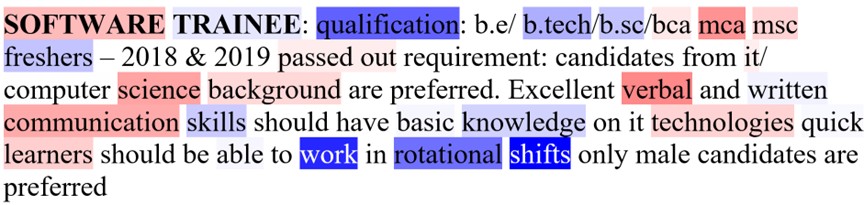
Notes: Words highlighted in red reflect female associations while those in blue reflect male associations; colour intensity reflects the strength of the attached gender association, with darker shades indicating a stronger association.
Policy implications and wider lessons on gender bias
Our findings complement recent work from other settings that examine the impact of eliminating explicit gender requests. Card et al (2025) show that reminding Austrian employers they cannot legally advertise gender-specific vacancies increases gender diversity in hiring without harming firm performance. Kuhn and Shen (2023) study a Chinese job portal that removed the “preferred gender” field and find that gender-mismatched applicants are not penalised in terms of hiring outcomes, suggesting that at least part of employers’ stated gender requests reflect outdated stereotypes.
Our results indicate that removing explicit ‘male only’ or ‘female only’ labels is a necessary but not sufficient step towards more equal opportunities at the application stage. Such bans need to be accompanied by broader efforts that challenge gendered job perceptions among employers and recruiters.
References
Afridi, F, M Bishnu and K Mahajan (2024), “What determines women’s labour supply? The role of home productivity and social norms”, Journal of Demographic Economics, 90(1): 55–87.
Borker, G (2021), “Safety first: Perceived risk of street harassment and educational choices of women”, Unpublished manuscript.
Bursztyn, L, A L González and D Yanagizawa-Drott (2020), “Misperceived social norms: Women working outside the home in Saudi Arabia”, American Economic Review, 110(10): 2997–3029.
Card, D, F Colella and R Lalive (2025), “Gender preferences in job vacancies and workplace gender diversity”, Review of Economic Studies, 92(4): 2437–2471.
Chaturvedi, S, K Mahajan and Z Siddique (2025), “Gendered language in job ads and applicant behaviour: Evidence from India”, Labour Economics, 96: 102726.
Fluchtmann, J, A M Glenny, N A Harmon and J Maibom (2024), “The gender application gap: Do men and women apply for the same jobs?”, American Economic Journal: Economic Policy, 16(2): 182–219.
Goldin, C (2014), “A grand gender convergence: Its last chapter”, American Economic Review, 104(4): 1091–1119.
Kuhn, P and K Shen (2023), “What happens when employers can no longer discriminate in job ads?”, American Economic Review, 113(4): 1013–1048.
Siddique, Z (2022), “Media reported violence and female labour supply”, Economic Development and Cultural Change, 70(4): 1337–1365.