




In Côte d'Ivoire, public sector jobs attract highly skilled graduates not primarily through wages but through non-wage amenities such as job security, lower stress, and predictable working conditions. This creates a costly outside option for private firms, suggesting that policies to boost private sector growth should focus on improving job quality and reducing information gaps rather than wages alone.
Editor's note: For a broader synthesis of themes covered in this article, check out our VoxDevLit on Barriers to Search and Hiring in Urban Labour Markets.
In many low- and middle-income countries, the public sector plays a central role in providing formal employment, particularly for educated workers. While public employment offers valued stability, a wage premium and other amenities, concerns have emerged that a generous public sector may contribute to firms' struggle to recruit highly skilled workers (Cavalcanti and Santos 2021, Mangal 2024, Girsberger and Méango 2025). Côte d'Ivoire is no exception (Christiaensen and Premand 2017).
This raises an important policy question: does the public sector compete with firms for talent in ways that raise labour costs and limit private-sector growth? Answering this question is difficult with standard labour market data. Observed job choices reflect both wages and hidden preferences – such as a taste for job security – which are not directly measurable.
To address this problem, we collect novel survey data on highly skilled students in Côte d'Ivoire and their preferences for public and private sector jobs (Méango and Girsberger 2026). We elicit how students value different job attributes and how they would choose between hypothetical public and private sector job opportunities.
A novel survey to measure how students value public vs. private jobs
We surveyed nearly 600 final-year students from two highly selective institutions who specialise in STEM fields, statistics, economics, and business. Their graduates represent some of the most skilled young workers entering the Ivorian labour market. We asked students to evaluate hypothetical job offers that varied along four key dimensions: wages, job security, working hours, and promotion prospects. Rather than making a simple choice, respondents reported the probability that they would choose one job over another. This captures the uncertainty that graduates face when deciding between sectors.
Broad perceptions: Private sector pays more, public sector is safer
Most students in our sample share some common views about labour market opportunities in the public sector (Figure 1A) and private sector (Figure 1B). Most associate the public sector with 'stable' and 'secure' jobs, and the private sector with 'stressful' but 'lucrative' opportunities. For example, the perceived (monthly) wage in the private sector is, on average, around 75,000 CFA (US$130) higher than in the public sector. However, these monetary benefits are also tied to higher job insecurity: the perceived chance of being laid off after two years is, on average, 12 percentage points higher in the private sector.
Figure 1: Perceptions of the public vs. private sector
A: Public sector B: Private sector


Moving beyond average perceptions: Students have very different preferences
These perceptions hold on average, but the data also reveals substantial differences in perceptions and preferences across individuals. Some students strongly favour private-sector careers, others clearly prefer public-sector employment, and a sizeable group does not express a strong preference when job offers are similar.
Figure 2 displays the chances of accepting a government job when presented with identical job offers in the public sector and in a small or medium enterprise (SME). Some students strongly prefer the public sector, others strongly prefer the private sector, but most express uncertainty and do not rule out either option.
Figure 2: Probability of accepting a public sector job offer
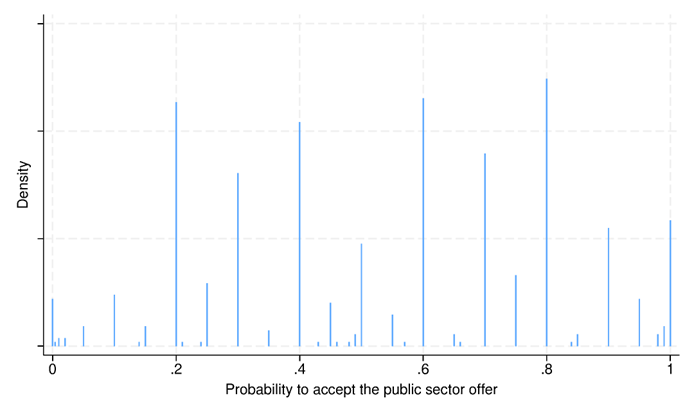
This heterogeneity translates into large differences in how much individuals value public sector jobs: While many students are willing to accept substantial pay cuts to work in the public sector, others require large wage premia to do so. For a significant share, the value of a public sector job is equivalent to a large fraction of their expected wage.
Why do public sector jobs attract talent? The role of amenities
We develop a novel method to estimate the perceived willingness-to-pay for job amenities in the population using only probabilistic hypothetical choice scenarios and apply this method to the Ivorian labour market setting. Our results reveal that the appeal of public sector employment for highly skilled graduates is driven primarily by non-wage amenities. This includes:
- Job stability: a large reduction in the risk of job loss significantly increases the attractiveness of public sector jobs.
- Working conditions: fewer working hours and lower stress matter substantially.
- Predictability: even if wages are lower, certainty is highly valued.
Quantitatively, improvements in job security alone can increase the perceived value of a public sector job by around one-fifth of average wages for much of the population, while the perceived value of lower working hours in the public sector corresponds to around 10% of the average wage.
Students are still uncertain about their choice
A key insight from our analysis is that highly skilled jobseekers face considerable uncertainty about future outcomes, such as which offers they will receive, how jobs will evolve, and whether expectations will materialise. Even when students favour one sector, most assign a non-zero probability to choosing the other. This uncertainty has two important implications:
- Policy effects are harder to predict: changes in wages or job conditions may not yield immediate or uniform responses.
- Information is valuable: jobseekers may delay decisions or value flexibility while they learn more about opportunities.
Implications for firms: A costly competition for talent
The public sector creates a strong outside option for highly skilled workers. To attract additional workers, private firms must offer wages high enough to compensate for the loss of public sector amenities. Our estimates suggest that increasing private sector employment by 1% may require a 1.3–2.1% increase in the wage bill, depending on assumptions.
This implies that hiring additional workers becomes progressively more expensive, and that the public sector effectively raises labour costs economy-wide. In practical terms, the marginal worker is increasingly costly to attract because firms must compensate not only wages, but also job security, working conditions, and perceived risk.
Policy implications for youth employment
Public sector policy has economy-wide effects. Even without expanding public employment, the public sector influences private labour markets by shaping expectations and providing a benchmark – suggesting public sector wage and employment policies should consider spillover effects on the private sector.
Improving private sector job quality matters. Closing the gap in non-wage amenities could reduce competition for talent without large wage increases. Priority areas include job stability (contracts, insurance mechanisms), predictable career progression, and working hours and conditions. These improvements can be more cost-effective than raising wages alone.
Information interventions could be effective. Given the high level of uncertainty, better information about career trajectories, job stability, and actual returns could influence choices and reduce mismatches.
Heterogeneity calls for targeted policies. Because preferences differ widely one-size-fits-all policies are unlikely to work and tailored approaches (e.g. sector-specific incentives, career pathways) may be more effective.
Broader implications for development
Our findings speak to a broader challenge in developing economies. When the public sector offers stability and prestige, it can draw talent away from potentially more productive private sector activities. This may contribute to misallocation of skilled labour and slower structural transformation. In Côte d'Ivoire, where the pool of highly educated workers is limited, these effects are particularly consequential.
Public sector jobs in Côte d'Ivoire are highly valued – not primarily for wages, but for stability and working conditions. This creates strong competition for talent and raises hiring costs for private firms. Policies that aim to foster private sector growth should therefore not only focus on wages, but also on job security, working conditions, and information frictions. Understanding how workers perceive and value jobs is critical for designing labour market policies that support both individual welfare and economic growth.
References
Cavalcanti, T, and M Santos (2021), "(Mis)allocation effects of an overpaid public sector," Journal of the European Economic Association, 19(2): 953–999.
Christiaensen, L, and P Premand (2017), "Côte d'Ivoire jobs diagnostic: Employment, productivity, and inclusion for poverty reduction," World Bank.
Girsberger, E M, and R Méango (2025), "The puzzle of educated unemployment in West Africa," Unpublished manuscript.
Mangal, K (2024), "How much are government jobs in developing countries worth?" World Bank Economic Review, 38(3): 443–465.
Méango, R, and E M Girsberger (2026), "Just ask them twice: Choice probabilities and identification of ex ante returns and willingness-to-pay," Economic Journal, ueag018.