



Armed conflict exacerbates gender inequality, but women are not just victims – they are also agents of change.
Editor's note: This article is part of series covering CEPR's Reducing Conflict and Improving Performance in the Economy (ReCIPE) programme. Siwan Anderson and Maria Micaela Sviatschi are the ReCIPE Theme Leaders on Gender, Inequality, and Conflict.
Armed conflicts have increased sharply in recent years, affecting hundreds of millions of civilians. Yet their impact is not evenly distributed. Women and girls disproportionately suffer from conflict – both directly and in its aftermath. We draw on the growing body of quantitative evidence synthesised in Anderson and Sviatschi (2025), focusing on gender-based violence (GBV), the roles women play as combatants and peacebuilders, and the gendered demographic, health, and political shifts conflict leaves behind.
A surge in conflict, a crisis for women
According to a 2024 UN report, more than 170 armed conflicts are active globally, with over 612 million women and girls living within 50 km of violent events – a 150% increase over the past decade. Nearly 90% of all casualties are civilians, and the proportion of women killed in conflict doubled in 2023 alone.
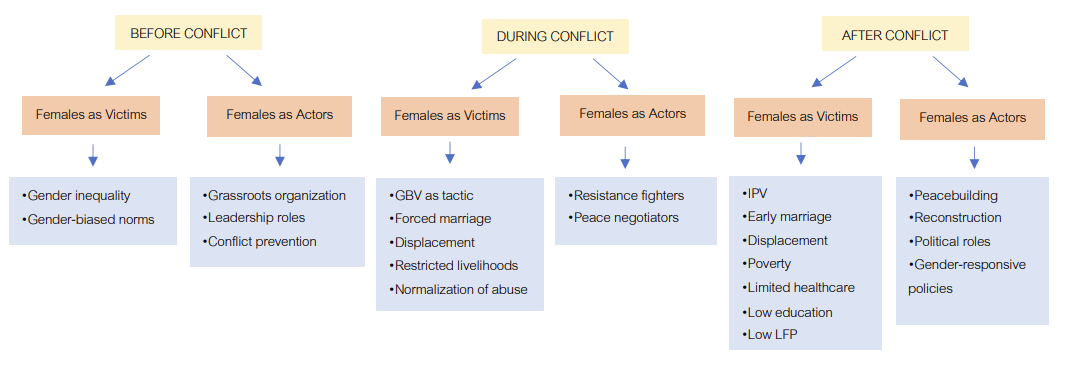
Yet women are not only victims of conflict; they also serve as combatants, political leaders, and peace negotiators (Figure 1). Furthermore, there is limited understanding of how pre-existing gender inequalities may amplify the onset and severity of conflict. Recognising the gendered dynamics of war is crucial for developing more inclusive and effective responses.
Figure 1: Gender and conflict
Gender-based violence: The silent weapon of war
Armed conflict is strongly associated with higher levels of GBV against women and girls. This includes murder, torture, sexual slavery, forced marriage, and sterilisation, among others. While exact numbers are difficult to obtain, estimates are staggering: 20,000 to 50,000 women were raped during the Bosnian war, 250,000 to 500,000 in the Rwandan genocide, and over 60,000 in the Sierra Leone Civil War (UN Women n.d.).
Recent data confirms that conflict-related sexual violence (CRSV) is on the rise. Presently, the number of UN verified cases of CRSV which occurred in 2024 was 50% higher compared to the year before. Between 2020 and 2024, the Armed Conflict and Event Data Project (ACLED) dataset reveals that GBV attacks on female civilians were concentrated in Mexico, Brazil, Syria, Myanmar, the DRC, and Nigeria (Figure 2). Sexual violence remains the most prevalent form of GBV during armed conflict. According to the Sexual Violence in Armed Conflict (SVAC) dataset, the countries with the highest incidence are the DRC, Myanmar, India, and Sudan (Figure 3).
Figure 2: Gender-based violence and armed conflict
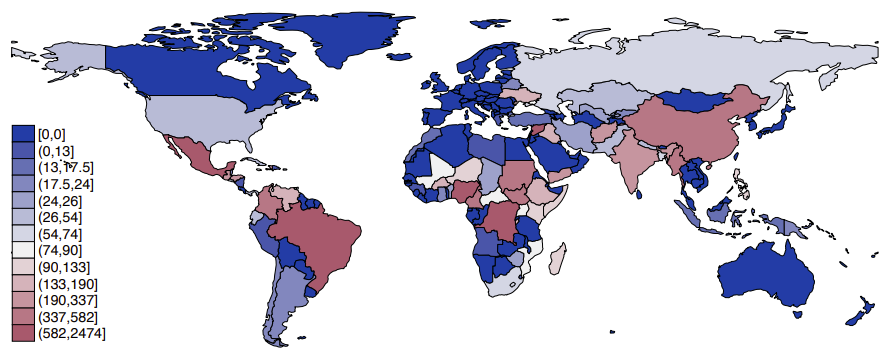
Notes: Total number of GBV attacks between 2020-2024. Source: ACLED.
Figure 3: Sexual violence and armed conflict
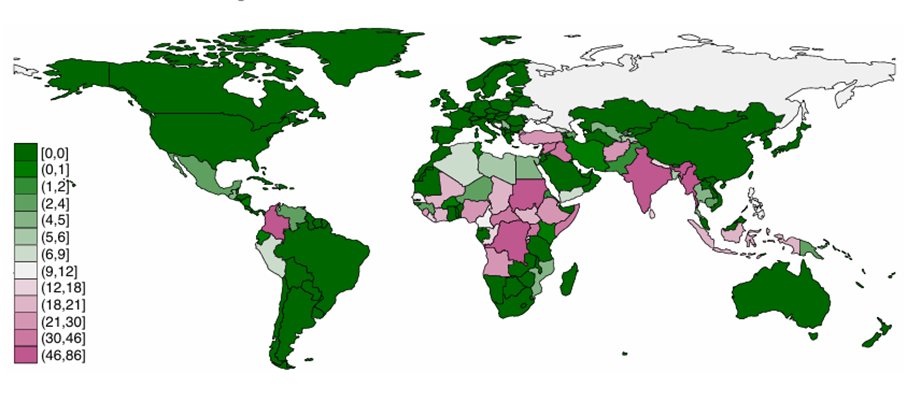
Notes: Total number of conflicts with sexual violence committed by armed actors between 1989-2021. Source: SVAC.
Gender-based violence (GBV) is not a random occurrence. Case studies demonstrate that armed groups often employ rape strategically – as a weapon of war, tool of terror, means to dishonour and demoralise enemies, or even to foster unit cohesion within their ranks (Leiby 2009, Skjelsbaek 2001, Cohen 2013). Descriptive research further indicates that state militaries are more likely to commit sexual violence compared to rebel groups (Cohen and Nordås 2014, Leiby 2009). Complementing these findings, recent causal investigations underscore how gender-unequal social norms exacerbate the incidence of such violence (Guarnieri and Tur-Prats 2023).
The gendered aftershocks of conflict: Education, health, and domestic violence
Conflict creates long-term scars for women and girls. There is ample evidence on the negative consequences on human capital and gender violence. Education is often interrupted; girls are less likely to enrol in school and complete primary education (Shemyakina 2011). Health outcomes also worsen: exposure to conflict reduces facility-based childbirth, increases maternal mortality, and limits access to modern contraception (Kotsadam and Østby 2019, Amberg et al. 2023, Torrisi 2024). The risk of intimate partner violence (IPV) also rises after war. Research across Africa, Colombia, and Peru show that girls who grow up in war-affected areas are significantly more likely to experience IPV in adulthood (La Mattina 2017, Gutierrez and Gallegos 2016, Svallfors 2023). This is partly due to the normalisation of violence, trauma, and reinforced patriarchal norms (Cesur and Sabia 2016, Ajefu and Casale 2024, Ekhator-Mobayode et al. 2022, La Mattina and Shemyakina 2024).
Even displacement offers little safety for women. By 2017, over 16 million women were forcibly displaced by conflict, mostly in Syria, Colombia, the DRC, Yemen, Afghanistan, and Somalia (Bendavid et al. 2021). Displaced women face heightened risks of IPV, early marriage, and lost livelihoods. In Jordan, Syrian refugee women experienced a rise in IPV post-migration, especially in socially isolated and economically strained households (Göçke and Kїrdar 2024). Marriage patterns also shifted: early and non-arranged unions became more common among younger migrants (Foster et al. 2024). Meanwhile, refugee women lag behind men in labour market recovery, with employment gaps persisting long after resettlement (Demirci and Kїrdar 2023, Kondylis 2010).
Demographic shocks and shifting gender roles
War often leads to a sharp decline in the male population, distorting sex ratios and reshaping the social and economic fabric of affected societies. While such demographic shocks can reduce marriage and fertility rates, they may also prompt lasting shifts in women’s roles – spurring greater female labour force participation, educational attainment, and more gender-equal norms (Goldin 1991, Acemoglu and Lyle 2004, Doepke et al. 2015).
A striking historical case is Paraguay’s War of the Triple Alliance (1864–1870), which decimated up to 70% of the male population. In its aftermath, women stepped into economic and social roles once reserved for men, leading to more female-headed households, better education outcomes for women, and long-term shifts toward egalitarian gender attitudes (Alix-Garcia et al. 2022).
A similar pattern emerges in the context of the transatlantic slave trade. Teso (2019) finds that ethnic groups in Africa more heavily affected by male slave capture developed new labour divisions, with women taking on traditionally male roles. These shifts in gendered labour persisted across generations through cultural transmission, reinforcing social acceptance of working women over time.
Not just victims: Women in rebel groups and resistance movements
Women are often portrayed as passive victims of war, but a growing body of evidence reveals a more complex picture. Estimates suggest that 63% of rebel organisations from 1946–2015 included female members. Many went beyond support roles: women served in frontline combat, leadership positions, and as recruiters, medics, spies, and political organisers (Loken and Matfess 2024).
In Uganda, surveys of former Lord’s Resistance Army female members show that participation led to heightened psychological distress post-conflict. Yet, these same women also displayed notable economic and social resilience in rebuilding their lives (Annan et al. 2011). In Colombia, the presence of female FARC leaders was correlated with fewer violent attacks, particularly in municipalities led by female mayors, suggesting a unique dynamic between women in armed groups and local governance (Eslava 2024). Moreover, groups with female combatants are more likely to engage in peace negotiations and include gender-inclusive provisions in peace agreements (Brannon et al. 2024, Thomas 2024).
Figure 4: Rebel groups with female participation
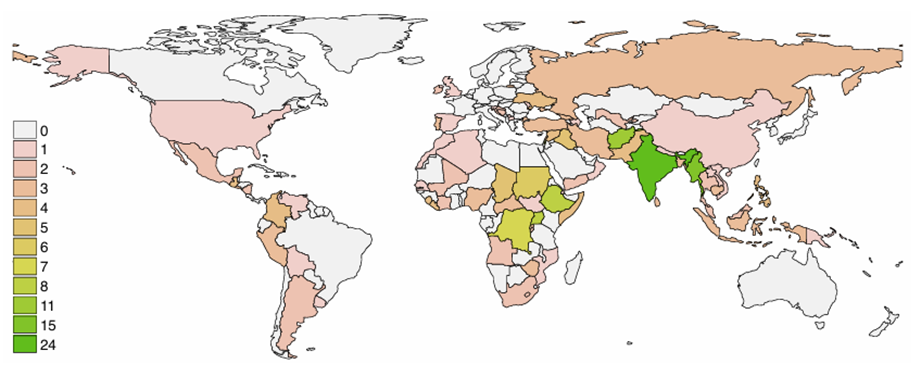
Notes: Total number of rebel groups with female participation between 1946-2015. Source: WAAR.
Female political participation and post-conflict governance
The political aftermath of conflict can also create space for women. In Rwanda, areas hit hardest by violence elected more and better-educated female leaders, often through the National Women’s Council (Rogall and Zárate-Barrera 2020). In Peru, municipalities exposed to conflict showed greater success in implementing gender quotas, particularly where women had ties to grassroots organisations (García-Ponce 2022).
However, outcomes vary. Sexual violence by state actors may reduce women's political engagement (García-Ponce 2022). Similarly, former rebel women are less likely to be elected when associated with wartime violence (Brannon 2023).
Where women hold power in peace negotiations, the results are significant. Peace agreements are more likely to include provisions for females, reintegration programmes, and protections for marginalised groups (Good 2024, Thomas 2024). Simply having women ‘in the room’ is not enough – decision-making power matters.
Does gender equality reduce conflict?
Cross-country evidence reveals a strong negative relationship between gender equality and conflict incidence. Countries with greater legal gender equality, in areas such as asset ownership, mobility, and workplace rights, and those with more gender-equal social norms are significantly less likely to experience armed conflict, especially intrastate violence (Figure 5). These patterns suggest that both inclusive institutions and egalitarian norms may help mitigate the risk of conflict.
Figure 5: Conflict incidence and gender equality
(a) Gender legal equality (b) Gender equal norms
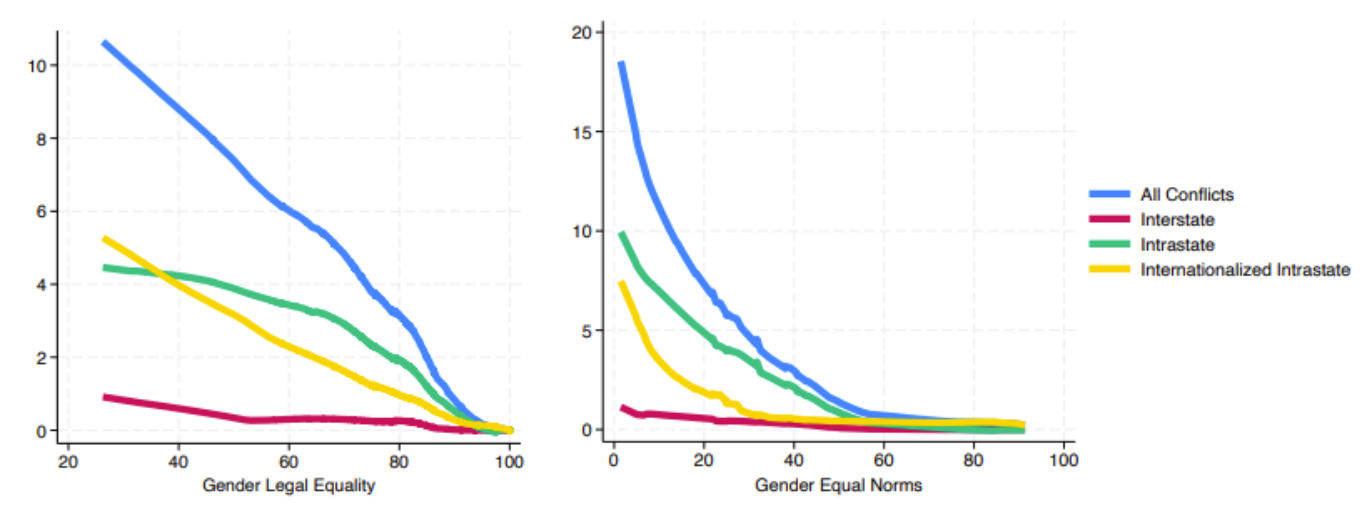
Notes: Horizontal axis is total number of conflicts between 2010 and 2023. Vertical axis is Gender Equality Index. Lowess smoothing graph. Sources: UCDP and Women, Business and the Law (WBL); and UNDP Gender Social Norms Index (GSNI).
Two main channels help explain this correlation. Institutionally, gender-equal societies enable more women to attain leadership and civic roles, increasing the likelihood of peaceful policy choices. Culturally, societies with lower gender bias may reject patriarchal norms that valorise aggression. However, while these correlations are compelling, the direction of causality remains uncertain – conflict itself can also erode gender equality. More causal research is needed to clarify whether empowering women can play a preventive role across the full conflict cycle.
Gender-based policy implications and research frontiers
Armed conflict magnifies gender inequality, but it also reshapes societies in ways that can open opportunities for change. The evidence calls for:
- Targeted prevention and response to GBV in both conflict and post-conflict settings.
- Meaningful inclusion of women in formal peace processes.
- Policies that address long-term effects of war on education, health, and IPV.
- Expanded support for experimental and causal research, particularly in low-income and fragile states, as well as more causal evidence on the mechanisms behind GBV.
- More evidence on women as agents of change, examining their roles as combatants, peacebuilders, and political actors—not only as victims.
From gender-responsive humanitarian aid to inclusive peacebuilding, understanding how conflict affects women is not just a moral imperative—it is a strategic necessity.
References
Acemoglu, D, A D H Autor, and D Lyle (2004), “Women, war, and wages: The effect of female labor supply on the wage structure at midcentury,” Journal of Political Economy 112: 497–551.
Alix-Garcia, J, L Schechter, F Caicedo, and S Zhu (2022), “Country of women? Repercussions of the triple alliance war in Paraguay,” Journal of Economic Behavior & Organization 202: 131–167.
Ajefu, J B, and D Casale (2024), “Long-term effects of childhood exposure to war on domestic violence,” European Journal of Development Research: 1–28.
Anderson, S, and M M Sviatschi (2025), “Gender and armed conflict,” Economic Policy, eiaf010.
Amberg, F, C Chansa, H Niangaly, O Sankoh, and M De Allegri (2023), “Examining the relationship between armed conflict and coverage of maternal and child health services in 35 countries in sub-Saharan Africa: A geospatial analysis,” The Lancet Global Health 11: e843–e853.
Annan, J, D Blattman, C Mazurana, and K Carlson (2011), “Civil war, reintegration, and gender in Northern Uganda,” Journal of Conflict Resolution 55: 877–908.
Bendavid, E, T Boerma, N Akseer, et al. (2021), “The effects of armed conflict on the health of women and children,” The Lancet 397: 522–532.
Brannon, E L (2023), “The election of former rebel women,” Journal of Peace Research.
Brannon, E L, J L Thomas, and L L DiBlasi (2024), “Fighting for peace? The direct and indirect effects of women’s participation in rebel groups on peace negotiations,” Journal of Politics 86.
Cesur, R, and J J Sabia (2016), “When war comes home: The effect of combat service on domestic violence,” Review of Economics and Statistics 98: 209–225.
Cohen, D K (2013), “Explaining rape during civil war: Cross-national evidence (1980–2009),” American Political Science Review 107: 461–477.
Cohen, D K, and R Nordås (2014), “Sexual violence in armed conflict: Introducing the SVAC dataset, 1989–2009,” Journal of Peace Research 51: 418–428.
Demirci, M, and M G Kırdar (2023), “The labor market integration of Syrian refugees in Turkey,” World Development 162.
Doepke, M, M Hazan, and Y D Maoz (2015), “The baby boom and World War II: A macroeconomic analysis,” Review of Economic Studies 82: 1031–1073.
Ekhator-Mobayode, U E, L C Hanmer, E Rubiano-Matulevich, and D J Arango (2022), “The effect of armed conflict on intimate partner violence: Evidence from the Boko Haram insurgency in Nigeria,” World Development 153: 105780.
Eslava, F (2024), “Conflict and female leadership: Evidence from Colombia,” Working Paper.
Foster, A, M Göçke, and M G Kırdar (2024), “Intergenerational power shift and the rise of nonarranged marriages among refugees,” Demography.
García-Ponce, O (2022), “Women’s political participation after civil war: The case of Peru,” Working Paper.
Goldin, C (1991), “The role of World War II in the rise of women’s employment,” American Economic Review 81: 741–756.
Göçke, M, and M G Kırdar (2024), “The effects of civil war and forced migration on intimate partner violence among Syrian refugee women in Jordan,” IZA Discussion Paper.
Good, E (2024), “Power over presence: Women’s representation in comprehensive peace negotiations and gender provision outcomes,” American Political Science Review: 1–16.
Guarnieri, E, and A Tur-Prats (2023), “Cultural distance and conflict-related sexual violence,” Quarterly Journal of Economics 138: 1817–1861.
Gutierrez, I A, and J V Gallegos (2016), “The effect of civil conflict on domestic violence: The case of Peru,” Working Paper.
Kotsadam, A, and G Østby (2019), “Armed conflict and maternal mortality: A micro-level analysis of sub-Saharan Africa, 1989–2013,” Social Science & Medicine 239.
Kondylis, F (2010), “Conflict displacement and labor market outcomes in post-war Bosnia and Herzegovina,” Journal of Development Economics 93: 235–248.
La Mattina, G (2017), “Civil conflict, domestic violence and intra-household bargaining in post-genocide Rwanda,” Journal of Development Economics 124: 168–198.
La Mattina, G, and O N Shemyakina (2024), “Growing up amid armed conflict: Women’s attitudes toward domestic violence,” Journal of Comparative Economics.
Leiby, M L (2009), “Wartime sexual violence in Guatemala and Peru,” International Studies Quarterly 53: 445–468.
Loken, M, and H Matfess (2024), “Introducing the Women’s Activities in Armed Rebellion (WAAR) project, 1946–2015,” Journal of Peace Research 61: 489–499.
Rogall, T, and T Zárate-Barrera (2020), “Yes they can: Genocide, political participation, and female empowerment,” Households in Conflict Network Working Paper.
Shemyakina, O (2011), “The effect of armed conflict on accumulation of schooling: Results from Tajikistan,” Journal of Development Economics 95: 186–200.
Skjelsbaek, I (2001), “Sexual violence and war: Mapping out a complex relationship,” European Journal of International Relations 7: 211–237.
Svallfors, S (2023), “Hidden casualties: The links between armed conflict and intimate partner violence in Colombia,” Politics & Gender 19(1): 133–165.
Teso, E (2019), “The long-term effect of demographic shocks on the evolution of gender roles: Evidence from the transatlantic slave trade,” Journal of the European Economic Association 17: 497–534.
Thomas, J (2024), “Sisters are doing it for themselves: How female combatants help generate gender-inclusive peace agreements in civil wars,” American Political Science Review 118: 831–847.
Torrisi, O (2024), “Violent instability and modern contraception: Evidence from Mali,” World Development 177: 106538.
UN Women (n.d.), “Rape as a tactic of war.”