




View Chapter:
Downloads:
Chapter 4
Complementary inputs
Infrastructure
Many technologies require complementary infrastructure. Machines require reliable electricity. Modern logistics require roads, ports, and storage. Digital tools require broadband, devices, and payment systems. Agricultural technologies often require irrigation, transport, and access to input and output markets.
This creates a sequencing problem. Firms may not invest in machinery, storage, or quality upgrading when power and logistics are unreliable. Governments and utilities may not expand capacity when private demand is still low. Adoption and infrastructure provision can therefore be mutually reinforcing, but also mutually stalled.
The evidence on electrification is mixed and context-dependent (Meeks and Mahadevan 2025). Early studies find large positive effects (Dinkelman 2011, Lipscomb et al. 2013), but more recent work suggests these depend heavily on local conditions, with benefits accruing in larger settlements but not smaller ones and demand remaining low where connections are subsidised (Lee et al. 2020, Burlig and Preonas 2024). Grid build-out and diversion across consumers also reshape estimation of electrification impacts (Castaneda et al. 2017, Davis et al. 2023, Hausman 2025). At the macro level, the aggregate output implications remain contested: while low electricity-sector productivity may explain little of aggregate output variation (Colmer et al. 2024), grid expansion can still matter for structural change and sectoral productivity (Pérez-Sebastián et al. 2020, Pérez-Sebastián et al. 2023).
Roads show a similar pattern. Lower transport costs can raise the return to modern inputs, storage, and quality upgrading. In agriculture, road improvements often increase the use of modern inputs and improve access to quality-differentiated markets (Aggarwal 2018, Asher and Novosad 2020, Fiorini et al. 2021, Shamdasani 2021, Bold et al. 2022, Aggarwal et al. 2024), though the effects are not uniform. The common point is that infrastructure has large effects only when other margins can respond.
Procurement, contracting, and upstream input markets also have direct impact on the realized returns to infrastructure. Road construction costs vary significantly across low- and middle-income countries, with roles for public-investment capacity, corruption, conflict, and market conditions (Collier et al. 2016). Related work by Beirne and Kirchberger (2023) shows that distortions in upstream materials markets can raise construction costs.
Policy implications. Roads, ports, electricity grids, transmission networks, and communications systems involve large fixed costs, coordination across users, and regulation that private firms alone often cannot provide. Thus, governments could take a leading role in infrastructure development and the institutions surrounding it. Infrastructure policy shapes the environment in which technologies are profitable and public-private partnerships could be fruitful to improve that environment.
The evidence reviewed above suggests that infrastructure can have large effects, but returns depend on location, scale, reliability, and complementary demand (Lipscomb et al. 2013, Lee et al. 2020, Pérez-Sebastián et al. 2020, Burlig and Preonas 2024). This is especially clear for electricity. The relevant policy margin is not only whether to connect more users, but what system to build. Grid expansion, transmission, distributed generation, storage, and future industrial demand have to be planned jointly. Falling costs of solar, batteries, and other modular technologies make this problem more interesting. They allow some users to bypass parts of the traditional grid, but they also raise new questions about reliability, integration, pricing, and the sequencing of public and private investment (Levin and Thomas 2016, Nemet 2019, Arkolakis and Walsh 2023, 2024, International Energy Agency 2025, Nober 2026). Energy security and macroeconomic transmission channels linked to oil and power markets further underscore how infrastructure investments interact with volatility and incentives (Hamilton 1983, Mork 1989, Blanchard and Galí 2010, Kilian 2009, Hassler et al. 2021, Känzig 2021, Del Canto et al. 2025, Känzig and Williamson 2025).
The policy challenge is as much about implementation as intent. Infrastructure must be built cheaply and reliably — and public-private partnerships can help by aligning incentives and improving cost recovery through proper service pricing. Yet infrastructure alone is not enough. Its returns depend on the willingness and ability of firms and consumers to invest in and adopt new technologies. It is a necessary condition for development, but not a sufficient one.
Human capital
Human capital is another complement to technology. Technologies diffuse when workers can operate new machinery, technicians, and engineers can adapt it to local conditions, and managers can reorganise production around it. The relevant margin is therefore broader than years of schooling alone. It includes basic skills, college education, technical expertise, managerial ability, and the allocation of talent across firms, sectors, and technologies (Porzio 2017, Bandiera et al. 2024).
The classic view is that human capital helps economies understand and implement new technologies. In Nelson and Phelps (1966), education raises the ability to learn from the frontier, so its value is higher when technologies are changing quickly. Later work emphasises that technologies differ in their skill requirements. Skill-biased technical change makes some technologies more complementary to educated labour, and the local supply of skills can affect both adoption and the direction of innovation (Acemoglu 2002a, Caselli and Coleman 2006, Rossi 2022).
The empirical evidence is consistent with this view. Countries with more educated workers adopted computers more intensively during the ICT revolution, and grew faster in human-capital-intensive industries during periods of rapid technological change (Caselli 2001, Ciccone and Papaioannou 2009). In agriculture, experience and learning from neighbours mattered for the adoption of high-yielding varieties (Foster and Rosenzweig 1995). These results point to a common mechanism: new technologies require users who can learn, experiment, and adjust production practices.
College education is likely to matter especially for modern technologies. Many new production methods require abstract reasoning, problem-solving, and the ability to combine codified knowledge with firm-specific learning. This is not only about frontier innovation. It also affects the ability of firms to adopt and scale existing technologies. Low levels of education can constrain the supply of white-collar workers and therefore the growth of large, complex firms that use them intensively (Engbom et al. 2025).
Technical skills are another margin. Endogenous growth theory places researchers, engineers, and scientists at the centre of innovation, and historical work stresses their role in the diffusion of electricity, chemicals, and modern manufacturing (Romer 1990, Mokyr 1998, Akcigit et al. 2025). Consistent with this, countries with larger engineering capacity around 1900 adopted new technologies faster and have higher income today (Maloney and Valencia Caicedo 2022). This evidence suggests that the relevant constraint is not only the average level of schooling, but also the availability of specific technical skills.
Managerial human capital matters for the same reason. Many technologies require changes in workflow, monitoring, incentives, procurement, quality control, and task allocation. Better management practices can raise productivity substantially, and the high relative cost of managers in poorer countries may limit the expansion of technologically advanced sectors (Bloom et al. 2013, Guner et al. 2018). The availability of young workers and managers may also matter if technology adoption requires mobility, experimentation, and the willingness to reorganise production. The reallocation of young workers across sectors is central to structural transformation, making demographics and labour-market transitions part of the technology-adoption process (Porzio et al. 2022).
Policy implications. If human capital is a complement to technology adoption, education policy is also technology policy. But the relevant investment is not the same in every setting. For some technologies, the binding margin may be basic literacy and numeracy. For others, it may be college graduates, engineers, technicians, managers, or workers able to move across firms and sectors.
The main policy implication is that education and technology policy should be considered jointly. Expanding schooling has limited effects if firms cannot use skilled workers. This may explain why technology adoption is not only correlated with human capital measures, but also with the availability of capital and trade-openness in the economy (Figure 3). Giving firms access to modern technologies has limited effects if the workers and managers needed to use them are missing. Human-capital policy is therefore not only a long-run social investment. It also shapes the short- and medium-run capacity of firms to adopt, adapt, and scale new technologies.
Figure 3: Raw correlations for the technology index
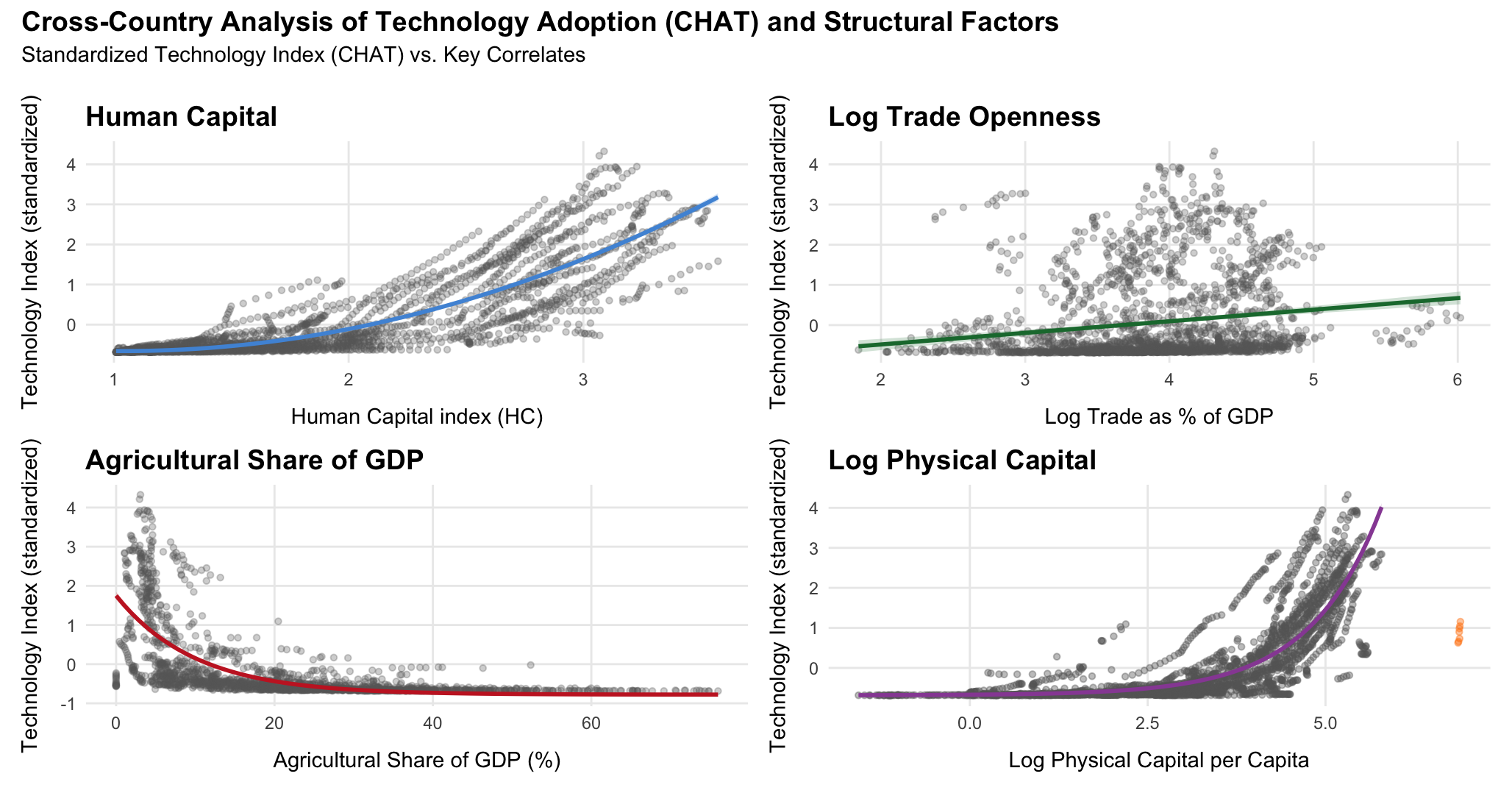
Notes: Raw cross-country correlations between the CHAT-based technology index and four variables: human capital (HC), log trade share of GDP, agricultural share of GDP, and log physical capital per capita (PC). Trendlines are estimated using a polynomial fit for HC, a linear fit for log trade openness, an exponential decay fit for agricultural share, and an exponential fit for log PC (excluding the UAE, which is denoted in orange). Data for HC and PC are from the Penn World Table (PWT), while agricultural share (NV.AGR.TOTL.ZS) and trade openness (NE.TRD.GNFS.ZS) are from the World Bank (WB). Sources: Feenstra et al. (2015), World Bank (2026b), World Bank (2026c), Comin and Hobijn (2009).
This also means that management and technical training belong in the same discussion as formal education. In many settings, the constraint may not be the number of years of schooling but the absence of the specific skills needed to reorganize production around new technologies. The relevant policy question is therefore which human-capital margin binds for the technologies that firms could plausibly adopt next. In some sectors this may still be basic literacy and numeracy. In others it may be vocational training, technicians, college-trained workers, engineers, or managers. As countries develop and production technologies become more complex, the binding margin is likely to move from broad basic education toward more specialised skills. Education policy can therefore promote technology adoption more deliberately when it is organised around the skill requirements of feasible technologies, rather than around schooling attainment alone.
For full reference list see the end of the conclusion chapter.
Contact VoxDev
If you have questions, feedback, or would like more information about this article, please feel free to reach out to the VoxDev team. We’re here to help with any inquiries and to provide further insights on our research and content.