




View Chapter:
Downloads:
Chapter 2
Introduction
Technology is central to economic development. Poor countries are poor largely because they produce less output from the same inputs, and technology is one of the main sources of these productivity differences. Some technologies are embodied in machines and equipment; others are embedded in production processes, managerial know-how, organisational choices, software, or worker skills. In all cases, development requires not only that technologies exist somewhere in the world, but that they are adopted, adapted, and used at scale.
This process does not happen automatically. Over the past half century, the global frontier has advanced rapidly, and countries have become increasingly connected through trade, capital goods, migration, multinational production, and digital communication. Yet income gaps across countries remain large and persistent (Figure 1). The puzzle of development has therefore remained broadly unchanged: why are some countries persistently poor while others are not?
This review asks why technology has not closed these gaps. Frontier technologies may be available in principle, but poorly suited to local conditions, unprofitable without complementary inputs, too costly to adopt at small scale, or difficult to use without the required skills, infrastructure, institutions, and organisational capacity. The central question is what prevents productive technologies from being adopted at scale in developing countries, and which policies can relax those constraints.
Figure 1: Income levels and GDP shares by 1970s country group
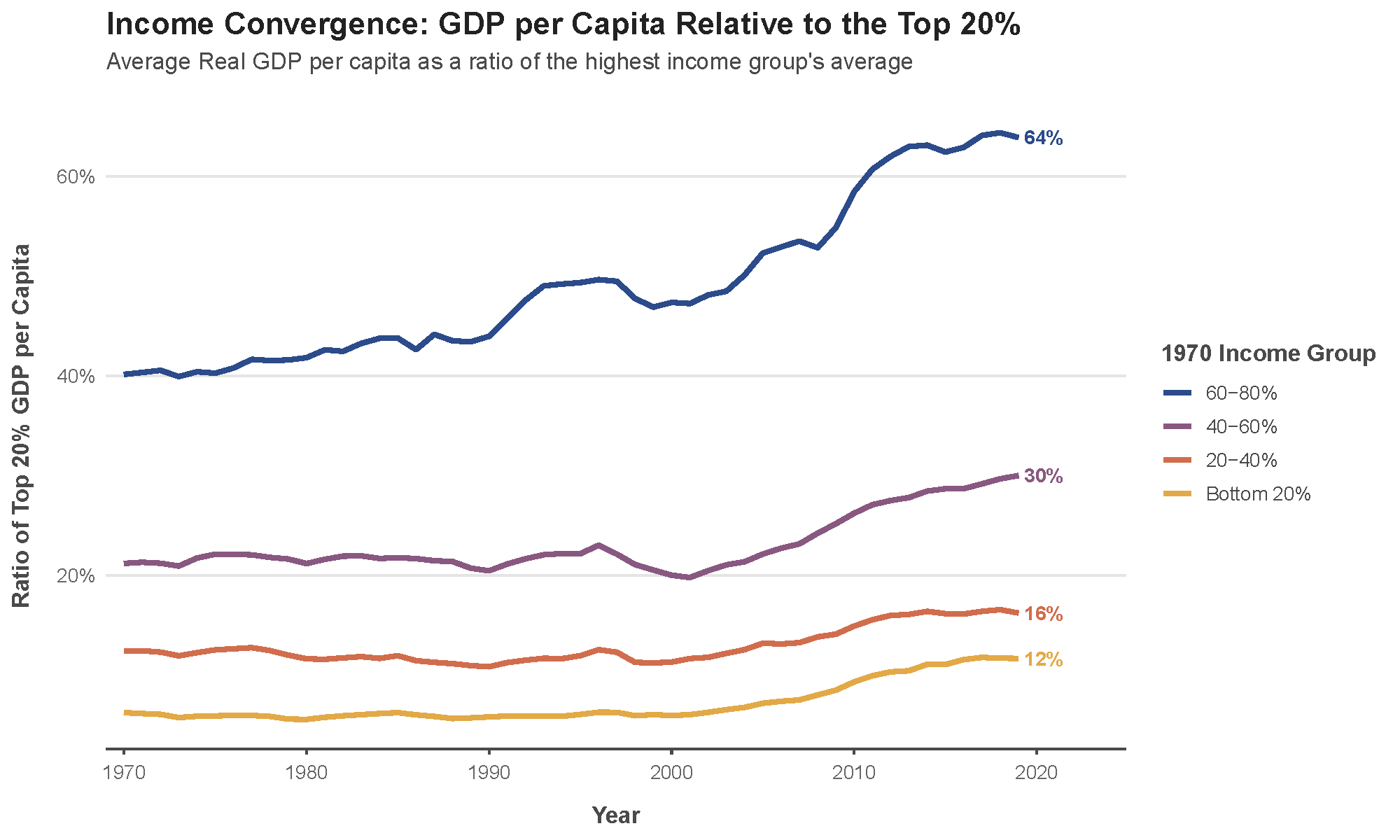
Notes: Based on a balanced panel (1970–2019) excluding oil-dependent states (ARE, KWT, QAT, SAU, BHR, OMN, BRN, IRN, IRQ, LBY, GAB). Countries are categorised into income quintiles by 1970 expenditure-side real GDP per capita. Averages are computed annually by 1970 quintile. Source: Penn World Tables 10.0 Feenstra et al. (2015).
This review begins by clarifying what we mean by technology and by adoption. Technologies may be embodied in machines and equipment or disembodied through management practices, organisational structures, software, or digital tools. This distinction matters because it changes what adoption itself means. We also distinguish adoption and diffusion from the process of innovation itself. After all, economic development often consists of adapting and using existing technologies to local conditions, and more rarely consists of developing new frontier technologies.
We next ask why technologies differ so widely across countries. A first step is conceptual: what is the relevant benchmark technology for a low-income country? Frontier technologies may not be optimal everywhere. Ecological conditions, factor endowments and skills, infrastructure, local demand, and regulation all shape which technologies are profitable. Appropriate-technology frameworks therefore highlight that a country’s technological frontier may differ from the global one. This is an important insight because slow adoption can reflect either barriers to diffusion or the poor fit of the available menu of technologies.
The next step is to understand the mechanisms that suppress technology adoption even when productive technologies exist. A useful organising distinction is between forces that reduce the returns to adoption and forces that weaken individual incentives to adopt. The next sections of this review are organised around that problem. Four mechanisms appear repeatedly in the literature.
- Coordination and complementarities. Many technologies require simultaneous adoption, complementary investment, or a minimum user base to become profitable. When firms’ incentives depend on what others do, decentralised adoption may remain too low even when a high-adoption outcome would be productive. This logic runs from classic big-push settings to modern cases involving supplier networks, digital platforms, infrastructure, and the collective achievement of scale.
- Complementary inputs. Technologies are rarely productive in isolation. Roads, electricity, logistics, water, communications networks, and other system-level inputs determine whether firms can profitably use modern equipment and production methods. The same is true for the design and sequencing of these systems, especially in sectors such as energy where modular new technologies change the infrastructure problem itself. Modern technologies demand managerial expertise, technical skills, and workers capable of learning and adapting.
- Market structure and scale. At the same time, many technologies require scale, so firms upgrade when they can serve larger or richer markets that reward quality. Trade, roads, and supply chains can therefore raise the payoff to adoption through market access, but the gains vary and depend on initial capability and access to complementary inputs. Importantly, the nature of the markets for these technologies also determines their returns and whether frictions such as indivisibilities or fixed costs can be overcome.
- Risk, incentives, and behavioural frictions. Even profitable technologies may not be adopted when decision-makers face misaligned incentives, exposure to risk, distrust, or misperceived returns. Adoption decisions are made by owners, managers, workers, and consumers rather than by abstract production functions, so contracts, information, and organisational incentives matter directly.
Given these mechanisms, the relevant policy question is not whether governments should promote technology, but which specific barriers they can plausibly address. In what follows, each mechanism section is paired with a discussion of its policy implications. Some interventions target coordination failures, including industrial and clustering policies. Others operate through the direct provision of complementary inputs, such as infrastructure investment and worker education. And others work by tackling frictions in markets for inputs and outputs more directly, encompassing labour-market policy, financing provision, support for experimentation, and the design of market institutions. Finally, we cover how policy can redirect the course of innovation towards local conditions where private incentives fall short.
To close this review, we discuss the changing technological frontier and the extent to which new technologies permit leapfrogging. Technologies such as digital payments, platforms, artificial intelligence, and modular energy systems offer opportunities for partial leapfrogging (Burgess et al. 2025), but they also make the old questions more interesting rather than less. Digital tools can reduce information and transaction costs, but they often create new issues around observability, trust, interoperability, and skill requirements. Likewise, the spread of cheaper modular energy technologies changes the problem of electrification from one of simple expansion to one of system design and sequencing.
Definitions: Technology, innovation, adoption, appropriateness, and fit
Before discussing barriers or policy, it is useful to define the object at stake. Technology is the collection of tools, methods, and techniques that allows inputs to be transformed into outputs. Technological progress is therefore the production of more output, or higher-quality output, from the same inputs.
The classic question is whether this progress is embodied in capital or disembodied from it. Solow (1959) contrasts a view in which productivity improvements are embedded in successive generations of capital, so that progress arrives through investment in newer machines, with a view in which technical change raises the productivity of existing factors through knowledge, management, organisation, or methods. A connected question concerns the source of technological progress. A dominant approach emphasises the production of non-rival ideas or instructions that can be used repeatedly at no additional cost (Romer 1990). Trade-centred modelling of technology diffusion and international spillovers provides a complementary benchmark (Eaton and Kortum 1996). Throughout the literature these objects are labelled as ideas, designs, innovations, or technologies, and the process that generates them is labelled invention, innovation, research, or R&D.
In what follows, it will be useful to keep separate the creation of these instructions from their use. Innovation refers to the production of new ideas or techniques (Romer 1990, Aghion and Howitt 1992, Jones 1995). Adoption refers to the implementation of existing technologies by firms, farms, or households. Diffusion refers to the spread of a technology across users.
This distinction between innovation, adoption and subsequent diffusion is central in development economics. A common benchmark is that countries near the global frontier grow mainly through innovation, while poorer countries grow mainly through adoption (Parente and Prescott 1994, 2000, Comin and Hobijn 2004, 2010). This benchmark is useful because adoption gaps explain a large share of income differences, and because micro evidence shows large gains from importing and using frontier technologies (Goldberg et al. 2009, Giorcelli 2019, Giorcelli and Li 2026, Bai et al. 2025a). But this view is incomplete. Technologies differ in the conditions under which they are productive, and the same technology may be highly profitable in one setting and poorly suited to another.
These distinctions also matter for measurement. Researchers rarely observe production technologies directly. In practice, technology adoption is inferred from proxies: the quality and variety of inputs, the vintages of capital goods, the introduction of new products, the use of management practices, observed prices or product characteristics, R&D spending, or patenting (Griliches 1957). These measures capture different margins, but together they support the same broad conclusion: productivity differences across countries are closely linked to differences in the adoption, adaptation, and creation of technology.
Appropriate technology
The idea of appropriate technology begins from a simple observation: technologies are developed for particular users and environments. If frontier innovation is shaped by factor endowments, market sizes, and institutions of high-income countries, then the resulting technologies need not be well matched to the conditions of poorer economies (Schumacher 1973).
The theory is straightforward. Because innovators respond to expected profits and market size (Atkinson and Stiglitz 1969, Acemoglu 2002b), global innovation is disproportionately targeted towards large, high-income markets. If those markets differ systematically from poorer economies, the resulting technologies may be mismatched. Three distinct explanations recur in the literature. One is ecological mismatch: in agriculture and health, technologies often depend on pests, pathogens, disease burdens, or climate conditions that vary sharply across places (Kremer and Glennerster 2004, Stewart 1978, Hotez 2021, Moscona and Sastry 2025). A second is factor and skill mismatch: technologies designed for skill-abundant or capital-abundant environments may be less productive where skills, finance, or complementary inputs are scarce (Basu and Weil 1998, Acemoglu and Zilibotti 2001). A third is market and institutional mismatch: business models or service technologies that work in frontier environments may fail where demand, regulation, state capacity, or infrastructure differ (Lerner et al. 2024a, b).
This perspective changes the interpretation of slow diffusion. In some contexts, slow diffusion reflects barriers to a productive existing technology. In others, it reflects a poor fit between the available technology menu and local conditions. Lowering adoption barriers remains valuable when fit is high. But when fit is low, adoption policy alone is insufficient.
When is local innovation desirable?
The answer depends on the sector and on the stage of development. In manufacturing, adoption often yields large gains because many technologies can be transferred through imported equipment, production methods, or managerial know-how (Bai et al. 2025a). In agriculture, local adaptation and local innovation are often more important because ecological heterogeneity is central. The Green Revolution illustrates both the gains from targeted innovation and the losses from poor fit (Evenson and Gollin 2003a, b, Pingali 2012). More recently, Moscona and Sastry (2025) show that global innovation in crops is concentrated on threats faced in rich countries, and that this mismatch reduces diffusion in poorer ones.
Services and health provide additional cases. In services, local experimentation may generate business models that are better suited to developing-country constraints (Lerner et al. 2024a, b). In health, diseases that disproportionately affect poor countries have long been underrepresented in private R&D (Kremer and Glennerster 2004, Hotez 2021). More broadly, what is “appropriate” is partly dynamic: the technologies demanded by richer economies evolve with structural change, and that shifts the direction of frontier innovation over time (Matsuyama 1992, Caselli 2005, McMillan and Rodrik 2014, Comin et al. 2025).
The policy question is therefore not whether countries should choose innovation instead of adoption. It is how to allocate scarce resources across frontier adoption, local adaptation, and local R&D, and how that allocation should evolve with development. Education and training matter for all three margins because they shape the speed of adoption, the ability to adapt imported technologies, and the capacity for domestic innovation (Nelson and Phelps 1966, Benhabib and Spiegel 1994, Trouvain 2024). Since appropriateness is partly dynamic, the answer will change with development itself: sectoral composition evolves, relative comparative advantage shifts, and frontier innovation responds to changing market size (Moscona and Sastry 2023, Comin et al. 2025).
What type of adoption?
The existence of appropriate technologies determines the set of productive possibilities relevant for an economy, but it does not by itself tell us what adoption requires in practice. That depends on what kind of technology is being adopted. In some cases, adoption means buying a machine or switching to a higher-quality capital vintage. In others it means adopting a management system, a new organisational routine, a digital tool, or a different internal allocation of tasks. The distinction matters because the relevant barriers differ depending on whether productivity growth is mostly embodied or disembodied from capital.
If a substantial share of productivity growth is embodied, then investment conditions are central to adoption. Poorer countries may face broadly similar observed prices for capital yet purchase systematically older or lower-quality vintages (Hsieh and Klenow 2007, Caunedo and Keller 2021). More generally, frontier technologies may be available in principle but diffuse little across establishments, so that a large part of the aggregate gap reflects the limited use of high-sophistication technologies rather than their total absence (Cirera et al. 2026). Which capital goods are actually adopted is therefore central to the development process (Buera and Trachter 2024, Casal and Caunedo 2024, Caunedo and Keller 2023).
These embodied-technology gaps can arise through several channels. Tariffs, financing costs, and macro risk act as implicit taxes on frontier capital, which is often imported into developing countries (Santacreu 2015, Ravikumar et al. 2019). The structure of markets for purchase, rental, and sharing can ration access to machinery and prevent firms from reaching the scale needed to use these technologies (Buera et al. 2011, Bassi et al. 2022, Caunedo et al. 2022). Any type of barrier, market failure, or distortion in sectors that provide complementary inputs, including structures, roads, and electricity, could shift the returns to capital adoption as well (Fried and Lagakos 2023, Beirne and Kirchberger 2023, Figueiredo Walter and Moneke 2024).
If a substantial share of productivity growth is instead disembodied from capital, then the adoption problem looks different. Firms may need to reorganise production, upgrade management practices, introduce monitoring systems, or combine codified knowledge with firm-specific routines. In that case, institutions and human capital become central because the constraint is not only acquiring the machine but also changing how production is run around it. Evidence on management and organisation points in this direction: large productivity gaps remain even when the relevant organisational “recipes” are, in principle, available to all firms (Bloom et al. 2013, Verhoogen 2023).
In practice, many technologies combine embodied and disembodied elements. A new machine often requires new skills, contracts, and managerial routines; new skills without the adoption of technology render those skills less useful. Thus, the relevant question is whether market structure and firms can adapt as new technologies emerge to better exploit them. Indeed, countries that experience disproportionate growth tend to be those where technology adoption is also disproportionately high (Figure 2). A one-standard deviation increase in this technology adoption index is associated with a 0.23% rise in real GDP per capita.
Figure 2: Tech Adoption Index (Using CHAT) and GDP growth
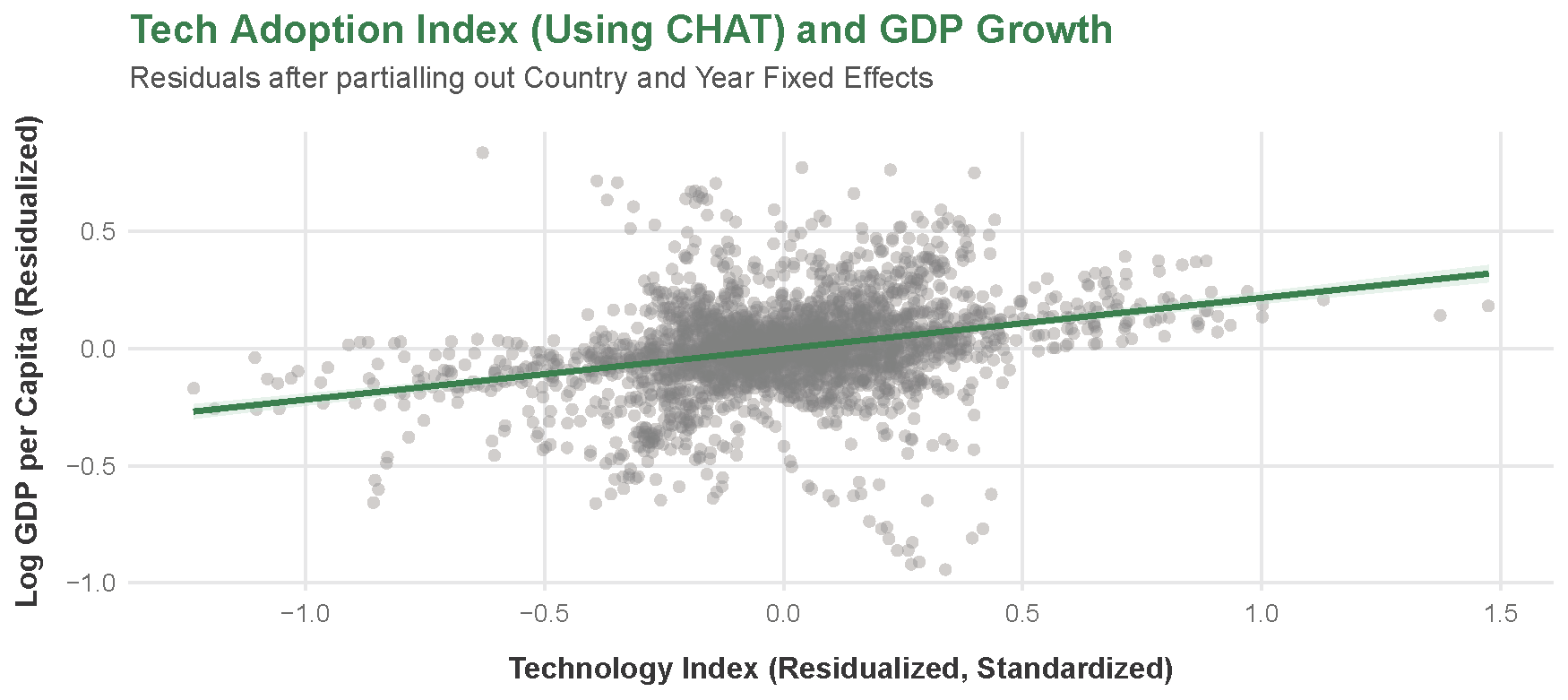
Notes: Principal component analysis-based index using electricity production per capita, number of telephones per capita, cars per capita, and tractors per capita from the CHAT dataset. Primary model is: yit = β0 + β1CHATit + ci + tt, where c and t are country and year fixed effects. Residuals are derived using the Frisch-Waugh-Lovell theorem. Thus, the plot depicts the CHAT index (x) and log GDP per capita (y) unexplained by country or year FEs. The estimated coefficient is β1 = 0.0229 (p < 0.01), with a within-R2 of 0.105. Source: Own estimates based on Comin and Hobijn (2009).
What drives technology adoption? So far, we have defined the object of technology and described channels that guide incentives to improvement and adoption. The next sections ask why technological improvement and adoption remain low in poor economies even when productive technologies exist. We describe mechanisms that drive adoption (or the lack thereof). They do not operate in isolation but have salient characteristics that define their nature and potential mitigation strategies.
Profitable adoption often depends on what others do, which creates room for coordination failures: how likely a company is to adopt a payment system depends on customers adopting the payment system themselves. Many technologies require complementary inputs that firms cannot provide on their own, including, for example, port infrastructure and college-educated workers. Profitable adoption also depends on the ability to overcome initial adoption costs by financing those investments and accessing larger markets, where benefits from adoption could be higher. This process induces scale, quality upgrading, and knowledge transfer. Finally, adoption is intrinsically a decentralised decision of firms and households, and therefore, behavioural and organisational frictions can slow diffusion.
For full reference list see the end of the conclusion chapter.
Contact VoxDev
If you have questions, feedback, or would like more information about this article, please feel free to reach out to the VoxDev team. We’re here to help with any inquiries and to provide further insights on our research and content.