




View Chapter:
Downloads:
Chapter 8
Future landscape and open questions
The mechanisms reviewed above apply across technologies, but the technological frontier is changing. Digital tools, modular energy systems, artificial intelligence, and new platform technologies alter the cost structure of adoption and the organisation of markets. They can make some barriers less binding, but they rarely remove the older constraints entirely. In many cases, they instead change where those constraints appear.
Digital technologies are the clearest example. They have diffused quickly in many poor countries, and they have the potential to reduce transaction, information, and monitoring costs. But their adoption still depends on complementary infrastructure, human capital, trust, and market organisation. This section first discusses what is distinctive about digital technologies, and then closes with open questions that are broader than digitalisation itself.
Digital technologies: Continuity and novelty
Digital technologies often appear to offer a form of leapfrogging. Internet use has converged substantially across the development spectrum, despite persistent income gaps (Figure 4). Once connectivity and devices are in place, digital tools can move information, payments, and records at very low marginal cost. They can therefore substitute, at least partly, for weak administrative capacity and some forms of physical intermediation. This is clearest in digital payments, digital identification, and digitally delivered government transfers, where the main gains often come from lower transaction costs, lower leakage, and better observability (Baker and Hubbard 2003, Aker et al. 2016, Suri and Jack 2016, de Rochambeau 2021, Bossuroy et al. 2025, Houeix 2025, Kala and Lyons 2025). Evidence on mobile money and agent banking also shows how digital rails interact with cash constraints and local financial intermediation (Suri et al. 2023). Digital tools can support new contract forms as well, as in PAYGo systems that use remote monitoring and lockout technologies to substitute for traditional collateral (Gertler et al. 2024, 2025a).
Figure 4: Internet adoption by 1970 quintile
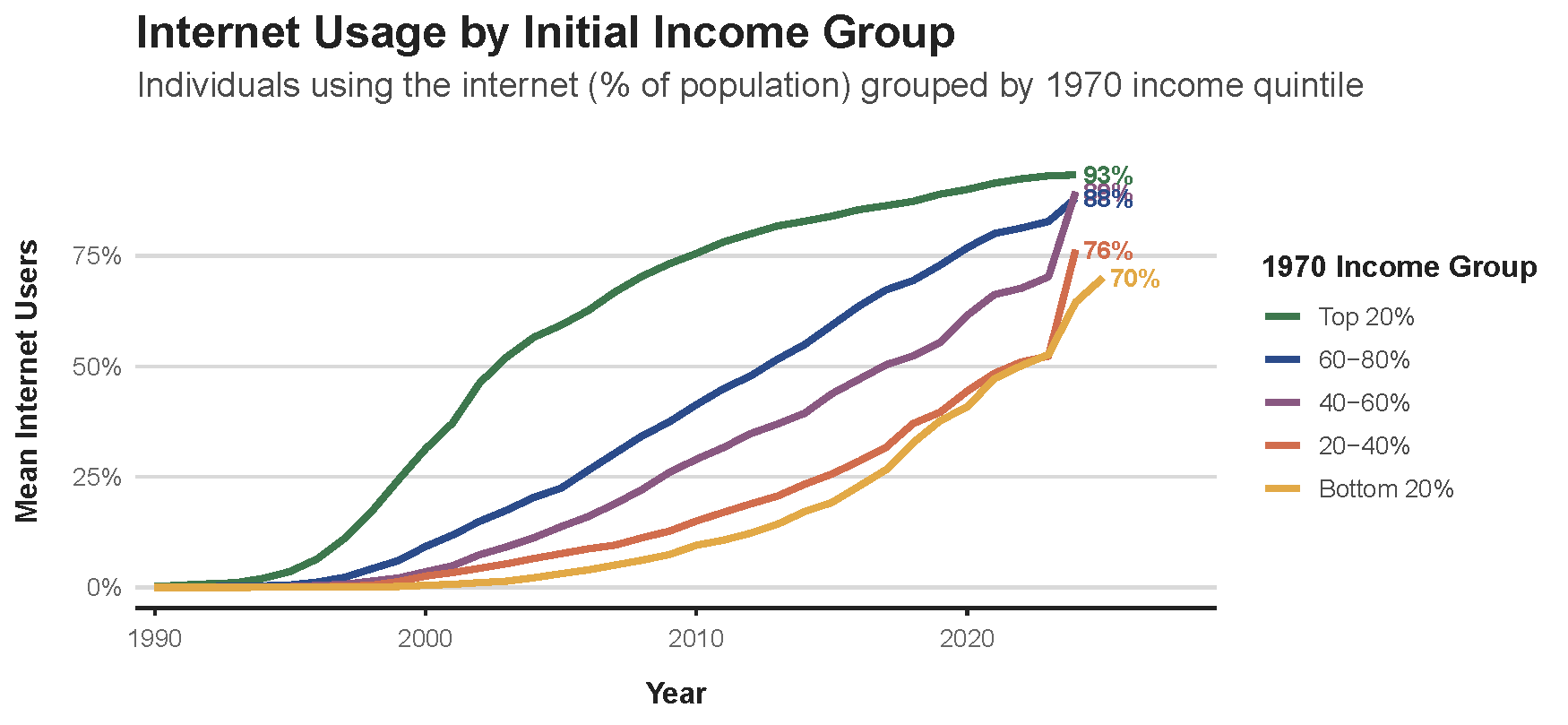
Notes: Average % of the population using the internet by 1970 income group. Calculated using PWT 1970 real GDP per capita quintiles and WB internet adoption data (IT.NET.USER.ZS). Sources: Feenstra et al. (2015), World Bank (2026a).
At the same time, digital technologies are not exempt from the constraints reviewed in this piece. They still require electricity, broadband, devices, and skills (Akerman et al. 2015, Hjort and Poulsen 2019, Blumenstock et al. 2022, Björkegren et al. 2025, Lang 2025). They often exhibit strong network effects, so their value depends on how many others adopt (Björkegren 2019, Brunnermeier et al. 2023, Crouzet et al. 2023, Higgins 2024, Knebelman et al. 2024, Alvarez et al. 2026). They can also create new barriers. Digital records make activity more visible to principals, regulators, or tax authorities, which may reduce private incentives to adopt even when the technology is productive (Houeix 2024, Brockmeyer and Sáenz Somarriba 2025, Houeix 2025). Digitalisation therefore changes the form of some frictions rather than eliminating them.
The evidence on digital trade and platforms points in the same direction. Digital tools can reduce search and distance frictions (Freund and Weinhold 2004, Lendle et al. 2016, Chen and Wu 2021, Akerman et al. 2022, Carballo et al. 2022), but trust, reputation, and platform design remain central. Bai et al. (2023) show that information frictions persist even in large online marketplaces. Bergquist et al. (2024) and Wiles and Houeix (2025) show that informal and relational digital tools can matter greatly where formal platform institutions remain weak. Experimental evidence on digital entrepreneurship and capital injections similarly points to both scalability and heterogeneity in who captures the gains (McKenzie 2017, Gonzalez-Uribe and Leatherbee 2018). The broad lesson is that digital technologies may be unusually scalable, but their adoption still depends on complementary infrastructure, institutional design, and human capital.
Open questions
We conclude with a few open questions on technology adoption in developing countries. Digital tools make some of these questions more visible, but the same issues arise in agriculture, manufacturing, energy, logistics, health, and services. They concern how countries move from access to use, from use to adaptation, and from adaptation to domestic innovation.
- Distinguishing weak fundamentals from coordination failures. Persistent low adoption may reflect weak fundamentals: low demand, high costs, poor infrastructure, or a bad fit between available technologies and local conditions. It may also reflect a failure to coordinate on a high-adoption equilibrium. Distinguishing these explanations remains difficult because the counterfactual equilibrium is not observed. More evidence is needed on when temporary interventions reveal latent complementarities and when they simply subsidise technologies that are not yet productive.
- Individual scale versus collective scale. Many technologies are indivisible, but indivisibility need not imply that only large integrated firms can use them. Rental markets, platforms, shared facilities, and industrial clusters may allow smaller firms to achieve scale collectively. We know less about when these arrangements substitute for firm scale, when they create congestion or hold-up problems, and how policy should support them. This includes the design of rental and sharing markets, public-service auctions, titling systems, and financing arrangements.
- Infrastructure design under modular technologies. New energy and digital technologies change the optimal scale and architecture of infrastructure provision. This is especially important for electricity systems, where centralised grids, distributed generation, storage, and future industrial demand must be planned jointly rather than sequentially. Similar issues arise for broadband, payments, logistics, and other networked inputs.
- Which human-capital margins bind, and when? Basic schooling, college education, engineering capacity, managerial capability, and youth-specific learning margins may matter at different stages of development and for different technologies. The key policy problem is not simply to expand education in general, but to identify which human-capital investments are most complementary to the technologies and firms that can actually grow.
- Market access, capability accumulation, and global fragmentation. Market access can induce upgrading, but it can also push firms or countries towards simpler activities. This margin is becoming more important as geopolitical tensions, strategic trade restrictions, and fragmentation of global value chains reshape the older path of export-led capability accumulation. A central question is when integration helps firms climb the technology ladder and when it reallocates activity away from complex production.
- Digital observability and the limits of substitution. Digital tools can reduce information and transaction costs, but they also generate data trails that may deter adoption when users fear surveillance, taxation, or tighter control by principals. We still know too little about when digital technologies substitute for missing infrastructure and institutions, and when they mostly amplify existing capabilities.
- The direction of innovation under mismatch and climate change. When the main problem is not failed diffusion but the absence of locally appropriate technologies, policy has to affect the direction of innovation itself. This question is central in agriculture, health, climate adaptation, and emerging service technologies. It raises difficult issues about how to pool demand, design public R&D, and coordinate innovation across countries.
These are not small questions at the edge of the literature. They go to the core of how developing countries adopt, adapt, and create technology. The recent literature has made considerable progress in measuring adoption, identifying mechanisms, and evaluating policy. The next step is to connect those advances more tightly across fields. Technology adoption should not remain split into separate conversations about trade, firms, infrastructure, human capital, finance, and digitalisation. These margins interact in the data, and they should interact in the analysis.
References
Acemoglu, D (2002a), "Technical change, inequality, and the labor market," Journal of Economic Literature, 40(1): 7–72.
Acemoglu, D (2002b), "Directed technical change," Review of Economic Studies, 69(4): 781–809.
Acemoglu, D, and F Zilibotti (2001), "Productivity differences," Quarterly Journal of Economics, 116(2): 563–606.
Acemoglu, D, P Aghion, and F Zilibotti (2006), "Distance to frontier, selection, and economic growth," Journal of the European Economic Association, 4(1): 37–74.
Adhvaryu, A, N Kala, and A Nyshadham (2022), "Management and shocks to worker productivity," Journal of Political Economy, 130(1): 1–47.
Aggarwal, S (2018), "Do rural roads create pathways out of poverty? Evidence from India," Journal of Development Economics, 133: 375–395.
Aggarwal, S, B Giera, D Jeong, J Robinson, and A Spearot (2024), "Market access, trade costs, and technology adoption: Evidence from northern Tanzania," Review of Economics and Statistics, 106(6): 1511–1528.
Aghion, P, and P Howitt (1992), "A model of growth through creative destruction," Econometrica, 60(2): 323–351.
Aghion, P, N Bloom, R Blundell, R Griffith, and P Howitt (2005), "Competition and innovation: An inverted-U relationship," Quarterly Journal of Economics, 120(2): 701–728.
Aghion, P, A Bergeaud, M Lequien, and M J Melitz (2024), "The heterogeneous impact of market size on innovation: Evidence from French firm-level exports," Review of Economics and Statistics, 106(3): 608–626.
Akcigit, U, H Alp, J Pearce, and M Prato (2025), "Transformative and subsistence entrepreneurs: Origins and impacts on economic growth," NBER Working Paper, 33766.
Aker, J C, R Boumnijel, A McClelland, and N Tierney (2016), "Payment mechanisms and antipoverty programs: Evidence from a mobile money cash transfer experiment in Niger," Economic Development and Cultural Change, 65(1): 1–37.
Akerman, A, I Gaarder, and M Mogstad (2015), "The skill complementarity of broadband internet," Quarterly Journal of Economics, 130(4): 1781–1824.
Akerman, A, E Leuven, and M Mogstad (2022), "Information frictions, internet, and the relationship between distance and trade," American Economic Journal: Applied Economics, 14(1): 133–163.
Alfaro, L, A Chanda, S Kalemli-Ozcan, and S Sayek (2004), "FDI and economic growth: The role of local financial markets," Journal of International Economics, 64(1): 89–112.
Alvarez, F, F Buera, and N Trachter (2025), "Technology adoption and optimal industrial policy," Unpublished manuscript.
Alvarez, F, D Argente, F Lippi, E Méndez-Chacon, and D Van Patten (2026), "Strategic complementarities in a dynamic model of technology adoption: P2P digital payment," CEPR Discussion Paper, 21211.
Amiti, M, and A K Khandelwal (2013), "Import competition and quality upgrading," Review of Economics and Statistics, 95(2): 476–490.
Amiti, M, and J Konings (2007), "Trade liberalization, intermediate inputs, and productivity: Evidence from Indonesia," American Economic Review, 97(5): 1611–1638.
Arkolakis, C, and C Walsh (2023), "Clean growth," NBER Working Paper, 31615.
Arkolakis, C, and C Walsh (2024), "The economic impacts of clean energy," Brookings Papers on Economic Activity, 2024(2): 161–212.
Asher, S, and P Novosad (2020), "Rural roads and local economic development," American Economic Review, 110(3): 797–823.
Asiedu, E, M Lambon-Quayefio, F Truffa, and A Wong (2023), "Female entrepreneurship and professional networks," Unpublished manuscript.
Atkinson, A B, and J E Stiglitz (1969), "A new view of technological change," Economic Journal, 79(315): 573–578.
Aw, B Y, M J Roberts, and D Y Xu (2011), "R&D investment, exporting, and productivity dynamics," American Economic Review, 101(4): 1312–1344.
Bai, J, P J Barwick, S Cao, and S Li (2025a), "Quid pro quo, knowledge spillovers, and industrial quality upgrading: Evidence from the Chinese auto industry," American Economic Review, 115(11): 3825–3852.
Bai, J, D S Park, and A Shenoy (2025b), "Misperceptions and product choice: Evidence from a randomized trial in Zambia," Unpublished manuscript.
Bai, X, Y Chen, Y Liu, X Mu, and D Xu (2023), "Stand out from the millions: Market congestion and information friction on global e-commerce platforms," Unpublished manuscript.
Baker, G P, and T N Hubbard (2003), "Contractibility and asset ownership: On-board computers and governance in the U.S. trucking," Quarterly Journal of Economics, 118(4): 1443–1479.
Baldwin, R, and P R Krugman (1986), "Market access and international competition: A simulation study of 16k random access memories," NBER Working Paper, 1936.
Bandiera, O, A Kotia, I Lindenlaub, C Moser, and A Prat (2024), "Meritocracy across countries," NBER Working Paper, 32375.
Bartelme, D, T Lan, and A A Levchenko (2024), "Specialization, market access and real income," Journal of International Economics, 150: 103923.
Bassi, V, R Muoio, T Porzio, R Sen, and E Tugume (2022), "Achieving scale collectively," Econometrica, 90(6): 2937–2978.
Bastos, P, J Silva, and E Verhoogen (2018), "Export destinations and input prices," American Economic Review, 108(2): 353–392.
Basu, S, and D N Weil (1998), "Appropriate technology and growth," Quarterly Journal of Economics, 113(4): 1025–1054.
Beirne, K, and M Kirchberger (2023), "Concrete thinking about development," CEPR Discussion Paper, 18170.
Benhabib, J, and M M Spiegel (1994), "The role of human capital in economic development evidence from aggregate cross-country data," Journal of Monetary Economics, 34(2): 143–173.
Benmelech, E, and N K Bergman (2011), "Vintage capital and creditor protection," Journal of Financial Economics, 99(2): 308–332.
Bergquist, L F, C McIntosh, and M Startz (2024), "Search costs, intermediation, and trade: Experimental evidence from Ugandan agricultural markets," NBER Working Paper, 33221.
Berrutti, F, and M Ruzzante (2025), "Price regulation and the adoption–innovation trade-off," Unpublished manuscript.
Björkegren, D, D Choi, R Budihal, H Sobhani, O Garrod, and P Atherton (2025), "Could AI leapfrog the web? Evidence from teachers in Sierra Leone," Unpublished manuscript.
Björkegren, D (2019), "The adoption of network goods: Evidence from the spread of mobile phones in Rwanda," Review of Economic Studies, 86(3): 1033–1060.
Blalock, G, and P J Gertler (2008), "Welfare gains from foreign direct investment through technology transfer to local suppliers," Journal of International Economics, 74(2): 402–421.
Blanchard, O J, and J Galí (2010), "The macroeconomic effects of oil price shocks: Why are the 2000s so different from the 1970s?", in J Galí and M Gertler (eds), International Dimensions of Monetary Policy, University of Chicago Press: 373–428.
Bloom, N, M Draca, and J Van Reenen (2016), "Trade induced technical change? The impact of Chinese imports on innovation, IT and productivity," Review of Economic Studies, 83(1): 87–117.
Bloom, N, A Mahajan, D McKenzie, and J Roberts (2020), "Do management interventions last? Evidence from India," American Economic Journal: Applied Economics, 12(2): 198–219.
Bloom, N, J S Hartley, R Sadun, R Schuh, and J Van Reenen (2025), "Management and firm dynamism," Harvard Business School Working Paper, 25-052.
Blumenstock, J, J Robinson, and D S Park (2022), "The impact of digital credit in developing economies: A review of recent evidence," Unpublished manuscript.
Bossuroy, T, C Delavallade, and V Pons (2025), "Biometric monitoring, service delivery and misreporting: Evidence from healthcare in India," Review of Economics and Statistics, 107(6): 1553–1572.
Brambilla, I, D Lederman, and G Porto (2012), "Exports, export destinations, and skills," American Economic Review, 102(7): 3406–3438.
Brunnermeier, M K, N Limodio, and L Spadavecchia (2023), "Mobile money, interoperability, and financial inclusion," Unpublished manuscript.
Buera, F J, and N Trachter (2024), "Sectoral development multipliers," NBER Working Paper, 32230.
Buera, F J, J P Kaboski, and Y Shin (2011), "Finance and development: A tale of two sectors," American Economic Review, 101(5): 1964–2002.
Buera, F J, H Hopenhayn, Y Shin, and N Trachter (2021), "Big push in distorted economies," NBER Working Paper, 28561.
Burgess, R, M Greenstone, N Ryan, and A Sudarshan (2025), "The global electrification frontier and climate change," Unpublished manuscript.
Bustos, P (2011), "Trade liberalization, exports, and technology upgrading: Evidence on the impact of Mercosur on Argentinian firms," American Economic Review, 101(1): 304–340.
Cabral, L, P Pandey, and X Xu (2022), "Epic narratives of the Green Revolution in Brazil, China, and India," Agriculture and Human Values, 39(1): 249–267.
Cai, J, and A Szeidl (2018), "Interfirm relationships and business performance," Quarterly Journal of Economics, 133(3): 1229–1282.
Cai, J, W Lin, and A Szeidl (2024), "Firm-to-firm referrals," NBER Working Paper, 33082.
Carballo, J, M Rodriguez Chatruc, C Salas Santa, and C Volpe Martincus (2022), "Online business platforms and international trade," Journal of International Economics, 137: 103599.
Casal, L, and J Caunedo (2024), "On the investment network and development," CEPR Discussion Paper, 19481.
Caselli, F (2001), "Technological revolutions," American Economic Review, 91(1): 78–102.
Caselli, F (2005), "Accounting for cross-country income differences," in P Aghion and S N Durlauf (eds), Handbook of Economic Growth, 1: 679–741.
Caselli, F, and W J Coleman (2006), "The world technology frontier," American Economic Review, 96(3): 499–522.
Castaneda, M, M Jimenez, S Zapata, C J Franco, and I Dyner (2017), "Myths and facts of the utility death spiral," Energy Policy, 110: 105–116.
Caunedo, J, and N Kala (2021), "Mechanizing agriculture," NBER Working Paper, 29061.
Caunedo, J, and E Keller (2021), "Capital obsolescence and agricultural productivity," Quarterly Journal of Economics, 136(1): 505–561.
Caunedo, J, and E Keller (2023), "Capital embodied structural change," Unpublished manuscript.
Caunedo, J, N Kala, and H Zhang (2022), "Economies of density and congestion in the sharing economy," NBER Working Paper, 30788.
Cefalà, L, F Irakoze, P Naso, and N Swanson (2025), "The economic consequences of knowledge hoarding," Unpublished manuscript.
Chaurey, R, G Nayyar, S Sharma, and E Verhoogen (2025), "Social learning among urban manufacturing firms: Energy-efficient motors in Bangladesh," NBER Working Paper, 34296.
Chen, M X, and M Wu (2021), "The value of reputation in trade: Evidence from Alibaba," Review of Economics and Statistics, 103(5): 857–873.
Choi, J, and A A Levchenko (2025), "The long-term effects of industrial policy," Journal of Monetary Economics, 152: 103779.
Choi, J, and Y Shim (2026), "Industrialization and the big push: Theory and evidence from South Korea," Review of Economics and Statistics.
Choi, J, A A Levchenko, D Ruzic, and Y Shim (2025), "Superstars or supervillains? Large firms in the South Korean growth miracle," NBER Working Paper, 32648.
Ciccone, A (2002), "Input chains and industrialization," Review of Economic Studies, 69(3): 565–587.
Ciccone, A, and E Papaioannou (2009), "Human capital, the structure of production, and growth," Review of Economics and Statistics, 91(1): 66–82.
Cirera, X, D Comin, and M Cruz (2026), "Technology sophistication across establishments," Quarterly Journal of Economics, qjag018.
Cockburn, I M, J O Lanjouw, and M Schankerman (2016), "Patents and the global diffusion of new drugs," American Economic Review, 106(1): 136–164.
Cole, H L, J Greenwood, and J M Sanchez (2016), "Why doesn't technology flow from rich to poor countries?" Econometrica, 84(4): 1477–1521.
Collier, P, M Kirchberger, and M Söderbom (2016), "The cost of road infrastructure in low- and middle-income countries," World Bank Economic Review, 30(3): 522–548.
Colmer, J M, D Lagakos, and M Shu (2024), "Is the electricity sector a weak link in development?" NBER Working Paper, 32041.
Comin, D, and B Hobijn (2004), "Cross-country technology adoption: Making the theories face the facts," Journal of Monetary Economics, 51(1): 39–83.
Comin, D, and B Hobijn (2009), "Cross-country historical adoption of technology (CHAT) dataset."
Comin, D, and B Hobijn (2010), "An exploration of technology diffusion," American Economic Review, 100(5): 2031–2059.
Comin, D, D Lashkari, and M Mestieri (2025), "The structural transformation of innovation," NBER Working Paper, 33855.
Cox, A (2025), "Fostering development through higher education: College attainment, firms and economic growth," Unpublished manuscript.
Crouzet, N, A Gupta, and F Mezzanotti (2023), "Shocks and technology adoption: Evidence from electronic payment systems," Journal of Political Economy, 131(11): 3003–3065.
Cugat, G, and A Manera (2024), "Do capital inflows spur technology diffusion? Evidence from a new technology adoption index," IMF Working Paper, 2024/044.
Davis, D R, and D E Weinstein (2002), "Bones, bombs, and break points: The geography of economic activity," American Economic Review, 92(5): 1269–1289.
Davis, D R, and D E Weinstein (2008), "A search for multiple equilibria in urban industrial structure," Journal of Regional Science, 48(1): 29–65.
Davis, L W, C Hausman, and N L Rose (2023), "Transmission impossible? Prospects for decarbonizing the US grid," Journal of Economic Perspectives, 37(4): 155–180.
De Loecker, J (2013), "Detecting learning by exporting," American Economic Journal: Microeconomics, 5(3): 1–21.
de Rochambeau, G (2021), "Monitoring and intrinsic motivation: Evidence from Liberia's trucking firms," Unpublished manuscript.
Del Canto, F, J Grigsby, E Qian, and C Walsh (2025), "Are inflationary shocks regressive? A feasible set approach," Quarterly Journal of Economics, 140(4): 2685–2747.
Diamond, J M (1997), Guns, Germs, and Steel: The Fates of Human Societies, W. W. Norton & Company.
Dinkelman, T (2011), "The effects of rural electrification on employment: New evidence from South Africa," American Economic Review, 101(7): 3078–3108.
Diwan, I, and D Rodrik (1991), "Patents, appropriate technology, and North-South trade," Journal of International Economics, 30(1–2): 27–47.
Drexler, A, G Fischer, and A Schoar (2014), "Keeping it simple: Financial literacy and rules of thumb," American Economic Journal: Applied Economics, 6(2): 1–31.
Duflo, E, M Kremer, and J Robinson (2011), "Nudging farmers to use fertilizer: Theory and experimental evidence from Kenya," American Economic Review, 101(6): 2350–90.
Duggan, M, C Garthwaite, and A Goyal (2016), "The market impacts of pharmaceutical product patents in developing countries: Evidence from India," American Economic Review, 106(1): 99–135.
Dugoua, E, and J Moscona (2025), "The economics of climate innovation: Technology, climate policy, and the clean energy transition," NBER Working Paper, 34601.
Dybvig, P H, and C S Spatt (1983), "Adoption externalities as public goods," Journal of Public Economics, 20(2): 231–247.
Eaton, J, and S Kortum (1996), "Trade in ideas: Patenting and productivity in the OECD," Journal of International Economics, 40(3–4): 251–278.
Engbom, N, H Malmberg, T Porzio, F Rossi, and T Schoellman (2025), "Economic development according to Chandler," NBER Working Paper, 34483.
Evenson, R E, and D Gollin (2003a), "Assessing the impact of the Green Revolution, 1960 to 2000," Science, 300(5620): 758–762.
Evenson, R E, and D Gollin (2003b), Crop Variety Improvement and Its Effect on Productivity: The Impact of International Agricultural Research, CABI Publishing.
Fafchamps, M, and S Quinn (2018), "Networks and manufacturing firms in Africa: Results from a randomized field experiment," World Bank Economic Review, 32(3): 656–675.
Farrokhi, F, A Lashkaripour, and H S Pellegrina (2024), "Trade and technology adoption in distorted economies," Journal of International Economics, 150: 103922.
Feenstra, R C, R Inklaar, and M P Timmer (2015), "The next generation of the Penn World Table," American Economic Review, 105(10): 3150–3182.
Fieler, A C, M Eslava, and D Y Xu (2018), "Trade, quality upgrading, and input linkages: Theory and evidence from Colombia," American Economic Review, 108(1): 109–146.
Figueiredo Walter, T, and N Moneke (2024), "When does electrification work? Evidence from Sub-Saharan Africa," Unpublished manuscript.
Fiorini, M, M Sanfilippo, and A Sundaram (2021), "Trade liberalization, roads and firm productivity," Journal of Development Economics, 153: 102712.
Foster, A D, and M R Rosenzweig (1995), "Learning by doing and learning from others: Human capital and technical change in agriculture," Journal of Political Economy, 103(6): 1176–1209.
Frankenthal, I (2024), "The gig economy and crime in Brazil," Unpublished manuscript.
Freund, C, and D Weinhold (2004), "The effect of the internet on international trade," Journal of International Economics, 62(1): 171–189.
Fried, S, and D Lagakos (2023), "Electricity and firm productivity: A general-equilibrium approach," American Economic Journal: Macroeconomics, 15(4): 110–141.
Garcia-Marin, A, and N Voigtländer (2019), "Exporting and plant-level efficiency gains: It's in the measure," Journal of Political Economy, 127(4): 1777–1825.
Garg, T (2025), "Can industrial policy overcome coordination failures? Theory and evidence," Unpublished manuscript.
Gertler, P, B Green, and C Wolfram (2024), "Digital collateral," Quarterly Journal of Economics, 139(3): 1713–1766.
Gertler, P, B Green, Y Li, and D Sraer (2025a), "The welfare benefits of pay-as-you-go financing," Unpublished manuscript.
Gertler, P, S Higgins, U Malmendier, and W Ojeda (2025b), "Do behavioral frictions prevent firms from adopting profitable opportunities?" NBER Working Paper, 33387.
Giorcelli, M (2019), "The long-term effects of management and technology transfers," American Economic Review, 109(1): 121–152.
Giorcelli, M, and B Li (2026), "Technology transfer and early industrial development: Evidence from the Sino-Soviet alliance," Review of Economic Studies.
Goldberg, P, A Khandelwal, N Pavcnik, and P Topalova (2009), "Trade liberalization and new imported inputs," American Economic Review, 99(2): 494–500.
Goldberg, P K, A K Khandelwal, N Pavcnik, and P Topalova (2010), "Imported intermediate inputs and domestic product growth: Evidence from India," Quarterly Journal of Economics, 125(4): 1727–1767.
Gonzalez-Uribe, D, and M Leatherbee (2018), "The effects of business accelerators on venture performance: Evidence from start-up Chile," Review of Financial Studies, 31(6): 1566–1603.
Görg, H, L Halpern, and B Muraközy (2017), "Why do within-firm-product export prices differ across markets? Evidence from Hungary," World Economy, 40(6): 1233–1246.
Griliches, Z (1957), "Hybrid corn: An exploration in the economics of technological change," Econometrica, 25(4): 501–522.
Guadalupe, M, O Kuzmina, and C Thomas (2012), "Innovation and foreign ownership," American Economic Review, 102(7): 3594–3627.
Guner, N, A Parkhomenko, and G Ventura (2018), "Managers and productivity differences," Review of Economic Dynamics, 29: 256–282.
Hamilton, J D (1983), "Oil and the macroeconomy since World War II," Journal of Political Economy, 91(2): 228–248.
Hanna, R, S Mullainathan, and J Schwartzstein (2014), "Learning through noticing: Theory and evidence from a field experiment," Quarterly Journal of Economics, 129(3): 1311–1353.
Hardy, M, and J McCasland (2021), "It takes two: Experimental evidence on the determinants of technology diffusion," Journal of Development Economics, 149: 102600.
Hassler, J, P Krusell, and C Olovsson (2021), "Directed technical change as a response to natural resource scarcity," Journal of Political Economy, 129(11): 3039–3072.
Hausman, C (2025), "Power flows: Transmission lines, allocative efficiency, and corporate profits," American Economic Review, 115(8): 2574–2615.
Hausmann, R, and D Rodrik (2003), "Economic development as self-discovery," Journal of Development Economics, 72(2): 603–633.
Hausmann, R, J Hwang, and D Rodrik (2007), "What you export matters," Journal of Economic Growth, 12: 1–25.
Head, K (1994), "Infant industry protection in the steel rail industry," Journal of International Economics, 37(3–4): 141–165.
Hoff, K (1997), "Bayesian learning in an infant industry model," Journal of International Economics, 43(3–4): 409–436.
Hotez, P J (2021), Forgotten People, Forgotten Diseases: The Neglected Tropical Diseases and Their Impact on Global Health and Development, John Wiley & Sons.
Houeix, D (2024), "Asymmetric information and digital technology adoption: Evidence from Senegal," Unpublished manuscript.
Houeix, D (2025), "Nationwide diffusion of technology within firms' social networks," Unpublished manuscript.
Hsieh, C-T, and P J Klenow (2007), "Relative prices and relative prosperity," American Economic Review, 97(3): 562–585.
International Energy Agency (2025), "World energy investment 2025."
Itskhoki, O, and B Moll (2019), "Optimal development policies with financial frictions," Econometrica, 87(1): 139–173.
Javorcik, B S (2004), "Does foreign direct investment increase the productivity of domestic firms? In search of spillovers through backward linkages," American Economic Review, 94(3): 605–627.
Jones, B F, and L H Summers (2022), "A calculation of the social returns to innovation," in Innovation and Public Policy, University of Chicago Press: 13–60.
Jones, C I (1995), "R&D-based models of economic growth," Journal of Political Economy, 103(4): 759–784.
Jovanovic, B (1989), "Observable implications of models with multiple equilibria," Econometrica, 57(6): 1431–1437.
Juhász, R (2018), "Temporary protection and technology adoption: Evidence from the Napoleonic blockade," American Economic Review, 108(11): 3339–3376.
Kala, N, and E Lyons (2025), "Biometrics/GPS/platform surveillance and performance," Unpublished manuscript.
Känzig, D R (2021), "The macroeconomic effects of oil supply news: Evidence from OPEC announcements," American Economic Review, 111(4): 1092–1125.
Känzig, D R, and C T Williamson (2025), "Unraveling the drivers of energy-saving technical change," NBER Working Paper, 34511.
Katz, M L, and C Shapiro (1985), "Network externalities, competition, and compatibility," American Economic Review, 75(3): 424–440.
Khwaja, A I, and A Mian (2005), "Do lenders favor politically connected firms? Rent provision in an emerging financial market," Quarterly Journal of Economics, 120(4): 1371–1411.
Kilian, L (2009), "Not all oil price shocks are alike: Disentangling demand and supply shocks in the crude oil market," American Economic Review, 99(3): 1053–1069.
Killeen, G (2025), "Risk aversion and barriers to firm growth: Experimental evidence from small retailers," Unpublished manuscript.
Kline, P, and E Moretti (2014), "Local economic development, agglomeration economies, and the big push: 100 years of evidence from the Tennessee Valley Authority," Quarterly Journal of Economics, 129(1): 275–331.
Knebelman, A, V Pouliquen, and L Sarr (2024), "Discretion versus algorithms: Bureaucrats and tax equity in Senegal," Unpublished manuscript.
Kremer, M (2002), "Pharmaceuticals and the developing world," Journal of Economic Perspectives, 16(4): 67–90.
Kremer, M, and R Glennerster (2004), Strong Medicine: Creating Incentives for Pharmaceutical Research on Neglected Diseases, Princeton University Press.
Kremer, M, G Rao, and F Schilbach (2019), "Behavioral development economics," in B D Bernheim, S DellaVigna, and D Laibson (eds), Handbook of Behavioral Economics: Foundations and Applications 1, 2: 345–458.
Kremer, M, J Levin, and C M Snyder (2020), "Advance market commitments: Insights from theory and experience," AEA Papers and Proceedings, 110: 269–273.
Kremer, M, J Levin, and C M Snyder (2022), "Designing advance market commitments for new vaccines," Management Science, 68(7): 4786–4814.
Krugman, P (1991), "History versus expectations," Quarterly Journal of Economics, 106(2): 651–667.
Lang, V (2025), "The role of market frictions in demand for prepaid electricity," Journal of Development Economics, 175: 103495.
Lendle, A, M Olarreaga, S Schropp, and P-L Vézina (2016), "There goes gravity: eBay and international trade," Economic Journal, 126(591): 406–441.
Lerner, J, J Liu, J Moscona, and D Y Yang (2024a), "Appropriate entrepreneurship? The rise of China and the developing world," NBER Working Paper, 32193.
Lerner, J, J Liu, J Moscona, and D Y Yang (2024b), "Case studies of the emulation of Chinese entrepreneurial business models," Unpublished manuscript.
Levin, T, and V M Thomas (2016), "Can developing countries leapfrog the centralized electrification paradigm?" Energy for Sustainable Development, 31: 97–107.
Lileeva, A, and D Trefler (2010), "Improved access to foreign markets raises plant-level productivity... for some plants," Quarterly Journal of Economics, 125(3): 1051–1099.
Lipscomb, M, A M Mobarak, and T Barham (2013), "Development effects of electrification: Evidence from the topographic placement of hydropower plants in Brazil," American Economic Journal: Applied Economics, 5(2): 200–231.
Maloney, W F, and F Valencia Caicedo (2022), "Engineering growth," Journal of the European Economic Association, 20(4): 1554–1594.
Manova, K (2008), "Credit constraints, equity market liberalizations and international trade," Journal of International Economics, 76(1): 33–47.
Manova, K, and Z Zhang (2012), "Export prices across firms and destinations," Quarterly Journal of Economics, 127(1): 379–436.
Matsuyama, K (1991), "Increasing returns, industrialization, and indeterminacy of equilibrium," Quarterly Journal of Economics, 106(3): 617–650.
Matsuyama, K (1992), "Agricultural productivity, comparative advantage, and economic growth," Journal of Economic Theory, 58(2): 317–334.
McMillan, M S, and D Rodrik (2014), "Globalization, structural change and productivity growth," World Development, 63: 11–32.
Meeks, R and M Mahadevan (2025), "Electricity Infrastructure", VoxDevLit, 15(1).
Meki, M (2025), "Small firm investment under uncertainty: The role of equity finance," Unpublished manuscript.
Midrigan, V, and D Y Xu (2014), "Finance and misallocation: Evidence from plant-level data," American Economic Review, 104(2): 422–458.
Mokyr, J (1998), The Second Industrial Revolution, 1870–1914, St. Martin's Press.
Mork, K A (1989), "Oil and the macroeconomy when prices go up and down: An extension of Hamilton's results," Journal of Political Economy, 97(3): 740–744.
Moscona, J, and K A Sastry (2023), "Does directed innovation mitigate climate damage? Evidence from US agriculture," Quarterly Journal of Economics, 138(2): 637–701.
Murphy, K M, A Shleifer, and R W Vishny (1989), "Industrialization and the big push," Journal of Political Economy, 97(5): 1003–1026.
Nelson, R R, and E S Phelps (1966), "Investment in humans, technological diffusion, and economic growth," American Economic Review, 56(1/2): 69–75.
Nemet, G F (2019), How Solar Energy Became Cheap: A Model for Low-Carbon Innovation, Routledge.
Nober, W (2026), "Batteries and the efficiency of electricity transmission," Unpublished manuscript.
Parente, S L, and E C Prescott (1994), "Barriers to technology adoption and development," Journal of Political Economy, 102(2): 298–321.
Parente, S L, and E C Prescott (2000), Barriers to Riches, MIT Press.
Pavcnik, N (2002), "Trade liberalization, exit, and productivity improvements: Evidence from Chilean plants," Review of Economic Studies, 69(1): 245–276.
Pérez-Sebastián, F, J Steinbuks, J G Feres, and I M Trotter (2020), "Electricity access and structural transformation: Evidence from Brazil's electrification," World Bank Policy Research Working Paper, 9182.
Pérez-Sebastián, F, R Serrano Quintero, and J Steinbuks (2023), "Spatial misallocation of complementary infrastructure investment: Evidence from Brazil," World Bank Policy Research Working Paper, 10650.
Pingali, P L (2012), "Green revolution: Impacts, limits, and the path ahead," Proceedings of the National Academy of Sciences, 109(31): 12302–12308.
Porzio, T (2017), "Cross-country differences in the optimal allocation of talent and technology," Unpublished manuscript.
Porzio, T, F Rossi, and G Santangelo (2022), "The human side of structural transformation," American Economic Review, 112(8): 2774–2814.
Ravikumar, B, A M Santacreu, and M Sposi (2019), "Capital accumulation and dynamic gains from trade," Journal of International Economics, 119: 93–110.
Redding, S J, D M Sturm, and N Wolf (2011), "History and industry location: Evidence from German airports," Review of Economics and Statistics, 93(3): 814–831.
Rodriguez-Clare, A (1996), "The division of labor and economic development," Journal of Development Economics, 49(1): 3–32.
Rodrik, D (1996), "Coordination failures and government policy: A model with applications to East Asia and Eastern Europe," Journal of International Economics, 40(1–2): 1–22.
Rogers, E M (2003), Diffusion of Innovations, 5th edition, Free Press.
Romer, P M (1990), "Endogenous technological change," Journal of Political Economy, 98(5): S71–S102.
Rossi, F (2022), "The relative efficiency of skilled labor across countries: Measurement and interpretation," American Economic Review, 112(1): 235–66.
Santacreu, A M (2015), "Innovation, diffusion, and trade: Theory and measurement," Journal of Monetary Economics, 75: 1–20.
Schroeder, C M (2023), "China's evolving global tech expansion – a lens from the Middle East," Substack.
Schumacher, E F (1973), Small Is Beautiful: Economics as If People Mattered, Harper & Row.
Shamdasani, Y (2021), "Rural road infrastructure & agricultural production: Evidence from India," Journal of Development Economics, 152: 102686.
Solow, R M (1959), "Investment and technical progress," in K J Arrow, S Karlin, and P Suppes (eds), Mathematical Methods in the Social Sciences, Stanford University Press: 89–104.
Stewart, F (1978), Technology and Underdevelopment, Springer.
Suri, T (2011), "Selection and comparative advantage in technology adoption," Econometrica, 79(1): 159–209.
Suri, T, and W Jack (2016), "The long-run poverty and gender impacts of mobile money," Science, 354(6317): 1288–1292.
Takeda, K, and A Yamagishi (2024), "The economic dynamics of city structure: Evidence from Hiroshima's recovery," Unpublished manuscript.
Tanaka, M (2020), "Exporting sweatshops? Evidence from Myanmar," Review of Economics and Statistics, 102(3): 442–456.
Topalova, P, and A Khandelwal (2011), "Trade liberalization and firm productivity: The case of India," Review of Economics and Statistics, 93(3): 995–1009.
Trouvain, F (2024), "Technology adoption, innovation, and inequality in a global world," Unpublished manuscript.
Verhoogen, E (2008), "Trade, quality upgrading, and wage inequality in the Mexican manufacturing sector," Quarterly Journal of Economics, 123(2): 489–530.
Wiles, J, and D Houeix (2025), "Relational frictions along the supply chain: Evidence from Senegalese traders," Unpublished manuscript.
Williams, H L (2017), "How do patents affect research investments?" Annual Review of Economics, 9: 441–469.
World Bank (2026a), "Individuals using the internet (% of population)," World Bank Open Data.
World Bank (2026b), "Agriculture, forestry, and fishing, value added (% of GDP)," World Development Indicators.
World Bank (2026c), "Trade (% of GDP)," World Development Indicators.
Yeaple, S R (2005), "A simple model of firm heterogeneity, international trade, and wages," Journal of International Economics, 65(1): 1–20.
Zhou, H, X Zhang, and L Yang (2025), "Balancing export intensity and innovation: Uncovering the inverted-U relationship in Chinese manufacturing firms," Economic Analysis and Policy, 85: 1830–1845.
Contact VoxDev
If you have questions, feedback, or would like more information about this article, please feel free to reach out to the VoxDev team. We’re here to help with any inquiries and to provide further insights on our research and content.